
Deuteronomy 20 · Subject · Featured Study
The rules of war
Deuteronomy 20 sets the order of Israel's wars from the muster to the siege, and three later laws of the book add to it.
Even the fruit trees around a besieged city had a law to protect them.
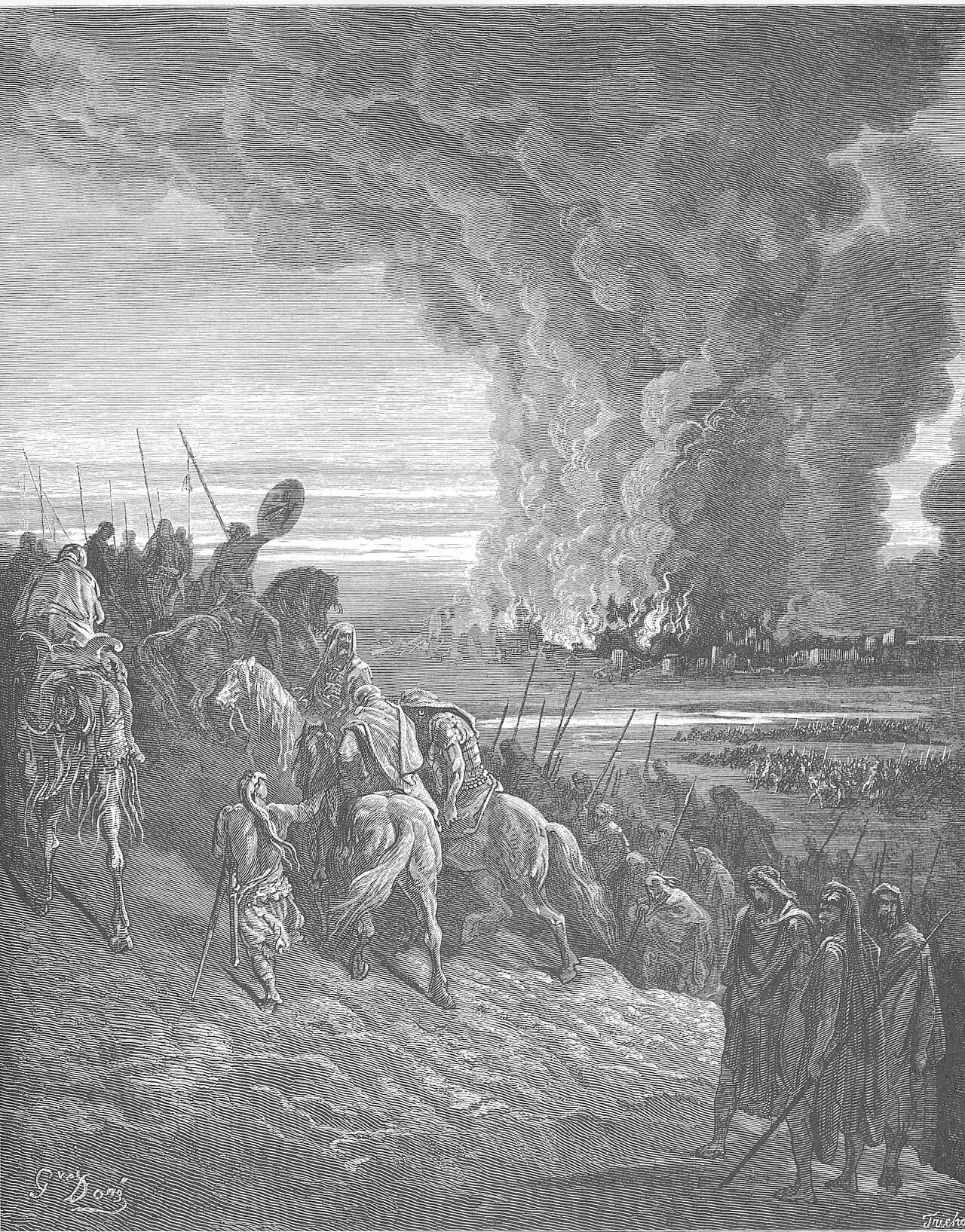
Gustave Doré, Joshua Burns the Town of Ai, 1866, from Doré's English Bible. Public domain (published before 1930), via Wikimedia Commons, File:049.Joshua_Burns_the_Town_of_Ai.jpg.
THE ARTWORKDoré engraved Ai burning across the plain while Israel's army watches from a hillside, as Joshua 8:28 tells it. A rider in the centre leans down to speak with a man on foot, and ranks of spearmen stand below the smoke.
Summary
Deuteronomy 20 tells Israel's army who speaks before a battle, who goes home, which cities are offered peace and how a siege is fought.
- A priest addressed the army before the battle and told it that the LORD would fight for it.
- Officers sent home the fearful and any man with a new house, vineyard or bride.
- A city far away was offered peace first, and its people lived if it opened its gates.
- The cities of the nations within the land were devoted to destruction, for the reason Deuteronomy 20:18 gives.
- Later laws protect a captive woman, keep the camp clean and free a new husband for a year.
The Order of a Campaign
Seven parts, from the priest's charge to the siege works
The law deals with Israel's own army before it deals with the enemy's city.
- The priest's chargeThe priest tells the troops to hold firm, since the LORD fights for them.Deuteronomy 20:2 to 4
- Four releasesMen with a new house, vineyard or bride go home, and so do the fearful.Deuteronomy 20:5 to 8
- Commanders appointedWhen the officers finish speaking, commanders are set over the army.Deuteronomy 20:9
- Peace offeredA distant city hears terms of peace, and if it opens its gates its people become forced laborers.Deuteronomy 20:10 to 11
- The siegeA distant city that fights is besieged, its men killed and its goods taken.Deuteronomy 20:12 to 14
- The cities of the landIn the cities of the nations Israel inherits, nothing that breathes is left alive.Deuteronomy 20:16 to 18
- The treesFruit trees stand through a long siege, and other trees build the siege works.Deuteronomy 20:19 to 20
Each numbered stop names a part of the law, with the verses that give it.
Adam Clarke notes that the priest spoke as the representative of God, and that almost all ancient nations took their priests with them to battle.
saying to them, “Hear, O Israel, today you are going into battle with your enemies. Do not be fainthearted or afraid; do not be alarmed or terrified because of them. For the LORD your God goes with you to fight for you against your enemies, to give you the victory.”When you approach a city to fight against it, you are to make an offer of peace. If they accept your offer of peace and open their gates, all the people there will become forced laborers to serve you. But if they refuse to make peace with you and wage war against you, lay siege to that city.Two kinds of city are set apart by their distance from Israel, each with its own rule.
This is how you are to treat all the cities that are far away from you and do not belong to the nations nearby. However, in the cities of the nations that the LORD your God is giving you as an inheritance, you must not leave alive anything that breathes. For you must devote them to complete destruction—the Hittites, Amorites, Canaanites, Perizzites, Hivites, and Jebusites—as the LORD your God has commanded you, so that they cannot teach you to do all the detestable things they do for their gods, and so cause you to sin against the LORD your God.The officers' four questionsDeuteronomy 20:5 to 8
The officers speak after the priest, and their questions thin the ranks before a blow is struck.
Furthermore, the officers are to address the army, saying, “Has any man built a new house and not dedicated it? Let him return home, or he may die in battle and another man dedicate it. Has any man planted a vineyard and not begun to enjoy its fruit? Let him return home, or he may die in battle and another man enjoy its fruit. Has any man become pledged to a woman and not married her? Let him return home, or he may die in battle and another man marry her.” Then the officers shall speak further to the army, saying, “Is any man afraid or fainthearted? Let him return home, so that the hearts of his brothers will not melt like his own.”The trees around a besieged cityDeuteronomy 20:19 to 20
The chapter ends with what an army may cut down while a siege drags on.
When you lay siege to a city for an extended time while fighting against it to capture it, you must not destroy its trees by putting an axe to them, because you can eat their fruit. You must not cut them down. Are the trees of the field human, that you should besiege them? But you may destroy the trees that you know do not produce fruit. Use them to build siege works against the city that is waging war against you, until it falls.The Other War Laws of Deuteronomy
Three laws later in Deuteronomy that govern the soldier in the field
The first law governs a woman taken in war.
When you go to war against your enemies and the LORD your God delivers them into your hand and you take them captive, if you see a beautiful woman among them, and you desire her and want to take her as your wife, then you shall bring her into your house. She must shave her head, trim her nails, and put aside the clothing of her captivity. After she has lived in your house a full month and mourned her father and mother, you may have relations with her and be her husband, and she shall be your wife. And if you are not pleased with her, you are to let her go wherever she wishes. But you must not sell her for money or treat her as a slave, since you have dishonored her.The camp law ends with its reason.
For the LORD your God walks throughout your camp to protect you and deliver your enemies to you. Your camp must be holy, lest He see anything unclean among you and turn away from you.The last of the war laws adds one more man to those kept at home.
If a man is newly married, he must not be sent to war or be pressed into any duty. For one year he is free to stay at home and bring joy to the wife he has married.The captive woman in the commentatorsAdam Clarke; Albert Barnes; Jamieson, Fausset and Brown
Adam Clarke, in his Commentary on the Bible, says that no forcible possession was allowed even of a woman taken in war. A man could take her only as a wife, and on the law's conditions.
Albert Barnes, in his Notes on Deuteronomy 21:13, reads the month of mourning as a mercy, giving her time to loosen her ties to her own family.
Jamieson, Fausset and Brown state what the woman kept if the marriage failed.
“If his love should afterwards cool and he become indifferent to her person, he was not to lord it over her, neither to sell her in the slave market, nor retain her in a subordinate condition in his house; but she was to be free to go where her inclinations led her.”
Jamieson, Fausset & Brown · Commentary Critical and Explanatory on the Whole Bible · on Deuteronomy 21:14Reformed
Origen on the beautiful captiveHomilies on Leviticus 7.6
Origen turns the law of the captive into a rule for the Christian reader of pagan books.
“But nevertheless I also intellectually have ‘gone out to war against my enemies, and I saw there’ in the plunder ‘a woman with a beautiful figure.’ Whatever we find said well and reasonably among our philosophical enemies, or we read anything said among them wisely and knowingly, we must cleanse it. We must remove and cut off all that is dead and worthless. It is as if one were trimming the hairs of the head and the nails of the woman taken from the spoils of the enemy. Only then would you take her as a wife.”
Origen of Alexandria · Homilies on Leviticus 7.6.7 · on Deuteronomy 21:10 to 11Patristic
A year's release for the new husbandAlbert Barnes; Adam Clarke; Jamieson, Fausset and Brown
Albert Barnes, in his Notes on Deuteronomy 20:5, says that the release of the man with a new house lasted one year. He sets it beside the release of the betrothed man and of the new husband of Deuteronomy 24:5.
Adam Clarke, on Deuteronomy 24:5, notes that other peoples made a like provision, and he cites Arrian for Alexander's order that soldiers married that year should winter with their wives. Jamieson, Fausset and Brown judge the law favourable to marriage, since it gave the couple's affection time to take root.
The camp law in the wilderness and after itAlbert Barnes; Charles Spurgeon
Albert Barnes, on Deuteronomy 23:9, applies the passage to the campaigns Israel would send out from Canaan, rather than to the camps of the wilderness.
Charles Spurgeon, preaching on Deuteronomy 23:14 in his sermon Camp Law and Camp Life, reads the law of Israel's camp in the wilderness. He calls it a sanitary rule of the wisest kind, and he admires that the All-Holy God would make laws about such things.
What the Text Says
Two details often passed over, with Rashi, John Gill and Matthew Henry on the war laws
THE RELEASE WAS USED
Gideon put the question about the fearful to his own army, and more than two thirds of it went home.
THE OATH TO GIBEON WAS KEPT
When the deceit came out, Israel's leaders let the Gibeonites live because they had sworn an oath by the LORD.
Rashi on the priest and the officersRashi on Deuteronomy 20:2 and 20:8
Rashi, Rabbi Shlomo Yitzchaki of Troyes (1040 to 1105), the standard medieval Jewish commentator on the Torah, reads the chapter with the Talmud and the earlier rabbis. He gives the priest of Deuteronomy 20:2 the Talmud's title, the priest anointed for war, after Sotah 42a.
On Deuteronomy 20:8 Rashi divides the speech between two voices. The priest spoke the three questions about the house, the vineyard and the bride quietly and the officers proclaimed them, and the question about fear the officers both spoke and proclaimed, after Sotah 43a.
Rashi on the captive womanRashi on Deuteronomy 21:10 to 14
Rashi holds that the law of the captive belongs to a war that is not obligatory, since Deuteronomy 20:16 let no one in the cities of the land live.
He reads the words about her nails as letting them grow, so that she would become unattractive to her captor. He takes the clothing of her captivity to be the finery worn to lure the enemy. The Berean text reads trim her nails, and Adam Clarke reports that learned men doubt whether paring or growing is meant.
Rashi on the camp and the new wifeRashi on Deuteronomy 23:10 and 24:5
The Hebrew text counts the verse that opens the camp law as Deuteronomy 23:10, where the Berean text has Deuteronomy 23:9. On it Rashi says that the soldier must keep himself from evil because Satan accuses men in a time of danger, citing the Jerusalem Talmud, Shabbat 2:6.
On Deuteronomy 24:5 he reads the new wife as one new to her husband, a widow included. He excludes a man who remarries the wife he had divorced, after Sifrei Devarim 271:1 and Sotah 44a.
The seventh nationRashi on Deuteronomy 20:17
Rashi reads the words as the LORD your God has commanded you at the end of the list as bringing in the Girgashites, the seventh nation, citing Sifrei Devarim 201:4.
A siege left open on one sideJohn Gill
John Gill, in his Exposition of the Old Testament on Deuteronomy 20:12, reports the Jewish rule that a siege surrounded a city on three sides only, leaving one open for any who wished to flee.
The question about the treesMatthew Henry
Matthew Henry compares two readings of the last clause of Deuteronomy 20:19. The Berean text reads it as a question.
“That reason, for the tree of the field is man's (the word life we supply), all the ancient versions, the Septuagint, Targums, &c., read, For is the tree of the field a man? Or the tree of the field is not a man, that it should come against thee in the siege, or retire from thee into the bulwark.”
Matthew Henry · Commentary on the Whole Bible · on Deuteronomy 20:19 to 20Puritan
Where the Two Kinds of City Lay
Six places in Joshua and 2 Samuel, four within the land given and two beyond it
Within the land the cities were devoted to destruction, and beyond it the conquered peoples served Israel.
- Located: the site is known
- Identified: the point stands for an area, or is rounded
- Proposed: one candidate among several
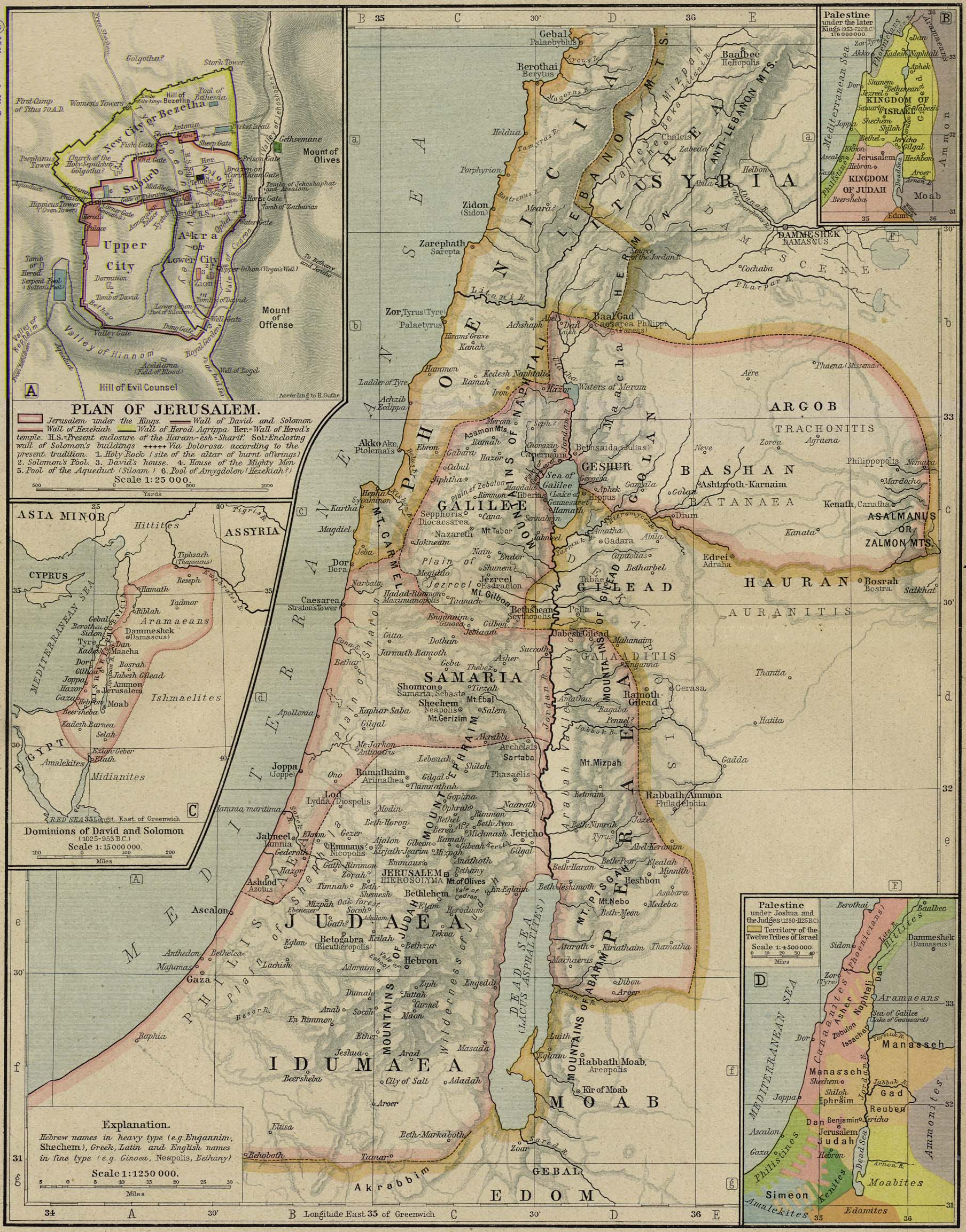
- 1Jericho, A city within the land, where everything was devoted to destruction. Joshua 6:21
- 2Ai, A city within the land, whose people were devoted to destruction. Joshua 8:26
- 3Gilgal, The camp where envoys from Gibeon, a city of the land, claimed a distant home and won a treaty. Joshua 9:6
- 4Hebron, A city within the land, which Joshua devoted to destruction with everyone in it. Joshua 10:37
- 5Ammon, David took Rabbah and put its people to work with saws, picks and axes. 2 Samuel 12:31
- 6Damascus, A city beyond Israel's land, whose Arameans became subject to David and brought him tribute. 2 Samuel 8:6
Base map: Reference map of ancient Palestine, Rand McNally reference map (1926), public domain. Each place stands at its place page's coordinates, set on the plate by Jerusalem and Damascus, as the plate prints them.
Each numbered place opens its page, and each line of the key ends with the verse that records what happened there.
Ammon, a land Israel was not givenDeuteronomy 2:19
But when you get close to the Ammonites, do not harass them or provoke them, for I will not give you any of the land of the Ammonites. I have given it to the descendants of Lot as their possession.”The Gibeonites and the rule for distant citiesJoshua 9; John Wesley; Ambrose of Milan; Adam Clarke
A treaty with a distant city was lawful under Deuteronomy 20:10 to 15.
Three days after they had made the treaty with the Gibeonites, the Israelites learned that they were neighbors, living among them.Adam Clarke, on Joshua 9:16, gives Gibeon as reputed to lie only about eight leagues from Gilgal. Ambrose of Milan explains why Joshua believed them without asking the LORD.
“And he, being as yet ignorant of localities and not knowing anything of the inhabitants, did not see through their deceit, nor did he enquire of God but readily believed them. So sacred was one's promised word held in those days that no one would believe that others could try to deceive. Who could find fault with the saints in this, namely, that they should consider others to have the same feelings as themselves and suppose no one would lie because truth was their own companion?”
Ambrose of Milan · On the Duties of the Clergy 3.10.67-68 · on Joshua 9:14 to 15Patristic
John Wesley weighs whether the Gibeonites should have been spared at all.
“For though it is probable, if God had been consulted, he would have consented to the sparing of the Gibeonites; yet it should have been done with more caution, and an obligation upon them to embrace the true religion. In every business of importance, we should stay to take God along with us, and by the word and prayer consult him.”
John Wesley · Explanatory Notes upon the Old Testament · on Joshua 9:14Evangelical
The plunder of Jericho and of AiJoshua 6 and 8; John Gill
John Gill, on Joshua 8:2, notes that Israel had not been allowed to take the plunder of Jericho.
And you shall do to Ai and its king as you did to Jericho and its king, except that you may carry off their plunder and livestock for yourselves. Set up an ambush behind the city.”Hebrew Terms of the Law
Six Hebrew words of Deuteronomy 20 and their uses
| Word | Strong's number | In Deuteronomy 20 | Strong's dictionary gives | Uses |
|---|---|---|---|---|
| charam | H2763 | Deuteronomy 20:17 | to seclude; specifically (by a ban) to devote to religious uses (especially destruction) | 52 |
| shalom | H7965 | Deuteronomy 20:10 and Deuteronomy 20:11 | safe, i.e. (figuratively) well, happy, friendly; also (abstractly) welfare, i.e. health, prosperity, peace | 236 |
| mas | H4522 | Deuteronomy 20:11 | properly, a burden (as causing to faint), i.e. a tax in the form of forced labor | 23 |
| nachalah | H5159 | Deuteronomy 20:16 | properly, something inherited, i.e. (abstractly) occupancy, or (concretely) an heirloom; generally an estate, patrimony or portion | 222 |
| neshamah | H5397 | Deuteronomy 20:16 | a puff, i.e. wind, angry or vital breath, divine inspiration, intellect. or (concretely) an animal | 24 |
| shoter | H7860 | Deuteronomy 20:5, Deuteronomy 20:8 and Deuteronomy 20:9 | properly, a scribe, i.e. (by analogy or implication) an official superintendent or magistrate | 25 |
What the Text Leaves Unsaid
Three questions Deuteronomy 20 leaves open
Deuteronomy 20 names no city of either kind, so every case comes from the later books.
Deuteronomy 20:10 gives no words for the offer of peace and names no one to carry it.
Deuteronomy 20:17 names six nations where Deuteronomy 7:1 names seven, and it gives no reason for leaving out the Girgashites.
The LORD Who Fights for Israel
Matthew Henry and David on the LORD who fights for his people
Matthew Henry finds in the priest who spoke before the battle a title that fits Christ.
“This encouragement must be particularly addressed to the common soldiers by a priest appointed, and, the Jews say, anointed, for that purpose, whom they call the anointed of the war, a very proper title for our anointed Redeemer, the captain of our salvation: This priest, in God's name, was to animate the people; and who so fit to do that as he whose office it was as priest to pray for them?”
Matthew Henry · Commentary on the Whole Bible · on Deuteronomy 20:1Puritan
David went out against Goliath with the faith the priest's charge asked of every soldier.
And all those assembled here will know that it is not by sword or spear that the LORD saves; for the battle is the LORD’s, and He will give all of you into our hands.”Voices on the Laws of War
Clement of Alexandria and the commentary of Jamieson, Fausset and Brown on the releases, the trees and the captive
Clement of Alexandria on the releases and the treesThe Stromata, Book 2
Clement of Alexandria gives a soldier's reason for the releases.
“Again, the law in its humanity says that if a man has built a new house but has not yet moved in, or laid out a new vineyard but has not yet enjoyed the fruit, or become betrothed to a girl but has not yet married her, he is to be excused military service. This makes military sense, since we would be unenthusiastic in our military service if we were being pulled in the direction of the things we longed for. People expose themselves to danger without a second thought only if they are free in relation to natural impulses.”
Clement of Alexandria · The Stromata Book 2 · on Deuteronomy 20:5Patristic
He hears the Word of God teaching through the law of the fruit trees.
“The Logos in his goodness, richly equipped with love of humankind, teaches that it is not right to cut down cultivated trees, still less to cut crops for purposes of vandalism before harvest, and even less still to destroy, root and branch, cultivated fruit, whether of the land or of the soul. It does not even allow the razing of enemy land. Yes, and farmers find their profit from the law.”
Clement of Alexandria · The Stromata Book 2 · on Deuteronomy 20:19Patristic
Jamieson, Fausset and Brown on the fruit treesCommentary Critical and Explanatory, 1871
The commentary sets the fruit tree law beside the customs of India.
“But fruit-bearing trees were to be carefully spared; and, indeed, in warm countries like India, where the people live much more on fruit than we do, the destruction of a fruit tree is considered a sort of sacrilege.”
Jamieson, Fausset & Brown · Commentary Critical and Explanatory on the Whole Bible · on Deuteronomy 20:19Reformed
Clement of Alexandria on the month of waitingThe Stromata, Book 3
Clement reads the month of waiting as a check on desire.
“The [Deuteronomic] law wishes males to have responsible sexual relations with their marriage partners, solely for the generation of children. This is clear when a bachelor is prevented from enjoying immediate sexual relations with a woman prisoner of war. If he once falls in love with her, he must let her cut her hair short and mourn for thirty days. If even so his desire has not faded away, then he may father children by her. The fixed period of time enables the overpowering impulse to be scrutinized and to turn into a more rational appetency.”
Clement of Alexandria · The Stromata Book 3 · on Deuteronomy 21:13Patristic
Where Readers Disagree
Four readings, each with its holders and the strongest objection against it
Deuteronomy 20:18 gives the reason for the command against the cities of the land, and two earlier verses set it on those nations' own wickedness. The Canaanite Conquest page argues the whole case.
In the fourth generation your descendants will return here, for the iniquity of the Amorites is not yet complete.”It is not because of your righteousness or uprightness of heart that you are going in to possess their land, but it is because of their wickedness that the LORD your God is driving out these nations before you, to keep the promise He swore to your fathers, to Abraham, Isaac, and Jacob.Peace was offered to distant cities onlyRashi; Albert Barnes
Rashi reads Deuteronomy 20:10 as the rule of a war that is not obligatory, citing Sifrei Devarim 199:1, and he finds the proof in the cities far away of Deuteronomy 20:15. On Deuteronomy 20:11 he allows that people of the seven nations found in such a city may be kept alive.
Albert Barnes keeps the same line between the two kinds of war. In his Notes on Deuteronomy 21:10 he writes that the wars of the captive law are wars against neighbouring nations, fought after Israel had destroyed the Canaanites.
Joshua 11:19 weighs against this reading, because it counts the cities that made peace as if any city of the land might have done so.
No city made peace with the Israelites except the Hivites living in Gibeon; all others were taken in battle.Peace was open to the cities of the landMatthew Henry; Adam Clarke; John Wesley
Matthew Henry, on Joshua 11:19, says that the other cities might have made as good terms for themselves if they had humbled themselves, but they never so much as desired conditions of peace.
Adam Clarke reports that interpreters are greatly divided over Deuteronomy 20:10, and he grants that the bare letter limits the offer to cities beyond the seven nations. On Joshua 11:20 he calls the cities' refusal of peace the proof that they held to their idols. John Wesley, on Joshua 6:25, sees in Rahab an exception for any who cast off their wickedness and submitted.
Rashi, who limits the offer of Deuteronomy 20:10 to distant cities, still reads Deuteronomy 20:18 to mean that those nations could be received if they repented and became proselytes, after Sifrei Devarim 202:1. Henry also weighs the message Moses sent to Sihon in Deuteronomy 2:26.
“Moses herein did neither disobey God, who bade him contend with Sihon, nor dissemble with Sihon; but doubtless it was by divine direction that he did it, that Sihon might be left inexcusable, though God hardened his heart. This may illustrate the method of God's dealing with those to whom he gives his gospel, but does not give grace to believe it.”
Matthew Henry · Commentary on the Whole Bible · on Deuteronomy 2:26 to 29Puritan
Against this reading stand Deuteronomy 20:15 to 16, which set the distant cities apart from those of the land, and the order of Deuteronomy 7:2 to make no treaty with the nations of the land.
Charam is death under a banJohn Gill
John Gill, in his Exposition of the Old Testament on Deuteronomy 20:16, gives the reason for the severity as the nations' capital crimes, among them idolatry, witchcraft and necromancy. He says they were kept for this destruction until the measure of their iniquities was full.
The strongest objection is that Exodus 23:29 to 30 has the LORD drive the nations out little by little, and Deuteronomy 7:3 forbids marriage with them, so the law expects some to remain.
Charam is the end of a nation's existenceAdam Clarke
Adam Clarke, in his Commentary on the Bible on Deuteronomy 20:17, proposes rendering the verb as utterly subduing the nations. They would be slain if they resisted, expelled from the land or reduced to slavery in it, so that they no longer existed as a people.
Joshua 11:20 weighs against this reading.
For it was of the LORD to harden their hearts to engage Israel in battle, so that they would be set apart for destruction and would receive no mercy, being annihilated as the LORD had commanded Moses.Books to Read Next
Four works in the public domain that read the war laws verse by verse
Commentary on the Whole Bible
Matthew Henry · 1710
Henry asks whether Ai was ever rebuilt, and suggests that it may be the Aijah of Nehemiah 11.
Commentary on the Bible
Adam Clarke · 1832
Clarke also explains the covenant sacrifice by which the Gibeonite treaty was made in Joshua 9.
Commentary Critical and Explanatory on the Whole Bible
Robert Jamieson, A. R. Fausset and David Brown · 1871
The commentary takes the officers of Deuteronomy 20:5 to be keepers of the muster roll or military heralds.
Pentateuch with Rashi's Commentary
M. Rosenbaum and A. M. Silbermann, translators · 1929 to 1934
Rashi also reads the guards of Deuteronomy 20:9, posted in front of the battle line and behind it.
In print: find it wherever books are sold.
Weapons of Another Kind
Paul applies the language of battle to the church's own struggle.
For though we live in the flesh, we do not wage war according to the flesh. The weapons of our warfare are not the weapons of the world. Instead, they have divine power to demolish strongholds.John Gill, on 2 Corinthians 10:4, writes that believers are enlisted as volunteers under the captain of their salvation and fight his battles. He reads the warfare of this verse itself as the work of ministers of the gospel.
Keep studying
Studies7
Symbols1
Doctrines8
Peoples and groups2