

Genesis 37:34 · Symbol · Featured Study
Sackcloth
A symbol study of the coarse cloth of grief and repentance, with the Hebrew and Greek words and two readings in dispute.
Jacob put on sackcloth for Joseph, who was alive and on his way to Egypt.
- The word
- שַׂק (saq), H8242
- First appears
- Genesis 37:34 “…Jacob tore his clothes, put sackcloth around his…”
John Martin, The Repentance of Nineveh, 1840. Public domain.
Summary
Sackcloth in Scripture is coarse cloth worn next to the skin in grief, in repentance and in a plea for mercy, and its Hebrew name also means a sack for grain.
- The Hebrew saq stands 49 times in the Old Testament, and the Greek sakkos 4 times in the New.
- Kings put it on: Ahab after Elijah's word, Hezekiah under the Assyrian threat, and the king of Nineveh at Jonah's preaching.
- Jesus says in Matthew 11:21 that Tyre and Sidon would have repented long ago in sackcloth and ashes.
Sackcloth in Genesis
A father's mourning and his sons' grain, both named with one Hebrew word.
All his sons and daughters tried to comfort him, but he refused to be comforted. “No,” he said. “I will go down to Sheol mourning for my son.” So his father wept for him.Jacob refuses every comfort, so the sackcloth of the verse before stays on.
At the place where they lodged for the night, one of them opened his sack to get feed for his donkey, and he saw his silver in the mouth of the sack.The same Hebrew word names the bag that held the brothers' grain and the silver Joseph returned.
Jamieson, Fausset and Brown, in their Commentary Critical and Explanatory, describe the mourner's cloth as a coarse, rough piece of black sackcloth or camel's hair wound round the waist. A tear was made in the skirt of the garment above it.
Who Used Sackcloth, and Why
Eleven people and peoples from Genesis to Revelation, each with the occasion and what the cloth expressed.
Sackcloth answers four kinds of trouble: grief, danger, guilt and a word from God.
| Verse | Who | The occasion | What it expressed |
|---|---|---|---|
| Genesis 37:34 | Jacob | Joseph's robe brought home dipped in blood | Grief |
| 2 Samuel 3:31 | David's men | The murder of Abner | Grief |
| 2 Samuel 21:10 | Rizpah | Her sons hanged on the hill before the LORD | Grief |
| 1 Kings 20:31 | Ben-hadad's servants | The king of Israel has defeated their master | A plea for life |
| 1 Kings 21:27 | Ahab | Elijah's word against his house | Humbling under judgment |
| 2 Kings 6:30 | The king of Israel | The famine in besieged Samaria | Distress worn under his clothes |
| 2 Kings 19:1 | Hezekiah | The Assyrian threat to Jerusalem | He pleads in the house of the LORD |
| Esther 4:1 | Mordecai | The decree against the Jews | Grief and a plea |
| Daniel 9:3 | Daniel | The years of Jerusalem's desolation | Prayer and confession |
| Jonah 3:5 | The people of Nineveh | Jonah's warning of overthrow | Repentance |
| Revelation 11:3 | The two witnesses | Their days of prophecy | Mourning, or the dress of prophets |
2 Kings 19:1, Esther 4:1, Daniel 9:3, Jonah 3:5, Revelation 11:3
Sackcloth Through Scripture
Eleven places in canon order, from Nehemiah to Amos.
The cloth runs through the histories, the poetry and the prophets.
- NehemiahThe people fast in sackcloth, Nehemiah 9:1
- JobSewn over my skin, Job 16:15
- Psalm 30You peeled off my sackcloth, Psalm 30:11
- Psalm 69Sackcloth for clothing, Psalm 69:11
- Isaiah 20Isaiah told to take it off, Isaiah 20:2
- Isaiah 50The heavens in sackcloth, Isaiah 50:3
- Isaiah 58Is this the fast I have chosen, Isaiah 58:5
- JeremiahRoll in ashes, Jeremiah 6:26
- LamentationsThe elders of Zion, Lamentations 2:10
- JoelThe priests called to lament, Joel 1:13
- AmosFeasts turned to mourning, Amos 8:10
Each stop opens its verse in the reader.
Said Outright, and Heard by Readers
Two verses that weigh what sackcloth is worth.
SACKCLOTH FOR OTHERS
The psalmist wore it when his enemies were sick, a grief carried for others.
THEIR ACTIONS
God's answer names their turning from evil ways and says nothing of the cloth.
Two readings set beside the textLeviticus 11:32 and Isaiah 58:5 to 6
Neither reading stands in the words of the text.
| Verse | The reading | What the text says |
|---|---|---|
| Leviticus 11:32 | The law of Moses orders sackcloth for mourning. | The Torah names sackcloth once in law, as an article that becomes unclean, and gives no command to wear it. |
| Isaiah 58:5 to 6 | Putting on sackcloth wins God's favour by itself. | Isaiah asks whether bowing the head and spreading sackcloth is the fast God has chosen, and names breaking the chains of wickedness instead. |
Nineveh in Sackcloth
The Yale canvas, read part by part with its verse.
Martin set the city behind and its people bowed on a terrace before it.
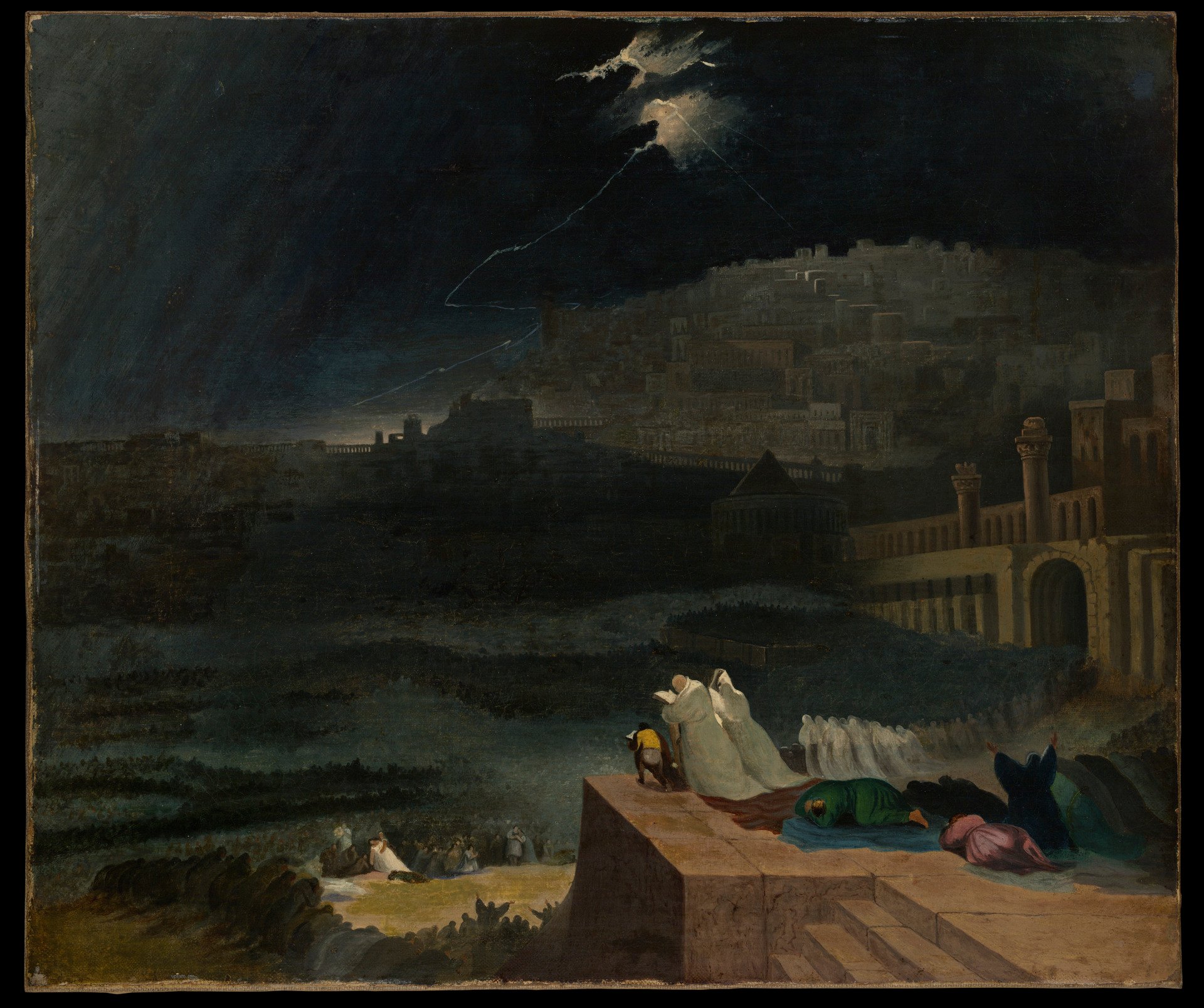
- The great cityWalls and towers cover the hills under a dark sky.Jonah 3:3
- Those who call on GodRobed figures stand and bow with raised hands on the terrace.Jonah 3:8
- Those lying on the groundFigures lie face down on the stone beside them.Jonah 3:6
- The people on the plainCrowds kneel across the plain below the city.Jonah 3:5
John Martin, The Repentance of Nineveh, 1840. Public domain.
Martin set the scene at night under lightning, which Jonah 3 does not describe.
Jonah 3:7 to 8 puts the animals of the city under the same decree, so that herds and flocks went without food and were covered with sackcloth beside their owners.
Saq and Sakkos
The Hebrew and Greek words for sackcloth and the words for the ashes that go with it, with their counts.
James Strong's concordance describes saq as a mesh that lets liquid run through, a coarse loose cloth used in mourning and for bagging, and from there a bag for grain. Revelation 6:12 likens the darkened sun to sackcloth of goat hair, and Strong gives the Greek word as mohair, the material or the garments made of it. Ashes go with the cloth in Esther 4:1 and Daniel 9:3, where the Hebrew word for ashes stands beside saq.
saq
coarse cloth, sacking; a sack
epher
ashes
sakkos
sackcloth of goat hair
spodos
ashes
The lexicon in full1 table or figure
The Old Testament names sackcloth far more often than the New.
| Word | Meaning | Uses |
|---|---|---|
| saq, H8242 | coarse cloth, sacking; a sack | 49 |
| epher, H665 | ashes | 22 |
| sakkos, G4526 | sackcloth of goat hair | 4 |
| spodos, G4700 | ashes | 3 |
What Scripture Does Not Say
Three things about sackcloth that the text leaves open.
Mourning into Dancing
Sackcloth taken off in the psalm and refused by the cities of Galilee.
You turned my mourning into dancing; You peeled off my sackcloth and clothed me with joy,David speaks of the change after a healing he credits to God in Psalm 30:2 to 3.
“Woe to you, Chorazin! Woe to you, Bethsaida! For if the miracles that were performed in you had been performed in Tyre and Sidon, they would have repented long ago in sackcloth and ashes.Jesus sets the cities that saw His miracles below pagan cities that would have repented.
“Observe the contrast, God takes away the mourning of his people; and what does he give them instead of it? Quiet and peace? Aye, and a great deal more than that. Thou hast turned for me my mourning into dancing. He makes their hearts to dance at the sound of his name. He takes off their sackcloth. That is good. What a delight to be rid of the habiliments of woe! But what then? He clothes us. And how? With some common dress? Nay, but with that royal vestment which is the array of glorified spirits in heaven.”
Charles Spurgeon · The Treasury of David, Vol. 2 · on Psalm 30:11
Voices on Sackcloth
Three teachers from the early church to the eighteenth century on sackcloth and the repentance it shows.
died 420 · Jerome
Jerome, in his Letter 22, on Isaiah 58:5, warns the one who has fasted two or three days against thinking himself better than those who eat and give God thanks.
1662 to 1714 · Matthew Henry
Matthew Henry, in his Commentary on the Whole Bible, on Jonah 3:5, writes that sackcloth was hard wear for people used to fine linen. He holds that they would not have put it on without a deep sense of their sin.
1703 to 1791 · John Wesley
John Wesley, in his Explanatory Notes upon the Old Testament, on Jonah 3:8, reads the violence the king of Nineveh renounced as oppression and plunder practised by the people's own hands.
Where Careful Readers Differ
Two questions about sackcloth that readers answer in different ways.
How deep Ahab's humbling wentMatthew Henry and Albert Barnes
When Ahab heard these words, he tore his clothes, put on sackcloth, and fasted. He lay down in sackcloth and walked around meekly.The verse gives Ahab every outward sign of sorrow that Scripture records.
Matthew Henry, in his Commentary on the Whole Bible, calls it an outside repentance that lamented the judgment and not the sin, since Ahab kept his idols and gave back no vineyard. Still God took notice of it. The objection is that God Himself points Elijah to Ahab's humbling, which treats it as more than outward show.
Albert Barnes, in his Notes, Explanatory and Practical, holds that the repentance was sincere and real while it lasted, though it sprang from fear of the consequences and was short-lived, like that of Nineveh. The objection is that 1 Kings 21 does not state Ahab's motive, and Barnes supplies one.
Why the two witnesses wear sackclothBede and Adam Clarke
Bede, in his Commentary on Revelation, reads the sackcloth as penitential mourning and cites Psalm 35:13. The objection is that Revelation 11:6 gives the witnesses power to shut the sky and strike the earth with plagues, which is the authority of prophets more than the posture of penitents.
Adam Clarke, in his Commentary on the Bible, calls the passage extremely obscure and declines to choose among the readers who have tried to name the witnesses. The objection is that Revelation 11:4 names them the two olive trees and the two lampstands, which points the reader to Zechariah 4.
Books to Read Next
Two public domain works, each with a free copy to read.
Letter 22, to Eustochium
Jerome · before 420
The letter to Eustochium is his long counsel on the life of virginity.
Read at New AdventExposition on Psalm 30
Augustine of Hippo · before 430
He hears the psalm in the voice of the Church, whose sackcloth of mortality is torn off.
Read at New AdventThe God Who Relented
Joel called the priests into sackcloth, and in the next chapter he tells the people what the LORD wants beneath it.
“Yet even now,” declares the LORD, “return to Me with all your heart, with fasting, weeping, and mourning.” So rend your hearts and not your garments, and return to the LORD your God. For He is gracious and compassionate, slow to anger, abounding in loving devotion. And He relents from sending disaster.The text asks the reader to return to the LORD with all his heart.
Sources
Scripture is the Berean Standard Bible.
- James Strong, Exhaustive Concordance of the Bible, 1890, entries H8242, H665, G4526 and G4700.
- Jamieson, Fausset and Brown, Commentary Critical and Explanatory on the Whole Bible, 1871, on Genesis 37:34.
- Jerome, Letter 22.37, on Isaiah 58:5.
- Matthew Henry, Commentary on the Whole Bible, 1710, on Jonah 3:5; on 1 Kings 21:27.
- John Wesley, Explanatory Notes upon the Old Testament, 1765, on Jonah 3:8.
- Charles Spurgeon, The Treasury of David, volume 2, 1870, on Psalm 30:11.
- Albert Barnes, Notes, Explanatory and Practical, on 1 Kings 21:27.
- Bede, Commentary on Revelation, on Revelation 11:3.
- Adam Clarke, Commentary on the Bible, 1832, on Revelation 11:3.
- Augustine of Hippo, Exposition on Psalm 30, on Psalm 30:11.
Keep Studying
Read it6
People and groups8
Show the next 2 titles
Places1