
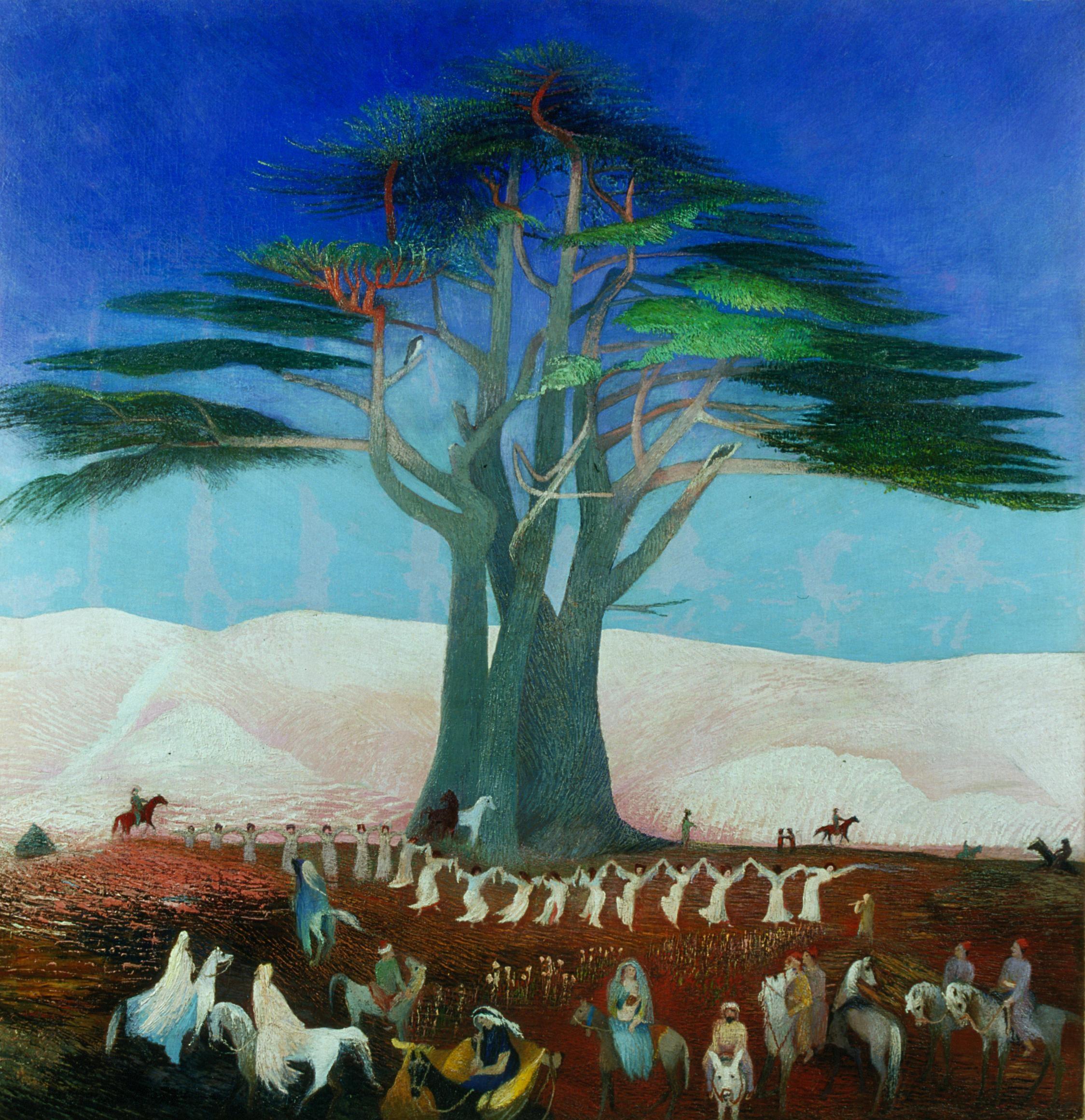
Tivadar Csontváry Kosztka, Pilgrimage to the Cedars in Lebanon, 1907. Public domain.
Deuteronomy 1:7 to 11:24 · Place · Featured Study
Lebanon
Lebanon is the mountain range behind the coast of Sidon and Tyre, known in Scripture for its cedars and its snow.
Nahum 1:4 says that when the LORD rebukes the sea, the flower of Lebanon wilts.
Resume your journey and go to the hill country of the Amorites; go to all the neighboring peoples in the Arabah, in the hill country, in the foothills, in the Negev, and along the seacoast to the land of the Canaanites and to Lebanon, as far as the great River Euphrates.
- Today
- The Lebanon range, in the modern state of Lebanon
- Region
- North of Galilee, between the coast and the valley of Coele-Syria
- First named
- Deuteronomy 1:7 “…of the Canaanites and to Lebanon, as far…”
- Last named
- Zechariah 11:1 “Open your doors, O Lebanon, that the…”
Summary
Deuteronomy 11:24 sets Lebanon inside the land promised to Israel, at its far end.
- Solomon sent men to Lebanon in shifts of 10,000 a month (1 Kings 5:14).
- Solomon spoke of trees, from the cedar in Lebanon to the hyssop in the wall (1 Kings 4:33).
- The exiles who came home had cedar brought from Lebanon to Joppa by sea (Ezra 3:7).
Lebanon in Moses' Words
Moses names the range in the LORD's command to break camp and again in his own plea to cross the Jordan.
This study asks where Lebanon lies and what Scripture makes of its cedars. It sets the range on an atlas plate of 1915 and follows it through the record. It also gives three readings of the hall Solomon named after its forest.
Deuteronomy 1:7 sets Lebanon at the end of the list of regions, just before the Euphrates.
Please let me cross over and see the good land beyond the Jordan—that pleasant hill country as well as Lebanon!” But the LORD was angry with me on account of you, and He would not listen to me. “That is enough,” the LORD said to me. “Do not speak to Me again about this matter.The answer to the request comes in the same passage, and it is a refusal.
Word data for the Hebrew Bible counts the name 71 times, and Strong's dictionary glosses it: Lebanon, a mountain range in Palestine. Jamieson, Fausset and Brown, on Jeremiah 18:14, take the name to mean the white mountain, from its snow.
Lebanon on Bartholomew's Plate
The plate shades the high ground of Mount Lebanon and Mount Hermon darkest and colours the coastal strip green.
Mount Lebanon runs parallel to the coast north-east of Sidon, and Mount Hermon rises to the south-east beyond the valley.
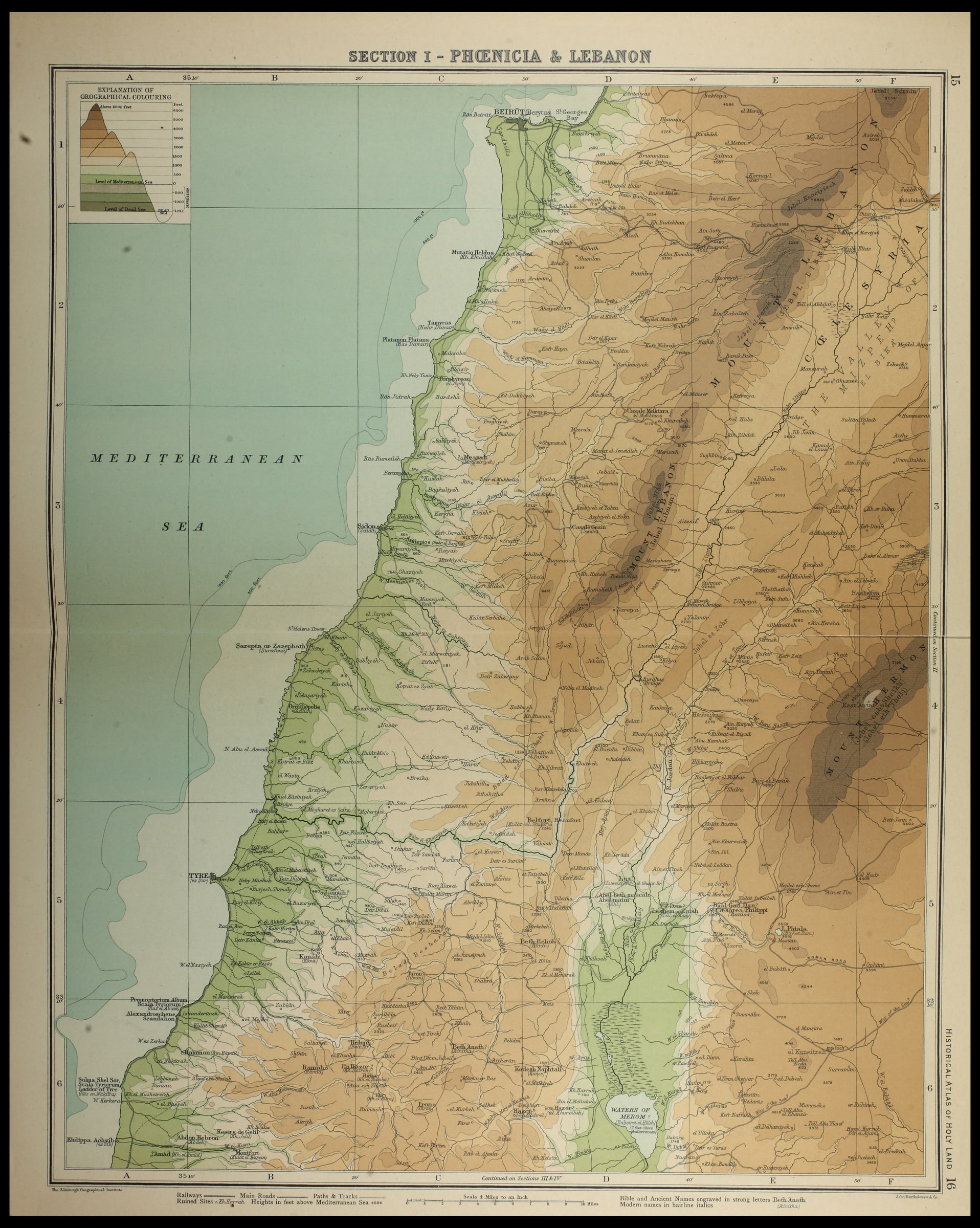
- Mount LebanonThe Hivites lived in its mountains from Mount Baal-hermon to Lebo-hamath. Bartholomew draws the range, and its place is known: the long ridge north-east of Sidon, the northernmost point.Judges 3:3
- SidonSolomon's request for cedar says none in Israel could log as the Sidonians did. Bartholomew locates it with no query, on the coast in the middle of the plate.1 Kings 5:6
- TyreEzekiel's lament for Tyre says its builders took a cedar from Lebanon for a mast. Bartholomew locates it with no query, on the coast south of Sidon, the south-westernmost point.Ezekiel 27:5
- Mount HermonThe bride is called from Lebanon, down from the summits of Senir and Hermon. Bartholomew marks the summit, and its place is known: the high mass in the south-east of the plate, the easternmost point.Song of Solomon 4:8
- Baal-gadJoshua's conquest west of the Jordan reached it in the Valley of Lebanon. Bartholomew proposes it with a query, beside Caesarea Philippi at the south-western foot of Hermon, the southernmost point.Joshua 12:7
John Bartholomew and Co., Section I, Phoenicia and Lebanon, in George Adam Smith's Atlas of the Historical Geography of the Holy Land, 1915. Public domain; File:John Bartholomew & Co., Section I - Phoenicia & Lebanon (FL46962151 3907192).jpg.
Five numbered points, each where Bartholomew's plate of 1915 prints the place, with north at the top. The plate's key sets Bible names in strong letters and modern names in hairline italics, and it marks the railways and roads of 1915. It prints a scale of four miles to an inch and a key of heights.
Lebanon in Scripture, in Order
Scripture names the range and its cedars in histories, fables and oracles.
Four of the six moments use Lebanon or its cedars in a word to or about a king.
- Joshua's old ageThe LORD tells Joshua that all Lebanon to the east is among the land that remainsJoshua 13:5
- Jotham's fableJotham, the youngest son of Jerubbaal, tells the leaders of Shechem, who had made Abimelech king, a fable of a thornbush that threatens fire on the cedars of LebanonJudges 9:6 to 15
- Jehoash's answerJehoash of Israel answers Amaziah of Judah with the parable of a thistle and a cedar2 Kings 14:9
- Sennacherib's boastThe LORD's word against Sennacherib of Assyria quotes his boast of felling Lebanon's cedars2 Kings 19:20 to 23
- Jeremiah's oracleThe LORD likens the house of the king of Judah to the summit of LebanonJeremiah 22:6
- Zechariah's lamentThe prophet tells Lebanon to open its doors so that fire may consume its cedarsZechariah 11:1
Six moments from Joshua to Zechariah in the order of the canon, each with its verse.
Two studies tell two of these moments whole: the land that remained to be taken, and Jotham's fable.
The Range Apart
Jeremiah and a geographer of 1897 each describe the range by what sets it apart.
George Adam Smith, a Scottish scholar, counts seven chief features of the land. He does so in The Historical Geography of the Holy Land, whose fourth edition appeared in 1897. He says the Lebanons could head the list, since the land's long strips flow from them. He sets them beside the list rather than in it, because they are too separate and stand by themselves.
Does the snow of Lebanon ever leave its rocky slopes? Or do its cool waters flowing from a distance ever run dry? Yet My people have forgotten Me. They burn incense to worthless idols that make them stumble in their ways, leaving the ancient roads to walk on rutted bypaths instead of on the highway.Jeremiah sets the lasting snow of Lebanon beside a people who have forgotten the LORD.
What the Text Leaves Unsaid
Scripture records Moses' wish to see Lebanon and never records that he saw it.
Deuteronomy 34:1 to 3 lists the land the LORD showed Moses from Pisgah, from Gilead as far as Dan and south to Zoar. Lebanon is not among the places it names.
The Cedars of Lebanon
Isaiah uses the trees of Lebanon for the proud brought low, and Hosea for a people restored.
The study of Scripture's trees sets the cedar of Psalm 92:12 beside the cedars of Ezekiel 17 and 31.
For the Day of the LORD of Hosts will come against all the proud and lofty, against all that is exalted—it will be humbled— against all the cedars of Lebanon, lofty and lifted up, against all the oaks of Bashan,Isaiah's oracle against pride begins its list with the trees of this range.
I will be like the dew to Israel; he will blossom like the lily and take root like the cedars of Lebanon. His shoots will sprout, and his splendor will be like the olive tree, his fragrance like the cedars of Lebanon.Hosea's promise to a repentant people borrows the strength and scent of the range's trees.
Voices on Lebanon
Cyril of Alexandria, Matthew Henry and Charles Spurgeon wrote on Lebanon in the Song of Solomon and the psalms.
Cyril of Alexandria (died 444)
Cyril of Alexandria, bishop of that city, reads the call from Lebanon in Song of Solomon 4:8 as a call to the church.
“This teaches us the bride's place of origin, that she comes from the worship of idols. For Mount Lebanon is full of idols, whence you come, it says, hastening past through the law. Without knowing the law, you were taught the mystery of Christ.”
Cyril of Alexandria · Fragments in the Commentary on the Song of Songs 4:8 · on Song of Solomon 4:8Patristic
Matthew Henry (1662 to 1714)
Matthew Henry, the English commentator, draws three lessons for believers from the cedar of Psalm 92.
“Where God gives true grace he will give more grace. God's trees shall grow higher, like the cedars, the tall cedars in Lebanon; they shall grow nearer heaven, and with a holy ambition shall aspire towards the upper world; they shall grow stronger, like the cedars, and fitter for use.”
Matthew Henry · Commentary on the Whole Bible · on Psalm 92:12Puritan
Charles Spurgeon (1834 to 1892)
Charles Spurgeon, the London preacher, applies the breaking of the cedars in Psalm 29 to the greatest of men.
“The voice of the Lord breaketh the cedars. ‘Black from the stroke above, the smouldering pine Stands a sad shattered trunk.’ Noble trees fall prostrate beneath the mysterious bolt, or stand in desolation as mementoes of its power. Lebanon itself is not secure, high as it stands, and ancient as are its venerable woods: Yea, the Lord breaketh the cedars of Lebanon. The greatest and most venerable of trees or men, may not reckon upon immunity when the Lord is abroad in his wrath.”
Charles Spurgeon · The Treasury of David, Vol. 2 · on Psalm 29:5Particular Baptist
The House of the Forest of Lebanon
Readers differ on where Solomon's cedar hall stood and why it bore the name.
He built the House of the Forest of Lebanon a hundred cubits long, fifty cubits wide, and thirty cubits high, with four rows of cedar pillars supporting the cedar beams.The verse gives the hall's measures and its cedar pillars and leaves the name unexplained.
Built among the trees of LebanonMatthew Henry, Commentary on the Whole Bible
Henry inclines to think the house stood in the forest of Lebanon itself, as a retreat Solomon could reach from his chariot cities.
The objection: 1 Kings 7:1 to 2 sets the house within Solomon's thirteen years of palace building, and Isaiah 22:8 has Judah look to the weapons in the House of the Forest.
A hall in Jerusalem named for its cedarAdam Clarke, Commentary on the Bible
Adam Clarke, the Methodist commentator, holds that the house was not built in Lebanon and was thought to stand on Mount Sion. He suggests it took the name because it was built almost entirely of materials from Lebanon.
The objection, which Clarke grants: why the house bore the name does not appear in the text.
A store for weaponsIshodad of Merv, Books of Sessions
Ishodad of Merv denies that the house stood in a forest or in Lebanon. He reads it as a huge house where weapons were gathered, and 1 Kings 10:17 has the king put three hundred gold shields there.
The objection: 1 Kings 7:2 describes the house by its cedar pillars and beams and says nothing of weapons.
Planted in the House of the LORD
The cedar of the psalms grows where the LORD plants it, and Jesus calls Himself the vine and His disciples the branches (John 15:5). The text asks the reader to remain in Him.
Planted in the house of the LORD, they will flourish in the courts of our God.The verse gives the reason the righteous flourish.
Remain in Me, and I will remain in you. Just as no branch can bear fruit by itself unless it remains in the vine, neither can you bear fruit unless you remain in Me.Jesus gives the command to remain in Him and the reason for it.
Sources
Scripture is the Berean Standard Bible.
- James Strong, Exhaustive Concordance of the Bible (1890), Hebrew dictionary, entry 3844.
- George Adam Smith, The Historical Geography of the Holy Land, fourth edition (London, 1897), page 50.
- Jamieson, Fausset and Brown, Commentary Critical and Explanatory on the Whole Bible (1871), on Jeremiah 18:14.
- Charles Spurgeon, The Treasury of David, volume 2 (1870), on Psalm 29:5.
- Matthew Henry, Commentary on the Whole Bible (1710), on Psalm 92:12.
- Cyril of Alexandria, Fragments in the Commentary on the Song of Songs, on Song of Solomon 4:8.
- Matthew Henry, Commentary on the Whole Bible (1710), on 1 Kings 7:2.
- Adam Clarke, Commentary on the Bible (1832), on 1 Kings 7:2.
- Ishodad of Merv, Books of Sessions, on 1 Kings 7:2.
Keep Studying
Read it4
People and groups4
Places11
Doctrines1
Subjects1