
1 Corinthians 8-10 · Featured Study
Food Offered to Idols
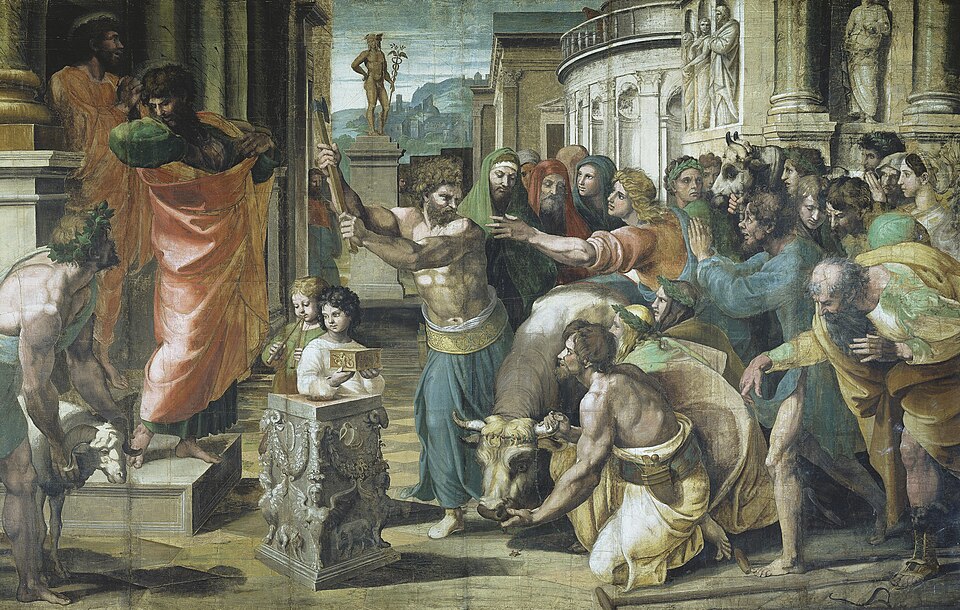
Corinth’s meat markets and dinner invitations ran through the idol temples, and the church asked Paul what a believer may eat. His three-chapter answer turns a menu question into a theology of love, liberty, and worship: knowledge puffeth up but love edifieth, an idol is nothing yet the weak conscience is real, Paul lays down his own rights as the living example, Israel’s wilderness falls stand written for our admonition, and the table of the Lord will not share its guests with the table of demons.
Summary
Corinth asked whether a believer may eat meat that had been offered to an idol, and Paul answers across chapters 8, 9 and 10. The rule he builds runs from love for the weaker brother, through his own waived rights, to the table of the Lord, and it ends at the glory of God.
- “Knowledge puffeth up, but love edifieth”: right answers used without love wound the brother for whom Christ died (8:1-13)
- Paul waived his own right to be supported, becoming all things to all men to save some (9:1-23)
- The race is real: the runner exercises self-control so that after preaching to others he is himself approved (9:24-27)
- Israel had the cloud, the sea, the manna and the rock, and still fell in the wilderness; those examples are written for our admonition, and God gives the way of escape (10:1-13)
- The cup of the Lord excludes the cup of demons; in doubtful cases, eat without questions unless conscience is named, and do all to the glory of God (10:14-33)
Knowledge and Love
8:1-3: the rule that governs all three chapters
“Now about food sacrificed to idols: We know that we all have knowledge. Knowledge puffs up, but love builds up.” 1 Corinthians 8:1
“The one who thinks he knows something does not yet know as he ought to know. But the one who loves God is known by God.” 1 Corinthians 8:2-3
In Corinth, most meat for sale had passed through a temple. Animals were offered to the gods, the priests took a portion, and the rest went to the market stalls and the dinner tables of the city. The Corinthians who wrote to Paul knew their theology and led with it: an idol is nothing, so the meat is nothing. Paul grants the knowledge and then weighs it. Knowledge by itself inflates the one who holds it; love builds up the person standing next to him. That measure governs everything the next three chapters say.
“The first step to knowledge is to know our own ignorance. Without love there is only the appearance of knowledge.”
Jamieson, Fausset & Brown · Commentary Critical and Explanatory on the Whole Bible, 1871Reformed
1 Cor 8:2
“It is therefore better and more profitable to belong to the simple and unlettered class, and by means of love to attain to nearness to God, than, by imagining ourselves learned and skilful, to be found [among those who are] blasphemous against their own God, inasmuch as they conjure up another God as the Father.”
Irenaeus · Against Heresies, Book II, c. 180Early Church
1 Cor 8:1
Paul returns to this same scale in chapter 13, where love is weighed against every gift and outlasts them all. The full study of that chapter is at The Love Chapter.
An Idol Is Nothing
8:4-13: true knowledge, the weak conscience, and the brother for whom Christ died
“So about eating food sacrificed to idols: We know that an idol is nothing at all in the world, and that there is no God but one.” 1 Corinthians 8:4
1 Corinthians 8:6 (BSB)
“yet for us there is but one God, the Father, from whom all things came and for whom we exist. And there is but one Lord, Jesus Christ, through whom all things came and through whom we exist.” 1 Corinthians 8:6
Against the many gods and many lords of the pagan world, Paul sets one God the Father and one Lord Jesus Christ, and gives the Lord the same creative sweep as the Father: all things are through him. The confession stands beside the Shema of Israel as the church’s one-sentence creed.
Then the turn: “But not everyone has this knowledge” (8:7). Some in the church had eaten at those temples all their lives as worshippers, and could still hear the old gods in the smell of the meat. For such a man, eating meant returning to idolatry, and his conscience, being weak, was defiled.
“Be careful, however, that your freedom does not become a stumbling block to the weak.” 1 Corinthians 8:9
“Therefore, if what I eat causes my brother to stumble, I will never eat meat again, so that I will not cause him to stumble.” 1 Corinthians 8:13
“This does not contradict 1Co 10:20, which states that they who worship idols, worship devils; for here it is the GODS believed by the worshippers to be represented by the idols which are denied to have any existence, not the devils which really under the idols delude the worshippers.”
Jamieson, Fausset & Brown · Commentary Critical and Explanatory on the Whole Bible, 1871Reformed
1 Cor 8:4
“The heathens frequently made entertainments in their temples, on what hath been sacrificed to their idols.”
John Wesley · Explanatory Notes upon the New Testament, 1755Evangelical
1 Cor 8:10
“Note, Injuries done to Christians are injuries to Christ, especially to babes in Christ, to weak Christians; and most of all, involving them in guilt: wounding their consciences is wounding him.”
Matthew Henry · Commentary on the Whole Bible, 1710Presbyterian
1 Cor 8:12
“When it is certainly foreseen that my doing what I may forbear will occasion a fellow-christian to do what he ought to forbear, I shall offend, scandalize, or lay a stumbling-block in his way, which to do is a sin, however lawful the thing itself be which is done. And, if we must be so careful not to occasion other men's sins, how careful should we be to avoid sin ourselves!”
Matthew Henry · Commentary on the Whole Bible, 1710Presbyterian
1 Cor 8:13
The brother for whose sake Christ died: the readings, with holders8:11
Verse 11 asks whether the weak brother perisheth, “the brother for whose sake Christ died.” Two honored teachers draw the implication differently, and this page names both without a verdict. Clarke hears in it a real possibility of perishing; Jamieson, Fausset & Brown answer that the verse argues from the worth Christ set on the brother, and that suppositions about final outcomes go beyond the text’s own point. The wider doctrine, with the warning passages and the promises held together, is walked at Eternal Security.
“Ye sin against Christ - By sending to perdition, through your bad example, a soul for whom he shed his blood; and so far defeating the gracious intentions of his sacrificial death. This is a farther intimation, that a person for whom Christ died may perish; and this is the drift of the apostle's argument.”
Adam Clarke · Commentary on the Bible, 1832Methodist
1 Cor 8:12
“Scripture is our rule, not our suppositions as to consequences. More is involved in redemption than the salvation of man: the character of God as at once just and loving is vindicated even in the case of the lost for they might have been saved, and so even in their case Christ has not died in vain.”
Jamieson, Fausset & Brown · Commentary Critical and Explanatory on the Whole Bible, 1871Reformed
1 Cor 8:11
Paul's Waived Rights
9:1-23: the living example of a liberty laid down
Chapter 9 is the proof of chapter 8, given in Paul’s own life. He has just told the Corinthians to yield their rights for the weak; now he shows them the receipt. As an apostle he held a real right to be supported by the churches, and he establishes that right at length before declining it. The argument stacks up: the soldier, the vinedresser and the shepherd live from their work (9:7); the law of Moses says the same (9:8-10); the temple priests eat of the altar (9:13); and the Lord himself ordained it (9:14).
“For it is written in the Law of Moses: ‘Do not muzzle an ox while it is treading out the grain.’ Is it about oxen that God is concerned? Isn’t He actually speaking on our behalf? Indeed, this was written for us” 1 Corinthians 9:9-10
“In the same way, the Lord has prescribed that those who preach the gospel should receive their living from the gospel.” 1 Corinthians 9:14
Then the turn that gives the chapter its force: “But I have not used any of these rights” (9:15). Paul worked with his hands so the gospel would travel free of charge, and he bent his liberty toward every audience he served.
“Though I am free of obligation to anyone, I make myself a slave to everyone, to win as many as possible.” 1 Corinthians 9:19
1 Corinthians 9:22 (BSB)
“To the weak I became weak, to win the weak. I have become all things to all people so that by all possible means I might save some.” 1 Corinthians 9:22
“THIS question occurs in the course of an argument. The Apostle was proving that the minister who gives all his time to the preaching of the Word is entitled to a maintenance from those people amongst whom he labours.”
Charles Spurgeon · The Metropolitan Tabernacle Pulpit, Sermon No. 3511: "The Battle of Life", 1916Particular (Reformed) Baptist
1 Cor 9:7
“Does not God also say, in effect, the same thing? The ox that treadeth out the corn - This was the custom in Judea, and many eastern nations. In several of them it is retained still.”
John Wesley · Explanatory Notes upon the New Testament, 1755Evangelical
1 Cor 9:8
“I made myself the servant of all - I acted with as self-denying a regard to their interest, and as much caution not to offend them, as if I had been literally their servant or slave. Where is the preacher of the gospel who treads in the same steps?”
John Wesley · Explanatory Notes upon the New Testament, 1755Evangelical
1 Cor 9:19
“To the weak became I as weak - Those who were conscientiously scrupulous, even in respect to lawful things. I am made all things to all men - I assumed every shape and form consistent with innocency and perfect integrity; giving up my own will, my own way, my own ease, my own pleasure, and my own profit, that I might save the souls of all.”
Adam Clarke · Commentary on the Bible, 1832Methodist
1 Cor 9:22
“He who did not think it robbery to be equal with God took the nature of a slave. He became all things to all men to bring salvation to all. Paul, an imitator of him, lived as if outside the law while remaining accountable to the law. He spent his life for the advantage of those he wished to win. He willingly became weak for the weak in order to strengthen them. He ran the race to overtake them.”
Ambrose of Milan · Letter 37 (To Simplician), c. 397Latin Father
1 Cor 9:22
The Race and the Castaway
9:24-27: the Isthmian games, the crown, and the buffeted body
“Do you not know that in a race all the runners run, but only one receives the prize? Run in such a way as to take the prize. Everyone who competes in the games trains with strict discipline. They do it for a crown that is perishable, but we do it for a crown that is imperishable.” 1 Corinthians 9:24-25
“Therefore I do not run aimlessly; I do not fight like I am beating the air. No, I discipline my body and make it my slave, so that after I have preached to others, I myself will not be disqualified.” 1 Corinthians 9:26-27
Corinth hosted the Isthmian games on the narrow neck of land beside the city, so every reader of this letter had watched the runners train. The athlete’s months of self-control for a pine wreath become Paul’s picture of the Christian life aimed at a crown that lasts. The discipline of the body in 9:27 closes the loop with chapter 8: the man who would waive meat for a brother must first be a man who governs himself.
“WE ARE CONTINUALLY insisting upon it from day to day, that salvation is not of works, but of grace. We lay this down as one of the very first doctrines of the gospel.”
Charles Spurgeon · The New Park Street Pulpit, Sermon No. 198: "The Heavenly Race", 1858Particular (Reformed) Baptist
1 Cor 9:24
“It is sufficiently evident that the apostle alludes to the athletic exercises in the games which were celebrated every fifth year on the isthmus, or narrow neck of land, which joins the Peloponnesus, or Morea, to the main land; and were thence termed the Isthmian games. The exercises were running, wrestling, boxing, throwing the discus or quoit, etc.; to the three first of these the apostle especially alludes.”
Adam Clarke · Commentary on the Bible, 1832Methodist
1 Cor 9:24
“‘Crown’ here is not that of a king (which is expressed by a different Greek word, namely, ‘diadem’), but a wreath or garland.”
Jamieson, Fausset & Brown · Commentary Critical and Explanatory on the Whole Bible, 1871Reformed
1 Cor 9:25
I buffet my body: the boxer's word9:27
The verb Paul chooses comes from the boxing ring, and the old commentators enjoyed saying so.
“The word is derived probably from ὑπώπιον hupōpion, the part of the face ‘under the eye’ (Passow), and means properly, to strike under the eye, either with the fist or the cestus, so as to render the part livid, or as we say, ‘black and blue’; or as is commonly termed, ‘to give anyone a black eye.’ The word is derived, of course, from the athletic exercises of the Greeks.”
Albert Barnes · Notes, Explanatory and Practical, on the Old and New Testaments, 1832-1869
1 Cor 9:27
Rejected: what Paul fears losing9:27
The word rendered “rejected” (KJV “castaway”) is the games word for a competitor disqualified by the judge. Jamieson, Fausset & Brown read the fear as failing of the prize after calling others to the contest, the herald himself barred from the crown. How that warning sits beside the promises of preservation is a question the church reads carefully, and it is walked with all the passages on the table at Eternal Security.
“a castaway--failing shamefully of the prize myself, after I have called others to the contest. Rejected by God, the Judge of the Christian race, notwithstanding my having, by my preaching, led others to be accepted.”
Jamieson, Fausset & Brown · Commentary Critical and Explanatory on the Whole Bible, 1871
1 Cor 9:27
Written for Our Admonition
10:1-13: Israel's wilderness examples, and the faithful God
The warning of 9:27 now gets its evidence. Israel in the wilderness had privileges every Corinthian would recognize in sacramental colors: all were under the cloud, all passed through the sea, all ate the same spiritual food and drank the same spiritual drink. Privilege did not carry them. Most of that generation fell, and Paul names the sins that felled them: lust, idolatry at the golden calf, fornication at Baal-peor, putting the Lord to the test, and murmuring.
“They all ate the same spiritual food and drank the same spiritual drink; for they drank from the spiritual rock that accompanied them, and that rock was Christ.” 1 Corinthians 10:3-4
“Now these things happened to them as examples and were written down as warnings for us, on whom the fulfillment of the ages has come. So the one who thinks he is standing firm should be careful not to fall.” 1 Corinthians 10:11-12
“Christ is the pillar cloud that screens us from the heat of God's wrath. Christ as ‘the light of the world’ is our ‘pillar of fire’ to guide us in the darkness of the world. As the rock when smitten sent forth the waters, so Christ, having been once for all smitten, sends forth the waters of the Spirit.”
Jamieson, Fausset & Brown · Commentary Critical and Explanatory on the Whole Bible, 1871Reformed
1 Cor 10:2
“The manna on which they fed was a type of Christ crucified, the bread which came down from heaven, which whoso eateth shall live forever. Their drink was a stream fetched from a rock which followed them in all their journeyings in the wilderness; and this rock was Christ, that is, in type and figure.”
Matthew Henry · Commentary on the Whole Bible, 1710Presbyterian
1 Cor 10:2
“Grumbling is an indictment against the goodness of God. Grumbling is an act of unbelief.”
Dr. Rob Reimer · Pursuing God (Renewal International), 2018
1 Cor 10:10
“Distrust of himself, putting him at once upon vigilance and dependence on God, is the Christian's best security against all sin. Note, He who thinks he stands is not likely to keep his footing, if he fears no fall, nor guards against it. God has not promised to keep us from falling, if we do not look to ourselves: his protection supposes our own care and caution.”
Matthew Henry · Commentary on the Whole Bible, 1710Presbyterian
1 Cor 10:12
1 Corinthians 10:13 (BSB)
“No temptation has seized you except what is common to man. And God is faithful; He will not let you be tempted beyond what you can bear. But when you are tempted, He will also provide an escape, so that you can stand up under it.” 1 Corinthians 10:13
The warning chapter carries its comfort in the middle of it. Temptation is common to man, God stays faithful, the measure is set to what the tempted one can bear, and the way of escape is made together with the trial. The verse belongs to every believer who has felt verse 12 land.
“Common to man - Or, as the Greek word imports, proportioned to human strength. God is faithful - In giving the help which he hath promised. And he will with the temptation - Provide for your deliverance.”
John Wesley · Explanatory Notes upon the New Testament, 1755Evangelical
1 Cor 10:13
“there is not one, except those who are too young to be conscious of evil, who will enter Heaven without having endured some temptation.”
Charles Spurgeon · The Metropolitan Tabernacle Pulpit, Sermon No. 2603: "Comfort for the Tempted", 1899Particular (Reformed) Baptist
1 Cor 10:13
Three and twenty thousand: the number at Baal-peor10:8
Numbers 25:9 counts twenty-four thousand dead in the plague; Paul writes twenty-three thousand fallen “in one day.” Clarke records the common reconciliation.
“In Num 25:9, the number is 24,000; and, allowing this to be the genuine reading, (and none of the Hebrew MSS. exhibit any various reading in the place), Moses and the apostle may be thus reconciled: in Num 25:4, God commands Moses to take all the heads (the rulers) of the people, and hang them up before the Lord against the sun; these possibly amounted to 1000, and those who fell by the plague were 23,000”
Adam Clarke · Commentary on the Bible, 1832
1 Cor 10:8
The Rock in the Wilderness
The smitten rock of Exodus 17 and Numbers 20, and Paul’s reading of it here.
The full study →The Wilderness Generation
The generation that fell, from Kadesh to the plains of Moab.
The full study →The Golden Calf
The feast Paul quotes at 10:7: the people sat down to eat and drink, and rose up to play.
The full study →The Table of the Lord
10:14-22: the cup of blessing, the one bread, and the table of demons
“Therefore, my beloved, flee from idolatry.” 1 Corinthians 10:14
“Is not the cup of blessing that we bless a participation in the blood of Christ? And is not the bread that we break a participation in the body of Christ? Because there is one loaf, we who are many are one body; for we all partake of the one loaf.” 1 Corinthians 10:16-17
Here the meat question reaches its floor. Eating at a sacrificial feast joins the eater to the altar it was offered on; Israel’s own sacrifices worked that way (10:18), and the Lord’s Supper works that way for the church. The idol itself remains nothing (10:19), and Paul now names what stands behind it: the sacrifices of the Gentiles go to demons. A believer cannot hold communion at both altars.
1 Corinthians 10:21 (BSB)
“You cannot drink the cup of the Lord and the cup of demons too; you cannot partake in the table of the Lord and the table of demons too.” 1 Corinthians 10:21
The two tables draw the line of the whole section. Meat in the market is a matter of liberty; a seat at the demon’s feast is a matter of allegiance, and 10:22 presses the point with the jealousy of God: are we stronger than he?
“Appeal to their own powers of judgment to weigh the force of the argument that follows: namely, that as the partaking of the Lord's Supper involves a partaking of the Lord Himself, and the partaking of the Jewish sacrificial meats involved a partaking of the altar of God, and, as the heathens sacrifice to devils, to partake of an idol feast is to have fellowship with devils.”
Jamieson, Fausset & Brown · Commentary Critical and Explanatory on the Whole Bible, 1871Reformed
1 Cor 10:15
“The cup which we bless - By setting it apart to a sacred use, and solemnly invoking the blessing of God upon it. Is it not the communion of the blood of Christ - The means of our partaking of those invaluable benefits, which are the purchase of the blood of Christ.”
John Wesley · Explanatory Notes upon the New Testament, 1755Evangelical
1 Cor 10:16
“we have nothing to do with either altar, we adore neither image; we do not offer sacrifices to the gods, and we make no funeral oblations to the departed; nay, we do not partake of what is offered either in the one case or the other, for we cannot partake of God's feast and the feast of devils.”
Tertullian · De Spectaculis, c. 200Early Church
1 Cor 10:21
The full study of the Supper itself, from the Passover table to the church’s practice, is at The Lord’s Supper.
The Practical Rule
10:23-33: the market, the dinner table, and the glory of God
Paul closes with working instructions a Corinthian could carry to market that afternoon. Liberty is real: buy what is sold, eat what a host serves, and leave the meat’s history unexamined, because the earth is the Lord’s. Love sets the one limit: the moment someone names the meat as sacrificed, the believer declines it, for the sake of the conscience of the one who spoke.
“Eat anything sold in the meat market without raising questions of conscience, for, ‘The earth is the Lord’s, and the fullness thereof.’” 1 Corinthians 10:25-26
“But if someone tells you, ‘This food was offered to idols,’ then do not eat it, for the sake of the one who told you and for the sake of conscience, the other one’s conscience, I mean, not your own. For why should my freedom be determined by someone else’s conscience?” 1 Corinthians 10:28-29
“And why then should they scrupulously enquire whether what was set before them had been sacrificed? It is to be understood of civil feasting, not religious; for the latter among the heathens was feasting upon their sacrifices, which he had condemned before as a participation in their idolatrous worship.”
Matthew Henry · Commentary on the Whole Bible, 1710Presbyterian
1 Cor 10:27
“Wherefore daintiness is to be shunned, and we are to partake of few and necessary things.”
Clement of Alexandria · The Instructor, Book 2, c. 200Greek Father
1 Cor 10:27
“Give none offence--in things indifferent (1Co 8:13; 2Co 6:3); for in all essential things affecting Christian doctrine and practice, even in the smallest detail, we must not swerve from principle, whatever offense may be the result (1Co 1:23). Giving offense is unnecessary, if our own spirit cause it; necessary, if it be caused by the truth.”
Jamieson, Fausset & Brown · Commentary Critical and Explanatory on the Whole Bible, 1871Reformed
1 Cor 10:32
The shambles: the word for the meat market10:25
The BSB reads “meat market”; the King James and American Standard word for it was “shambles”, and Gill traces that word itself.
“the word μακελλον, rendered ‘shambles’, here used, is a Latin word, and is made use of by Latin writers in the same sense as here, for a place where food was sold”
John Gill · Exposition of the New Testament (1746-1748), 1748
1 Cor 10:25
1 Corinthians 10:31 (BSB)
“So whether you eat or drink or whatever you do, do it all to the glory of God.” 1 Corinthians 10:31
The whole three-chapter answer lands here. A question about meat becomes a rule for everything: eating, drinking, and whatsoever a believer does, all of it aimed at the glory of God, and at the salvation of the many (10:33). Chapter 11 of the letter opens with the sentence that completes it: you are to imitate me, just as I imitate Christ.
The Voices
with the work named
Commentary Critical and Explanatory on the Whole Bible (1871) · public domain
Harmonizes 8:4 with 10:20 (the gods have no existence; the demons under the idols do), and reads the smitten rock as Christ sending forth the waters of the Spirit.
Explanatory Notes upon the New Testament (1755) · public domain
Renders 10:13's "common to man" as proportioned to human strength, and asks of 9:19, where is the preacher who treads in the same steps?
Commentary on the Whole Bible (1710) · public domain
Reads the manna and the rock as types of Christ, and distrust of self as the Christian's best security against a fall.
Commentary on the Bible (1832) · public domain
Supplies the Isthmian-games background of 9:24-27 and a reconciliation of 10:8's twenty-three thousand with Numbers 25:9.
The New Park Street Pulpit, Sermon No. 198, "The Heavenly Race" (1858) · public domain
Preaches the race of 9:24 with both truths held: salvation by grace, and the necessity of running.
De Spectaculis (c. 200) · public domain
Carries 10:21 into early church practice: we cannot partake of God's feast and the feast of devils.
Letter 37, To Simplician (c. 397) · public domain
Reads 9:22 through Philippians 2: the one who took the nature of a slave became all things to all to bring salvation to all.
Pursuing God, Renewal International (2018) · modern, cited within fair use
Names the sin of 10:10 at its root: grumbling as an indictment against the goodness of God.
Marcus Brown's own commentary leads above all; within a tier, all voices are equal. Public-domain voices are quoted at length; the one modern voice on these chapters, Dr. Rob Reimer, is cited within fair use at fifteen words with the work named.
Word studies
The Hebrew and Greek under this study, each word in its own room.
Keep Studying
On this page
Doctrines6