
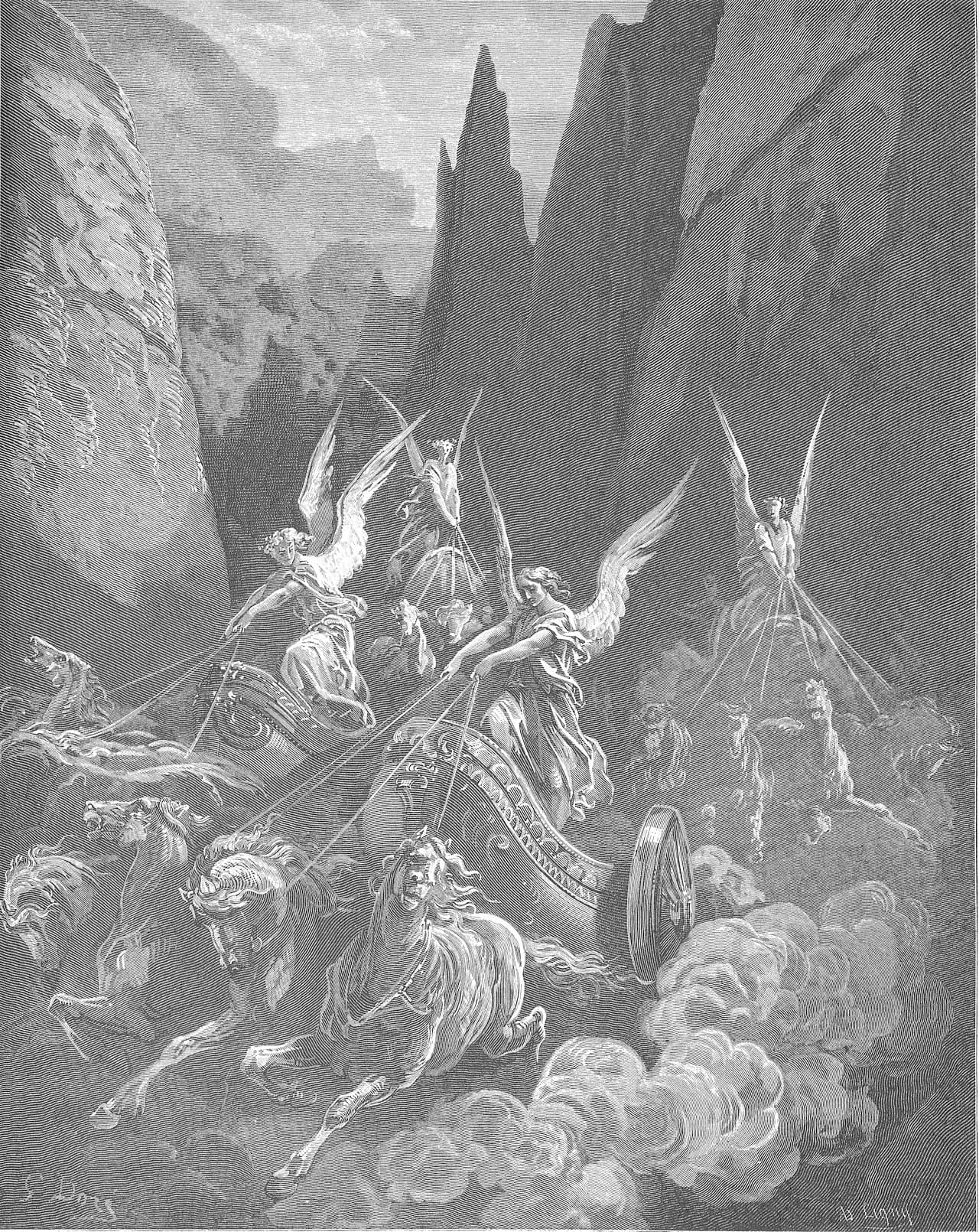
Zechariah's Vision of Four Chariots, Gustave Doré, 1866. Public domain.
Old Testament · Book 38 of 66
Zechariah
Zechariah records eight night visions given to the prophet while the returned exiles rebuilt the temple. Its later chapters tell of Zion's king riding on a donkey and of the one whom they have pierced.
Zechariah records eight night visions given to the prophet while the returned exiles rebuilt the temple. Its later chapters tell of Zion's king riding on a donkey and of the one whom they have pierced.
What is Zechariah about?
Zechariah is the book of a prophet of the priestly house of Iddo, sent in the reign of Darius to the exiles who had come home from Babylon to rebuild the temple. It opens with a call to return to the LORD and eight visions seen in one night, with the high priest made clean and a lampstand at their centre. The word to the governor is “Not by might nor by power, but by My Spirit” (4:6). Men from Bethel then ask about a fast, and the LORD turns the fasts to feasts. Two burdens close the book with a humble king, a rejected shepherd, a pierced one mourned and the LORD king over all the earth.
All 14 chapters
Every chapter of the book, in one grid. Each cell opens that chapter.
- The eight night visionsChapters 1 to 6
- The question of the fastsChapters 7 to 8
- The two burdensChapters 9 to 14
The colour is the movement of the book the chapter stands in, and every cell opens that chapter's Study level.
Who wrote it, where, when, for whom, and why?
The book opens with the word of the LORD coming to the prophet Zechariah son of Berechiah, the son of Iddo (1:1). Ezra names Haggai and Zechariah son of Iddo as the prophets who spoke to the Jews in Judah and Jerusalem (Ezra 5:1), and says the elders built and prospered through their prophesying (Ezra 6:14). Nehemiah lists a Zechariah as head of the priestly house of Iddo (Nehemiah 12:16). Matthew gives the words about the thirty pieces of silver as spoken through Jeremiah the prophet, and John quotes 12:10 as another Scripture (John 19:37).
Later, the prophets Haggai and Zechariah son of Iddo prophesied to the Jews in Judah and Jerusalem in the name of the God of Israel, who was over them.
Ezra 5:1, Berean Standard Bible.
Zechariah speaks in Jerusalem to those who have come back from Babylon while the temple is being rebuilt (4:9, 8:9). He calls to the exiles still living with the Daughter of Babylon to escape from the land of the north (2:6 and 7). The men who ask about the fast come from Bethel (7:2), and the first burden looks out to Hadrach, Damascus, Hamath, Tyre, Sidon and the cities of the Philistines (9:1 to 7).
The first word is dated to the eighth month of the second year of Darius (1:1), the visions to the twenty-fourth day of the eleventh month of that year (1:7), and the question of the fast to the fourth day of the ninth month of his fourth year (7:1). Haggai's first word came two months before Zechariah's (Haggai 1:1), and the temple was completed in the sixth year of Darius (Ezra 6:15). Chapters 9 to 14 carry no date.
Zechariah speaks to all the people of the land and the priests (7:5), to Joshua the high priest and to Zerubbabel the governor by name (3:8, 4:6), and to the exiles still in Babylon (2:7). The first burden calls to the Daughter of Zion (9:9), and the second concerns Israel (12:1).
The book gives its reason in the LORD's words. He calls the people to return to him so that he will return to them (1:3), promises that Zerubbabel will finish the house (4:9), asks for justice and compassion where they had kept fasts (7:5 to 10), and promises a king coming to Zion (9:9) and a day when he is king over all the earth (14:9).
The exiles have come back to a ruined city under the Persian king Darius. The book names seventy years of the LORD's anger on Jerusalem (1:12), a foundation laid in a day of small things that some despise (4:9 and 10), and a governor and a high priest over the returned people (3:1, 4:6). It names the horns that scattered Judah, Israel and Jerusalem (1:19), Babylon still holding exiles (2:7), and the sons of Greece (9:13).
Sources. Zechariah 1:1, 1:3, 1:7, 1:12, 1:19, 2:6 and 7, 3:1, 3:8, 4:6, 4:9 and 10, 7:1, 7:2, 7:5 to 10, 8:9, 9:1 to 7, 9:9, 9:13, 12:1, 12:10 and 14:9; Ezra 5:1, 6:14 and 6:15; Nehemiah 12:16; Haggai 1:1; Matthew 27:9; John 19:37. Every verse is read in the Berean Standard Bible.
How is Zechariah arranged, and what is it for?
The three movements the book falls into, then what it teaches and what it was written to do.
- The eight night visionsChapters 1 to 6, 84 verses, the turn at 4:6
A call to return, then eight visions in one night around a cleansed priest and a lampstand, and a crown for Joshua.
- The question of the fastsChapters 7 to 8, 37 verses, the turn at 8:19
Men from Bethel ask about a fast, and the LORD answers with justice, his return to Zion and the fasts made feasts.
- The two burdensChapters 9 to 14, 90 verses, the turn at 9:9
Two undated oracles: the humble king, the rejected shepherd, the pierced one mourned and the LORD king over all the earth.
The theme
The LORD of Hosts returns to a people who return to him. He is jealous for Jerusalem, and in the visions he cleanses its priest, throws down its enemies, carries its wickedness away and promises that its temple will be finished by his Spirit. He asks for justice and mercy where the people had kept fasts, and turns their mourning into feasts. Beyond the rebuilt house the book looks to a king who comes humble, a shepherd rejected for thirty pieces of silver, a pierced one mourned, and the day the LORD is king over all the earth.
The purpose
Zechariah was sent with Haggai to stir the returned exiles to finish the house of the LORD, and the house was finished in the sixth year of Darius. The book sets down his call, his visions and his answer to the question from Bethel, so that the people knew the work was the LORD's. Its two burdens carry the promise past the building to the king and the day to come, and leave Judah looking for the LORD to come and dwell among them.
Eight visions in one night, answering across a ring
The visions (8)
- 1The rider among the myrtles1:7 to 17, 11 verses, Pair AThe LORD's riders report the earth at rest, and he will return to Jerusalem with mercy. “a man riding on a red horse” (1:8)
- 2Four horns and four craftsmen1:18 to 21, 4 verses, Pair BThe powers that scattered Judah are thrown down. “the craftsmen have come to terrify them” (1:21)
- 3The measuring line2:1 to 13, 13 verses, Pair CJerusalem will spread past any wall, with the LORD as its wall. “I will be a wall of fire around it” (2:5)
- 4Joshua made clean3:1 to 10, 10 verses, The centreThe high priest is cleansed and the Branch is promised. “I am going to bring My servant, the Branch” (3:8)
- 5The lampstand and two olive trees4:1 to 14, 14 verses, The centreThe governor will finish the house by the LORD's Spirit. “by My Spirit, says the LORD of Hosts” (4:6)
- 6The flying scroll5:1 to 4, 4 verses, Pair CThe curse goes through the land against the thief and the perjurer. “This is the curse that is going out over the face of all the land” (5:3)
- 7The woman in the basket5:5 to 11, 7 verses, Pair BWickedness is carried out of the land to Shinar. “To build a house for it in the land of Shinar” (5:11)
- 8The four chariots6:1 to 8, 8 verses, Pair AThe four spirits of heaven go out over the whole earth. “These are the four spirits of heaven” (6:5)
- Pair A, visions 1 and 8
- Horses sent over the whole earth, first to report and last to go out as chariots.
- Pair B, visions 2 and 7
- What stood against Judah removed: the horns thrown down, wickedness carried away.
- Pair C, visions 3 and 6
- The city and the land: Jerusalem measured and filled, the land cleansed by the scroll.
- The centre, visions 4 and 5
- The priest and the governor: the Branch promised, and the house finished by the Spirit.
The eight night visions, Zechariah 1 to 6
What the text says in these 84 verses, and the pages they open on.
The word comes in the eighth month of the second year of Darius with a call to return to the LORD, who will return to his people (1:3). Three months later Zechariah sees eight visions in one night (1:7). A rider among the myrtle trees reports the earth at rest, and the LORD says he will return to Jerusalem with mercy (1:8 to 17). Four craftsmen come to throw down the four horns that scattered Judah (1:18 to 21). A man goes to measure Jerusalem and is told the city will have no walls, because the LORD will be a wall of fire around it (2:1 to 5). Joshua the high priest stands accused by Satan, his filthy garments are taken off, and the LORD promises his servant the Branch (3:1 to 10). A gold lampstand stands between two olive trees, and Zerubbabel is told he will finish the temple (4:1 to 14). A flying scroll carries the curse through the land, and a woman called wickedness is shut in a basket and carried to Shinar (5:1 to 11). Four chariots go out from between two bronze mountains (6:1 to 8). Then a crown is set on Joshua, and the man named the Branch will build the temple of the LORD (6:9 to 15).
So he said to me, “This is the word of the LORD to Zerubbabel: Not by might nor by power, but by My Spirit, says the LORD of Hosts.
- Study
Zechariah 1the call to return, the rider among the myrtles, the horns and the craftsmenShow the summary and 3 pagesShow summary, 3 pagesHide the summary
The book opens with a summons before it opens with visions: 'Return to Me, declares the LORD of Hosts, and I will return to you'. Your fathers, where are they? and the prophets, do they live for ever?, but the word outlived them and overtook them. Then the night visions begin. A man rides a red horse among the myrtle-trees, with horses behind him that have patrolled the earth and report that all the world sits still and is at rest, quiet for the empires, unbearable for Zion. The angel asks: 'How long, O LORD of Hosts, will You withhold mercy from Jerusalem'? and the answer is comfortable words: 'I am very jealous for Jerusalem and Zion'. Then four horns, and four smiths to cast them down.
On this chapter (3)
- The Exile and Return
The seventy years and the return from Babylon.
- What did the visions mean for the temple building of the second to sixth years of Darius?
Answered under Where do readers disagree, lower on this page, with each reading and who holds it.
- Zechariah 1:3
The verse on its own page, with the commentators on it by era.
- The Exile and Return
- Study
Zechariah 2the measuring line, the wall of fire, and the nations joined to the LORDShow the summary and 1 pageShow summary, 1 pageHide the summary
A man goes out with a measuring line to size up Jerusalem, and is stopped: the city will be inhabited as villages without walls, for the multitude of men and cattle in it. The reason is better than masonry: 'I will be a wall of fire around it … and I will be the glory within it' (2:5). Then the call to the exiles still in Babylon: 'Flee from the land of the north … Escape, you who dwell with the Daughter of Babylon!' for 'whoever touches you touches the apple of His eye'. The chapter ends singing: 'I am coming to dwell among you,' with many nations joined to Jehovah in that day.
On this chapter (1)
- Zechariah 2:5
The verse on its own page, with the commentators on it by era.
- Zechariah 2:5
- Study
Zechariah 3Joshua cleansed, Satan rebuked, the Branch and the stone promisedShow the summary and 3 pagesShow summary, 3 pagesHide the summary
A courtroom vision. Joshua the high priest stands before the angel of Jehovah 'with Satan standing at his right hand to accuse him'. And the defense is not argument but rebuke: 'The LORD rebukes you, Satan! … Is not this man a firebrand snatched from the fire?' (Jude 9 echoes the formula.) Joshua stands there in filthy garments, and the order goes out to strip them off: 'I have removed your iniquity, and I will clothe you with splendid robes.' The prophet dares to ask for a clean mitre, and gets it. Then 'My servant, the Branch', a stone with seven eyes, and atonement in a clause: 'I will remove the iniquity of this land in a single day.'
On this chapter (3)
- The Branch and the King
The Branch of Zechariah 3 and 6 and the king who comes to Zion.
- What are the seven eyes of 3:9 and 4:10?
Answered under Where do readers disagree, lower on this page, with each reading and who holds it.
- Zechariah 3:8
The verse on its own page, with the commentators on it by era.
- The Branch and the King
- Study
Zechariah 4the lampstand, the two olive trees, and the word to ZerubbabelShow the summary and 3 pagesShow summary, 3 pagesHide the summary
A golden lampstand with a bowl above it, seven lamps, seven pipes, and two olive-trees beside it feeding it oil without human hands. Zechariah asks what it means, and the answer is given for a governor rebuilding a temple with too few men and too little money: 'Not by might nor by power, but by My Spirit, says the LORD of Hosts' (4:6). The obstacle is addressed directly ('What are you, O great mountain? Before Zerubbabel you will become a plain') and the finish is guaranteed: the hands that laid the foundation shall also finish it. 'For who has despised the day of small things?' The two olive-trees are the anointed ones who stand by the Lord of the whole earth.
On this chapter (3)
- The Lampstand
The gold lampstand from the tabernacle to Zechariah and Revelation.
- The Spirit in the Old Testament
The Spirit of the LORD from creation to the prophets.
- Zechariah 4:6
The verse on its own page, with the commentators on it by era.
- The Lampstand
- Study
Zechariah 5the flying scroll, and the woman in the basket carried to ShinarShow the summary and 1 pageShow summary, 1 pageHide the summary
Two visions of sin removed rather than merely forgiven. A flying roll twenty cubits by ten sails over the land ('this is the curse that goeth forth over the face of the whole land') entering the house of the thief and of the man who swears falsely by God's name, consuming it, timber and stones. Then a measuring basket comes out with a lead cover, and inside sits a woman: 'This is Wickedness.' She is shoved down and the lead weight slammed on the mouth of it. Two winged women lift the basket between earth and heaven, and Zechariah asks where: 'To build her a house in the land of Shinar': evil deported to Babylon's plain, where Revelation 17 finds it again.
On this chapter (1)
- Zechariah 5:3
The verse on its own page, with the commentators on it by era.
- Zechariah 5:3
- Study
Zechariah 6the four chariots, and the crown set on Joshua's headShow the summary and 3 pagesShow summary, 3 pagesHide the summary
Four chariots come out from between two mountains of brass with red, black, white, and grisled horses ('these are the four winds of heaven, which go forth from standing before the Lord of all the earth') and those that go north 'have quieted my spirit in the north country.' Then the visions stop and the prophet acts: take the silver and gold brought by the exiles, make a crown, and set it on the head of Joshua the high priest, a crown on a priest, which the law never allowed. 'Here is a man whose name is the Branch … He will build the temple of the LORD … He will be a priest on His throne' (6:12-13). King and priest in one person.
On this chapter (3)
- The Branch and the King
The Branch of Zechariah 3 and 6 and the king who comes to Zion.
- Melchizedek
The priest who is also king.
- Zechariah 6:12
The verse on its own page, with the commentators on it by era.
- The Branch and the King
The eight visions are drawn as a ring with the priest and the lampstand at its centre, under The book as a whole.
Characters (6)
Who the text names. A name with a page carries its door.
- Zechariah son of Berechiah
The prophet, grandson of Iddo, who sees the visions (1:1).
- Zerubbabel
The governor whose hands laid the foundation and will finish the house (4:9).
- Joshua the high priest
Cleansed of his filthy garments and crowned as a sign (3:4, 6:11).
- Darius
The Persian king by whose years the book is dated (1:1).
Show the next 2
- The angel of the LORD
Stands among the myrtles and pleads for Jerusalem (1:11 and 12).
- Satan the accuser
Stands at Joshua's right hand and is rebuked by the LORD (3:1 and 2).
Places (4)
Where the chapters stand.
Themes (4)
What these chapters raise, each on its own page where one stands.
- The return to the LORD
Return to Me, and I will return to you (1:3).
- The Branch
The servant promised to Joshua, who will build the temple (3:8, 6:12).
- Not by might but by My Spirit
The word to Zerubbabel at the lampstand (4:6).
- The lampstand
The gold lampstand fed by two olive trees (4:2 and 3).
Where the New Testament uses these chapters (3)each marked as a quotation or an allusion, with the evidence
- Probable allusionZechariah 3:2 at Jude 9. Michael, disputing with the devil over the body of Moses, answers him with the words the LORD speaks to Satan over Joshua. Jude names no prophet, and the rebuke stands in the same words in both places. Robert Jamieson, A. R. Fausset and David Brown, Commentary Critical and Explanatory on the Whole Bible, set the two side by side on Zechariah 3.
- Probable allusionZechariah 4:3 and 4:14 at Revelation 11:4. The two witnesses are the two olive trees and the two lampstands that stand before the Lord of the earth. John names no prophet, and the olive trees standing before the Lord of all the earth are Zechariah's. The store holds this pair as an allusion.
- Later Christian readingZechariah 6:12 at Luke 1:78. The Greek of Zechariah names the Branch with the word for the rising of the sun, and Luke uses that word for the Dawn that will visit from on high. Held by Basil of Caesarea, Homilies on the Psalms, who reads Behold a man, the Orient is his name, of Christ. Zechariah's line stands in the Greek Old Testament, and Luke's verse names no prophet.
The question of the fasts, Zechariah 7 to 8
What the text says in these 37 verses, and the pages they open on.
In the fourth year of Darius the people of Bethel send men to ask the priests and the prophets whether they should still weep and fast in the fifth month (7:1 to 3). The LORD asks in return whether the fasts of those seventy years were kept for him (7:5). He repeats what the earlier prophets called for: true justice, loving devotion and compassion, and no oppression of the widow, the fatherless, the foreigner or the poor (7:9 and 10). The fathers refused to listen, and the land was left desolate (7:11 to 14). Chapter 8 answers in a run of sayings, each opening This is what the LORD of Hosts says. He will return to Zion, and old men and women will sit in Jerusalem's streets while boys and girls play there (8:3 to 5). The people are to speak truth and judge soundly in their gates (8:16). The four fasts will become cheerful feasts (8:19), and ten men of the nations will take hold of the robe of a Jew to go up with him (8:23).
“This is what the LORD of Hosts says: The fasts of the fourth, the fifth, the seventh, and the tenth months will become times of joy and gladness, cheerful feasts for the house of Judah. Therefore you are to love both truth and peace.”
- Study
Zechariah 7the question from Bethel, and the justice the LORD asks forShow the summary and 2 pagesShow summary, 2 pagesHide the summary
Two years later a delegation arrives from Beth-el with a practical question: should we keep the fast for the temple's destruction now that the temple is being rebuilt? God answers a deeper question than the one asked. 'When you fasted and mourned in the fifth and seventh months for these seventy years, was it really for Me that you fasted?' Their fasting and their feasting alike were for themselves. The former prophets said it when Jerusalem was still prosperous: 'Show loving devotion and compassion to one another. Do not oppress the widow or the fatherless, the foreigner or the poor.' They stopped their ears and made their hearts as an adamant stone. So the whirlwind scattered them.
On this chapter (2)
- Fasting
What Scripture says of the fast the LORD asks for.
- Zechariah 7:9
The verse on its own page, with the commentators on it by era.
- Fasting
- Study
Zechariah 8the LORD's return to Zion, the fasts made feasts, the ten menShow the summary and 1 pageShow summary, 1 pageHide the summary
Ten oracles, each headed 'This is what the LORD of Hosts says:' and the sunniest chapter in the book. 'I will return to Zion and dwell in Jerusalem. Then Jerusalem will be called the City of Truth'. The picture of that peace is deliberately ordinary: old men and old women in the streets, each with a staff for very age, 'the streets of the city will be filled with boys and girls playing there' (8:5). He gathers them from east and west; the fasts become cheerful feasts. 'Speak truth to one another' (8:16; Paul quotes it, Ephesians 4:25). And ten men from all languages take hold of a Jew's skirt: 'Let us go with you'.
On this chapter (1)
- Zechariah 8:19
The verse on its own page, with the commentators on it by era.
- Zechariah 8:19
What the LORD asks, before the exile and after it
“This is what the LORD of Hosts says: ‘Administer true justice. Show loving devotion and compassion to one another. Do not oppress the widow or the fatherless, the foreigner or the poor. And do not plot evil in your hearts against one another.’
These are the things you must do: Speak truth to one another, render true and sound judgments in your gates, do not plot evil in your hearts against your neighbor, and do not love to swear falsely, for I hate all these things,” declares the LORD.
Characters (3)
Who the text names. A name with a page carries its door.
- The men of Bethel
Sharezer and Regem-melech, sent to ask about the fast (7:2 and 3).
- The earlier prophets
Whose words the fathers refused to hear (7:7 and 12).
- Ten men of the nations
Who take hold of a Jew's robe to go with him (8:23).
Places (3)
Where the chapters stand.
Themes (3)
What these chapters raise, each on its own page where one stands.
- The fasts turned to feasts
The fasts of four months made times of joy (8:19).
- Justice and mercy
True justice, loving devotion and compassion (7:9).
- The nations seeking the LORD
Many peoples come to Jerusalem to seek him (8:22).
Where the New Testament uses these chapters (1)each marked as a quotation or an allusion, with the evidence
- Probable allusionZechariah 8:16 at Ephesians 4:25. Paul tells the church to speak truthfully each to his neighbour, the charge of 8:16. The Greek words of Paul's charge stand in the Greek of 8:16, and Paul names no prophet.
The two burdens, Zechariah 9 to 14
What the text says in these 90 verses, and the pages they open on.
Chapters 9 to 14 carry no date and stand under two headings, each called the burden of the word of the LORD (9:1 and 12:1). The first burden falls on Hadrach, Damascus, Tyre and Philistia, then tells the Daughter of Zion to rejoice, because her king comes righteous and humble, riding on a donkey (9:9). The LORD attends to his flock and will gather his scattered people (10:3 to 12). In chapter 11 the prophet shepherds the flock marked for slaughter, breaks his two staffs Favor and Union, and is paid thirty pieces of silver, which he throws to the potter (11:4 to 14). The second burden gathers the nations against Jerusalem, and the LORD pours out a spirit of grace, so that the people look on the one they have pierced and mourn (12:10). A fountain is opened to cleanse from sin (13:1), and the shepherd is struck and the sheep are scattered (13:7). On that day the LORD's feet stand on the Mount of Olives, living water flows out from Jerusalem, and the LORD is king over all the earth (14:4 to 9). The book ends with HOLY TO THE LORD on the bells of the horses (14:20).
Rejoice greatly, O Daughter of Zion! Shout in triumph, O Daughter of Jerusalem! See, your King comes to you, righteous and victorious, humble and riding on a donkey, on a colt, the foal of a donkey.
- Study
Zechariah 9the burden on the nations, and the king on a donkeyShow the summary and 3 pagesShow summary, 3 pagesHide the summary
The word marches down through Hadrach, Damascus, Hamath, Tyre (who heaped up silver as the dust and will be devoured with fire) and the Philistine cities, until God encamps about his own house 'for now I keep watch with My own eyes.' Then the coronation verse: 'Rejoice greatly, O Daughter of Zion! … See, your King comes to you, righteous and victorious, humble and riding on a donkey, on a colt, the foal of a donkey' (9:9), quoted at the triumphal entry in Matthew 21 and John 12. He cuts off chariot and battle bow and speaks peace to the nations, his dominion from sea to sea. 'Return to your stronghold, O prisoners of hope'.
On this chapter (3)
- The Branch and the King
The Branch of Zechariah 3 and 6 and the king who comes to Zion.
- Are chapters 9 to 14 by the Zechariah of chapters 1 to 8, and what are the two burdens?
Answered under Where do readers disagree, lower on this page, with each reading and who holds it.
- Zechariah 9:9
The verse on its own page, with the commentators on it by era.
- The Branch and the King
- Study
Zechariah 10the LORD's care for his flock, and the scattered gatheredShow the summary and 2 pagesShow summary, 2 pagesHide the summary
'Ask the LORD for rain in springtime', go to the God who makes lightnings, not to the teraphim that speak vanity and the diviners who tell false dreams. The flock wanders 'for lack of a shepherd', so God's anger burns against the shepherds and he visits his flock himself, making them his goodly horse in the battle. 'The cornerstone will come from Judah, the tent peg from him, as well as the battle bow', leadership rising out of Judah rather than imported. He will strengthen Judah and save Joseph and bring them back 'as though I had not rejected them', whistling for them and gathering them out of Egypt and Assyria until no room is left.
On this chapter (2)
- The Good Shepherd
The shepherd of Israel and the shepherd who gives his life.
- Zechariah 10:3
The verse on its own page, with the commentators on it by era.
- The Good Shepherd
- Study
Zechariah 11the two staffs broken, and the thirty pieces of silverShow the summary and 2 pagesShow summary, 2 pagesHide the summary
The dark chapter, between two chapters of glory. Fire devours Lebanon's cedars, shepherds wail, young lions roar over the ruined pride of the Jordan. Then Zechariah is made to act it out: 'Feed the flock of slaughter; whose possessors slay them, and hold themselves not guilty,' while traders say, Blessed be Jehovah, for I am rich. He takes two staves, Beauty and Bands, and breaks Beauty, annulling the covenant. Then he asks his wage and they weigh out thirty pieces of silver ('the goodly price that I was prized at by them') cast to the potter in the house of Jehovah, which Matthew 27 sees fulfilled in Judas's blood money and the potter's field.
On this chapter (2)
- Why does Matthew 27:9 name Jeremiah for the thirty pieces of silver?
Answered under Where do readers disagree, lower on this page, with each reading and who holds it.
- Zechariah 11:12
The verse on its own page, with the commentators on it by era.
- Why does Matthew 27:9 name Jeremiah for the thirty pieces of silver?
- Study
Zechariah 12Jerusalem defended, and the pierced one mournedShow the summary and 3 pagesShow summary, 3 pagesHide the summary
'This is the burden of the word of the LORD concerning Israel', spoken by the God who stretches out the heavens and 'forms the spirit of man within him'. Jerusalem becomes a cup of reeling to the peoples round about and 'a heavy stone for all the peoples; all who would heave it away will be severely injured', with all the nations of the earth gathered against it, a siege still ahead of history. God strikes the horses with terror and their riders with madness, saving the tents of Judah first so no house may boast. Then the mourning: 'they will look on Me, the One they have pierced' (12:10), grieving as for an only son, the verse John 19 and Revelation 1 both quote of Christ.
On this chapter (3)
- The Passion in John
The cross as John tells it, with the Scripture he reads there.
- Who is the pierced one of 12:10, and what do the Hebrew and the Greek read there?
Answered under Where do readers disagree, lower on this page, with each reading and who holds it.
- Zechariah 12:10
The verse on its own page, with the commentators on it by era.
- The Passion in John
- Study
Zechariah 13the fountain opened, and the shepherd struckShow the summary and 2 pagesShow summary, 2 pagesHide the summary
'In that day there shall be a fountain opened to the house of David and to the inhabitants of Jerusalem, for sin and for uncleanness': the cleansing that answers chapter 12's mourning. Idols' names are cut off and the unclean spirit removed; false prophets are so discredited they hide the hairy mantle and claim to be farmers. Then the sword falls on the true one: 'Awake, O sword, against my shepherd, and against the man that is my fellow… smite the shepherd, and the sheep shall be scattered': quoted by Jesus on the way to Gethsemane. Two parts of the land perish; the third is refined as silver: 'I will say, ‘They are My people,’ and they will say, ‘The LORD is our God.’' (13:9).
On this chapter (2)
- The Remnant
The third brought through the fire, and the few God keeps.
- Zechariah 13:7
The verse on its own page, with the commentators on it by era.
- The Remnant
- Study
Zechariah 14the LORD on the Mount of Olives, king over all the earthShow the summary and 4 pagesShow summary, 4 pagesHide the summary
The last chapter of the prophets' end-time map. Nations gather against Jerusalem, the city is taken and half go into captivity: 'Then the LORD will go out to fight against those nations'. 'On that day His feet will stand on the Mount of Olives,' which splits east and west into a very great valley for the people to flee through, 'Then the LORD my God will come, and all the holy ones with Him.' Neither day nor night, but at evening time there shall be light; living waters flowing east and west; 'the LORD will become King over all the earth … the LORD alone, and His name alone' (14:9). Even the bells of the horses will read HOLY TO JEHOVAH.
On this chapter (4)
- The Millennial Kingdom
The reign of the LORD on the earth the prophets foretold.
- The Day of the LORD
The day the prophets foretold, and what they said of it.
- Is Zechariah 14 a picture of the end or of the church's age, and how have the schools read it?
Answered under Where do readers disagree, lower on this page, with each reading and who holds it.
- Zechariah 14:9
The verse on its own page, with the commentators on it by era.
- The Millennial Kingdom
The burdens where the New Testament takes them up
| Zechariah | Where the New Testament takes it up |
|---|---|
Rejoice greatly, O Daughter of Zion! Shout in triumph, O Daughter of Jerusalem! See, your King comes to you, righteous and victorious, humble and riding on a donkey, on a colt, the foal of a donkey.Zechariah 9:9 |
|
Then I told them, “If it seems right to you, give me my wages; but if not, keep them.” So they weighed out my wages, thirty pieces of silver. And the LORD said to me, “Throw it to the potter”—this magnificent price at which they valued me. So I took the thirty pieces of silver and threw them to the potter in the house of the LORD.Zechariah 11:12–13 |
|
Then I will pour out on the house of David and on the people of Jerusalem a spirit of grace and prayer, and they will look on Me, the One they have pierced. They will mourn for Him as one mourns for an only child, and grieve bitterly for Him as one grieves for a firstborn son.Zechariah 12:10 |
|
Awake, O sword, against My Shepherd, against the man who is My Companion, declares the LORD of Hosts. Strike the Shepherd, and the sheep will be scattered, and I will turn My hand against the little ones.Zechariah 13:7 |
|
Characters (4)
Who the text names. A name with a page carries its door.
- The king on the donkey
Righteous and humble, bringing peace to the nations (9:9 and 10).
- The worthless shepherd
Who deserts the flock, under the LORD's woe (11:17).
- The shepherd struck
The LORD's own companion, whose sheep are scattered (13:7).
- The pierced one
Mourned by the house of David as an only child (12:10).
Places (6)
Where the chapters stand.
- Hadrach and Damascus
The first places the burden falls on (9:1).
- Tyre and Sidon
Shrewd, with silver heaped up like dust (9:2 and 3).
- Philistia
Ashkelon, Gaza, Ekron and Ashdod, their pride cut off (9:5 and 6).
- Greece
Whose sons Zion is roused against (9:13).
Show the next 2
- Egypt
Where the scattered are brought back from, and which must go up to the feast (10:10, 14:18).
- The Mount of Olives
Split in two under the LORD's feet (14:4).
Themes (4)
What these chapters raise, each on its own page where one stands.
- The humble king
The king who comes to Zion on a colt (9:9).
- The pierced one
The one they look on and mourn (12:10).
- The day of the LORD
The day the LORD fights for Jerusalem (14:1 to 3).
- The LORD king over all the earth
The LORD alone, and his name alone (14:9).
Where the New Testament uses these chapters (7)each marked as a quotation or an allusion, with the evidence
- Explicit quotationZechariah 9:9 at Matthew 21:5. Matthew reads these words of Zechariah in the Passion. Introduced as what was spoken through the prophet (21:4).
- Explicit quotationZechariah 9:9 at John 12:15. John reads these words of Zechariah in the Passion. Introduced as it is written (12:14).
- Explicit quotationZechariah 11:12 to 13 at Matthew 27:9 to 10. Matthew reads these words of Zechariah in the Passion. Introduced as spoken through Jeremiah the prophet (27:9).
- Explicit quotationZechariah 12:10 at John 19:37. John reads these words of Zechariah in the Passion. Introduced as another Scripture (19:37).
- Probable allusionZechariah 12:10 at Revelation 1:7. Revelation reads these words of Zechariah in the Passion. No formula: those who pierced him and the tribes that mourn.
- Explicit quotationZechariah 13:7 at Matthew 26:31. Matthew reads these words of Zechariah in the Passion. Jesus says, for it is written (26:31).
- Explicit quotationZechariah 13:7 at Mark 14:27. Mark reads these words of Zechariah in the Passion. Jesus says, for it is written (14:27).
- Author
- Zechariah son of Berechiah, son of Iddo (1:1), priest and prophet of the return
- Date
- Began 520 BC, contemporary with Haggai; later oracles (ch. 9–14) may date to the later 5th c. BC
- Audience
- The post-exilic community and all who look for Zion's king
Where do readers disagree?
One list: the readings with their holders, and what the evidence does not settle.
Are chapters 9 to 14 by the Zechariah of chapters 1 to 8, and what are the two burdens?
- One prophet wrote the whole book. Held by Joyce Baldwin, Haggai, Zechariah, Malachi (1972), and by Merrill F. Unger, Zechariah: Prophet of Messiah's Glory (1963).
- Chapters 9 to 11 are older than the exile. Held by Adam Clarke, Commentary on the Bible (1832), on 9:1, who says the chapters seem to suit the age and manner of Hosea.
- Later hands after Zechariah. Held by Bernhard Stade, Deuterosacharja, in the Zeitschrift für die alttestamentliche Wissenschaft (1881).
What the evidence does not settle: The book gives chapters 9 to 14 no date and no name, so their setting is read from their content. The two burdens open with the same heading (9:1 and 12:1), and Malachi opens with it too (Malachi 1:1).
The argument in full
One prophet wrote the whole book. Both halves share the title LORD of Hosts, the call to look to the LORD and the nations first judged and then gathered, and the change of manner follows a change of subject, from a building in the reign of Darius to the far horizon.
Chapters 9 to 11 are older than the exile. The chapters name Ephraim beside Judah and Assyria beside Egypt (9:13, 10:10), and Matthew gives words of chapter 11 as Jeremiah's.
Later hands after Zechariah. After chapter 8 no date, no Zerubbabel and no temple appears, the interpreting angel is gone, and the sons of Greece at 9:13 are read as the Greek age after Alexander.
The first burden, chapters 9 to 11, falls on the nations around Israel and brings the king to Zion; it ends with the shepherd rejected and the two staffs broken. The second, chapters 12 to 14, concerns Israel: the nations gather against Jerusalem, the people mourn the pierced one, and the LORD comes and reigns. Both carry the word burden, a thing lifted up and carried, as their heading.
Why does Matthew 27:9 name Jeremiah for the thirty pieces of silver?
- Matthew joins Zechariah to the Jeremiah he builds on. Held by Robert Jamieson, A. R. Fausset and David Brown, Commentary Critical and Explanatory on the Whole Bible (1871), on 11:13, who call Jeremiah the original author from whom Zechariah derived the groundwork of the prophecy.
- The copies differ at the name. Held by Adam Clarke, Commentary on the Bible, on 11:13, who refers to his note on that verse of Matthew examining the reading Zechariah the prophet in place of Jeremiah.
- Jeremiah stood first in the scroll of the prophets. Held by John Lightfoot, Horae Hebraicae et Talmudicae (1658), on the verse in Matthew, who cites the order of the prophets in the Babylonian Talmud, Bava Batra 14b.
What the evidence does not settle: Which words Matthew means to join, since his quotation matches neither Zechariah 11:13 nor any verse of Jeremiah word for word.
The argument in full
Matthew joins Zechariah to the Jeremiah he builds on. Matthew's words speak of a field bought for the silver, and Jeremiah goes down to the potter's house and buys a field (Jeremiah 18:2, 32:9), where Zechariah has no field.
The copies differ at the name. Some early copies and versions of Matthew read Zechariah or name no prophet, so the name is read as a copyist's change.
Jeremiah stood first in the scroll of the prophets. A saying could be cited by the name of the first book of its scroll, as Jesus calls the Writings the Psalms (Luke 24:44).
Who is the pierced one of 12:10, and what do the Hebrew and the Greek read there?
The Passion in John→- The LORD himself, pierced in the Messiah. Held by Charles Spurgeon, Mourning for Christ, Metropolitan Tabernacle Pulpit (1877), who reads the move from Me to Him as one Person speaking of himself.
- The Greek reads insulted. Held by Jerome, in his Commentary on Zechariah, on 12:10, who notes that the Septuagint reads because they have insulted me.
- A Messiah son of Joseph slain. Held by Rabbi Dosa, in the Babylonian Talmud, tractate Sukkah 52a.
What the evidence does not settle: Whether the one looked on and the one mourned for are one person, since the verse moves from Me to Him in one sentence.
The argument in full
The LORD himself, pierced in the Messiah. The LORD is the speaker, and the Hebrew says they will look on Me, then mourn for Him. John reads the verse at the spear thrust (John 19:37).
The Greek reads insulted. The Hebrew letters daleth and resh differ by one small stroke, so the Greek translators read a word for dancing in scorn where the Hebrew has pierced. John and Revelation follow the Hebrew.
A Messiah son of Joseph slain. The great mourning of 12:10 to 12 is read as the mourning for the Messiah son of Joseph, who is slain in battle.
What are the seven eyes of 3:9 and 4:10?
- The perfect knowledge of Christ, the stone. Held by John Wesley, Explanatory Notes upon the Old Testament (1765), on 3:9, who reads the eyes as set to look many ways, an emblem of Christ's perfect knowledge and wisdom.
- The eyes of the LORD's providence. Held by Albert Barnes, Notes on the Old Testament, on 4:10.
- The seven eyes of the Lamb. Held by Bonaventure, Collations on the Hexaemeron, collation 1, who joins them to the seven eyes of the Lamb.
What the evidence does not settle: Whether the eyes are on the stone or look upon it, since the Hebrew of 3:9 allows both, and why a stone set before the priest carries the eyes the angel names as the LORD's.
The argument in full
The perfect knowledge of Christ, the stone. The stone set before Joshua follows the promise of the Branch (3:8), and the stone is read as Christ.
The eyes of the LORD's providence. The angel names the seven as the eyes of the LORD which scan the whole earth (4:10), so they watch over the work of Zerubbabel with joy.
The seven eyes of the Lamb. Revelation gives the Lamb seven eyes, which are the seven Spirits of God sent out into all the earth (Revelation 5:6).
Is Zechariah 14 a picture of the end or of the church's age, and how have the schools read it?
The Millennial Kingdom→- The LORD's coming and reign on the earth. Held by Robert Jamieson, A. R. Fausset and David Brown, Commentary Critical and Explanatory on the Whole Bible (1871), on 14:4, who look for him to come from the east.
- The church's age, told in figures. Held by John Wesley, Explanatory Notes upon the Old Testament (1765), on 14:8, who reads the living waters as the saving truths of the gospel and Jerusalem as the church of Christ.
- A history already past. Held by Ephrem the Syrian, in his Commentary on Zechariah, on 14:9, who reads the verse of the time of the Maccabees.
What the evidence does not settle: How far the chapter's places are to be read as places, since the book gives no date for that day, and 14:16 has the nations keep the Feast of Tabernacles year after year.
The argument in full
The LORD's coming and reign on the earth. The feet on the Mount of Olives answer the angels at the ascension, who say Jesus will come back in the same way from the mount near the city (Acts 1:11 and 12), and the LORD then reigns over the earth (14:9).
The church's age, told in figures. The living water and the one LORD over all the earth are read of the gospel going out from Jerusalem through the nations.
A history already past. The LORD king over all the land (14:9) is read of Judea turning to the one God after the idols Antiochus brought in were thrown out.
This site reads the chapter as the premillennial tradition reads it, of the LORD's return in person and his reign on the earth. The church-age reading has a cost the text makes plain: the feet on the mountain, the valley split from east to west and the yearly feast of the nations must each be taken as a figure. The chapter is read here in its own terms, and no reading on this page is applied to a nation or an event of the present day.
What did the visions mean for the temple building of the second to sixth years of Darius?
- Courage to finish the work begun. Held by Charles Spurgeon, Encouragement for the Depressed, Metropolitan Tabernacle Pulpit (1915), on 4:10.
- The governor and the priest set over the restored people. Held by Carol L. Meyers and Eric M. Meyers, Haggai, Zechariah 1 to 8, Anchor Bible (1987).
- A house that points past itself. Held by Adam Clarke, Commentary on the Bible, on 3:9, who says the foundation stone of the temple represented Christ Jesus.
What the evidence does not settle: How far the promises of 2:5, 3:8 and 6:12 to 13 reach past the house completed in the sixth year of Darius (Ezra 6:15), since the text gives no date for the Branch.
The argument in full
Courage to finish the work begun. The foundation looked small beside Solomon's house, and the visions told the builders the LORD's eyes rejoiced at the plumb line in Zerubbabel's hand (4:10).
The governor and the priest set over the restored people. The two olive trees are the two anointed ones who stand by the Lord of all the earth (4:14), and the visions back the rule of a governor and a high priest in Persian Judah.
A house that points past itself. The Branch who will build the temple of the LORD (6:12 and 13) is promised as someone still to come, while Zerubbabel was already building.
The Text and the Spade
- The Behistun Inscription of Darius Icarved c. 520 to 518 BC, on the cliff face at Bisitun in western Iran
The external anchor for the book's three dates. Darius's own trilingual record of his accession and the revolts of his first years fixes 'the second year of Darius' (1:7) and 'the fourth year of King Darius' (7:1) in ordinary chronology, and confirms that the empire had in fact settled by the time the watchers reported that 'all the earth is at rest and tranquil' (1:11).
- Yehud coins, jar-handle stamp impressions, and governors' sealslate 6th to 4th century BC
The material record of the small Persian province the book was written in, including silver coins struck with the province name and sealings from a Judean administrative archive published by Nahman Avigad (Bullae and Seals from a Post-Exilic Judean Archive, Qedem 4, 1976). They establish the offices the book takes for granted, a governor administering Yehud and a high priest over the temple, which are the two chairs Zerubbabel and Joshua occupy in chapters 3 and 4.
- The Elephantine papyri5th century BC, from the Jewish military colony on Elephantine island in Egypt
Aramaic letters and legal documents from a Judean community in Egypt, including a petition of 407 BC addressed to Bagohi the governor of Judah, which also names Johanan the high priest in Jerusalem and the sons of Sanballat in Samaria. Written about a century after Zechariah, they show the same two-office arrangement still running, and they are the clearest documentary evidence that the Jerusalem high priesthood Joshua held continued as a recognised authority under Persian rule.
- Megiddo and the valley named at 12:11excavated from 1903 onward; the site occupied from the fourth millennium BC into the Persian period
Zechariah compares a coming grief to 'the wailing of Hadad-rimmon in the plain of Megiddo' (12:11). The traditional identification, held in Jewish and Christian commentary alike, connects it with the national mourning for Josiah, who 'came to fight in the valley of Megiddo' and died of it, after which 'all Judah and Jerusalem mourned for Josiah' and lamentations were composed and kept (2 Chronicles 35:22 to 35:25). Megiddo's excavated gates, water system, and long sequence of destruction layers confirm the site as the pass where armies met and kings fell. The name Hadadrimmon is disputed: some read it as a place near Megiddo, others as the storm god Hadad joined to Rimmon and so as a reference to the loud mourning of a pagan rite. The traditional reading is given first here because the text sets the mourning in Judah's own memory, and the dispute over the name is named rather than settled.
The pages Zechariah opens on
Studies66
- The Branch and the King
- The Passion in John
- The Lampstand
- The Spirit in the Old Testament
- The Day of the LORD
- The Millennial Kingdom
Show the next 6 titles
Show the next 6 titles
- The Fulfillment Formula
- Melchizedek
- Malachi, the Study Guide
- Satan Across the Testaments
- The Crown
- The Dated Messages of Haggai and Zechariah
Show the next 6 titles
- The Entry into Jerusalem
- The Night Visions of Zechariah
- The One They Have Pierced
- The Scarlet Thread
- Revelation: the Canon's Closing Scroll
- Messianic Psalms
Show the next 6 titles
Show the next 6 titles
- Types of Christ: Joseph and Joshua
- Michael the archangel
- Satan
- The Names of Satan
- The Garment and the Robe
- The Stone
Show the next 6 titles
- The Second Temple
- Nimrod and the First Kingdoms
- Kindness
- The Widow, the Orphan & the Stranger
- The Tassels and the Blue Cord
- The Words Tiqvah and Elpis
Show the next 6 titles
- The Gentleness of Christ
- The Words Anav and Praus
- Parallelism: the Bible's Rhyme of Thoughts
- Precious Stones
- Shiloh and the Scepter: Genesis 49:10
- The King
Show the next 6 titles
Show the next 6 titles
People and groups5
Words6
Books beside it5
Sources for this page
The movements, the chapter entries, the figures and the Context are read off the text of Zechariah. The works behind the readings under Where do readers disagree are the Babylonian Talmud, tractate Sukkah; Jerome, Commentary on Zechariah (420); Ephrem the Syrian, Commentary on Zechariah (373); Basil of Caesarea, Homilies on the Psalms (379); Bonaventure, Collations on the Hexaemeron (1273); John Lightfoot, Horae Hebraicae et Talmudicae (1658); John Wesley, Explanatory Notes upon the Old Testament (1765); Adam Clarke, Commentary on the Bible (1832); Albert Barnes, Notes on the Old Testament, 1832 to 1869; Robert Jamieson, A. R. Fausset and David Brown, Commentary Critical and Explanatory on the Whole Bible (1871); Charles Spurgeon, Metropolitan Tabernacle Pulpit, sermons 1362 (1877) and 3489 (1915); Bernhard Stade, Deuterosacharja, Zeitschrift für die alttestamentliche Wissenschaft (1881); Merrill F. Unger, Zechariah: Prophet of Messiah's Glory (1963); Joyce Baldwin, Haggai, Zechariah, Malachi (1972); and Carol L. Meyers and Eric M. Meyers, Haggai, Zechariah 1 to 8 (1987). Every verse quoted on this page is the Berean Standard Bible, read from the store.