
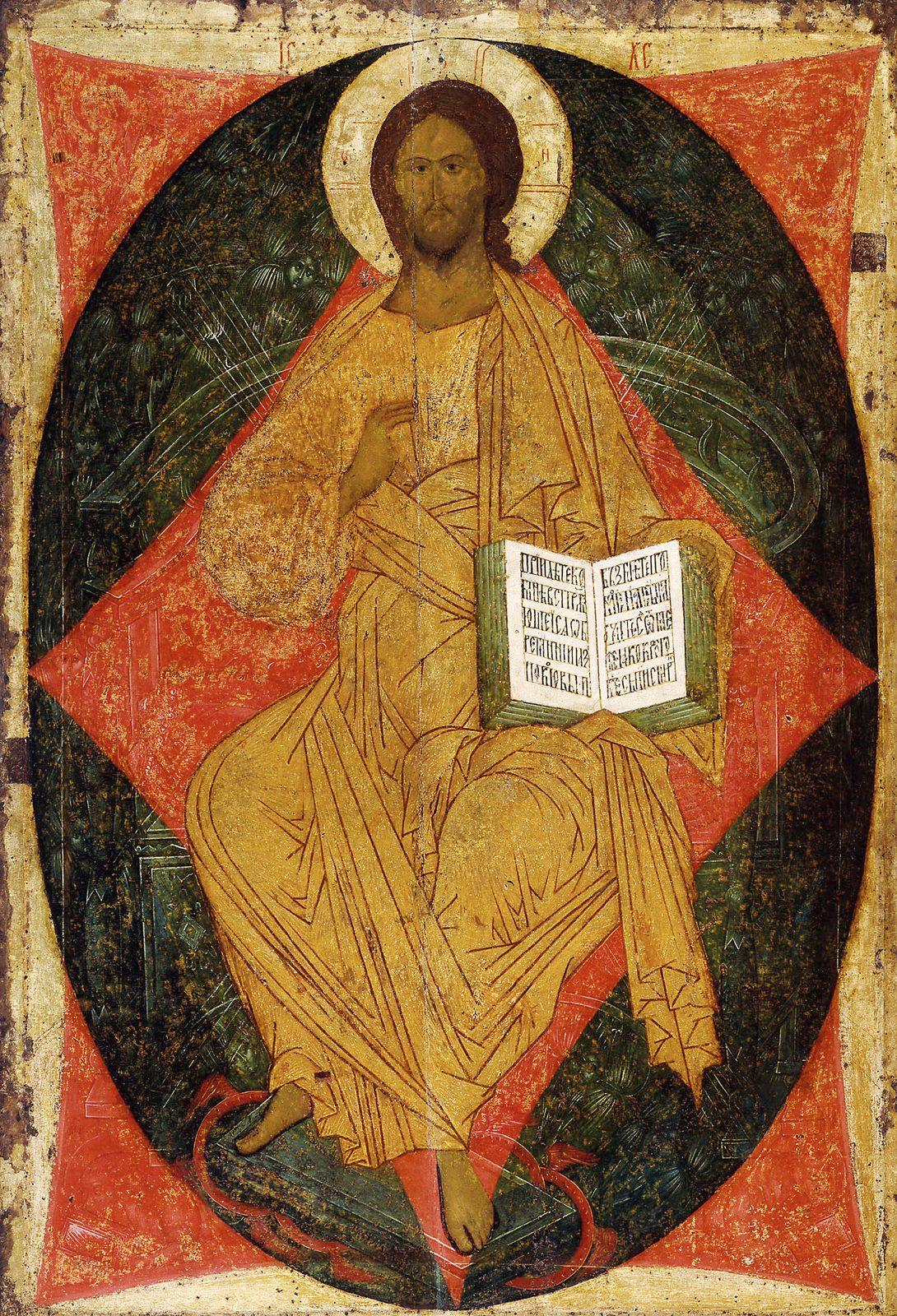
Dionisius, The Saviour in Power, 1500. Public domain.
Isaiah 9 · Passage · Featured Study
The Throne Names of Isaiah 9:6
Isaiah, Moses and Jeremiah give the words of three of the child's titles to the LORD Himself.
The Hebrew word for the child's government stands in only two verses of the Old Testament, and both of them are here.
For unto us a child is born, unto us a son is given, and the government will be upon His shoulders. And He will be called Wonderful Counselor, Mighty God, Everlasting Father, Prince of Peace.
For unto us a child is born, unto us a son is given, and the government will be upon His shoulders. And He will be called Wonderful Counselor, Mighty God, Everlasting Father, Prince of Peace.
- The passage
- Isaiah 9:6 to 7, Isaiah 28:29, Isaiah 22:22
- Book
- Isaiah
- Hold in memory
- Isaiah 9:6
Summary
Isaiah 9:6 lays the government on a child's shoulder and gives Him four names. The word peace is used again of a ruler from Bethlehem.
- The word for shoulder runs through Isaiah from the yoke on Israel to the key of David's house.
- The Greek translation gives the child one name, the Messenger of great counsel.
- The Cambridge Bible compares the names with the titles of the kings of Egypt and Babylon.
The Names in Their Verse
Each name joins two Hebrew words.
The pairs are wonder and counselor, God and mighty, father and eternity, prince and peace. A companion page sets out the oracle's setting and the readings of who the child is.
Where the Words Stand
Seven verses outside Isaiah 9 carry words of the names.
Five of these seven verses speak of God Himself.
| The name | The same words elsewhere | Of whom |
|---|---|---|
| Wonderful Counselor | who is wonderful in counsel and excellent in wisdom | The LORD of Hosts |
| Wonderful Counselor | You have worked wonders, plans formed long ago | The LORD |
| Mighty God | the great, mighty, and awesome God | The LORD your God |
| Mighty God | O great and mighty God whose name is the LORD of Hosts | The LORD, in Jeremiah's prayer |
| Everlasting Father | who inhabits eternity, whose name is Holy | The One who is high and lifted up |
| Everlasting Father | he will be a father to the dwellers of Jerusalem | Eliakim son of Hilkiah |
| Prince of Peace | And He will be our peace | The ruler from Bethlehem |
But you, Bethlehem Ephrathah, who are small among the clans of Judah, out of you will come forth for Me One to be ruler over Israel—One whose origins are of old, from the days of eternity.Micah 5:5 calls this ruler from Bethlehem our peace.
Upon His Shoulder
Isaiah uses the word for shoulder in five verses, these three among them.
For as in the day of Midian You have shattered the yoke of their burden, the bar across their shoulders, and the rod of their oppressor.Isaiah uses the word first for the bar of the oppressor.
On that day the burden will be lifted from your shoulders, and the yoke from your neck. The yoke will be broken because your neck will be too large.The word returns when Assyria's burden is lifted.
I will place on his shoulder the key to the house of David. What he opens no one can shut, and what he shuts no one can open.Isaiah uses the same word for shoulder when he gives Eliakim the key.
Jamieson, Fausset and Brown note that the ensign of office was worn on the shoulder, and they set the government on Messiah's shoulder against the yoke on Israel's. Adam Clarke names the scepter, the sword or the key as that ensign.
Albert Barnes reads the word for government as His rule as a prince, carried on from the name Prince of Peace.
Matthew Henry wrote that the child would set His shoulder to the government and never complain, as Moses did, that the people were too heavy to bear.
The Greek and the Jewish Renderings
The old Greek translation and a 1917 Jewish translation each print the names in a form of their own.
The Septuagint is the old Greek translation of the Hebrew Scriptures. In Brenton's English it calls the child the Messenger of great counsel and promises peace upon the princes. Brenton's note, marked Alex., adds a longer list: Wonderful, Counsellor, Mighty One, Potentate, Prince of Peace, Father of the age to come.
Matthew Henry follows that Greek line when he calls the child the Father of the world to come.
The Jewish Publication Society translation of 1917 numbers the verse Isaiah 9:5. It keeps the Hebrew sounds and prints the four names as one long name, Pele-joez-el-gibbor-Abi-ad-sar-shalom.
A King's Titles
Gerhard von Rad and Charles Spurgeon read the names in two different ways.
The Cambridge Bible for Schools and Colleges calls the names a series of titles that belong to the child as king. After Guthe it compares the titles that kings of Egypt and Babylon claimed in their inscriptions.
J. J. M. Roberts, in the Harvard Theological Review of 1997, reports that Gerhard von Rad argued in 1947 that Judah's rite for crowning a king leaned on Egypt's. In von Rad's reading Isaiah 9:5, in the Hebrew numbering, reflects a king's five-fold royal titulary. A titulary is the set of names given to a king at his crowning.
Charles Spurgeon preached on Wonderful in Sermon No. 214 and on Counsellor in No. 215, in 1858. He held that the titles belong only to the Lord Jesus Christ.
Voices on the Names
One voice from the early church speaks to the name Counselor.
John Chrysostom (died 407)
John Chrysostom, in his homilies Against the Anomoeans, used the name to answer those who denied the Son's equality with the Father.
“When Scripture wishes to show that God needs no one, it says that he has no counselor. When it wishes to show the equal honor of the Only Begotten, it calls the Son of God his counselor.”
John Chrysostom · Against the Anomoeans 11:14 · on Isaiah 9:6Patristic
Isaiah 40:13 is one such text.
Who has directed the Spirit of the LORD, or informed Him as His counselor?Chrysostom's argument rests on texts like this one.
The Zeal of the LORD
Of the increase of His government and peace there will be no end. He will reign on the throne of David and over his kingdom, to establish and sustain it with justice and righteousness from that time and forevermore. The zeal of the LORD of Hosts will accomplish this.Isaiah names the LORD's own zeal as the power behind the promise.
Sources
Scripture is the Berean Standard Bible.
- Brenton Septuagint Translation, Esaias 9:5, with its note marked Alex.
- The Jewish Publication Society translation of 1917, Isaiah 9:5.
- The Cambridge Bible for Schools and Colleges, on Isaiah 9:6.
- J. J. M. Roberts, Whose Child Is This? Reflections on the Speaking Voice in Isaiah 9:5, Harvard Theological Review 90.2 (1997), on Gerhard von Rad, Das judäische Königsritual (1947)
- Jamieson, Fausset and Brown, Commentary Critical and Explanatory on the Whole Bible (1871), on Isaiah 9:6.
- Adam Clarke, Commentary on the Bible (1832), on Isaiah 9:6.
- Albert Barnes, Notes, Explanatory and Practical, on Isaiah 9:7.
- Matthew Henry, Commentary on the Whole Bible (1710), on Isaiah 9:6 to 7.
- Charles Spurgeon, The New Park Street Pulpit, Sermons No. 214, His Name, Wonderful, and No. 215, His Name, The Counsellor, 1858, CCEL edition.
- John Chrysostom, Against the Anomoeans 11.
Keep Studying
People and groups6
Places1
Symbols1
Subjects2
Values1