
Genesis 1:1 to 2 · Passage · Featured Study
The Gap Reading at Genesis 1:2
Genesis 1:1 to 2 tells that God created the heavens and the earth and then describes the earth before God's first word.
The second verse of the Bible calls the earth formless and void, and the gap reading holds that it became so through a ruin after the first verse.
- The passage
- Genesis 1:1 to 2
- Book
- Genesis
- When
- 1814
- Hold in memory
- Genesis 1:1 to 2
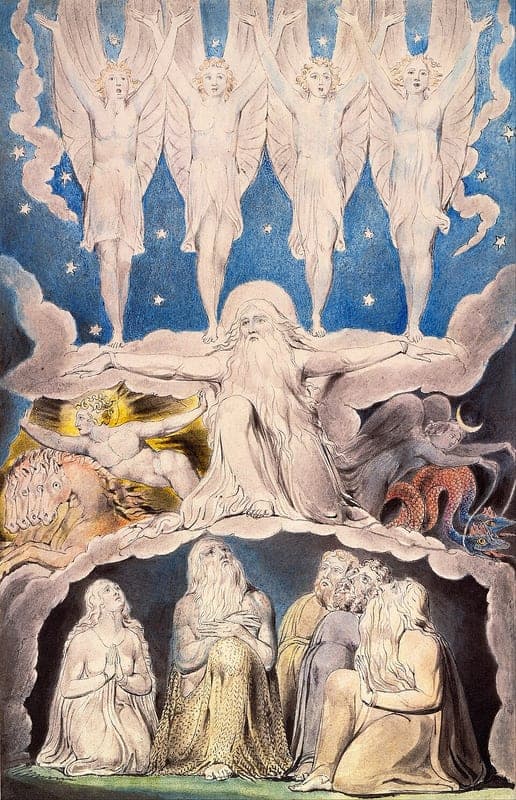
William Blake, When the Morning Stars Sang Together, 1804. Public domain, via Wikimedia Commons.
THE ARTWORKBlake painted the scene of Job 38:7, in which the morning stars sing together while the LORD lays the foundations of the earth, and he set Job and his friends beneath it.
Summary
Genesis 1:2 uses a verb that can mean was or became, and readers divide over which sense it carries there.
- Outside Genesis the Berean text has the words formless and void only in Jeremiah 4:23.
- Thomas Chalmers in 1814 and the Scofield Reference Bible in 1909 placed a ruin of the first world between verse 1 and verse 2.
- Augustine, Hippolytus and Matthew Henry read verse 2 as the earth's first state, which the six days then shape.
- The verse is silent on any world before this one, on the fall of angels and on how long the earth lay formless.
Two Verses Before the First Word
The Bible opens with these two verses, and the first day follows in verses 3 to 5.
In the beginning God created the heavens and the earth.This verse is the creating that every reading of verse 2 looks back to.
Now the earth was formless and void, and darkness was over the surface of the deep. And the Spirit of God was hovering over the surface of the waters.This is the verse the readings dispute, and it speaks of the earth alone.
In Hebrew the second verse runs to fourteen words, in three clauses that each open with and.
And God said, “Let there be light,” and there was light. And God saw that the light was good, and He separated the light from the darkness. God called the light “day,” and the darkness He called “night.” And there was evening, and there was morning—the first day.The text moves from verse 2 straight to God's first recorded word.
Six Hebrew Words of Genesis 1:2
Six Hebrew words carry the description of the earth in verse 2, and each is used again elsewhere in Scripture.
| Hebrew word | Strong's | Berean wording | Another verse that uses it |
|---|---|---|---|
| hayetah, a form of hayah | H1961 | was | Genesis 19:26, where another form of the verb reads became |
| tohu | H8414 | formless | Job 26:7, where the Berean text renders it empty space |
| bohu | H922 | void | Isaiah 34:11, in a judgment on Edom |
| choshek | H2822 | darkness | Genesis 1:4, where God separates the light from the darkness |
| tehom | H8415 | the deep | Psalm 104:6, where the deep covers the earth like a garment |
| merachefet, a form of rachaph | H7363 | hovering | Deuteronomy 32:11, in the song of Moses |
- Hebrew word
- hayetah, a form of hayah
- Strong's
- H1961
- Berean wording
- was
- Another verse that uses it
- Genesis 19:26, where another form of the verb reads became
- Hebrew word
- tohu
- Strong's
- H8414
- Berean wording
- formless
- Another verse that uses it
- Job 26:7, where the Berean text renders it empty space
- Hebrew word
- bohu
- Strong's
- H922
- Berean wording
- void
- Another verse that uses it
- Isaiah 34:11, in a judgment on Edom
- Hebrew word
- choshek
- Strong's
- H2822
- Berean wording
- darkness
- Another verse that uses it
- Genesis 1:4, where God separates the light from the darkness
- Hebrew word
- tehom
- Strong's
- H8415
- Berean wording
- the deep
- Another verse that uses it
- Psalm 104:6, where the deep covers the earth like a garment
- Hebrew word
- merachefet, a form of rachaph
- Strong's
- H7363
- Berean wording
- hovering
- Another verse that uses it
- Deuteronomy 32:11, in the song of Moses
Strong's lexicon gives hayah the sense to exist, to be or to become. Albert Barnes, in his Notes on Genesis 1:2, sets out three senses of the verb: to come to pass, to become, and to be in a state.
Adam Clarke, in his Commentary on the Bible, calls the origin of tohu and bohu uncertain and says that wherever they are used they carry the idea of confusion and disorder. Rashi, in his commentary on Genesis in the translation of Rosenbaum and Silbermann, explains tohu as the astonishment a person would have felt at the earth's emptiness.
Where Else Scripture Uses Tohu and Bohu
Jeremiah and Isaiah use the words of verse 2, and Matthew Henry and Jamieson, Fausset & Brown comment on each use.
I looked at the earth, and it was formless and void; I looked to the heavens, and they had no light. I looked at the mountains, and behold, they were quaking; all the hills were swaying. I looked, and no man was left; all the birds of the air had fled. I looked, and the fruitful land was a desert. All its cities were torn down before the LORD, before His fierce anger.Jeremiah's vision uses tohu and bohu together for a land under the LORD's fierce anger.
“It is Tohu and Bohu, the words there used, as far as the land of Judea goes. It is confusion and emptiness, stripped of all its beauty, void of all its wealth, and, compared with what it was, every thing out of place and out of shape.”
Matthew Henry · Commentary on the Whole Bible · on Jeremiah 4:23Puritan
The desert owl and screech owl will possess it, and the great owl and raven will dwell in it. The LORD will stretch out over Edom a measuring line of chaos and a plumb line of destruction.Jamieson, Fausset & Brown, in their Commentary Critical and Explanatory on the Whole Bible, take the sense of Genesis 1:2 from this verse, confusion and emptiness.
For thus says the LORD, who created the heavens—He is God; He formed the earth and fashioned it; He established it; He did not create it to be empty, but formed it to be inhabited: “I am the LORD, and there is no other.Tohu, the word rendered formless in the creation account, stands in this verse for what God did not make the earth to be.
Jamieson, Fausset & Brown read the verse in its chapter, as a promise that Judah, lying waste in the Babylonian captivity, would be peopled again by the exiles.
When the Reading Arose
Three works carried the gap reading from 1814 to 1909, and two frameworks of the present day stand beside it.
Thomas Chalmers of Edinburgh set out the gap reading in 1814, in a review of Cuvier's Theory of the Earth. G. H. Pember argued it in Earth's Earliest Ages in 1876, and the Scofield Reference Bible of 1909 printed it in its note on Genesis 1:2.
Hugh Ross, in A Matter of Days (2004), reads the days themselves as long ages whose order tracks the order science proposes. John F. Ashton edited In Six Days (1999), in which scientists with doctorates explain why they read Genesis 1 as six ordinary days.
The gap reading holds Ashton's ordinary days and Ross's old earth together, by setting the ages before the first day.
What Genesis 1:2 Leaves Unsaid
The verse leaves open three matters that the debate over it raises.
Genesis 1 names no world before the one verse 1 creates, and it records no judgment on such a world.
Verse 2 gives no account of angels or of a rebellion among them.
Verse 2 gives no length of time for the earth's formless state. Jamieson, Fausset & Brown call the beginning of verse 1 a period of remote and unknown antiquity.
The fall from heaven in Isaiah 14 and Ezekiel 282 passages
you will sing this song of contempt against the king of Babylon: How the oppressor has ceased, and how his fury has ended!Isaiah addresses the song of Isaiah 14:12 to 15 to the king of Babylon.
“Son of man, take up a lament for the king of Tyre and tell him that this is what the Lord GOD says: ‘You were the seal of perfection, full of wisdom and perfect in beauty.The prophet speaks these words to a ruler of Tyre.
Ambrose of Milan, in On Paradise, reads the prince of Tyre as the devil. John Gill, in his Exposition of the Old Testament, reads Isaiah 14:12 of the king of Babylon, with a possible allusion to the fall of Satan. Adam Clarke notes that the verse speaks of Nebuchadnezzar and has been applied to the chief of the fallen angels.
The world that perished in 2 Peter 32 passages
But they deliberately overlook the fact that long ago by God’s word the heavens existed and the earth was formed out of water and by water, through which the world of that time perished in the flood.Peter names the flood as the way the world of that time perished.
In the six hundredth year of Noah’s life, on the seventeenth day of the second month, all the fountains of the great deep burst forth, and the floodgates of the heavens were opened.The account of the flood uses tehom, the word for the deep in Genesis 1:2, for its fountains of the great deep.
The Spirit Over the Waters
The last clause of verse 2 names the Spirit of God, and teachers of the church read its verb as brooding.
The verb merachefet appears in only two other verses of Scripture.
As an eagle stirs up its nest and hovers over its young, He spread His wings to catch them and carried them on His pinions.This verse shows the same verb used of an eagle that hovers over its young and carries them.
Jerome, in his Hebrew Questions on Genesis, renders the word as hovering or brooding, like a bird warming its eggs. He reads the Spirit here as the Holy Spirit, the giver of life to all things from the beginning. Jamieson, Fausset & Brown also read it as brooding.
Charles Spurgeon, in his sermon The Spirit's Work in the New Creation, calls the Spirit's movement on the waters the first divine act in fitting the earth for the habitation of man.
Voices on the Beginning
Two teachers of the church read the opening of Genesis with the New Testament beside it.
“Scripture is not speaking here of any temporal beginning, but it says that the heavens and the earth and all things that were made were made ‘in the beginning,’ that is, in the Savior.”
Origen of Alexandria · Homilies on Genesis 1.1 · on Genesis 1:1Patristic
“It is manifest that a beginning should be made from the One from whom the two greatest Wise Men began: Moses, the originator of wisdom, and John, its consummator.”
Bonaventure · Collations on the Hexaemeron, Collation 1 · on Genesis 1:1Patristic
Two Readings of Verse 2
The readings divide over whether the earth of verse 2 is a world ruined after verse 1 or the first state of what verse 1 made.
A ruin between verse 1 and verse 2Chalmers, Pember, the Scofield Reference Bible, Jamieson, Fausset & Brown, Missler
On this reading verse 1 tells of a first creation, a judgment left the earth formless and empty, and the six days tell of its remaking. Its holders read the verb of verse 2 as became.
Jamieson, Fausset & Brown, in their Commentary Critical and Explanatory on the Whole Bible, read verse 2 as a globe convulsed and broken up at some undescribed period and left a dark and watery waste. Chuck Missler, in his article The Gap Theory: An Exegetical Controversy, writes that the earth seems not to have been formless and void at first, but to have come under some catastrophic judgment.
Matthew Henry, in his Commentary on the Whole Bible, answers that the chaos of verse 2 was the first matter, which leaves no interval after the creating of verse 1. The Berean text renders the verb was. In the Hebrew text verse 2 sets its noun first and puts its verb in the perfect, while verse 3 and the became of Genesis 19:26 open with the verb joined to and.
The first state of the one creationAugustine, Hippolytus, Matthew Henry
On this reading verse 2 describes the earth God made in verse 1 as it stood before the six days. Over those days God forms the parts of the world and then fills them.
Augustine, in his Confessions, takes the words to describe formlessness, from which a visible and organized heaven and earth were then made.
“On the first day God made what He made out of nothing. But on the other days He did not make out of nothing, but out of what He had made on the first day, by moulding it according to His pleasure.”
Hippolytus of Rome · Hippolytus Exegetical Fragments - On Genesis · on Genesis 1:6Patristic
The objection is the ruin reading's own case, which rests on the other uses of the two words shown under Where Else Scripture Uses Tohu and Bohu.
Light Out of Darkness
Three passages of the New Testament go back to the beginning of Genesis.
For God, who said, “Let light shine out of darkness,” made His light shine in our hearts to give us the light of the knowledge of the glory of God in the face of Jesus Christ.Paul sets God's first word of creation beside the light God gives a believer.
In the beginning was the Word, and the Word was with God, and the Word was God. He was with God in the beginning. Through Him all things were made, and without Him nothing was made that has been made.John opens with the words of Genesis 1:1 and says that all things were made through the Word.
For in Him all things were created, things in heaven and on earth, visible and invisible, whether thrones or dominions or rulers or authorities. All things were created through Him and for Him. He is before all things, and in Him all things hold together.Paul names the Son as the one through whom the heavens and the earth of Genesis 1:1 were made.
The text asks the reader to trust the God who brought light out of darkness and to look for that light in Christ.
Keep studying
Read it1
Symbols2