
John 10 · Romans 8 · Hebrews 2–12 · Featured Study
Eternal Security, and the Five Warnings of Hebrews
Every believer asks it sooner or later, usually in the dark: can I lose this? Scripture answers twice over. It gives some of the strongest promises of security in the whole Bible, a Shepherd whose hand cannot be forced open. And, in one letter alone, it gives five of the most searching warnings in the whole Bible: do not drift, do not disbelieve, do not fall away, do not despise, do not refuse. Both are in the Book. Neither cancels the other.
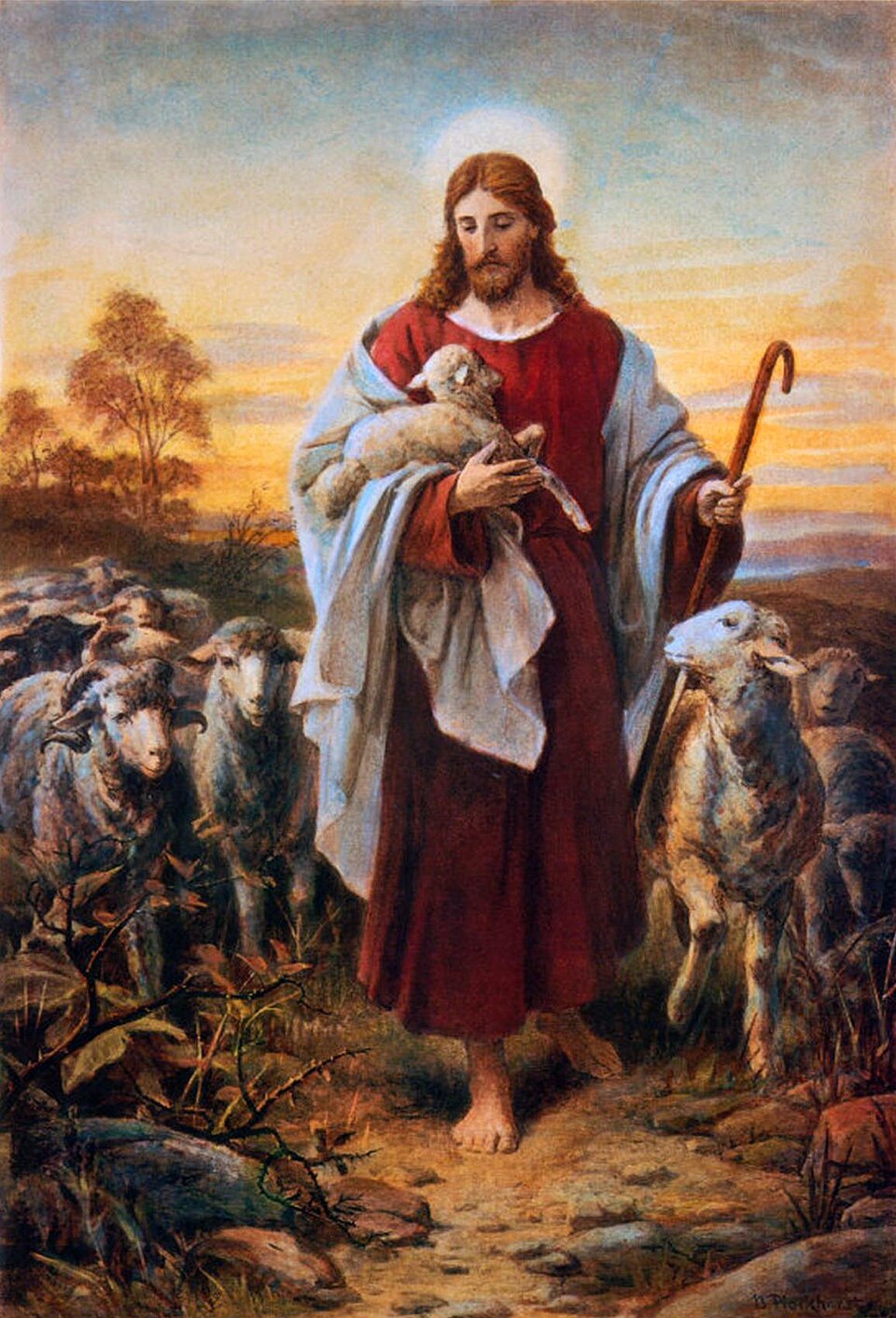
The Good Shepherd, Bernhard Plockhorst. Public domain.
THE ARTWORKPlockhorst paints John 10 as the sheep know it: carried, not clinging. The lamb in Christ's arm is this page's whole question, “neither shall any man pluck them out of my hand”, and the flock still walking the path below is the five warnings' whole audience.
Summary
The page walks the Bible's strongest security texts and the five warnings of Hebrews side by side, in full, then lays out four traditions for how to hold both together without erasing either.
- The assurance texts walked one by one: John 10, John 6, Romans 8, Ephesians 1 and 4, and four more
- All five warnings of Hebrews, in full, including the interpretive fork at Hebrews 6:4-9
- Four traditions: Reformed perseverance, Wesleyan-Arminian conditional, Free Grace, and the moderate readings
- Security and assurance treated as two different questions, not one
- Where this site lands: the believer is in the Father's hand, and Jesus holds him there
The Two Threads
see the whole page at a glance: gold holds, scarlet warns, both are the Book
● THE GOLD THREAD: WHAT HOLDS YOU
The Hand Inside the Hand
John 10:28–29 and the strongest promises of security in Scripture, walked one by one
THE IDEAWhat God holds, nothing can pry loose, not wolves, not angels, not devils, and not your own weak grip.
John 10:27-30: the two hands
My sheep listen to My voice; I know them, and they follow Me. I give them eternal life, and they will never perish. No one can snatch them out of My hand. My Father who has given them to Me is greater than all. No one can snatch them out of My Father’s hand. I and the Father are one.”The Shepherd's own words: no one snatches His sheep out of His hand, or out of the Father's.
The verb Jesus chose for “snatch” is the very verb Scripture uses for God's own catching-up of His people, counted in this site's tagged Greek text. The only harpazō a believer will ever know is the one that carries them home.
And the grammar doubles the grip: verse 28 uses ou mē with the future: “they shall by no means perish”, the strongest negation Greek has; the snatch is denied twice, out of the Son's hand (v. 28) and out of the Father's (v. 29).
I give unto them eternal life—not 'will give them'; for it is a present gift. It is a very grand utterance, couched in the language of majestic authority.
Jamieson, Fausset & Brown · Commentary Critical and Explanatory on the Whole Bible, 1871Reformed
John 10:28
I give unto them eternal life... Shall never perish... The original is expressed with remarkable strength: They shall not be destroyed forever... My hand — The hand is that by which we hold or secure an object. It means that Jesus has them safely in his own care and keeping. Compare Rom 8:38-39.
Albert Barnes · Notes, Explanatory and Practical, on the Old and New Testaments, 1832–1869Reformed
John 10:28
Which gave them me... Is greater — Is more powerful. Than all — Than all others — men, angels, devils. The word includes everything... It implies, further, that God will keep them, and will so control all other beings and things that they shall be safe.
Albert Barnes · Notes, Explanatory and Practical, on the Old and New Testaments, 1832–1869Reformed
John 10:29
It is a general expression of an admitted truth... 'and none is able to pluck them out of My Father's hand.' The impossibility of true believers being lost, in the midst of all the temptations which they may encounter, does not consist in their fidelity and decision, but is founded upon the power of God.
Jamieson, Fausset & Brown · Commentary Critical and Explanatory on the Whole Bible, 1871Reformed
John 10:29
DEEPER: not every early reader read the security as unconditionalOrigen, 3rd c.
Origen, in a homily on Jeremiah, drew the line differently, the earliest form of the conditional reading of this very text, and it belongs in the record honestly:
it is not written that just as no one snatches us away, no one also falls from his hands... we are able to fall from his hands if we are negligent.
Origen · Homilies on Jeremiah 18.3, 253Church Father
John 10:29
John 6:37-40
Everyone the Father gives Me will come to Me, and the one who comes to Me I will never drive away. For I have come down from heaven, not to do My own will, but to do the will of Him who sent Me. And this is the will of Him who sent Me, that I shall lose none of those He has given Me, but raise them up at the last day. For it is My Father’s will that everyone who looks to the Son and believes in Him shall have eternal life, and I will raise him up at the last day.”Everyone the Father gives the Son will come, and none will be cast out.
(2) "AND HIM THAT COMETH TO ME I WILL IN NO WISE CAST OUT." As the former was the divine, this is just the human side of the same thing.
Jamieson, Fausset & Brown · Commentary Critical and Explanatory on the Whole Bible, 1871Reformed
John 6:37
Romans 8:28-39: the golden chain
Verses 29-30 trace foreknew, predestined, called, justified, glorified as one unbroken sequence, glorified stated in the past tense, an already-settled outcome. The chapter closes with one of the boldest sentences in the New Testament.
And we know that God works all things together for the good of those who love Him, who are called according to His purpose. For those God foreknew, He also predestined to be conformed to the image of His Son, so that He would be the firstborn among many brothers. And those He predestined, He also called; those He called, He also justified; those He justified, He also glorified.The golden chain: foreknew, predestined, called, justified, glorified.
For I am convinced that neither death nor life, neither angels nor principalities, neither the present nor the future, nor any powers, neither height nor depth, nor anything else in all creation, will be able to separate us from the love of God that is in Christ Jesus our Lord.Nothing in all creation can separate the believer from the love of God in Christ.
For I am persuaded, that neither death nor life, nor angels, nor principalities, nor powers, nor things present, nor things to come, nor height, nor depth, nor any other creature, shall be able to separate us from the love of God, which is in Christ Jesus our Lord. And here the words he uses are high-wrought and exceedingly warm, to show his love... even if a person were to threaten me with that future death to which there is no death, to separate me from Christ, nor if he promised the life without end, would I agree to it... none of them could part me from that love.
John Chrysostom · Homily on Romans 15, 407Church Father
Romans 8:38-39
For I am persuaded,.... These words with the following, express the strong persuasion, and full assurance of faith the apostle had, that nothing whatever could separate him and the rest of God's people, from his love towards them in Christ Jesus.
John Gill · Exposition of the New Testament, 1746–1748Reformed Baptist
Romans 8:38
'The whole universe, with all that it contains, so far as it is good, is the friend and ally of the Christian; and, so far as it is evil, is more than a conquered foe' (Ro 8:35-39) [Hodge]... Are we who 'have tasted that the Lord is gracious,' both 'kept by the power of God through faith unto salvation' (1Pe 1:5), and embraced in the arms of Invincible Love?
Jamieson, Fausset & Brown · Commentary Critical and Explanatory on the Whole Bible, 1871Reformed
Romans 8:39
Ephesians 1:13-14 and 4:30: the sealed, dated inheritance
And in Him, having heard and believed the word of truth—the gospel of your salvation—you were sealed with the promised Holy Spirit, who is the pledge of our inheritance until the redemption of those who are God’s possession, to the praise of His glory.Sealed with the Holy Spirit, the guarantee of the inheritance until redemption.
And do not grieve the Holy Spirit of God, in whom you were sealed for the day of redemption.Do not grieve the Holy Spirit, by whom you were sealed for the day of redemption.
Ye were sealed by that Holy Spirit of promise — Holy both in his nature and in his operations, and promised to all the children of God.
John Wesley · Explanatory Notes upon the New Testament, 1755Wesleyan
Ephesians 1:13
The blessed Spirit is holy himself, and he makes us holy. He is called the Spirit of promise, as he is the promised Spirit. By him believers are sealed; that is, separated and set apart for God, and distinguished and marked as belonging to him.
Matthew Henry · Commentary on the Whole Bible, 1710Reformed
Ephesians 1:13
The earnest is part of payment, and it secures the full sum: so is the gift of the Holy Ghost; all his influences and operations, both as a sanctifier and a comforter, are heaven begun, glory in the seed and bud. The Spirit's illumination is an earnest of everlasting light; sanctification is an earnest of perfect holiness; and his comforts are earnests of everlasting joys.
Matthew Henry · Commentary on the Whole Bible, 1710Reformed
Ephesians 1:14
The witnessing to our hearts that we are the children of God, and heirs (Eph 1:11), is the Spirit's present testimony, the 'earnest of the (coming) inheritance' (Ro 8:16-18).
Jamieson, Fausset & Brown · Commentary Critical and Explanatory on the Whole Bible, 1871Reformed
Ephesians 1:13
DEEPER: the seal against the whole arc of predestinationChrysostom
Chrysostom reads the seal as the mark of those already chosen, not a mark that could later be erased:
God separate them for believing, and sealed them for the allotment of the things to come
John Chrysostom · Homily on Ephesians 2, 407Church Father
Philippians 1:6, 1 Peter 1:5, 1 John 5:11-13, Jude 24
being confident of this, that He who began a good work in you will carry it on to completion until the day of Christ Jesus.He who began a good work will complete it.
who through faith are shielded by God’s power for the salvation that is ready to be revealed in the last time.Kept by the power of God, a military-guard word, phrouroumenous.
And this is that testimony: God has given us eternal life, and this life is in His Son. Whoever has the Son has life; whoever does not have the Son of God does not have life. I have written these things to you who believe in the name of the Son of God, so that you may know that you have eternal life.He who has the Son has life, that you may know you have eternal life.
Now to Him who is able to keep you from stumbling and to present you unblemished in His glorious presence, with great joy—Able to keep you from stumbling, and to present you faultless.
These things have I written - In the introduction, chap. i, 4, he said, I write: now, in the close, I have written. That ye may know - With a fuller and stronger assurance, that ye have eternal life.
John Wesley · Explanatory Notes upon the New Testament, 1755Wesleyan
1 John 5:13
Where this site lands
This site reads these promises as the believer's security. The one who belongs to Christ is in the Father's hand, and Jesus holds him there, so the one who is saved stays saved.
I give them eternal life, and they will never perish. No one can snatch them out of My hand. My Father who has given them to Me is greater than all. No one can snatch them out of My Father’s hand.The Book That Promises Also Warns
the five warnings of Hebrews, in full: the same epistle that says “perfected for ever” sounds five alarms
THE IDEAThe same Book that promises also warns, five alarms in one letter, written to believers, meant to be felt.
Modern scholarship increasingly treats these five passages as one rhetorical unit that escalates across the letter: Herbert W. Bateman IV's edited volume Four Views on the Warning Passages in Hebrews (Kregel, 2007) is the standard modern reference point for that reading.
Warning One · 2:1-4 · Drift
We must pay closer attention, therefore, to what we have heard, so that we do not drift away. For if the message spoken by angels was binding, and every transgression and disobedience received its just punishment, how shall we escape if we neglect such a great salvation? This salvation was first announced by the Lord, was confirmed to us by those who heard Him, and was affirmed by God through signs, wonders, various miracles, and gifts of the Holy Spirit distributed according to His will.The mildest of the five: a boat slipping its mooring, not a shipwreck.
The author includes himself: “we,” not “you.”
Lest we should let them slip - As water out of a leaky vessel. So the Greek word properly signifies.
John Wesley · Explanatory Notes upon the New Testament, 1755Wesleyan
Hebrews 2:1
Warning Two · 3:7-4:13 · Disbelieve
Built on Psalm 95 and the wilderness generation. The “rest” (katapausis) Israel forfeited was Canaan, the promise, not the exodus. The section closes with the word of God as a living, discerning sword.
Therefore, as the Holy Spirit says: “Today, if you hear His voice, do not harden your hearts, as you did in the rebellion, in the day of testing in the wilderness,Today, if you hear His voice, do not harden your hearts.
For the word of God is living and active. Sharper than any double-edged sword, it pierces even to dividing soul and spirit, joints and marrow. It judges the thoughts and intentions of the heart. Nothing in all creation is hidden from God’s sight; everything is uncovered and exposed before the eyes of Him to whom we must give account.No creature is hidden from His sight.
Take heed, lest there be in any of you - As there was in them. An evil heart of unbelief - Unbelief is the parent of all evil, and the very essence of unbelief lies in departing from God, as the living God - The fountain of all our life, holiness, happiness.
John Wesley · Explanatory Notes upon the New Testament, 1755Wesleyan
Hebrews 3:12
Warning Three · 5:11-6:12 · Degenerate
The most debated of the five.
It is impossible for those who have once been enlightened, who have tasted the heavenly gift, who have shared in the Holy Spirit, who have tasted the goodness of the word of God and the powers of the coming age— and then have fallen away—to be restored to repentance, because they themselves are crucifying the Son of God all over again and subjecting Him to open shame. For land that drinks in the rain often falling on it and that produces a crop useful to those for whom it is tended receives the blessing of God. But land that produces thorns and thistles is worthless, and its curse is imminent. In the end it will be burned. Even though we speak like this, beloved, we are convinced of better things in your case—things that accompany salvation.Impossible to renew again to repentance those who have fallen away, and, in the same breath, better things.
This is the sad end to which apostasy leads, and therefore Christians should go on and grow in grace, lest, if they do not go forward, they should go backward, till they bring matters to this woeful extremity of sin and misery.
Matthew Henry · Commentary on the Whole Bible, 1710Reformed
Hebrews 6:8
The interpretive fork, named honestly by the pool's own PD commentators
Albert Barnes states the division plainly, in his own words, without picking a side for the reader, this is worth quoting at length, because it is the fork the whole page turns on.
It is needless to say that the passage here Heb 6:4-6, has given occasion to much controversy, and that the opinions of commentators and of the Christian world are yet greatly divided in regard to its meaning. On the one hand, it is held that the passage is not intended to describe those who are true Christians, but only those who have been awakened and enlightened, and who then fall back; and on the other it is maintained that it refers to those who are true Christians, and who then apostatize. The contending parties have been Calvinists and Arminians; each party, in general, interpreting it according to the views which are held on the question about falling from grace... it seems to me that it refers to true Christians; that the object is to keep them from apostasy, and that it teaches that if they should apostatize, it would be impossible to renew them again or to save them.
Albert Barnes · Notes, Explanatory and Practical, on the Old and New Testaments, 1832–1869Reformed
Hebrews 6:4
John Wesley reads the same five marks, enlightened, tasted, partakers, tasted the good word, tasted the powers of the age to come, as describing a real, Spirit-indwelt believer, not a mere professor:
It is impossible for those who were once enlightened — With the light of the glorious love of God in Christ. And have tasted the heavenly gift — Remission of sins, sweeter than honey and the honeycomb.
John Wesley · Explanatory Notes upon the New Testament, 1755Wesleyan
Hebrews 6:4
And have fallen away — Here is not a supposition, but a plain relation of fact. The apostle here describes the case of those who have cast away both the power and the form of godliness; who have lost both their faith, hope, and love... and that wilfully, chap. x, 26.
John Wesley · Explanatory Notes upon the New Testament, 1755Wesleyan
Hebrews 6:6
Adam Clarke takes yet a third position, that the passage describes not backsliding believers at all but total apostates from the Christian system as a whole:
I do not consider them as having any reference to any person professing Christianity. 2. They do not belong, nor are they applicable, to backsliders of any kind. 3. They belong to apostates from Christianity; to such as reject the whole Christian system, and its author, the Lord Jesus.
Adam Clarke · Commentary on the Bible, 1832Wesleyan
Hebrews 6:4
Then the author pivots to comfort: 6:9, in the same breath
There are things that accompany salvation, things that are never separated from salvation, things that show the person to be in a state of salvation, and will issue in eternal salvation. The things that accompany salvation are better things than ever any hypocrite or apostate enjoyed.
Matthew Henry · Commentary on the Whole Bible, 1710Reformed
Hebrews 6:9
We confidently hope for better things respecting you. We trust that you are true Christians; that you will produce the proper fruits of holiness; that you will be saved.
Albert Barnes · Notes, Explanatory and Practical, on the Old and New Testaments, 1832–1869Reformed
Hebrews 6:9
Having therefore sufficiently rebuked them, and alarmed and wounded them, he in turn heals them, so as not to cast them down too much... For it is better to terrify you by words, that ye may not suffer by the realities.
John Chrysostom · Homily on Hebrews 10, 407Church Father
Hebrews 6:9
Warning Four · 10:19-39 · Despise
If we deliberately go on sinning after we have received the knowledge of the truth, no further sacrifice for sins remains, but only a fearful expectation of judgment and of raging fire that will consume all adversaries. Anyone who rejected the law of Moses died without mercy on the testimony of two or three witnesses. How much more severely do you think one deserves to be punished who has trampled on the Son of God, profaned the blood of the covenant that sanctified him, and insulted the Spirit of grace? For we know Him who said, “Vengeance is Mine; I will repay,” and again, “The Lord will judge His people.” It is a fearful thing to fall into the hands of the living God.If we sin willfully, no sacrifice remains, it is a fearful thing to fall into the hands of the living God.
Verse 29 sharpens who is warned, one who has trampled the Son of God underfoot, counted the blood of the covenant a common thing, and insulted the Spirit of grace.
So he treads under foot God Himself who 'glorified His Son as an high priest' (Heb 5:5; 6:6). ...No better than the blood of a common man, thus involving the consequence that Christ, in claiming to be God, was guilty of blasphemy, and so deserved to die! ...for Christ died even for him.
Jamieson, Fausset & Brown · Commentary Critical and Explanatory on the Whole Bible, 1871Reformed
Hebrews 10:29
Wesley's note on this verse is the clearest PD statement in the pool that this warning addresses a genuinely saved person, worth surfacing precisely because it is verified, verbatim, and directly on point:
Hath, as it were, trodden underfoot the Son of God — A lawgiver far more honourable than Moses. And counted the blood wherewith the better covenant was established, an unholy, a common, worthless thing. By which he hath been sanctified — Therefore Christ died for him also, and he was at least justified once.
John Wesley · Explanatory Notes upon the New Testament, 1755Wesleyan
Hebrews 10:29
Adam Clarke, by contrast, reads the same verse as describing the sin against the Holy Spirit itself, the one sin Scripture elsewhere says has no forgiveness:
Despite unto the Spirit of grace? — Hath insulted the Spirit of grace... This is properly the sin against the Holy Ghost, which has no forgiveness.
Adam Clarke · Commentary on the Bible, 1832Wesleyan
Hebrews 10:29
Remember the early days that you were in the light. In those days, you endured a great conflict in the face of suffering. Sometimes you were publicly exposed to ridicule and persecution; at other times you were partners with those who were so treated. You sympathized with those in prison and joyfully accepted the confiscation of your property, knowing that you yourselves had a better and permanent possession. So do not throw away your confidence; it holds a great reward. You need to persevere, so that after you have done the will of God, you will receive what He has promised. For, “In just a little while, He who is coming will come and will not delay. But My righteous one will live by faith; and if he shrinks back, I will take no pleasure in him.” But we are not of those who shrink back and are destroyed, but of those who have faith and preserve their souls.Then, as in Warning Three, the author pivots to comfort: not of those who draw back, but of those who believe.
If we live by faith, and die in faith, our souls will be safe for ever.
Matthew Henry · Commentary on the Whole Bible, 1710Reformed
Hebrews 10:39
Warning Five · 12:14-29 · Depart
Pursue peace with everyone, as well as holiness, without which no one will see the Lord. See to it that no one falls short of the grace of God, and that no root of bitterness springs up to cause trouble and defile many. See to it that no one is sexually immoral, or is godless like Esau, who for a single meal sold his birthright. For you know that afterward, when he wanted to inherit the blessing, he was rejected. He could find no ground for repentance, though he sought the blessing with tears.Esau: one who sold his birthright for a single meal, and found no place for repentance.
See to it that you do not refuse Him who speaks. For if the people did not escape when they refused Him who warned them on earth, how much less will we escape if we reject Him who warns us from heaven? At that time His voice shook the earth, but now He has promised, “Once more I will shake not only the earth, but heaven as well.” The words “Once more” signify the removal of what can be shaken—that is, created things—so that the unshakable may remain. Therefore, since we are receiving an unshakable kingdom, let us be filled with gratitude, and so worship God acceptably with reverence and awe. “For our God is a consuming fire.”See that you do not refuse Him who speaks, our God is a consuming fire.
He was rejected - He could not obtain it. For he found no place for repentance - There was no room for any such repentance as would regain what he had lost.
John Wesley · Explanatory Notes upon the New Testament, 1755Wesleyan
Hebrews 12:17
Four Traditions, One Bible, No Enemies
every position at full strength, held by brothers: the gracious rule governs
THE IDEAFaithful readers order the gold and scarlet threads differently, every position here is carried at full strength, and none is mocked.
Reformed perseverance of the saints
Worth stating plainly first, because it resolves confusion: classical Calvinism's perseverance of the saintsis not identical to the popular phrase “once saved, always saved.” Perseverance holds that all of the truly elect and regenerate will, without exception, persevere to the end, but does not promise that everyone who once made a profession is among the elect. A person who falls away totally and finally, on this view, thereby shows they were never regenerate (1 John 2:19).
Among the MannaFest roster, R.C. Sproul stands in this stream, and John Piper likewise defends the perseverance of the saints (Counted Righteous in Christ, 2002). Charles Spurgeon, public domain and quotable in full, preached the same architecture in A Defense of Calvinism.
If there is one single molecule in this universe running around loose, totally free of God's sovereignty, then we have no guarantee that a single promise of God will ever be fulfilled.
R.C. Sproul · Chosen by God, 1986Reformed
The Wesleyan-Arminian conditional view
John Wesley: public domain, quotable at length: wrote a full tract on this question, Serious Thoughts Upon the Perseverance of the Saints(1751). His own commentary notes, quoted above from the verified pool, describe both the Hebrews 6 and Hebrews 10 warned-of persons in language of real, prior salvation (“he was at least justified once”; the Hebrews 6 apostate has “lost both their faith, hope, and love”).
This is not a minority curiosity on this site, it is the historic default of the Wesleyan-Pentecostal tradition MannaFest itself grew from. Among the roster, John Bevere (Driven by Eternity, 2006) and Derek Prince (Faith to Live By, 1977, and Foundations of Christian Doctrine) both treat apostasy as a real possibility for the unfaithful believer, out of their own Pentecostal-Arminian and covenant-fidelity frames. Both stand, without contradiction to their own tradition's integrity, alongside Wesley in representing this reading at full strength, difference among brothers, never conflict.
The Free Grace position
Salvation is secured permanently at the moment of faith and cannot be lost by subsequent sin, but continuing in discipleship is a matter of reward, not salvation, at the judgment seat of Christ. Zane C. Hodges (The Gospel Under Siege, 1981) and Charles C. Ryrie (So Great Salvation, 1989) are the standard names for this reading; on this view the Hebrews warnings describe real, saved believers facing real, severe temporal and reward consequences, never the forfeiture of eternal life.
The middle and moderate readings
Buist Fanning's “classical Reformed” reading (in the Bateman volume, 2007) treats the warnings as addressed to genuine believers with severe, possibly temporal or disciplinary consequences, while the elect's final salvation remains secure throughout. Randall Gleason's “hypothetical” reading treats the warnings' rhetorical force as doing real pastoral work without requiring that genuine apostasy from a truly regenerate state ever actually occurs.
Security and Assurance Are Different Questions
THE IDEASecurity asks what is true of you; assurance asks what you can feel today. Different questions, and Scripture answers both.
Securityasks: is a genuine believer's salvation, as a matter of fact, eternally safe? Assurance asks: can a believer know, right now, that they are presently secure?
These are separable even within one tradition. A person can hold a strong doctrine of security while counseling caution about assurance, much of historic Calvinism does. Or a person can hold a conditional doctrine of security while teaching that assurance is an ordinary, present possession of the believer in good standing, Wesley's “witness of the Spirit.” Conflating the two is the most common source of needless heat in this debate.
Salvation and reward are also distinguished1 Cor 3:11-15 · 2 Cor 5:10
The New Testament separates salvation from reward, the possibility of a life “saved, yet so as through fire” that suffers real loss without forfeiting salvation itself. Several of the moderate and Free Grace readings of the Hebrews warnings locate their entire resolution here.
Across every tradition on this page, one pastoral note repeats: doubt and fear are a signal to run to Christ, examine the fruit, and rest in what He has done, never proof that the reader has already been lost. No voice in any tradition above counsels a frightened believer to conclude from these texts that they are, in their fear, beyond hope.
Walk On From Here
something above caught your eye: follow it
Read the Great Books
both sides of this question, in the writers' own hands: go further than this page
Chosen by God
R.C. Sproul · 1986
The modern classic on the security side, already quoted above on this page: if one molecule ran loose from God's sovereignty, no promise would be safe. Readable in an evening; weighed for a lifetime.
In print, find it wherever books are sold.
Serious Thoughts upon the Perseverance of the Saints
John Wesley · 1751
The other side of the question, from the site's own Wesleyan heritage: Wesley's short, earnest tract on the warnings this page presents in full. Read both men; then read Hebrews again.
READ IT FREE AT ARCHIVE.ORG →Notable art
— click a piece to enlargeKeep studying
Read it2
On this page
Studies4
Places1
Go further1