
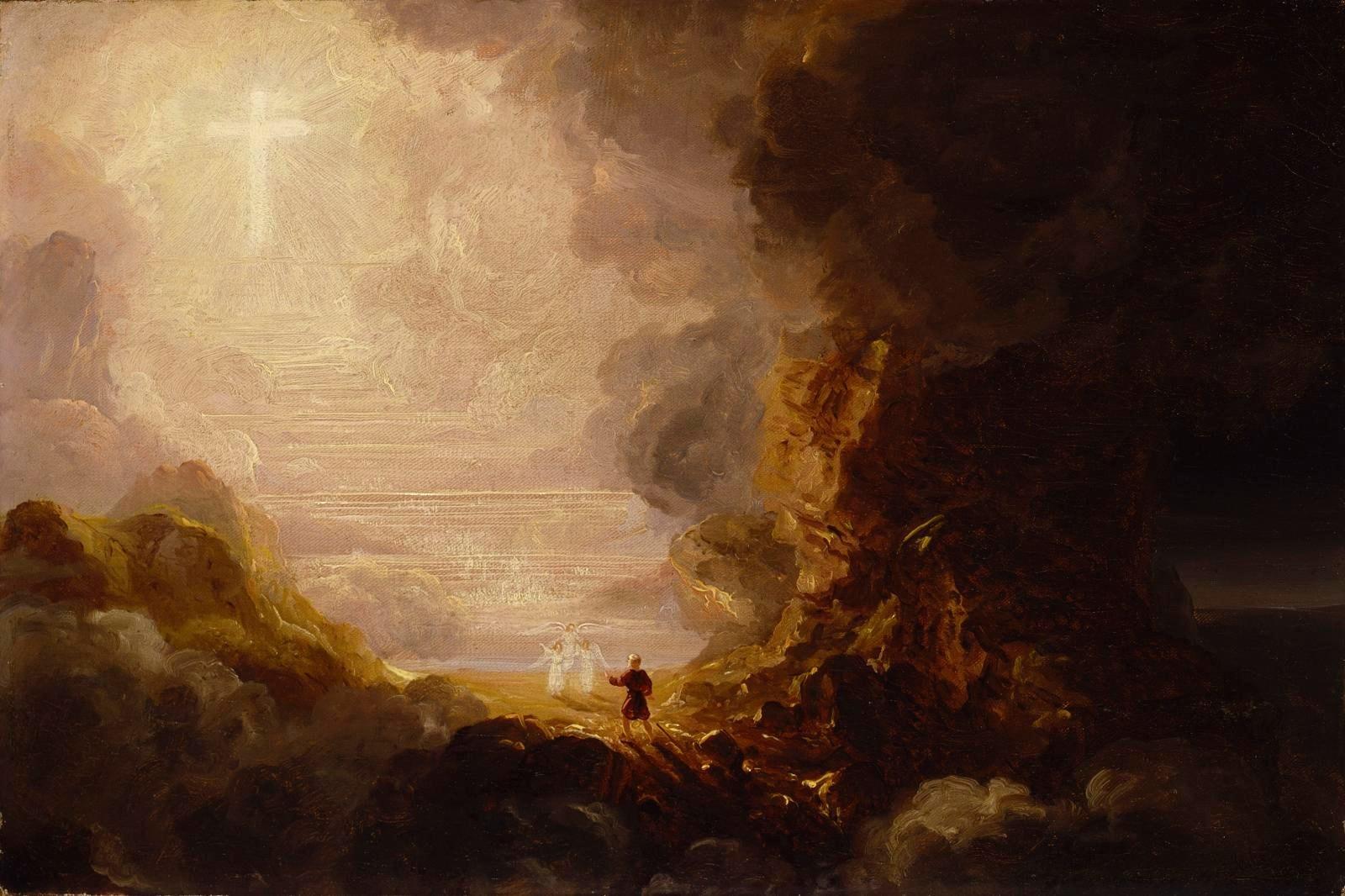
Thomas Cole, The Pilgrim of the Cross at the End of His Journey, 1846 to 1848. Public domain.
Isaiah 35:8 · Doctrine · Featured Study
The Way of Holiness
The Berean text names the Way of Holiness in one verse alone.
And there will be a highway called the Way of Holiness. The unclean will not travel it—only those who walk in the Way—and fools will not stray onto it.
- First taught
- Isaiah 11:16 “There will be a highway for the remnant…”
- Fullest statement
- Isaiah 62:10 “…through the gates; prepare the way for the…”
Isaiah's road is shut to the unclean and open to those God has set free.
Summary
Isaiah promises a holy highway for God's people coming home from exile. Mark, John, Acts and Hebrews take up the same road for John the Baptist, for Jesus and for the church.
- Strong's lexicon counts one use of maslul, the Hebrew word for this highway.
- In the Berean text Isaiah 51:11 repeats Isaiah 35:10 word for word.
- Readers place the end of the road in the return from Babylon, in the church, or in a return still to come.
A Highway in the Desert
Isaiah 35 turns a dry land into a garden and lays a road across it.
Isaiah 35 answers the oracle against Edom that comes before it. That oracle leaves Edom a burning land and a haunt for jackals, and this chapter turns the picture around for Zion. In its last three verses a highway crosses the renewed land, and the redeemed walk it home. Chapters 34 and 35 stand as a pair, judgment on one land and joy in the other. Hebrews 12:12 to 13 takes up the limp hands and feeble knees of Isaiah 35:3 and adds straight paths for the feet.
The wilderness and the land will be glad; the desert will rejoice and blossom like a rose.The next verse adds that the glory of the LORD will be seen in this desert.
Then the lame will leap like a deer and the mute tongue will shout for joy. For waters will gush forth in the wilderness, and streams in the desert.Jesus sent these signs back to John the Baptist when John asked from prison whether He was the One to come.
Say to those with anxious hearts: “Be strong, do not fear! Behold, your God will come with vengeance. With divine retribution He will come to save you.”The anxious hearts of this verse are the limp hands and feeble knees of the verse before it.
Isaiah 51:10 to 11 sets the same closing words after the memory of a road made through the sea for the redeemed.
Maslul and mesillahThe Hebrew of Isaiah 35:8
Strong's lexicon glosses maslul as a thoroughfare. The usual Hebrew word for a raised road is mesillah, which Strong's counts twenty-seven times in the Hebrew Bible.
Albert Barnes, in his Notes on Isaiah 35:8, takes maslul as a raised way cast up for the march of an army. He takes derek, the second word, as a road of any kind. John Wesley, in his Explanatory Notes on the same verse, reads the two words as one road, a causey built up above the ground.
The Road Through the Prophets
Six verses of Isaiah and four of the New Testament speak of a road for God's people.
Isaiah's highway and the New Testament's way stand here in the order of the canon.
- The step
- A highway for the remnant, as at the Exodus
- The step
- A highway from Egypt to Assyria for worship
- The step
- The Way of Holiness for the redeemed
- The step
- A highway prepared for the LORD
- The step
- The obstacles taken out of the way
- The step
- The highway built up for the people
- The step
- John prepares the way of the Lord
- The step
- Jesus is the way to the Father
- The step
- His followers are called the Way
- The step
- A new and living way into the Most Holy Place
Each verse adds one step to the picture of the road.
Mark 1:2 to 3, John 14:6, Acts 9:2, Hebrews 10:19 to 20
Who Walks on It
Three Hebrew words name the highway, the way and the ransom of Isaiah 35:8 to 10.
Maslul, highway
Its root is salal, to cast up.
Derek, way
The same word names the way prepared for the LORD in the wilderness.
Padah, ransom
To set free by paying a price, the verb behind the redeemed of the LORD in the chapter's last verse.
Holiness gives the road its name. Strong's, the numbered dictionary of Bible words, gives qadosh as the Hebrew word for holy and hagios as the Greek.
Fools will not stray onto itSamuel Horsley in Jamieson, Fausset and Brown; Adam Clarke
Jamieson, Fausset and Brown give Samuel Horsley's reading of the clause before it: the Holy One will be with them, walking in the way. On that reading even the simple will keep to the road, because God walks it with them.
Adam Clarke, in his Commentary on Isaiah 35:8, notes one Hebrew manuscript that adds the words in it. The Vulgate, Jerome's Latin translation, has the same words.
The ransomed and the redeemedAlbert Barnes
The King James Version reads the ransomed of the LORD in Isaiah 35:10, where the Berean text reads the redeemed. Albert Barnes, in his Notes on the verse, observes that this Hebrew word differs from the word for the redeemed in Isaiah 35:9.
Barnes judges the shade of difference lost to us.
The Road Home From Exile
Isaiah draws the return of the exiles in the colours of the Exodus from Egypt.
Albert Barnes, in his Notes on Isaiah 11:16, reads the comparison with Egypt as a promise. God would clear every obstruction from the road, as He did at the Red Sea.
On Isaiah 35:8 Barnes reads the highway in the language of the return from captivity. He holds that its main sense is the open way into the blessings of the Messiah's reign.
Isaiah 35 tells the return in the words of the first exodus.
| The question | The first exodus | Isaiah's road |
|---|---|---|
| Who travels | the people You have redeemed (Exodus 15:13) | the redeemed will walk upon it (Isaiah 35:9) |
| Where they go | to Your holy dwelling (Exodus 15:13) | enter Zion with singing (Isaiah 35:10) |
| The road | through the sea on dry ground (Exodus 14:22) | a highway (Isaiah 35:8) |
Whose chapter is it?C. C. Torrey; Franz Delitzsch
C. C. Torrey, in The Second Isaiah of 1928, held that chapters 34, 35 and 40 to 66 are poems of one later author. In his view the compilers split them at the end of chapter 35 and set the Isaiah narratives between.
Franz Delitzsch, in his commentary on Isaiah, held chapters 34 and 35 to be Isaiah's own close to the prophecies of chapters 28 to 33. He rested the case on the use Jeremiah and Zephaniah make of these chapters.
The Way in the New Testament
The voice of Isaiah 40:3 opens Mark's Gospel, and Acts gives the road's name to the church.
Luke 3:4 and John 1:23 also read Isaiah 40:3 of John the Baptist.
“A voice of one calling in the wilderness, ‘Prepare the way for the Lord, make straight paths for Him.’”Mark sets Isaiah's road at the head of his Gospel.
Thomas asked Jesus how the disciples could know the way, and Jesus answered with Himself.
Jesus answered, “I am the way and the truth and the life. No one comes to the Father except through Me.Jesus gives this answer on the night before the cross, in John 14:5 to 6.
I do confess to you, however, that I worship the God of our fathers according to the Way, which they call a sect. I believe everything that is laid down by the Law and written in the Prophets,Paul names the church by the road before the governor Felix.
Under the first covenant the high priest alone entered the Most Holy Place, once a year.
by the new and living way opened for us through the curtain of His body,The verse before it gives the ground of that entry, the blood of Jesus.
The wilderness community at QumranThe Community Rule, 1QS VIII.13 to 15
The Community Rule is one of the Dead Sea Scrolls, the Jewish texts found in caves near the Dead Sea. In 1QS VIII.13 to 15, in Geza Vermes's translation, it cites Isaiah 40:3 for the community's withdrawal into the wilderness. It reads the prepared path as the study of the Law.
Acts 24:14, Hebrews 10:20
The Voices
Eusebius in the fourth century read Isaiah 35 of Christ's healings, and Matthew Henry in the eighteenth read Isaiah 62:10 of John the Baptist.
Eusebius of Caesarea (died 339)
“Here also the coming of God for salvation, bringing many blessings, is precisely foretold. The prophet says that there will be a cure for the deaf, sight for the blind, yes, even healing for the lame and tongue-tied, and this was fulfilled only at the coming of our Savior Jesus Christ, by whom the eyes of the blind were opened, and the deaf regained their hearing. Why need I say, how many palsied and deaf and lame also received physical cure by the hands of his disciples? And how many others, afflicted with various diseases and maladies, received of him healing and salvation, according to the inspired prediction of prophecy and according to the unimpeachable testimony of the holy Gospels? And the prophecy here disguises under the name of ‘desert’ the church of the Gentiles, which for long years deserted of God is being evangelized by those of whom we are speaking, and it says that besides other blessings the glory of Lebanon will be given to the desert. Now it is customary to call Jerusalem Lebanon allegorically, as I will show, when I have time, by proofs from holy Scripture. This prophecy before us, therefore, teaches that by God's presence with men the glory of Lebanon will be given to that which is called ‘desert,’ that is to say, the church of the Gentiles.”
Eusebius of Caesarea · Proof of the Gospel 6:21 · on Isaiah 35:1Patristic
Matthew Henry (1662 to 1714)
“Thus John Baptist was sent to prepare the way of the Lord, Matt. iii. And, before Christ by his graces and comforts comes to any for salvation, preparation is made for him by repentance, which is called the preparation of the gospel of peace, Eph. vi.”
Matthew Henry · Commentary on the Whole Bible · on Isaiah 62:10Puritan
Where the Road Leads
Each reading names its holders and the work that sets it out.
The road home from Babylon, and a fuller redemption of IsraelJamieson, Fausset and Brown
Jamieson, Fausset and Brown, on Isaiah 35:10, apply the words to the return from Babylon in the letter. In a fuller sense they apply them to the completed redemption of literal and spiritual Israel.
The road is the holy life of the churchThomas Aquinas; Phoebe Palmer
Thomas Aquinas, in his Commentary on Isaiah, read the unclean of the verse as the Gentile. He applied the passage mystically to the Church militant and triumphant, the church on earth and in heaven.
Phoebe Palmer opened The Way of Holiness, her book of 1843, in the way cast up for the ransomed of the Lord. A footnote names the verse.
The road waits for a return of IsraelCharles Spurgeon
Charles Spurgeon opened Sermon No. 1912, The Holy Road, of 1886, with two returns of Israel in the past, from Egypt and from Babylon. He counted himself among those who believe a third return still awaits the chosen people.
Where It Points
Revelation bars everything unclean from the holy city. Hebrews ties the sight of the Lord to holiness.
But nothing unclean will ever enter it, nor anyone who practices an abomination or a lie, but only those whose names are written in the Lamb’s Book of Life.Revelation keeps the city as Isaiah kept the road.
Pursue peace with everyone, as well as holiness, without which no one will see the Lord.The letter sets holiness on the path of every believer.
Sources
Scripture is the Berean Standard Bible.
- Strong's Exhaustive Concordance and Brown-Driver-Briggs, Hebrew 4547 and 4546, as printed by Bible Hub.
- James Strong, the Hebrew and Greek dictionaries of the Exhaustive Concordance, 1890, Hebrew 1870, 4547, 6299 and 6918, and Greek 40.
- Berean Standard Bible, the whole text searched for the words Way of Holiness.
- Albert Barnes, Notes, Explanatory and Practical, on Isaiah 11:16, 35:8 and 35:10.
- John Wesley, Explanatory Notes upon the Old Testament, 1765, on Isaiah 35:8.
- Matthew Henry, Commentary on the Whole Bible, 1710, on Isaiah 62:10.
- Jamieson, Fausset and Brown, Commentary Critical and Explanatory on the Whole Bible, 1871, on Isaiah 35:8 and 35:10.
- Adam Clarke, Commentary on the Bible, 1832, on Isaiah 35:8 and 35:10.
- Eusebius of Caesarea, Proof of the Gospel 6:21.
- Thomas Aquinas, Commentary on Isaiah, on Isaiah 35:8.
- Charles Spurgeon, Metropolitan Tabernacle Pulpit No. 1912, The Holy Road, 1886, CCEL edition.
- Phoebe Palmer, The Way of Holiness, with Notes by the Way, New York: Piercy and Reed, 1843, section I, page 1.
- The Community Rule, 1QS VIII.13 to 15, translated by Geza Vermes.
- C. C. Torrey, The Second Isaiah: A New Interpretation, New York: Charles Scribner's Sons, 1928.
- Franz Delitzsch on Isaiah 34 to 35, in Keil and Delitzsch, Commentary on the Old Testament.
Keep Studying
Studies5