
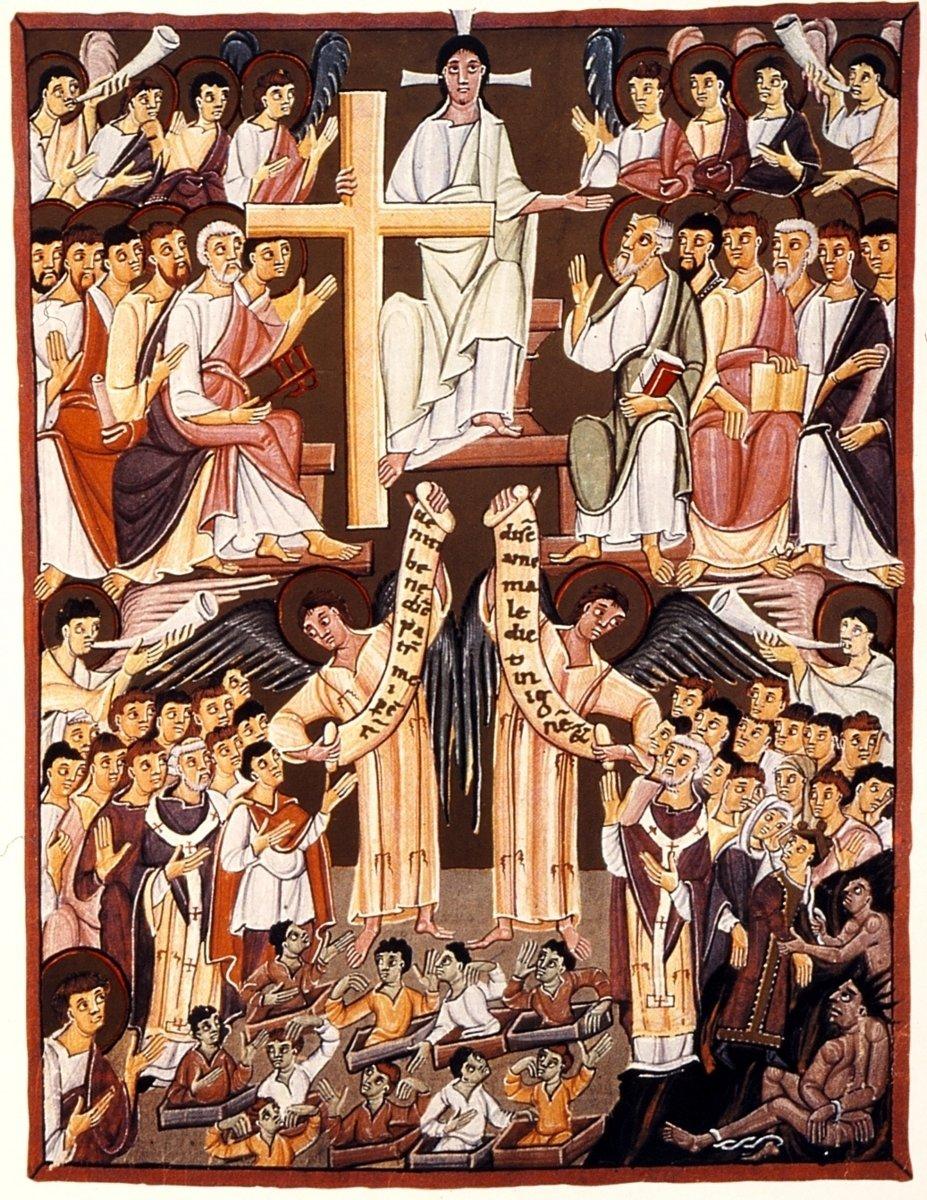
The Bamberg Apocalypse, The Last Judgement, about 1000. Public domain.
Exodus 32 and Malachi 3 · Symbol · Featured Study
The Book of Life
The record runs from the Law and the Psalms through the prophets and the gospels to the last chapters of Revelation.
Moses asked God to blot his own name out of His book if Israel could not be forgiven.
Nevertheless, do not rejoice that the spirits submit to you, but rejoice that your names are written in heaven.”
Nevertheless, do not rejoice that the spirits submit to you, but rejoice that your names are written in heaven.”
- The word
- βίβλος (biblos), G976
- First appears
- Exodus 32:32 “…blot me out of the book that You…”
Summary
The book of life is God's record of those who belong to Him. Scripture speaks of it in prayer, in prophecy, in the words of Jesus and in the visions of Revelation.
- The words Book of Life stand in eight verses of the Berean text, one in the Psalms, one in Philippians and six in Revelation.
- The Hebrew word for the book in Exodus 32:32 and for the scroll in Malachi 3:16 is the same, Strong's H5612.
- Christians differ over whether a name once written can be blotted out.
The Book Moses Named
The first mention comes in a prayer of intercession.
After the golden calf, Moses went to plead for Israel.
So Moses returned to the LORD and said, “Oh, what a great sin these people have committed! They have made gods of gold for themselves. Yet now, if You would only forgive their sin.... But if not, please blot me out of the book that You have written.” The LORD replied to Moses, “Whoever has sinned against Me, I will blot out of My book.Moses makes the offer, and the LORD answers it.
The Book Across the Canon
David, Daniel, Jesus, Paul and John each speak of the record.
From the Psalms to Revelation, God keeps a record of the names of His people.
- What it says of the book
- David prays that his enemies be blotted out of the Book of Life.
- What it says of the book
- Everyone whose name is found written in the book will be delivered.
- What it says of the book
- Jesus tells the seventy-two to rejoice that their names are written in heaven.
- What it says of the book
- Paul says the names of his fellow workers are in the Book of Life.
- What it says of the book
- The overcomer is dressed in white and confessed before the Father.
- What it says of the book
- Anyone not written in the Book of Life is thrown into the lake of fire.
- What it says of the book
- Only those written in the Lamb's Book of Life enter the city.
Each link with the verse that carries it.
The Scroll of Remembrance
Malachi wrote to people who said that it was futile to serve God.
The answer to their complaint came as a written record.
At that time those who feared the LORD spoke with one another, and the LORD listened and heard them. So a scroll of remembrance was written before Him regarding those who feared the LORD and honored His name. “They will be Mine,” says the LORD of Hosts, “on the day when I prepare My treasured possession. And I will spare them as a man spares his own son who serves him. So you will again distinguish between the righteous and the wicked, between those who serve God and those who do not.”The prophet gives the record a purpose.
Written from the Foundation of the World
One phrase in the verse can go with either of two words.
The King James Version joins the phrase from the foundation of the world to the Lamb's death, and the Berean text joins it to the writing of the names.
And all who dwell on the earth will worship the beast—all whose names have not been written from the foundation of the world in the Book of Life belonging to the Lamb who was slain.The Berean text follows the second reading.
Albert Barnes preferred the first reading and noted that Professor Stuart joined the phrase to the names. Barnes judged, “Either construction makes good sense.” Revelation 17:8 uses the same phrase of the names alone.
The beast that you saw—it was, and now is no more, but is about to come up out of the Abyss and go to its destruction. And those who dwell on the earth whose names were not written in the Book of Life from the foundation of the world will marvel when they see the beast that was, and is not, and yet will be.John gives the phrase a second time.
Registers of Names
Cities and Israel kept lists of their people, and the prophets speak of God's register in those terms.
Albert Barnes, on Luke 10:20, explains that a city or a state wrote the names of its citizens in a register.
Names were struck from it, he wrote, “when they became unworthy, or forfeited the favor of their country.”
Isaiah and Ezekiel speak of God's people in the same terms of a written roll.
Whoever remains in Zion and whoever is left in Jerusalem will be called holy—all in Jerusalem who are recorded among the living—Isaiah sees a roll of the survivors.
My hand will be against the prophets who see false visions and speak lying divinations. They will not belong to the council of My people or be recorded in the register of the house of Israel, nor will they enter the land of Israel. Then you will know that I am the Lord GOD.Ezekiel names those left off the roll.
The Word Biblos
The Greek word began as the name of a writing material.
The Greek word for book in the phrase book of life is biblos, Strong's G976. Strong's Concordance defines it as the inner bark of the papyrus plant and, by implication, a sheet or scroll of writing. In Philippians 4:3 it stands beside the word for life, Strong's G2222.
How the Teachers Read It
Teachers from the fourth century to the nineteenth read the book and the names in it.
Ambrose of Milan (died 397)
Concerning Repentance 1.9.42
Ambrose of Milan, on Exodus 32:32, read Moses' offer as a lesson in prayer for others.
“The greater the sin, the more worthy must be the prayers that are sought. For it was not any one of the common people who prayed for the Jewish people, but Moses, when forgetful of their covenant they worshiped the head of a calf. Was Moses wrong? Certainly he was not wrong in praying, who both merited and obtained that for which he asked. For what should such love not obtain as that of his when he offered himself for the people and said, ‘And now, if you will forgive their sin, forgive; but if not, blot me out of the book of life.’ We see that he does not think of himself, like a man full of fancies and scruples, whether he may incur the risk of some offense, as Novatian says he dreads that he might. But rather, thinking of all and forgetful of himself, he was not afraid lest he should offend, so that he might rescue and free the people from danger and offense.”
on Exodus 32:32Patristic
Theophylact of Ohrid (died 1107)
Catena Aurea by Aquinas
Theophylact of Ohrid, on Luke 10:20, set the fall of the devil beside the names of men written above.
“For the names of the saints are written in the book of life not in ink, but in the memory and grace of God. And the devil indeed fell from above; but men being below have their names inscribed above in heaven.”
on Luke 10:20Patristic
Matthew Henry (1662 to 1714)
Commentary on the Whole Bible
Matthew Henry, on Philippians 4:3, drew a rule of charity from the verse.
“Observe, There is a book of life; there are names in that book and not characters and conditions only. We cannot search into that book, or know whose names are written there; but we may, in a judgment of charity, conclude that those who labour in the gospel, and are faithful to the interest of Christ and souls, have their names in the book of life.”
on Philippians 4:3Puritan
Charles Spurgeon (1834 to 1892)
The Treasury of David, Vol. 3
Charles Spurgeon, on Psalm 69:28, read the prayer against those who had enrolled themselves among God's people falsely.
“Let them be blotted out of the book of the living. Though in their conceit they wrote themselves among the people of God, and induced others to regard them under that character, they shall be unmasked and their names removed from the register. Enrolled with honour, they shall be erased with shame. Death shall obliterate all recollection of them; they shall be held no longer in esteem, even by those who paid them homage.”
on Psalm 69:28Particular Baptist
Can a Name Be Blotted Out?
The LORD's answer to Moses, a prayer of David and the letter to Sardis speak of blotting out, and Christians read them three ways.
Three readings of the blotting out, each with its holders and a work to read.
| Reading | Its meaning | Held by | A work to read |
|---|---|---|---|
| Kept for ever | The book records those God has chosen, and none of them is lost. | Augustine; Matthew Henry | Augustine, City of God 20.8 |
| Can be removed | A name written can be taken off when a person turns away from God. | John Wesley; Adam Clarke | Wesley, Explanatory Notes upon the New Testament, on Revelation 3:5 |
| A roll of the living | In Psalm 69 the book is the roll of those alive on earth. | Albert Barnes; Adam Clarke | Barnes, Notes, Explanatory and Practical |
Kept for everAugustine of Hippo; Matthew Henry
Augustine wrote that in the last persecution “those who have not been written in the book of life shall in large numbers yield.”
Those who “desert to the devil,” he wrote, “do not belong to the predestinated number of the sons of God.”
Matthew Henry, on Luke 10:20, wrote that “they whose names are written in heaven shall never perish; they are Christ's sheep, to whom he will give eternal life.”
My sheep listen to My voice; I know them, and they follow Me. I give them eternal life, and they will never perish. No one can snatch them out of My hand. My Father who has given them to Me is greater than all. No one can snatch them out of My Father’s hand.The holders of this reading rest on these words of Jesus.
Against this reading stand Exodus 32:33, where God says He will blot out whoever has sinned against Him, and the words of Christ to the church at Sardis.
Can be removedJohn Wesley; Adam Clarke
Wesley, on Revelation 3:5, wrote that Christ would not blot out the overcomer's name “like that of the angel of the church at Sardis.”
On Revelation 21:27 he called those written in the Lamb's book “true, holy, persevering believers.”
Adam Clarke, on Revelation 20:15, urged his reader to see that his name was written in the register and never blotted out.
Against this reading stand Revelation 17:8, and Revelation 13:8 as the Berean text reads it.
A roll of the livingAlbert Barnes; Adam Clarke
Barnes read the prayer of Psalm 69:28 as a prayer that the wicked cease to live, and wrote, “The language has no reference to the future world”.
Clarke read it the same way: “They shall be cut off from life”.
Against this reading, the Berean text names the book in Psalm 69:28 the Book of Life and sets it beside being listed with the righteous, the name Revelation gives the record of eternal life.
Enrolled in Heaven
Hebrews pictures the church as already gathered before God.
in joyful assembly, to the congregation of the firstborn, enrolled in heaven. You have come to God the Judge of all, to the spirits of the righteous made perfect,Hebrews gives the church its place in the roll.
Sources
Scripture is the Berean Standard Bible.
- King James Version, Revelation 13:8.
- Hebrew and Greek word tags for Exodus 32:32, Malachi 3:16 and Revelation 3:5.
- Strong's Concordance, entry G976.
- Augustine of Hippo, The City of God, book 20, chapter 8.
- Matthew Henry, Commentary on the Whole Bible, 1710, on Luke 10:20.
- John Wesley, Explanatory Notes upon the New Testament, 1755, on Revelation 3:5 and 21:27.
- Adam Clarke, Commentary on the Bible, 1832, on Revelation 20:15 and Psalm 69:28.
- Albert Barnes, Notes, Explanatory and Practical, on Luke 10:20, Psalm 69:28 and Revelation 13:8.
- Theophylact of Ohrid, in Thomas Aquinas, Catena Aurea, on Luke 10:20.
- Matthew Henry, Commentary on the Whole Bible, 1710, on Philippians 4:3.
- Ambrose of Milan, Concerning Repentance 1.9.42, on Exodus 32:32.
- Charles Spurgeon, The Treasury of David, volume 3, 1872, on Psalm 69:28.
Keep Studying
People and groups6