
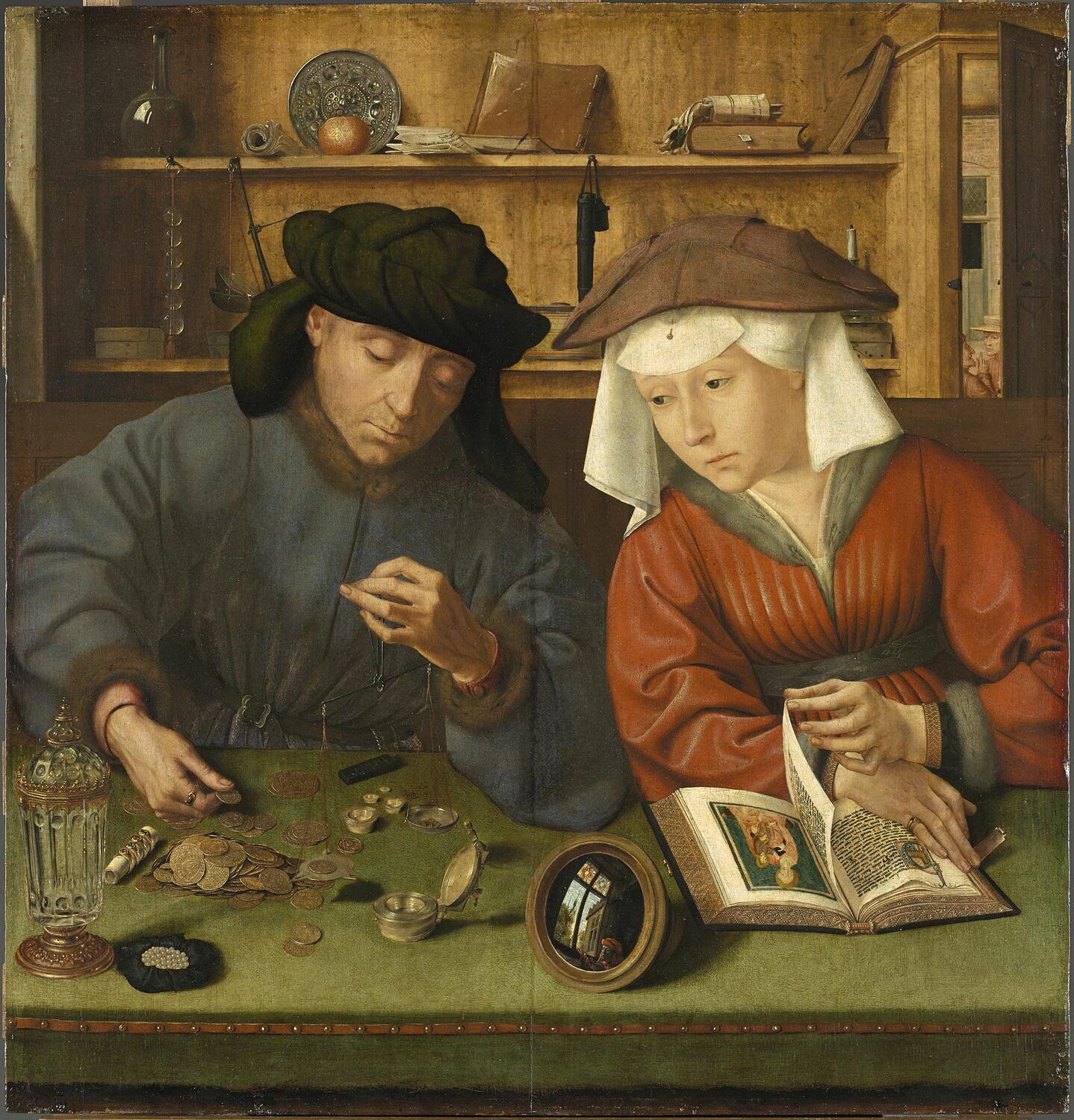
Quentin Metsys, The Moneylender and His Wife, 1514. Public domain.
Psalms 10, 17, 37, 49, 52 and 92 · Subject · Featured Study
The Prosperity of the Wicked
Six psalms describe the wicked at ease and answer with death, judgment and a better portion.
The psalmists watched men grow rich by wrong and wrote down what became of them.
“Look at the man who did not make God his refuge, but trusted in the abundance of his wealth and strengthened himself by destruction.”
- Book
- Psalms
- Hold in memory
- Psalm 49:17
Summary
Several psalms look at the wicked when they prosper and ask what their wealth is worth. They answer with pictures of things that fade, with death, and with a portion the wicked never have.
- Psalm 49 repeats its refrain on the man who cannot keep his riches, at verses 12 and 20
- The readings of Psalm 37:25 run from Origen in the third century to Spurgeon in the nineteenth
- Psalm 73, where Asaph tells his own envy of the wicked, has its own page
What the Psalmists Saw
Psalms 10 and 17 show the wicked secure in themselves.
He is secure in his ways at all times; Your lofty judgments are far from him; he sneers at all his foes. He says to himself, “I will not be moved; from age to age I am free of distress.”Psalm 10 sets this boast in the mouth of the wicked.
from such men, O LORD, by Your hand— from men of the world whose portion is in this life. May You fill the bellies of Your treasured ones and satisfy their sons, so they leave their abundance to their children.David sets the men of the world beside God's treasured ones.
Asaph's own account of his envy, and of the sanctuary where it ended, is read verse by verse on the page of Psalm 73.
The promise of the land to the meek in Psalm 37, which Jesus took into the Sermon on the Mount, has its own page.
The rule that the righteous prosper and the wicked suffer is traced through the canon with its limits.
Pictures of Prosperity
Each picture carries its end in the same verse.
The psalms draw the wealth of the wicked from the field, the forest and the flock.
| Picture | What it shows | Its end |
|---|---|---|
| Grass and tender plants | Quick growth | They wither quickly and wilt |
| The glory of the fields | A season's bloom | They vanish like smoke |
| A well-rooted native tree | A ruthless man flourishing | He passed away and could not be found |
| The beasts that perish | A man in his wealth | He cannot endure |
| Sheep bound for Sheol | The proud and their abode | Death will be their shepherd |
What the Psalms Answer
Psalms 49, 92 and 17 each give the reader an answer.
Psalm 49:17 says that the rich man carries nothing away when he dies. Charles Spurgeon, in The Treasury of David, calls his acres a leasehold that death ends.
that though the wicked sprout like grass, and all evildoers flourish, they will be forever destroyed.The next verse sets the LORD, exalted forever, beside these evildoers.
Spurgeon reads the flourishing of Psalm 92:7 as the prelude to an overthrow: the wicked grow to die and blossom to be blasted.
As for me, I will behold Your face in righteousness; when I awake, I will be satisfied in Your presence.David's own hope follows his prayer against the men of the world in verse 14.
The Fathers on Envy of the Rich
Ambrose, Basil and Jerome each teach against envy of the rich.
Basil of Caesarea (died 379)
Basil of Caesarea, in his Homilies on the Psalms, answers on Psalm 49:16 those who conclude from the unequal division of wealth that no providence watches over the earth. He tells the poor to await the everlasting life. Beside the psalm he sets the words to the rich man in Luke 16, that he received his good things in his lifetime.
Ambrose of Milan (died 397)
Ambrose of Milan, in his Commentary on Twelve Psalms, warns on Psalm 37:1 that good people who see others grow rich by fraud become green with jealousy. On Psalm 37:35 he likens the rich to a cedar on a high peak, which the wind can shatter and fire can burn.
Jerome (died 420)
Jerome, in his Homily 21, points to emperors, prefects and triumphs as he preaches on Psalm 92:7. He says that whatever has an end is not to be counted among good things.
Readings of Psalm 37:25
Four readings of David's witness from old age are named, each with its holders.
I once was young and now am old, yet never have I seen the righteous abandoned or their children begging for bread.Readers from Origen to Spurgeon have weighed this verse against what they saw.
Psalms 37 and 73 as a numbered pair, with Psalm 49 beside them, are studied on their own page.
True as it standsAdam Clarke
Clarke, in his Commentary on the Bible, writes that he believes the verse literally true in all cases. He says that he has travelled in different countries, grown grey, and seen no instance to the contrary.
The objection: Ambrose had seen many just people forsaken when those in power persecuted them.
A rule without exception under an older orderCharles Spurgeon
Spurgeon, in The Treasury of David, says the verse is not his own observation as it stands, since he has relieved the begging children of good men. He holds that David lived under a dispensation more outward than the present rule of faith, and that the righteous are never forsaken.
The objection: the reading divides the verse, keeping its first clause as a rule and setting its second aside.
One man's observation in a short lifeAmbrose of Milan; Augustine of Hippo
Ambrose, in his Commentary on Twelve Psalms, grants that David never saw the just forsaken in his own lifetime. He says a lifespan is brief and the statement, taken at face value, is incredible. Augustine, in his Exposition on Psalm 37, asks how long one man's life is, and recalls that righteous Abraham suffered hunger and left his land.
The objection: David offers the verse as teaching beside the commands of the psalm, and these readings narrow it to a report.
The bread of the will of GodOrigen of Alexandria
Origen, in his Homilies on the Psalms, reads the bread as the will of the Father and the bread from heaven. So read, the righteous never suffer the famine the verse denies.
The objection: the verse speaks of children begging bread, a plain picture of want.
The Portion
The psalms measure wealth by what remains after death.
The psalms grant that the wicked prosper. They set that wealth beside its end, at death and under the judgment of God. Psalm 37:37 to 38 bids the reader watch the upright, whose posterity is sure, and the wicked, whose future is cut off.
The cry of the wronged in Psalms 10 and 94 belongs to the study of injustice.
Keep Studying
People and groups3
Subjects1
Go further7
Trials of life1