
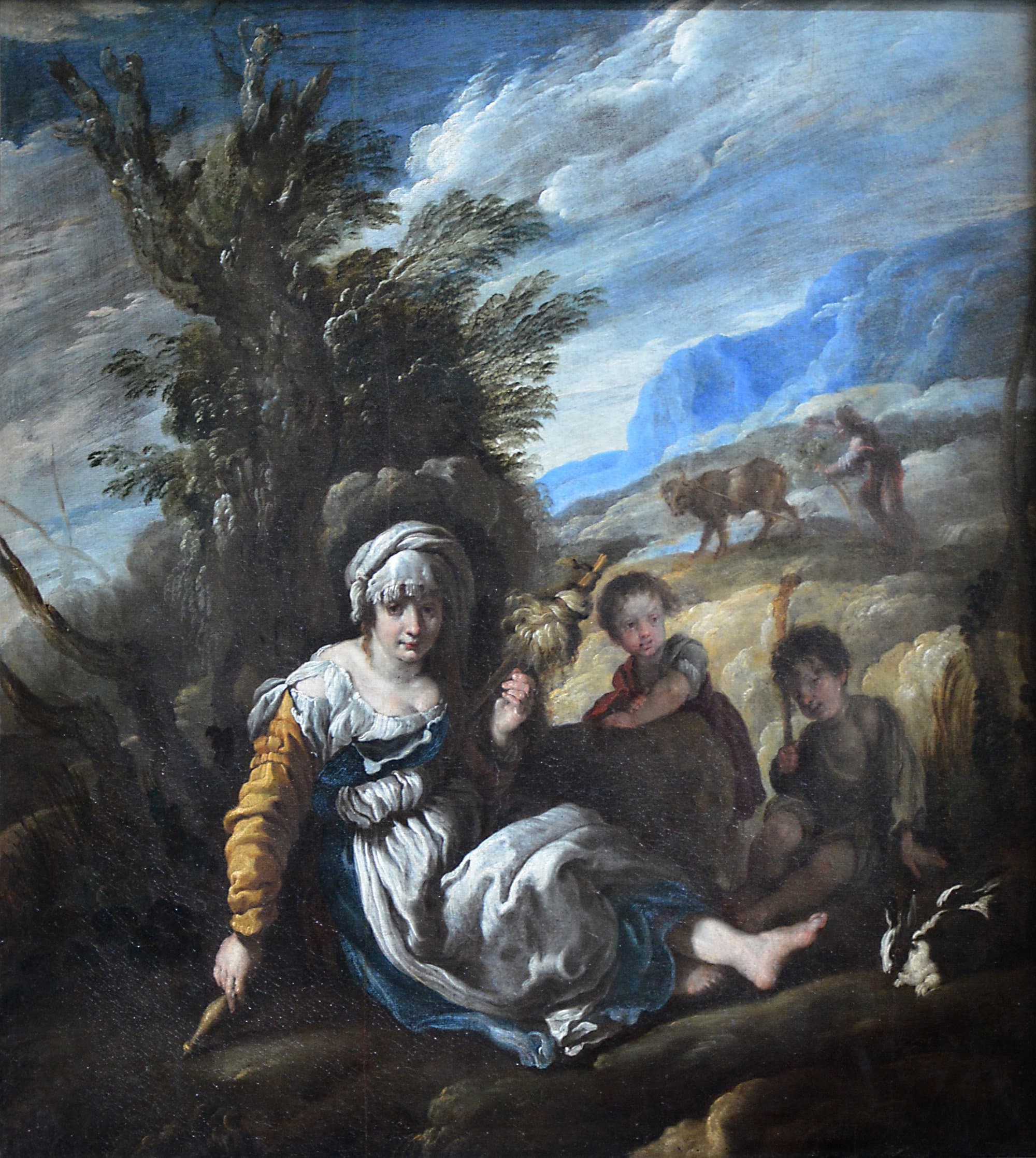
Genesis 3:17 to 19 · Passage · Work and Toil
Cursed Is the Ground
Genesis 3:17 to 19 is the last of God's three sentences after the fall, spoken to Adam after the serpent and the woman.
The one thing cursed in the sentence on the man is the ground under his feet.
And to Adam He said: “Because you have listened to the voice of your wife and have eaten from the tree of which I commanded you not to eat, cursed is the ground because of you; through toil you will eat of it all the days of your life.
- The passage
- Genesis 2:15, Genesis 3:17 to 19
- Book
- Genesis
- Hold in memory
- Genesis 2:15, Genesis 3:19
Summary
Genesis 3:17 to 19 is the sentence God spoke to Adam after he ate from the forbidden tree. It leaves him his work and changes the soil he works. The field now yields thorns and thistles, his bread comes by the sweat of his brow, and his labor ends when he returns to the dust from which he was taken. Toil in Scripture begins here, as the hard edge of work in a fallen world.
- God placed the man in Eden to cultivate and keep the garden before he sinned, so work was part of life in paradise.
- The Hebrew noun for toil in Genesis 3:17, itstsabon, also names the woman's pain in childbirth in Genesis 3:16.
- Lamech named his son Noah in hope of comfort from the toil the curse laid on the land (Genesis 5:29).
- Readers disagree whether the sentence made work itself a penalty or made the work of Eden hard.
The Charge and the Sentence
Genesis 2:15 and Genesis 3:17 to 19, read in the order Genesis gives them.
Cursed Is the Ground studies Genesis 2:15 and Genesis 3:17 to 19 within the trial of work and toil, the weariness of labor that never seems to pay for itself. Anyone who has come home worn out from a job, or watched a crop or a business fail after long effort, meets the question these verses raise.
The question it answers is what God's sentence did to the man's work. It compares the garden with the sentence, traces the word for toil to the naming of Noah, and follows the thorns of Genesis 3:18 to the Passion. It also sets out two questions readers still dispute, each reading with its holder and the objection to it.
Then the LORD God took the man and placed him in the Garden of Eden to cultivate and keep it.The verse stands here because it names the task in the garden that the sentence of Genesis 3 later touches, in two Hebrew verbs.
The two verbs of the charge are avad (H5647), to work or serve, and shamar (H8104), to keep or guard.
Before and After the Sentence
The man's ground, his food and the end of his days in Genesis 2 and in Genesis 3.
The ground that fed the man freely in the garden becomes a field that feeds him only by toil and sweat.
| What is set side by side | In the garden, Genesis 2 | After the sentence, Genesis 3 |
|---|---|---|
| What the ground gives | "Out of the ground the LORD God gave growth to every tree" (Genesis 2:9) | "Both thorns and thistles it will yield for you" (Genesis 3:18) |
| How the man eats | "You may eat freely from every tree of the garden" (Genesis 2:16) | "By the sweat of your brow you will eat your bread" (Genesis 3:19) |
| The end of his days | "the man became a living being" (Genesis 2:7) | "to dust you shall return" (Genesis 3:19) |
Each row takes something the garden supplied and turns it against the man's strength.
The last row rests on a pair of Hebrew words. Genesis 2:7 forms ha-adam, the man (H120), from the dust of ha-adamah, the ground (H127), and Genesis 3:19 sends him back to that ground and that dust (H6083).
What the Sentence Curses
The serpent and the soil in Genesis 3, and the word for toil at the birth of Noah.
The verb arur (H779), cursed, is spoken twice in the judgment of Genesis 3. God says it to the serpent, “cursed are you” (Genesis 3:14), and He says it of ha-adamah, the soil, in Genesis 3:17, where the Hebrew reads that it is cursed for your sake.
Charles Spurgeon drew the lesson in his sermon Thorns and Thistles, No. 2299 in The Metropolitan Tabernacle Pulpit. He said the curse “glances obliquely and falls upon the ground whereon he stands”, while the serpent is struck directly.
Strong's explains itstsabon (H6093) as worrisomeness, that is, labor or pain. The noun stands three times in Scripture, and the third is at the birth of Noah. Lamech prayed, “May this one comfort us in the labor and toil of our hands caused by the ground that the LORD has cursed” (Genesis 5:29).
Paul writes that the creation was subjected to futility in hope and groans together until the present time (Romans 8:20 to 22).
Thorns and the Crown
The crown of thorns at the Passion and John Gill's reading of it.
The soldiers twisted together a crown of thorns, set it on His head, and dressed Him in a purple robe.The verse stands here because its crown is woven of thorns, the plant Genesis 3:18 names first among the yield of the cursed ground.
John Gill wrote in his Exposition of the New Testament (1746 to 1748) that the crown was an emblem of Christ made a curse. He added, “thorns being the produce of the curse upon the earth”.
John's Gospel tells the mockery without naming Genesis.
Two Questions of the Curse
Whether work became a penalty, and how far the curse reaches, each reading with its holder and the objection to it.
A penalty or a hardship: labor came with the sentenceTertullian
Tertullian, in Against Marcion, book 2, chapter 11, read the fall as the start of labor for food. In the translation of Peter Holmes in the Ante-Nicene Fathers (1885) he wrote, “Immediately arise sweat and labour for bread, where previously on every tree was yielded spontaneous food and untilled nourishment.”
The objection: Genesis 2:5 says that before the garden “there was no man to cultivate the ground”, and Genesis 2:15 gives the man that cultivation before he sinned.
A penalty or a hardship: the same work made hardAdam Clarke; Jamieson, Fausset and Brown
Adam Clarke, in his Commentary on the Bible (1832), wrote on Genesis 2:15 that “God gave him work to do, and his employment contributed to his happiness”. Jamieson, Fausset and Brown wrote on Genesis 3:17 in their Commentary Critical and Explanatory (1871). They said that “what before his fall he did with ease and pleasure, was not to be accomplished after it without painful and persevering exertion”.
The objection: Genesis 2 says nothing of how hard the garden work was, so the ease these writers describe is drawn from the text's silence.
How far it reaches: the whole creationJohn Wesley
John Wesley read Romans 8:20 beside Genesis 3:17 and Genesis 5:29 in his Explanatory Notes upon the New Testament (1755). He wrote, “Adam only made it liable to the sentence which God pronounced; yet not without hope.”
The objection: Romans 8:20 names no verse of Genesis and does not say when the creation was subjected.
How far it reaches: the soil, with Romans 8 speaking of believersAlbert Barnes
Albert Barnes, in his Notes, Explanatory and Practical (1832 to 1869), read the creature of Romans 8:20 as “The renewed creature; the Christian mind”. On that reading the verse speaks of believers under trial, and the curse of Genesis 3:17 stays on the soil.
The objection: Romans 8:21 says the creation itself will be brought into the freedom “of the children of God”, which sets the creation beside the believers as a second party.
Work Carried Out of Eden
The verb of the charge in Eden returns as the man leaves it.
Genesis 3:23 sends the man out of the garden “to work the ground from which he had been taken”, and the Hebrew verb is avad, the verb of his charge in Genesis 2:15.
Sources
Scripture is the Berean Standard Bible.
- STEP Bible, Translators Amalgamated Hebrew Old Testament (Tyndale House, Cambridge), CC BY 4.0.
- STEP Bible brief lexicon of Extended Strongs for Hebrew (Tyndale House, Cambridge), CC BY 4.0, with the definitions of James Strong, Strong's Exhaustive Concordance of the Bible (1890)
- Charles Spurgeon, Thorns and Thistles, Sermon No. 2299, The Metropolitan Tabernacle Pulpit (1893)
- Tertullian, Against Marcion, book 2, chapter 11, translated by Peter Holmes, Ante-Nicene Fathers, volume 3 (Buffalo: Christian Literature Publishing, 1885)
- Adam Clarke, Commentary on the Bible (1832), Genesis 2:15.
- Robert Jamieson, A. R. Fausset and David Brown, Commentary Critical and Explanatory on the Whole Bible (1871), Genesis 3:17.
- John Wesley, Explanatory Notes upon the New Testament (1755), Romans 8:20.
- Albert Barnes, Notes, Explanatory and Practical, on the Old and New Testaments (1832 to 1869), Romans 8:20.
- John Gill, Exposition of the New Testament (1746 to 1748), John 19:2.
Keep Studying
Read it1
In this trial6
People and groups10
Symbols1
Subjects1