
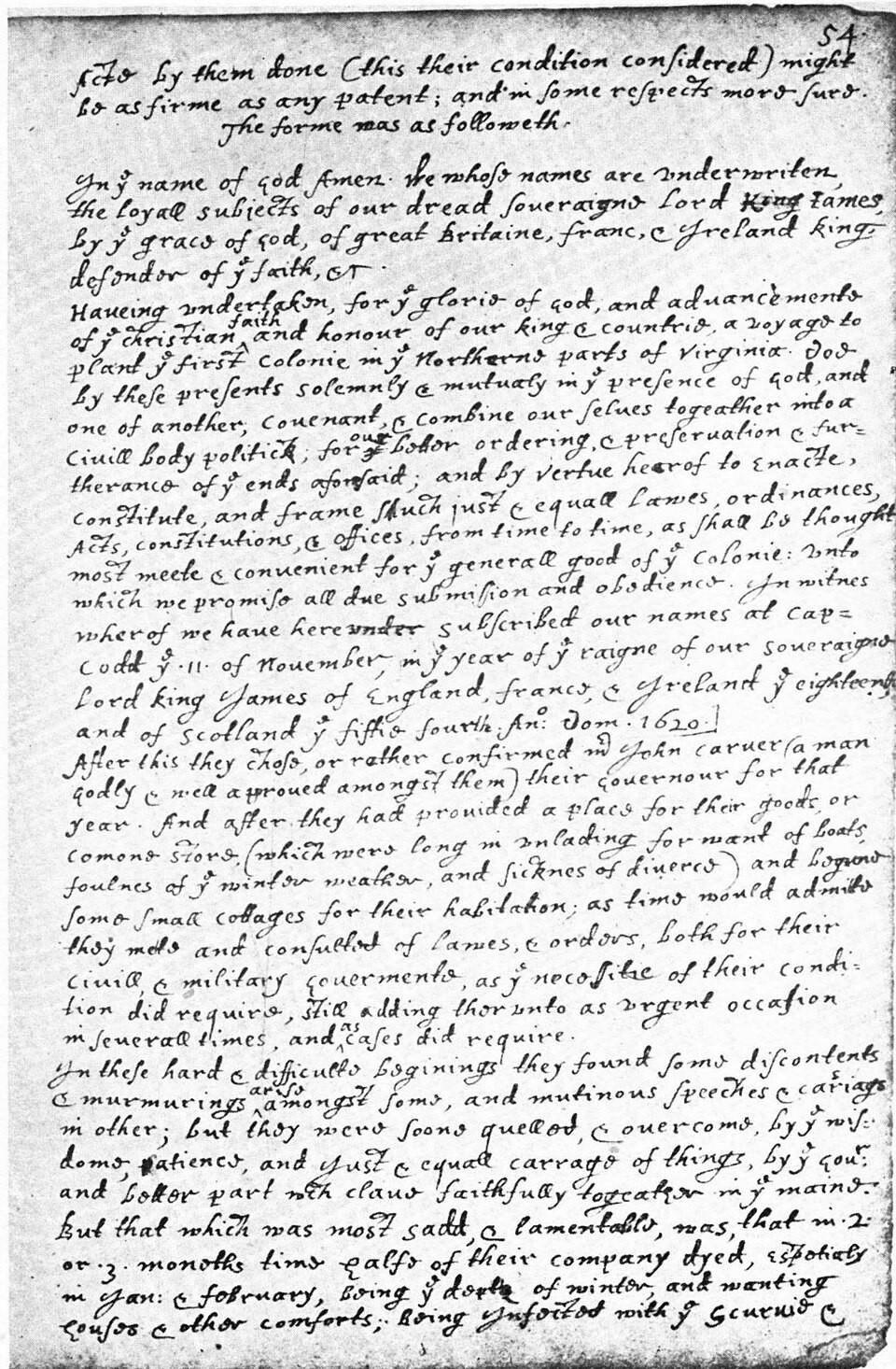
William Bradford, a page of his history of Plymouth with the compact, public domain
1607 to 1630 · The churches · Featured Study
The Pilgrims and the Puritans of New England
A Separatist church sailed from Leyden on the Mayflower to found Plymouth. Within a decade the churches of Salem and the Bay of Massachusetts followed it.
As the ship made ready at Delfthaven, Bradford wrote of the departing company that they knew they were pilgrims.
Give thanks to the LORD, for He is good; His loving devotion endures forever. Let the redeemed of the LORD say so, whom He has redeemed from the hand of the enemy
Give thanks to the LORD, for He is good; His loving devotion endures forever. Let the redeemed of the LORD say so, whom He has redeemed from the hand of the enemy
Summary
The Pilgrims were an English church. They fled to Holland and later crossed the ocean to New England.
- Their governor, William Bradford, wrote the main record of the colony.
- They signed a compact to rule themselves before they landed.
- Half of them died in the first winter.
- Later ships brought more settlers, who formed churches at Salem and around the Bay.
The Texts Bradford Heard in Their Story
Bradford wrote the crossing in the words of Psalm 107 and the departure in the words of Hebrews 11.
Looking back on the landing, Bradford borrowed the words of Psalm 107. The children of the settlers ought to say that their fathers crossed the great ocean and cried to the Lord in the wilderness.
Some wandered in desert wastelands, finding no path to a city in which to dwell. They were hungry and thirsty; their soul fainted within them.The wandering in the wilderness with no city to dwell in, which Bradford applied to the first winter.
Bradford's word for the company leaving Leyden comes from the letter to the Hebrews.
All these people died in faith, without having received the things they were promised. However, they saw them and welcomed them from afar. And they acknowledged that they were strangers and exiles on the earth.Bradford's word for the departing company echoes this confession of the patriarchs.
Instead, they were longing for a better country, a heavenly one. Therefore God is not ashamed to be called their God, for He has prepared a city for them.Bradford called heaven the company's dearest country in the same spirit.
From Holland to the Bay
Each event stands on the date Bradford's history gives it.
The congregation spent about twelve years in Holland and ten in Plymouth before the Bay was settled.
- The congregation flees to Holland, to Amsterdam and then Leyden1607 to 1608
- The church lives at Leyden under its pastor John Robinsonfrom 1609
- The company leaves Leyden and sails from DelfthavenJuly 1620
- The Mayflower puts to sea from Plymouth in England6 September
- They sight Cape Cod and sign the compact11 November 1620
- The sickness is at its worstJanuary and February 1621
- John Carver, the first governor, dies, and Bradford is chosenApril 1621
- Ships bring settlers to Salem1629
- Winthrop and the leading men arrive at the Bay of Massachusetts1630
A timeline of nine events. The Mayflower took about two months from Plymouth in England to Cape Cod.
John Carver, the first governor, dies, and Bradford is chosen, Ships bring settlers to Salem, Winthrop and the leading men arrive at the Bay of Massachusetts
Who They Were
Six of the people Bradford names, in the order his history meets them
John Robinsonpastor at Leyden
He was pastor of the congregation at Leyden, and he preached three times a week while he wrote books besides. He stayed at Leyden and sent the company off with a letter of farewell.
William Brewsterelder at Leyden
He had been Robinson's assistant before the church at Leyden called and chose him as its elder.
John Carverthe first governor
Bradford calls him a godly man and highly approved. The company confirmed him as governor, and he came out of the field very sick one hot day the next spring and died.
William Bradfordgovernor and historian
Chosen governor after Carver's death, he wrote the history of the settlement from its suppression in England to 1646.
John Endicottat Salem
He had chief command at Salem, where ships brought many godly persons, and he wrote to Bradford from there.
John Winthropat the Bay
He was one of the leading men newly arrived at the Bay of Massachusetts, and Plymouth consulted them before its first execution.
William Brewster (elder at Leyden), John Carver (the first governor), William Bradford (governor and historian), John Endicott (at Salem), John Winthrop (at the Bay)
The Compact and the First Winter
Before landing they bound themselves to one another by a written compact, and then the sickness came.
After nine weeks at sea they sighted Cape Cod and were not a little joyful. When they had found a good haven, Bradford writes, they knelt.
“Having found a good haven and being brought safely in sight of land, they fell upon their knees and blessed the God of Heaven who had brought them over the vast and furious ocean, and delivered them from all the perils and miseries of it, again to set their feet upon the firm and stable earth, their proper element.”
William Bradford · Bradford's History of the Plymouth Settlement 1608-1650, rendered into modern English by Harold Paget, Book 1, chapter 9, the arrival at Cape Cod, page 64English Separatist
Before they landed they drew up a deed of government, and Bradford copied its words into his history.
“covenant and combine ourselves into a civil body politic, for our better ordering and preservation”
William Bradford · Bradford's History of the Plymouth Settlement 1608-1650, rendered into modern English by Harold Paget, the compact signed at Cape Cod, 11 November 1620, Book 2, chapter 1, the deed of government, page 75English Separatist
In two or three months half of their company died, from the winter, the want of houses, scurvy and other diseases. Of the hundred odd persons scarcely fifty remained. At the worst only six or seven were sound enough to fetch wood, make fires, cook and nurse the rest.
The Separatists and the Churches of the Bay
Bradford tells how the church at Plymouth was gathered and how the churches of Salem and the Bay followed.
Bradford begins with the reformers in England who, as the Lord's free people, joined themselves together by covenant as a church. They promised to walk in all His ways, made known or to be made known to them, at whatever cost.
The Plymouth church was a Separatist body, and its people had left the Church of England before they left England itself. Bradford writes that the ships to Salem brought many godly persons. They began the settlements and churches of Christ there and in the Bay of Massachusetts.
Bradford calls the church at Salem the second church erected in these parts. He adds that the Lord afterwards established many more in several places.
The company parted from its friends at Delfthaven.1 quotation, 1 paragraph
Bradford writes of the parting at Delfthaven.
“they knew they were pilgrims, and lifted up their eyes to the heavens, their dearest country, and quieted their spirits.”
William Bradford · Bradford's History of the Plymouth Settlement 1608-1650, rendered into modern English by Harold Paget, Book 1, chapter 7, the departure from Leyden, page 49English Separatist
A Church Gathered by Covenant
What the Pilgrims show about the church, and where New England's faith led a century later
Robinson and Brewster wrote from Leyden in 1617 about their congregation. They said it was knit together as a body in a most strict and sacred bond and covenant of the Lord.
A century after Plymouth a revival began in 1734 at Northampton in Massachusetts under its pastor Jonathan Edwards.
Beloved, I urge you, as foreigners and exiles, to abstain from the desires of the flesh, which war against your soul.Peter's charge to believers who live away from their true home.
How the Key Verse Was Taught
John Bunyan and Charles Spurgeon read the strangers and exiles of Hebrews 11.
John Bunyan (died 1688)
The Pilgrim's Progress, Part I, Vanity Fair, Venables's edition (Oxford, 1900)
John Bunyan in 1678 put the confession of Hebrews 11:13 into the mouths of his two travellers at Vanity Fair.
“The men told them, that they were Pilgrims and Strangers in the World, and that they were going to their own Country, which was the Heavenly Jerusalem”
English Puritan
Charles Spurgeon (1834 to 1892)
The Metropolitan Tabernacle Pulpit, Sermon No. 1030: “The Pilgrim's Longings” (lightly modernized text, CCEL edition)
Charles Spurgeon preached on the better country of verse 16 in 1872 and found the proof of faith in Abraham's never going back.
“'And truly, if they had been mindful of that country from whence they came out, they might have had opportunity to have returned. But now they desire a better country, that is, an heavenly: wherefore God is not ashamed to be called their God: for he hath prepared for them a city.''Hebrews 11:15-16. ABRAHAM left his country at God's command, and he never went back again. The proof of faith lies in perseverance. There is a sort of faith which does run well, but it is soon hindered, and it doth not obey the truth.”
on Hebrews 11:15 to 16Particular Baptist
In Their Own Words
Winslow and Winthrop are quoted in their own spelling, and Bradford as his editor of 1909 rendered him.
Edward Winslow
Edward Winslow, Hypocrisie Unmasked (1646), his Brief Narration, as printed in Alexander Young, Chronicles of the Pilgrim Fathers of the Colony of Plymouth, from 1602 to 1625, second edition (Boston: Charles C. Little and James Brown, 1844), chapter 25, page 397
Robinson's charge at Leyden
“for he was very confident the Lord had more truth and light yet to break forth out of his holy word.”
English Separatist
About this saying1 paragraph
Edward Winslow wrote in 1646 what their pastor John Robinson charged the company as it left Leyden in 1620.
John Winthrop
John Winthrop, A Modell of Christian Charity, written on board the Arbella, in Collections of the Massachusetts Historical Society, third series, volume 7 (Boston: Charles C. Little and James Brown, 1838), Anno 1630
A city upon a hill
“For wee must consider that wee shall be as a citty upon a hill. The eies of all people are uppon us.”
Puritan
About this saying1 paragraph
John Winthrop wrote A Modell of Christian Charity on board the Arbella in 1630, on the passage of his company to New England.
William Bradford
Bradford's History of the Plymouth Settlement 1608-1650, rendered into modern English by Harold Paget (New York: E. P. Dutton and Company, 1909), Book 2, chapter 11, the year 1630
One small candle
“Thus out of small beginnings greater things have grown by His hand Who made all things out of nothing, and gives being to all things that are; and as one small candle may light a thousand, so the light enkindled here has shone to many, yea, in a sense, to our whole nation; let the glorious name of Jehovah have all the praise.”
English Separatist
About this saying1 paragraph
Harold Paget's modern English of 1909 gives the words with which Bradford closed his chapter on the year 1630. A letter from Salem had asked New Plymouth to keep a day of humiliation with the churches of the Bay.
Books to Read Next
Two men of the colony wrote these first-hand works.
Good Newes from New England
Edward Winslow · 1624
Winslow, who lived at Plymouth from the first arrival, tells the colony's preservation and the laws and customs of the Indians near it.
Bradford's History of the Plymouth Settlement 1608-1650
William Bradford, rendered into modern English by Harold Paget · 1909
Paget renders the governor's own history of the colony into modern English from the edition of 1901.
What the Pilgrims Hand On
The Pilgrims ask the reader what it costs to walk in all of God's ways. They answered with exile in Holland, the sea and a winter that killed half of them.
The letter to the Hebrews says that here we have no lasting city, but we are looking for the city that is to come.
Sources
Scripture is the Berean Standard Bible.
- Bradford's History of the Plymouth Settlement 1608-1650, rendered into modern English by Harold Paget, New York: E. P. Dutton and Company, 1909.
- Edward Winslow, Good Newes from New England, 1624, edited by Alexander Young.
- John Winthrop, A Modell of Christian Charity (1630), in Collections of the Massachusetts Historical Society, third series, volume 7, Boston: Charles C. Little and James Brown, 1838.
- John Bunyan, The Pilgrim's Progress, Part 1, Vanity Fair, 1678.
- Charles Spurgeon, The Metropolitan Tabernacle Pulpit, Sermon No. 1030, The Pilgrim's Longings, 1872.
Keep Studying
People and groups4
Doctrines1