

Palma Vecchio, Jacob and Rachel, 1520 to 1525. Public domain.
Genesis 29 · Symbol · Featured Study
The Sheep and the Flock
A symbol study of the flock from Abel and Rachel in Genesis to Revelation 7, with the Hebrew and Greek words and two readings of John 10:16.
Jacob met Rachel at a well where the shepherds watered their flocks.
He looked and saw a well in the field, and near it lay three flocks of sheep, because the sheep were watered from this well. And a large stone covered the mouth of the well. When all the flocks had been gathered there, the shepherds would roll away the stone from the mouth of the well and water the sheep. Then they would return the stone to its place over the mouth of the well.
- The word
- צֹאן (tson), H6629
- First appears
- Genesis 4:2 “…Abel was a keeper of sheep, while Cain…”
Jacob met Rachel at a well where the shepherds watered their flocks.
Summary
Scripture uses the flock for God's people. It says plainly that sheep stray, scatter without a shepherd and know the voice of their own.
- Genesis opens the image with Abel, a keeper of sheep, and Jacob's twenty years with Laban's flocks.
- Isaiah 53:6 says that we all like sheep have gone astray. 1 Peter 2:25 uses it of the readers' former life.
- Ezekiel 34 sets the shepherds who scattered the flock against God, who says He will search for His sheep Himself.
- Jesus says that His sheep listen to His voice and follow Him.
The Shepherds of Genesis
Genesis 29 sets Rachel at the well, and Genesis 30 counts Jacob's wages in the flock.
The Hebrew tson is a collective noun for a flock of sheep or goats. Jamieson, Fausset and Brown note that a keeper of sheep in the East always kept goats as well.
He looked and saw a well in the field, and near it lay three flocks of sheep, because the sheep were watered from this well. And a large stone covered the mouth of the well. When all the flocks had been gathered there, the shepherds would roll away the stone from the mouth of the well and water the sheep. Then they would return the stone to its place over the mouth of the well.The scene of Genesis 29 opens at a well among the people of the east.
Let me go through all your flocks today and remove from them every speckled or spotted sheep, every dark-colored lamb, and every spotted or speckled goat. These will be my wages.Jacob asks for his wages in the speckled and spotted animals of one mixed flock.
Let me go through all your flocks today and remove from them every speckled or spotted sheep, every dark-colored lamb, and every spotted or speckled goat. These will be my wages.Jacob asks for his wages in the speckled and spotted animals of one mixed flock.
The Flocks at the Well
The well of Genesis 29 and the charge of Ezekiel 34 show how a flock is kept.
Palma set the meeting of Jacob and Rachel among the flocks gathered at the well.
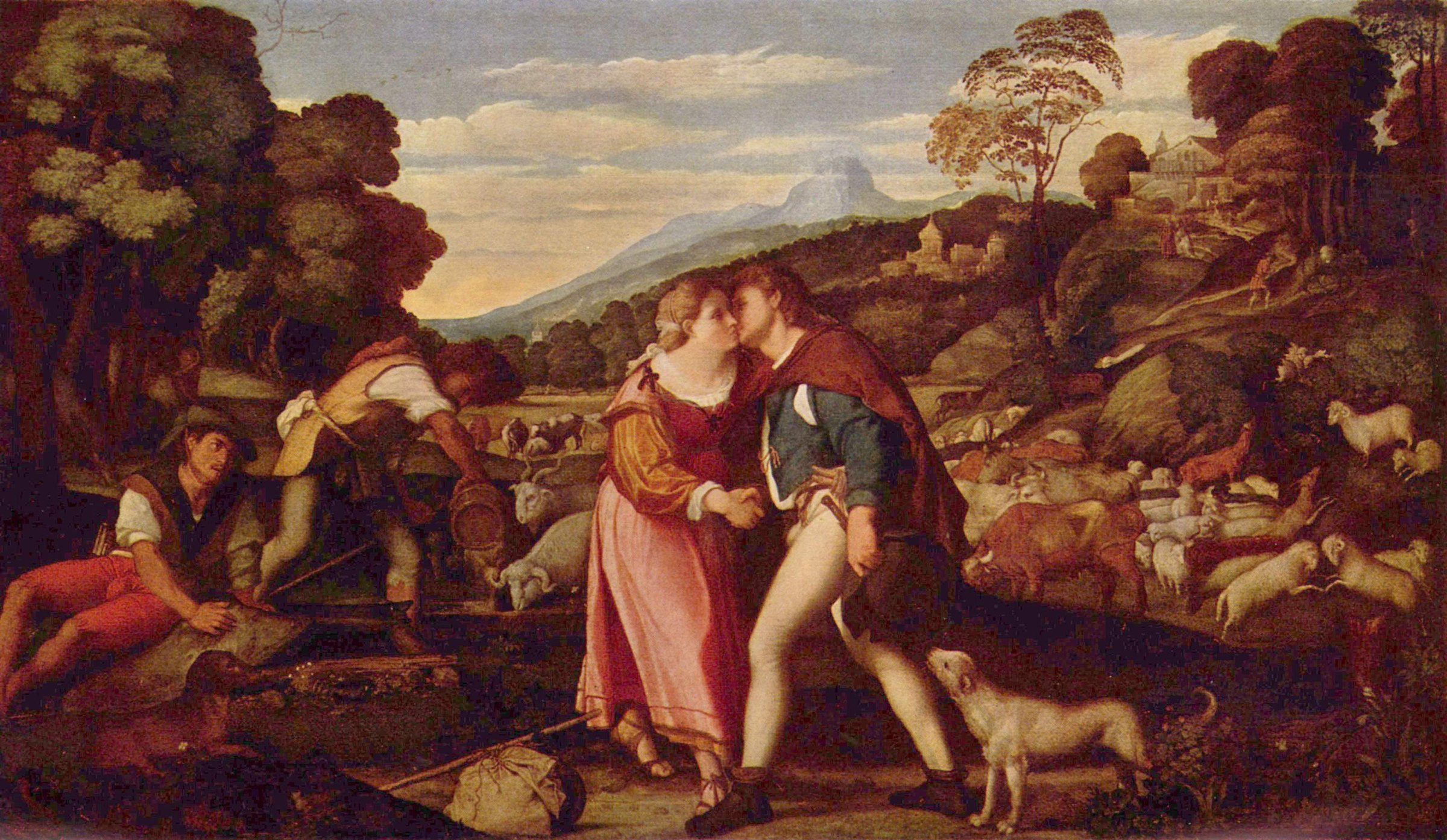
- Jacob and RachelJacob kisses Rachel in the middle of the field.Genesis 29:11
- The troughTwo shepherds pour water for the sheep at a stone trough.Genesis 29:3
- A shepherd at restA shepherd sits on the ground with his staff.Genesis 29:2
- Laban's flockSheep and goats spread over the slope behind Rachel.Genesis 29:10
Palma Vecchio, Jacob and Rachel, 1520 to 1525. Public domain.
Four parts of the painting, each numbered where it stands, with the verse the part answers to.
In Ezekiel 34 God promises to do each thing the shepherds of Israel failed to do.
| The flock's need | What the shepherds failed to do, Ezekiel 34:4 | What the LORD will do, Ezekiel 34:16 |
|---|---|---|
| The weak | not strengthened | I will strengthen |
| The injured | not bound up | I will bind up |
| The strays | not brought back | I will bring back |
| The lost | not searched for | I will seek |
The Flock Through Scripture
Sixteen places in canon order, from Abel's flock to the Lamb who shepherds.
The 2 texts in canon order.
1Jacob's account of his twenty years
- Genesis 31:39
2The Shepherd struck and the sheep scattered
- Matthew 26:31
Each station opens its verse page.
The flock runs from Abel's keeping of sheep in Genesis 4 to Revelation 7.
- Genesis 4Abel a keeper of sheep, Genesis 4:2
- Genesis 31Twenty years with Laban's flocks, Genesis 31:38
- Numbers 27Not like sheep without a shepherd, Numbers 27:17
- 1 Kings 22Israel scattered on the hills, 1 Kings 22:17
- Psalm 44Sheep to be slaughtered, Psalm 44:22
- Psalm 100The sheep of His pasture, Psalm 100:3
- Psalm 119I have strayed like a lost sheep, Psalm 119:176
- Isaiah 40He gathers the lambs in His arms, Isaiah 40:11
- Isaiah 53We all like sheep have gone astray, Isaiah 53:6
- Ezekiel 34I Myself will search for My flock, Ezekiel 34:11
- Micah 2Like sheep in a pen, Micah 2:12
- Zechariah 13Strike the Shepherd, Zechariah 13:7
- Matthew 9Harassed and helpless, Matthew 9:36
- Luke 15The one that is lost, Luke 15:4
- John 10One flock and one shepherd, John 10:16
- Revelation 7The Lamb will be their shepherd, Revelation 7:17
One stop for each passage in canon order; each stop opens its verse in the reader.
Jacob's account of his twenty yearsGenesis 31:38 to 40, with Adam Clarke
Adam Clarke reads Jacob's words as a mark of Laban's greed, since the law of Exodus 22:13 later spared a shepherd from making good what beasts had torn.
I did not bring you anything torn by wild beasts; I bore the loss myself. And you demanded payment from me for what was stolen by day or night.Jacob paid for losses a shepherd was not bound to pay.
The Shepherd struck and the sheep scatteredZechariah 13:7 and Matthew 26:31
Then Jesus said to them, “This very night you will all fall away on account of Me. For it is written: ‘I will strike the Shepherd, and the sheep of the flock will be scattered.’Jesus applies Zechariah's line to His disciples on the night of His arrest.
What Scripture Says of the Sheep
Four verses that say what the sheep are, and two readings of the lost sheep of Luke 15.
MADE AND OWNED
The psalmist calls Israel the people God made, the sheep of His pasture.
EACH TO HIS OWN WAY
Isaiah names every person a stray, and the LORD lays their iniquity on His servant.
RETURNED
Peter tells his readers they have come back to the Shepherd and Overseer of their souls.
KNOWN BY NAME
The shepherd calls his own sheep by name and leads them out.
Returned, Known by name
The sheep carried on the crossAmbrose of Milan, Exposition of the Gospel of Luke
Ambrose reads the lost sheep as humanity that strayed in Adam, and the shepherd's shoulders as the arms of the cross.
“Let us rejoice that the sheep that had strayed in Adam is lifted on Christ. The shoulders of Christ are the arms of the cross. There, I laid down my sins. I rested on the neck of that noble yoke. The sheep is one in kind, not in appearance, because ‘we are all one body’ but many members. It is written, ‘You are the body of Christ, and members individually.’ ‘The Son of man came to seek and save what was lost.’”
Ambrose of Milan · Exposition of the Gospel of Luke · on Luke 15:5Patristic
The friends and neighbors as the angelsGregory the Dialogist, Forty Gospel Homilies, Homily 34
Gregory reads the shepherd's homecoming as Christ's return to heaven, and the friends who rejoice with him as the angels.
“And coming home, he calls together his friends and neighbors, saying to them: ‘Rejoice with me, for I have found my sheep that was lost.’ Having found the sheep, he returns home because our Shepherd, having restored man, returned to the heavenly kingdom. There he finds friends and neighbors, namely those choirs of angels who are his friends because they continuously guard his will in their steadfastness. They are also his neighbors because they perpetually enjoy the brightness of his vision through their constant presence.”
Gregory the Dialogist · Forty Gospel Homilies, Homily 34 · on Luke 15:6Patristic
Tson, Seh and Probaton
The Hebrew and Greek words for the flock and the single sheep.
Tson, the flock, stands 274 times in the Old Testament, more than the other four words together.
| Word | Strong's number | Strong's definition | Uses |
|---|---|---|---|
| צֹאן tson | H6629 | “a flock of sheep or goats; figuratively of men” | 274 |
| שֶׂה seh | H7716 | “a member of a flock, a sheep or goat” | 47 |
| πρόβατον probaton | G4263 | “something that walks forward; specially a sheep” | 39 |
| ποίμνη poimne | G4167 | “a flock” | 5 |
| ποίμνιον poimnion | G4168 | “a flock; figuratively a group of believers” | 5 |
One flock in John 10:16poimne, G4167
John 10:16 sets the fold, the pen the sheep stand in, beside the one flock they become.
What the Text Does Not Say
Four questions about the flock that the text leaves open.
Four questions about the flock stay open in the text.
| What is not said | What the verse does say |
|---|---|
| Who are the other sheep? | Jesus says they are not of this fold, that He must bring them in, and that they will listen to His voice. |
| How was the one sheep lost? | The man has a hundred sheep, loses one of them, and leaves the ninety-nine in the pasture to go after it. |
| How many sheep did Abel keep? | Genesis says only that Abel was a keeper of sheep while Cain was a tiller of the soil. |
| What were the names of the shepherds of Ezekiel 34? | The LORD speaks against the shepherds of Israel and calls them to account for His flock. |
My Sheep Listen to My Voice
The promise of Ezekiel 34 and the words of Jesus in John 10 are set side by side.
For this is what the Lord GOD says: ‘Behold, I Myself will search for My flock and seek them out.The LORD takes the shepherd's work on Himself.
My sheep listen to My voice; I know them, and they follow Me. I give them eternal life, and they will never perish. No one can snatch them out of My hand.Jesus speaks as that Shepherd and promises that no one will snatch His sheep.
The flock in Scripture is kept by the voice of its shepherd more than by its own strength.
Voices on the Flock
Gregory of Nazianzus, Cyril of Alexandria, Hilary of Arles and Charles Spurgeon, each with the work named.
died 390 · Gregory of Nazianzus
Gregory of Nazianzus, in Oration 33, says the sheep follow the shepherd whose voice they love and flee from a stranger.
died 444 · Cyril of Alexandria
Cyril of Alexandria, in his Commentary on the Gospel of John, takes hearing in John 10:27 to mean obeying, and being known to mean being brought into friendship with God.
died 449 · Hilary of Arles
Hilary of Arles, in his Introductory Commentary on 1 Peter, names three causes of the sheep's wandering: darkness, loneliness and ignorance.
1834 to 1892 · Charles Spurgeon
Charles Spurgeon, in The Treasury of David, reads the last verse of Psalm 119 as a confession that the psalmist still wanders and must be sought.
Hilary of Arles, Charles Spurgeon
The Other Sheep
Two readings of the other sheep Jesus names, each with its holder and the strongest objection.
The Gentiles who will believe, for whom Christ diedAdam Clarke, Commentary on the Bible, 1832
Adam Clarke reads the other sheep as the Gentiles and the Samaritans, for whom Christ died as for every person. Those among them who believe are joined to the believing Jews in one fold.
The objection: Jesus says I have other sheep before they are brought in, which reads as sheep already His.
The chosen of God among the GentilesJohn Gill, Exposition of the New Testament
John Gill holds that they were His sheep by God's choice before they were called and folded, and that they are found among the nations.
The objection: the verse ties the sheep to hearing His voice in the future, and it names no choice made before they hear.
Books to Read Next
Three works a student reads next, each free to read.
Commentary on the Whole Bible
Matthew Henry · 1710
His notes on Ezekiel 34 name the neglect of the shepherds and God's care for the flock.
READ HIS EZEKIEL NOTES →Commentary on the Bible
Adam Clarke · 1832
His notes on Genesis 29 and 31 explain the shepherd's life in Jacob's day.
READ HIS GENESIS NOTES →Exposition of the New Testament
John Gill · 1746 to 1748
His notes on John 10 read the fold, the voice and the other sheep.
READ HIS JOHN NOTES →One Flock and One Shepherd
The sheep of Scripture are scattered by bad shepherds and gathered by the good one.
Revelation 7:17 ends the image with the Lamb leading the flock to springs of living water.
Sources
Scripture is the Berean Standard Bible.
- James Strong, Exhaustive Concordance of the Bible, 1890, entries H6629, H7716, G4263, G4167 and G4168, with each word's count of uses.
- Jamieson, Fausset and Brown, Commentary Critical and Explanatory, 1871, on Genesis 4:2.
- Adam Clarke, Commentary on the Bible, 1832, on Genesis 29:9.
- Adam Clarke, Commentary on the Bible, 1832, on Genesis 31:39.
- Ambrose of Milan, Exposition of the Gospel of Luke, on Luke 15:5.
- Gregory the Dialogist, Forty Gospel Homilies, Homily 34, on Luke 15:6.
- Gregory of Nazianzus, Oration 33.16, on John 10:3.
- Cyril of Alexandria, Commentary on the Gospel of John, Book 7, on John 10:27.
- Hilary of Arles, Introductory Commentary on 1 Peter, on 1 Peter 2:25.
- Charles Spurgeon, The Treasury of David, volume 6, 1882, on Psalm 119:176.
- Adam Clarke, Commentary on the Bible, 1832, on John 10:16.
- Matthew Henry, Commentary on the Whole Bible, 1710, on Ezekiel 34:4 to 16.
- John Gill, Exposition of the New Testament, on John 10:16.
Keep Studying
People and groups4