
Ruth 1 to 4 · Person · Featured Study
Ruth
The life of Ruth the Moabitess in the book of Ruth, from her marriage in Moab to the birth of her son Obed, and her name in Matthew 1:5.
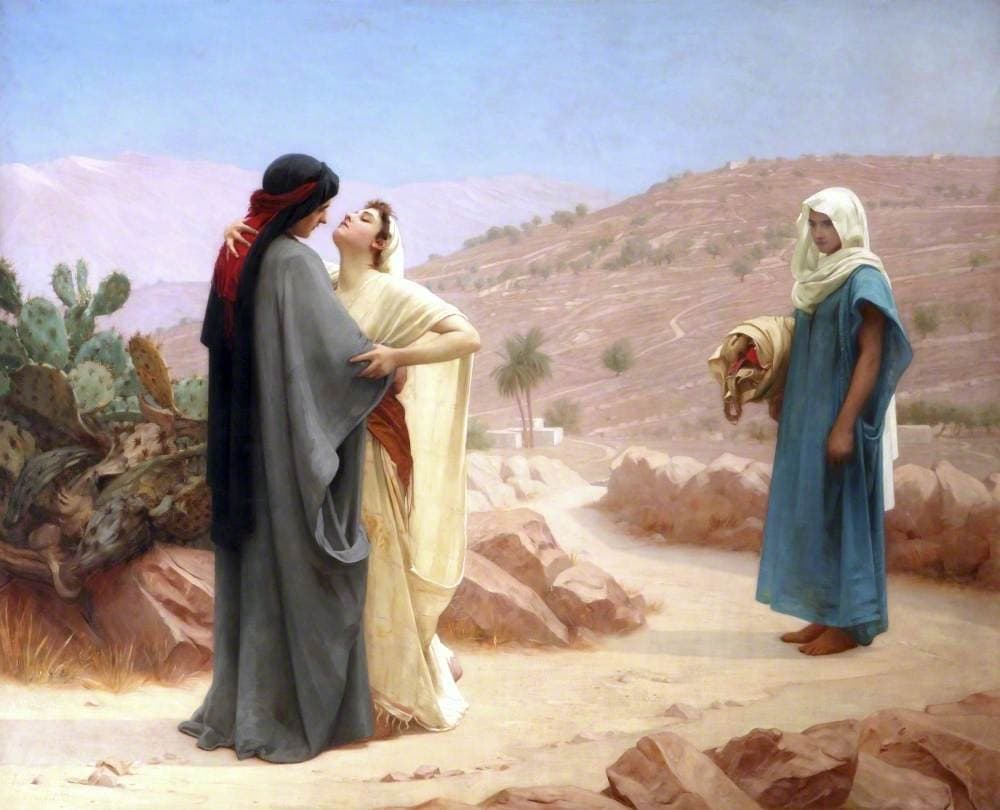
Philip Hermogenes Calderon, Ruth and Naomi, 1886, Walker Art Gallery, Liverpool. Public domain, via Wikimedia Commons (File:Philip Hermogenes Calderon (1833-1898) - Ruth and Naomi - WAG 114 - Walker Art Gallery.jpg).
THE ARTWORKCalderon painted Ruth with her arms around Naomi on a hill road, while a third young woman with a bundle stands apart from them.
A Moabite widow told her mother-in-law on the road to Judah that Naomi's people would be her people and Naomi's God her God.
Summary
Ruth was a Moabite woman, the widow of Mahlon son of Elimelech, who came to Bethlehem with Naomi, married Boaz and bore Obed, the grandfather of David.
- She held on to Naomi when her sister-in-law Orpah went back to her people and her gods.
- She gleaned in the field of Boaz until the barley and wheat harvests were finished.
- Boaz acquired her as his wife before the elders at the gate of Bethlehem.
- Matthew names her beside Rahab in the genealogy of Jesus.
Where Ruth Stands in Scripture
Her first line in the book of Ruth and her last in Matthew
Scripture names Ruth in twelve verses of the book that carries her name and once in the New Testament.
who took Moabite women as their wives, one named Orpah and the other named Ruth. And after they had lived in Moab about ten years,Her first verse names her as one of the two Moabite women whom Elimelech's sons married.
Salmon was the father of Boaz by Rahab, Boaz the father of Obed by Ruth, Obed the father of Jesse,Her last verse sets her in the line Matthew traces from Abraham to Jesus.
The Life, Turn by Turn
Moab, the road to Judah, the field, the threshing floor and the gate
Twelve turns take Ruth from a widow's home in Moab to a mother's in Bethlehem.
- She marries a son of ElimelechMoabRuth 1:4
- Her husband and his brother dieMoabRuth 1:5
- She sets out with Naomi for Judahthe road from MoabRuth 1:7
- Orpah goes home and Ruth clings to Naomithe road from MoabRuth 1:14
- She swears to stay with Naomi until deaththe road from MoabRuth 1:16
- She arrives at the beginning of the barley harvestBethlehemRuth 1:22
- She gleans in the part of the field that belongs to Boazthe field of BoazRuth 2:3
- Boaz prays the LORD will reward herthe field of BoazRuth 2:12
- She gleans until the wheat harvest endsthe field of BoazRuth 2:23
- She asks Boaz to spread his garment over herthe threshing floorRuth 3:9
- Boaz acquires her as his wife before witnessesthe gate of BethlehemRuth 4:10
- She bears a son, ObedBethlehemRuth 4:13
Each numbered turn gives its place and its verse in the book of Ruth.
From Moab to the House of Boaz
Ruth 1:4 to 4:17
Ruth was widowed in Moab, and when Naomi set out for Judah, Ruth went with her and would not be sent home.
The choice on the roadRuth 1:6 to 18
But Ruth replied: “Do not urge me to leave you or to turn from following you. For wherever you go, I will go, and wherever you live, I will live; your people will be my people, and your God will be my God. Where you die, I will die, and there I will be buried. May the LORD punish me, and ever so severely, if anything but death separates you and me.”Ruth names the LORD here for the first time in the book, and her choice of Naomi's God is made in these words.
A foreigner in the fieldRuth 2:2 to 13
Boaz replied, “I have been made fully aware of all you have done for your mother-in-law since the death of your husband, how you left your father and mother and the land of your birth, and how you came to a people you did not know before. May the LORD repay your work, and may you receive a rich reward from the LORD, the God of Israel, under whose wings you have taken refuge.”The verses prove that Boaz judged the Moabite by what she had done, and not by the people she came from.
Her request at the threshing floorRuth 3:1 to 11
Naomi sent Ruth down to the threshing floor on the night Boaz was winnowing barley there, and Ruth did all that Naomi told her.
“Who are you?” he asked. “I am your servant Ruth,” she replied. “Spread the corner of your garment over me, for you are a kinsman-redeemer.”Her word for the corner of his garment, kanaph, is the word Boaz used of the LORD's wings at Ruth 2:12.
And now do not be afraid, my daughter. I will do for you whatever you request, since all my fellow townspeople know that you are a woman of noble character.The verse proves that her request at the threshing floor did no harm to her good name in Bethlehem.
Wife and motherRuth 4:13 to 17
He will renew your life and sustain you in your old age. For your daughter-in-law, who loves you and is better to you than seven sons, has given him birth.”The women's words answer Naomi's own at Ruth 1:21, where she said the LORD had brought her back empty.
The neighbor women said, “A son has been born to Naomi,” and they named him Obed. He became the father of Jesse, the father of David.The neighbor women name the child, and the book closes his line at David.
What the Text Says Beside What Is Said
Three common sayings about Ruth, each set against its verse
RUTH'S WORDS WERE A VOW TO A HUSBAND
Ruth spoke them to Naomi, her widowed mother-in-law, after Naomi told her to follow Orpah home.
RUTH WAS A PRINCESS OF MOAB
The book names her people and her first husband, and it names neither her father nor her mother.
RUTH WAITED FOR BOAZ TO ACT
Ruth asked Naomi's leave to glean before anyone offered her a field, and at the threshing floor she made her request of Boaz herself.
The World Behind Her Life
Moab, a famine in the days of the judges, and the readings of later centuries
Elimelech took his family from Bethlehem to Moab when a famine came in the days when the judges ruled.
The Babylonian Talmud keeps two traditions of Ruth's life. In tractate Sanhedrin 105b, Rabbi Yosei bar Huna says that Ruth was the daughter of Eglon, king of Moab. In tractate Bava Batra 91b, the rabbis read the names of 1 Chronicles 4 to say that she lived to see the kingship of Solomon.
Matthew Henry, in his commentary of 1710, calls the tradition of Eglon's daughter groundless, and notes that the Aramaic paraphrase of Ruth adds it to the text.
Tractate Soferim, one of the minor tractates of the Talmud, requires a blessing over the reading of Ruth and four other books. The note of its Soncino translation of 1965 gives Pentecost, the Feast of Weeks, as the day Ruth is read.
The older daughter gave birth to a son and named him Moab. He is the father of the Moabites of today.Genesis names the father of the people Ruth was born into.
The Family of Ruth
Two houses in two lines, joined in her son Obed
- The house of ElimelechThe house of Salmon
The fathers
Ruth's generation
Her son and his line
The Places of Her Life
Six places of her life and her line, from Moab to Bethlehem
Ruth came from the land of Moab, east of the Dead Sea, to Bethlehem in Judah.
- Located: the site is known
- Identified: the point stands for an area, or is rounded
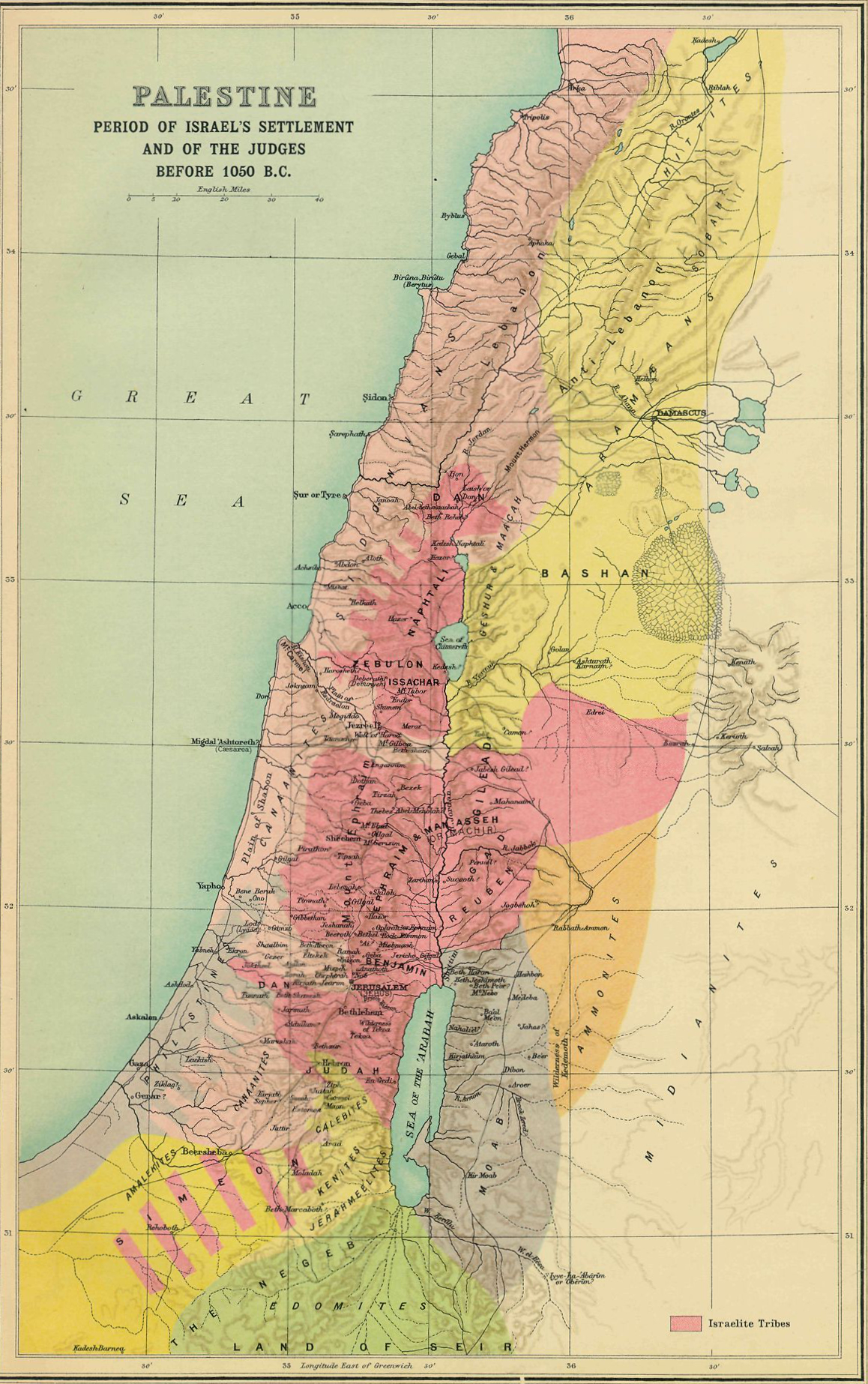
- 1Moab, Her homeland, where she married Mahlon and was widowed. Ruth 1:4
- 2The land of Judah, The land Naomi set out for with her two daughters-in-law beside her. Ruth 1:7
- 3Bethlehem, The town of Elimelech's clan, where she gleaned, married Boaz and bore Obed. Ruth 1:22
- 4Ephrathah, The name the elders gave Boaz's home district when they blessed his marriage at the gate. Ruth 4:11
- 5Jericho, The city of Rahab, whom Matthew names as the mother of Boaz. Matthew 1:5
- 6Mizpeh of Moab, Where David asked the king of Moab to keep his father and mother. 1 Samuel 22:3
Not placed: The land of Judah (2), Ephrathah (4), Mizpeh of Moab (6).
Base map: Israel's settlement and the period of the Judges, George Adam Smith, Atlas of the Historical Geography of the Holy Land (1915), public domain. Places with a place page stand at its coordinates and the others at the point cited for each, set on the plate by Jerusalem and Damascus, as the plate prints them.
Smith's plate shows the land in the period of Israel's settlement and of the judges, the days in which the book of Ruth is set.
Questions the Life Raises
Four questions, each answered from the text and its readers
How could a Moabite woman marry into Israel?Albert Barnes; Jamieson, Fausset and Brown
No Ammonite or Moabite or any of their descendants may enter the assembly of the LORD, even to the tenth generation.The commentators below read Ruth's marriage against this law of the assembly.
“Marriages of Israelites with women of Ammon or Moab are nowhere in the Law expressly forbidden, as were marriages with the women of Canaan Deu 7:1-3. In the days of Nehemiah the special law Deu 23:3-6 was interpreted as forbidding them, and as excluding the children of such marriages from the congregation of Israel Neh 13:1-3. Probably the marriages of Mahlon and Chilion would be justified by necessity, living as they were in a foreign land. Ruth was the wife of the older brother, Mahlon Rth 4:10.”
Albert Barnes · Notes, Explanatory and Practical, on the Old and New Testaments (1832-1869) · on Ruth 1:4Evangelical
Jamieson, Fausset and Brown hold that Boaz might marry her because she had embraced the true religion, and that he was under a legal necessity to marry her. The page on Moab and Ammon sets out the other readings of the law with their holders.
Was Rahab of Jericho the mother of Boaz?Matthew 1:5; John Gill; Jamieson, Fausset and Brown; John Wesley
John Gill notes that Ruth 4:21 names Salmon as the father of Boaz, and that no text of the Old Testament names Rahab as his mother. Gill holds that Matthew had it from tradition or from the Jewish records.
Jamieson, Fausset and Brown count about four centuries between Rahab and David, and judge that one or two links of the line are left out. John Wesley reads the line as it stands, and notes that Salmon, Boaz and Obed must each have been near a hundred years old when his son was born.
Why did David send his parents to Moab?1 Samuel 22:3 to 4; Albert Barnes
From there David went to Mizpeh of Moab, where he said to the king of Moab, “Please let my father and mother stay with you until I learn what God will do for me.” So he left them in the care of the king of Moab, and they stayed with him the whole time David was in the stronghold.The verses put Ruth's grandson Jesse under the protection of the king of Moab.
Albert Barnes suggests that David's descent from Ruth the Moabitess may have had something to do with his choice of a refuge for Jesse in the land of her birth.
How did the rabbis read Ruth's choice?Ruth 1:18; Babylonian Talmud, Yevamot 47b; Rashi
When Naomi saw that Ruth was determined to go with her, she stopped trying to persuade her.The rabbis read more than a journey into the resolve this verse records.
The Babylonian Talmud, in tractate Yevamot 47b, reads the verse as Ruth's resolve to convert and takes from it the rule for receiving a convert. It rebuilds Naomi's warnings, the first that Israel may not walk beyond the Sabbath limit, and gives Ruth's answers from Ruth 1:16 to 17.
Rashi, the French Jewish commentator who lived from 1040 to 1105, cites Rabbi Abahu on Ruth 1:19, who says that as soon as Ruth decided to convert, Scripture ranked her with Naomi.
What the Text Leaves Unsaid
Five things the book of Ruth does not tell of her
The book of Ruth gives her age at no point and no year for any turn of her life.
It records no child of hers by Mahlon in their years in Moab.
Her last words in the book are at Ruth 3:17, and it records nothing of her death or burial.
What Her Life Means
Abram's leaving, a woman of noble character, and a Gentile in God's household
Albert Barnes hears in Boaz's words at Ruth 2:11 the call of Abram in Genesis 12:1, and judges it probable that Boaz had Abraham in mind.
| Verse | Of whom | Who says it |
|---|---|---|
| Ruth 2:1 | Boaz | The narrator of the book |
| Ruth 3:11 | Ruth | Boaz |
| Proverbs 31:10 | The wife of noble character | The poem that closes Proverbs |
Therefore you are no longer strangers and foreigners, but fellow citizens with the saints and members of God’s household,Paul tells Gentile believers in Christ what Ruth became in Israel, a member of God's household.
How Ruth Has Been Taught
Six readings from Jerome to Matthew Henry, earliest first
“Ruth, a foreigner, did not leave Naomi's side. See how much merit there is in standing by the deserted in solace. From her seed, Christ is born.”
Jerome · LETTER 39.5 · on Ruth 1:16Patristic
“He praised Ruth's deed and, moreover, he did not betray temperance, but he kept to the law of nuptial congress. ‘You show by your deed,’ he said, ‘that this was not done out of voluptuousness. In fact, you might have gone to those who are …”
Theodoret of Cyrus · Questions on Ruth · on Ruth 3:10Patristic
“The constancy of Ruth, who because of the piety of her spirit and the memory of her husband preferred to her parents a woman worn out in old age and laboring in poverty, is praiseworthy.”
Theodoret of Cyrus · Questions on Ruth · on Ruth 1:16Patristic
“An oath for confirmation was an end of this strife, and would leave a lasting obligation upon her never to forsake that good way she was now making choice of. First, It is implied that death would separate between them for a time.”
Matthew Henry · Commentary on the Whole Bible · on Ruth 1:16 to 17Puritan
“But that which especially he commended her for was that she had left her own country, and had become a proselyte to the Jewish religion; for so the Chaldee expounds it: ‘Thou hast come to be proselyted, and to dwell among a people whom thou knowest not. ‘ Those that leave all, to embrace the true religion, are worthy of double honour.”
Matthew Henry · Commentary on the Whole Bible · on Ruth 2:11Puritan
“Grandmothers are often the most fond. Ruth is hereby brought in among the ancestors of David and Christ, which was the greatest honour. The genealogy is here drawn from Pharez, through Boaz and Obed, to David, and so leads towards the Messiah, and therefore it is not an endless genealogy.”
Matthew Henry · Commentary on the Whole Bible · on Ruth 4:16Puritan
Why Matthew Names Ruth
Three readings of Matthew 1:5, each with its holders
Among the sinners Christ came to saveJerome; John Chrysostom, Homily 3 on Matthew
“It should be noted, that none of the holy women are taken into the Saviour's genealogy, but rather such as Scripture has condemned, that He who came for sinners being born of sinners might so put away the sins of all; thus Ruth the Moabitess follows among the rest.”
Jerome · Catena Aurea by Aquinas · on Matthew 1:3Patristic
A figure of the church gathered from the nationsAmbrose of Milan, Commentary on Luke; Isidore of Seville, On Ruth; Theophylact of Ohrid; John Chrysostom
Ambrose of Milan, in his Commentary on Luke, sees in Ruth the figure of the Gentiles' entrance into the church. Isidore of Seville calls Ruth a type of the church, a stranger from the Gentiles who renounced her native land. Theophylact says the church comes from the Gentiles as Ruth did, and Chrysostom says Boaz received Ruth in her poverty as Christ received the church.
The objection: the book of Ruth draws no figure from her, and the reading rests on the fathers' typology rather than on a word of Scripture about Ruth.
The reward of her faithPseudo-Chrysostom; Theodoret of Cyrus
Pseudo-Chrysostom, quoted in the Catena Aurea of Thomas Aquinas, says Ruth married Boaz as the reward of her faith, because she cast off the gods of her forefathers and chose the living God. Theodoret says Ruth received the full reward Boaz prayed for, and became the forebear of the blessing of the nations.
The objection: Matthew gives no reason for naming any of the women in his line, and the prayer for her reward is Boaz's at Ruth 2:12.
Books to Read Next
Four works from the fourth century to the nineteenth, each free to read online
Homilies on Matthew, Homily 3
John Chrysostom · about 390
Chrysostom's third homily on Matthew takes up the genealogy and the women it names.
READ IT FREE AT NEW ADVENT →Letter 39, to Paula
Jerome · 389
Jerome wrote the letter to Paula in her grief for Blaesilla, and Ruth is one of the examples he sets before her.
READ IT FREE AT NEW ADVENT →Commentary on the Whole Bible, Volume II (Joshua to Esther)
Matthew Henry · 1710
Henry goes through the four chapters of Ruth verse by verse.
READ IT FREE AT CCEL →Ruth Deciding for God, Sermon 2680
Charles Spurgeon · 1881
Spurgeon preached this sermon on Ruth 1:16 at the Metropolitan Tabernacle, and it was printed in 1900.
READ IT FREE AT CCEL →Under Whose Wings She Took Refuge
Keep studying
Read it5
Doctrines7
Peoples and groups3