
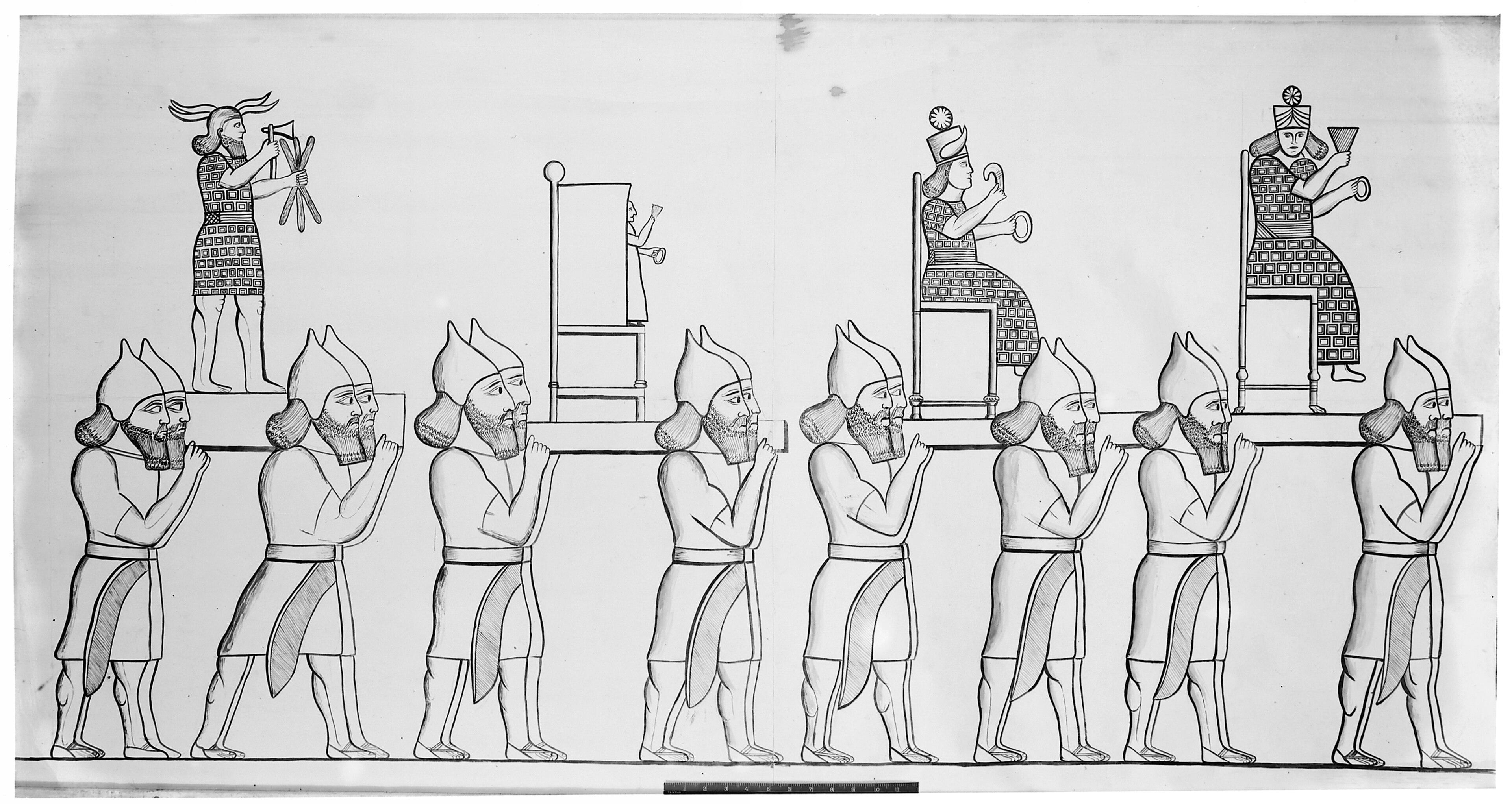
Idols carried by Assyrian warriors, a drawing from Layard's Nineveh expedition. CC BY 4.0.
Isaiah 46 and Isaiah 47 · Subject · Featured Study
The Religion of Babylon: Its Gods and Practices
Isaiah names Bel and Nebo, the gods of Babylon, and mocks its astrologers who observe the stars, and Ezekiel shows its king reading a liver.
Remember what happened long ago, for I am God, and there is no other; I am God, and there is none like Me.
- Books
- Isaiah, Jeremiah, Ezekiel
- Hold in memory
- Isaiah 46:4, Isaiah 46:9
Isaiah pictured the gods of Babylon as baggage on tired animals.
Summary
Babylon served its gods through statues, festivals, omens and the stars.
- Isaiah and Jeremiah name Bel and Nebo and tell of their fall.
- The king of Babylon sought an omen from arrows, idols and a liver.
- The prophets set against them the God who tells the end from the start.
Bel and Nebo
Isaiah 46 and Jeremiah 50 name the gods Babylon trusted.
Bel crouches; Nebo cowers. Their idols weigh down beasts and cattle. The images you carry are burdensome, a load to the weary animal. The gods cower; they crouch together, unable to relieve the burden; but they themselves go into captivity.Babylon's chief gods are named first in the chapter.
Bel is the Akkadian word for lord. It was the title Babylon gave its god Marduk, whose temple in the city was the Esagil.
“Announce and declare to the nations; lift up a banner and proclaim it; hold nothing back when you say, ‘Babylon is captured; Bel is put to shame; Marduk is shattered, her images are disgraced, her idols are broken in pieces.’Jeremiah adds Marduk's name beside Bel's in the oracle on Babylon's fall.
Nebo is Nabu, the god of writing and the patron of scribes. He was counted as Marduk's firstborn son, and his temple, the Ezida, stood at Borsippa.
In the month Nisannu the statues were brought out for the New Year festival, the akitu. The statue of Nabu was carried from Borsippa to Babylon.
At the festival the Babylonian creation epic was recited before Marduk's statue.
The Nabonidus Chronicle records years when the king stayed away at Tema. In those years Nabu did not come to Babylon, and Bel did not come out.
Who Carries Whom
The chapter turns on one verb, to carry.
In Isaiah 46 the people carry their gods, and the LORD carries His people.
- What the verse says
- Babylon's two chief gods sink low, their statues a load for tired animals
- What the verse says
- The gods cannot save their load and are taken away themselves
- What the verse says
- God has held up His people from their birth
- What the verse says
- The God who made them will hold them up into gray hair
- What the verse says
- No god can be set beside Him
- What the verse says
- A goldsmith makes a god that must be carried and cannot answer
- What the verse says
- He tells the end before it comes, and His plan stands
Seven steps of Isaiah 46:1 to 10, each with the verse that makes it.
The word for the load in the first verse of Isaiah 46 is massa, the word that heads Isaiah's burdens against the nations.
Who Was Tammuz
Readers differ on which god the women of Ezekiel 8:14 mourned.
Then He brought me to the entrance of the north gate of the house of the LORD, and I saw women sitting there, weeping for Tammuz.Ezekiel sees the mourning inside the LORD's own temple.
Jerome rendered the name as Adonis, and Adam Clarke noted that the Vulgate translates it so.
Matthew Henry reported that some took him for Adonis and others for Osiris of Egypt.
The Hebrew lexicon of Brown, Driver and Briggs gives the Babylonian form Duzu, also Dumuzi. The older dictionary of James Strong calls Tammuz a Phoenician deity.
The Gods in the Kings' Names
Four kings of Babylon in Scripture carry the name of Nabu, Bel or Marduk.
Nebuchadnezzar's name calls on Nebo, Belshazzar's on Bel, and two more kings carry Marduk's name.
| The name in Scripture | Who he was | The Babylonian form and its meaning |
|---|---|---|
| Merodach-baladan | The king of Babylon who wrote to Hezekiah | Marduk-bal-iddina means Merodach has given a son. |
| Nebuchadnezzar | The king of Babylon who besieged Jerusalem | Nabu-kudurri-usur means Nebo, defend my boundary. |
| Evil-merodach | The king of Babylon who released Jehoiachin | Amil-Marduk means man or servant of Marduk. |
| Belshazzar | The king who held a feast for a thousand nobles | Belsharusur means Bel preserve the king. |
| Belteshazzar | The name given to Daniel | The king says Daniel was named after his god. |
The Hebrew of the Gods
Three Hebrew names stand for the gods of Babylon in the prophets.
Bel (Hebrew, H1078)
Bel, the Baal of the Babylonians, named in Isaiah 46 and in Jeremiah 50 and 51.
Nebo (Hebrew, H5015)
The name of a Babylonian god, and also of a mountain in Moab and of a place in the land.
Merodach (Hebrew, H4781)
Marduk, a Babylonian idol, whose name also stands in the name Merodach-baladan.
Arrows, a Liver and the Stars
Ezekiel shows the king of Babylon seeking an omen, and Isaiah mocks the astrologers who could not save the city.
For the king of Babylon stands at the fork in the road, at the junction of the two roads, to seek an omen: He shakes the arrows, he consults the idols, he examines the liver. In his right hand appears the portent for Jerusalem, where he is to set up battering rams, to call for the slaughter, to lift a battle cry, to direct the battering rams against the gates, to build a ramp, and to erect a siege wall.Babylon's king lets an omen choose which city he attacks.
Adam Clarke counted three kinds of divination in Ezekiel 21:21, by arrows, by images and by the entrails of a sacrifice.
A clay model of a liver used for divination, from Sippar in the Old Babylonian period, is in the British Museum as BM 92668.
So take your stand with your spells and with your many sorceries, with which you have wearied yourself from your youth. Perhaps you will succeed; perhaps you will inspire terror! You are wearied by your many counselors; let them come forward now and save you—your astrologers who observe the stars, who monthly predict your fate.The prophet dares Babylon's stargazers to rescue the city.
The Hebrew of Isaiah 47:13 calls them those who divide the heavens and look at the stars.
Omens read in the sky were gathered in a series called Enuma Anu Enlil.
Hundreds of reports by scholars who watched the sky for the kings of Assyria are edited in State Archives of Assyria, volume 8.
Daniel answered the king, “No wise man, enchanter, medium, or magician can explain to the king the mystery of which he inquires. But there is a God in heaven who reveals mysteries, and He has made known to King Nebuchadnezzar what will happen in the latter days. Your dream and the visions that came into your mind as you lay on your bed were these:Daniel gives the credit for the answer to God alone.
I Will Carry You
Charles Spurgeon preached on these verses in 1888, in a sermon titled Idols Found Wanting, But Jehovah Found Faithful.
Even to your old age, I will be the same, and I will bear you up when you turn gray. I have made you, and I will carry you; I will sustain you and deliver you.The promise covers the whole of a life.
Sources
Scripture is the Berean Standard Bible.
- Strong's H1078, H4781, H5015, H8542 and H4853, with the Hebrew words of Isaiah 46:1, Isaiah 47:13, Ezekiel 8:14, Ezekiel 21:21 and Jeremiah 50:2.
- Ancient Mesopotamian Gods and Goddesses (ORACC, University of Pennsylvania), the entries on Marduk and Nabu.
- Livius.org, the articles Akitu and the Nabonidus Chronicle (ABC 7)
- Cuneiform Digital Library Initiative, the record of the clay liver model BM 92668.
- Cuneiform Commentaries Project (Yale) on Enuma Anu Enlil; H. Hunger, Astrological Reports to Assyrian Kings, State Archives of Assyria 8 (1992)
- The Jewish Encyclopedia (1906), the articles Nebuchadnezzar, Belshazzar and Evil-merodach.
- James Hastings, A Dictionary of the Bible, the article Merodach-baladan.
- Brown, Driver and Briggs, Hebrew and English Lexicon, on Tammuz (8542)
- Adam Clarke, Commentary on the Bible (1832), on Ezekiel 8:14 and 21:21.
- Matthew Henry, Commentary on the Whole Bible (1710), on Isaiah 46:7 and Ezekiel 8:14.
- Jerome, Commentary on Ezekiel, on Ezekiel 8:13 to 14.
- Charles Spurgeon, Idols Found Wanting, But Jehovah Found Faithful, Sermon 2056, The Metropolitan Tabernacle Pulpit (1888)
Keep Studying
Studies6
People and groups6
Places1
Doctrines4
Subjects5