
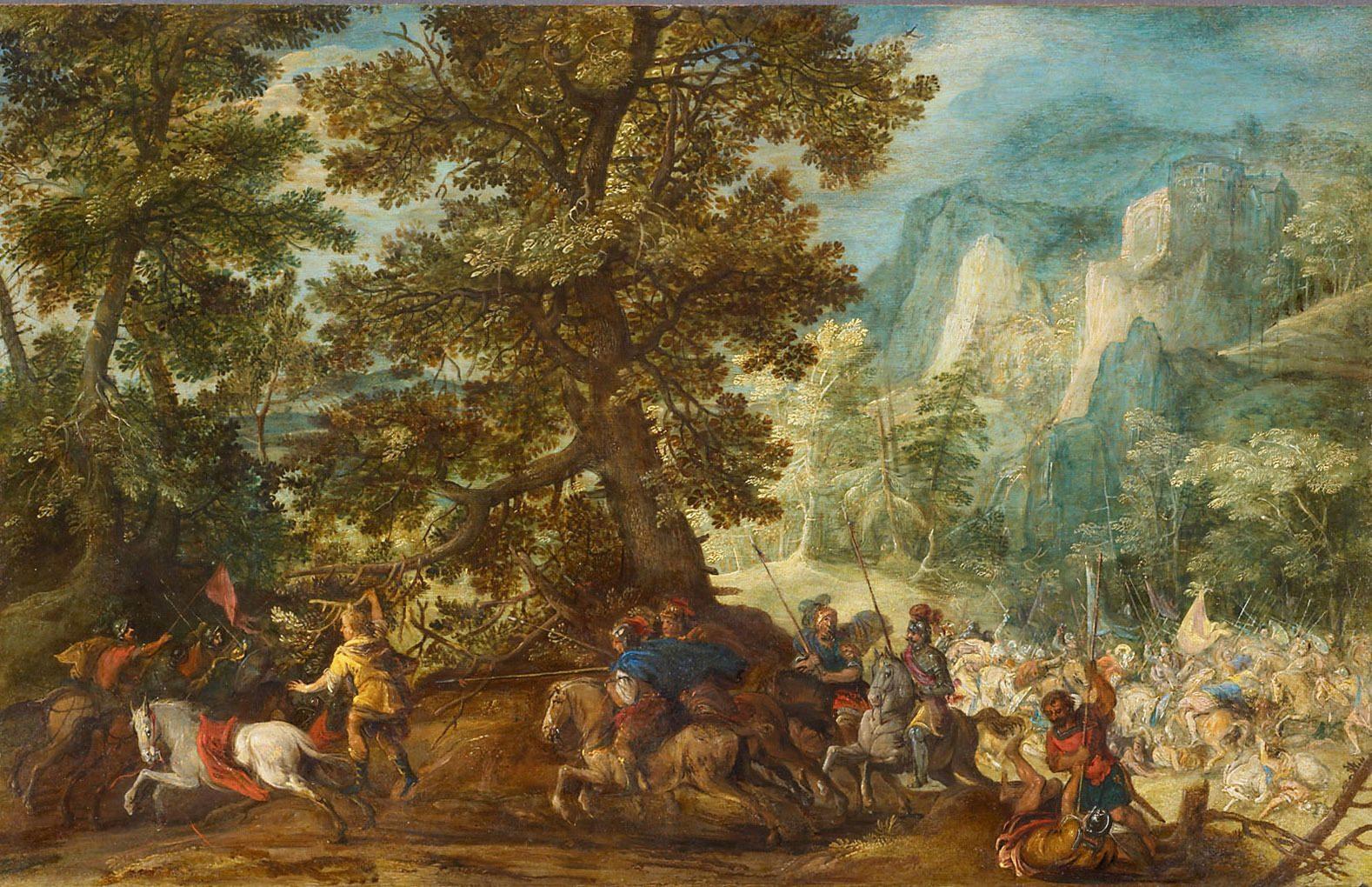
Attributed to David Vinckboons, The Death of Absalom, 1620 to 1630. Public domain.
2 Samuel 13 to 18 · Person · Featured Study
Absalom
David's third son killed his brother Amnon and later took his father's throne for a time.
Absalom did this to all the Israelites who came to the king for justice. In this way he stole the hearts of the men of Israel.
- Family
- father: David; mother: Maacah daughter of Talmai; sister: Tamar; half-brother: Amnon; half-brother: Adonijah; daughter: Tamar
- Places
- Hebron, Geshur, Jerusalem, Mount of Olives, Mahanaim
- First named
- 2 Samuel 3:3 “…of Carmel; his third was Absalom, the son…”
- Last named
- 2 Chronicles 11:21 “Rehoboam loved Maacah daughter of Absalom more than…”
He won Israel at the city gate, one grievance and one kiss at a time.
Summary
Absalom was the third son of David, born at Hebron to Maacah, the daughter of the king of Geshur. He killed his brother Amnon for the rape of his sister Tamar and fled. Later he had himself proclaimed king at Hebron and drove David from Jerusalem. He died in the forest of Ephraim.
- Psalm 3 is titled for the days of his revolt.
- His grandfather Talmai sheltered him in exile.
- Ahithophel, David's counselor, joined his revolt.
- His daughter Tamar bore his sister's name.
Where Absalom Stands in Scripture
He was David's third son.
Absalom is named in the list of the sons born to David at Hebron, and again in the list of 1 Chronicles 3. His story takes up six chapters of 2 Samuel, from the wrong done to his sister to his death.
his second was Chileab, by Abigail the widow of Nabal of Carmel; his third was Absalom, the son of Maacah daughter of King Talmai of Geshur;Geshur lay east of the Sea of Galilee, outside Israel.
His Life, Turn by Turn
His life runs from Hebron to the forest of Ephraim.
Absalom spent three years in exile and died in the revolt he raised.
- Born to David and MaacahHebron2 Samuel 3:3
- Takes in his sister Tamar after Amnon wrongs herhis house2 Samuel 13:20
- Strikes down Amnon two years laterBaal-hazor2 Samuel 13:28 to 29
- Flees to Talmai and stays three yearsGeshur2 Samuel 13:37 to 38
- Returns but may not see the kingJerusalem2 Samuel 14:23 to 24
- Received and kissed by DavidJerusalem2 Samuel 14:33
- Wins the people at the city gateJerusalem2 Samuel 15:6
- Proclaimed kingHebron2 Samuel 15:10
- Enters the city and takes the palaceJerusalem2 Samuel 16:15
- Killed by Joab under the oakthe forest of Ephraim2 Samuel 18:14 to 15
Three years passed in Geshur, and two more before he saw the king's face.
Wins the people at the city gate, Proclaimed king, Enters the city and takes the palace, Killed by Joab under the oak
From the King's Son to the Oak
Five turns of his story, from Amnon's crime to the oak.
Absalom's story begins with a wrong his father left unpunished and ends with his father weeping at the gate.
Tamar and Amnon2 Samuel 13:1 to 39; Matthew Henry
Amnon, David's firstborn, violated Absalom's sister Tamar. David was furious, and the text records no punishment.
And Absalom never said a word to Amnon, either good or bad, because he hated Amnon for disgracing his sister Tamar.His silence lasted two full years.
Matthew Henry sets this silence against the law of Leviticus 19.
“If Absalom had reasoned the matter with Amnon, he might have convinced him of his sin and brought him to repentance; but, saying nothing, Amnon's heart was hardened, and his own more and more embittered against him; therefore rebuking our neighbour is opposed to hating him in our hearts, Lev. xix.”
Matthew Henry · Commentary on the Whole Bible · on 2 Samuel 13:22Puritan
At the sheep shearing his servants killed Amnon on his order, and he fled to Talmai, king of Geshur.
Exile and return2 Samuel 13:38 to 14:33
After three years Joab brought him back to Jerusalem, but David would not see him. After two more years Absalom had Joab's barley field set on fire to make Joab come to him.
So Joab went and told the king, and David summoned Absalom, who came to him and bowed facedown before him. Then the king kissed Absalom.The king's kiss came with no word of judgment or of pardon.
The road to the gate2 Samuel 15:1 to 12
He provided himself a chariot and fifty men to run ahead of him, and he met those who came to the king for judgment.
He would get up early and stand beside the road leading to the city gate. Whenever anyone had a grievance to bring before the king for a decision, Absalom would call out and ask, “What city are you from?” And if he replied, “Your servant is from one of the tribes of Israel,” Absalom would say, “Look, your claims are good and right, but the king has no deputy to hear you.” And he would add, “If only someone would appoint me judge in the land, then everyone with a grievance or dispute could come to me, and I would give him justice.”Adonijah later gathered chariots and fifty runners in the same way, in 1 Kings 1:5.
He went to Hebron on the plea of a vow, and his spies told the tribes to cry that Absalom reigned there.
Two counselors2 Samuel 16:15 to 17:23
Ahithophel told him to go in to his father's concubines and to pursue David that night. Absalom took the first counsel and turned from the second.
Then Absalom and all the men of Israel said, “The advice of Hushai the Archite is better than that of Ahithophel.” For the LORD had purposed to thwart the good counsel of Ahithophel in order to bring disaster on Absalom.David had prayed in 2 Samuel 15:31 that this counsel would be turned to foolishness.
The forest of Ephraim2 Samuel 18:1 to 17; Matthew Henry
Now Absalom was riding on his mule when he met the servants of David, and as the mule went under the thick branches of a large oak, Absalom’s head was caught fast in the tree. The mule under him kept going, so that he was suspended in midair.The mule was the mount of the king's sons in 2 Samuel 13:29.
David had charged his commanders to deal gently with the young man. Joab took three spears and struck him while he hung in the oak.
Matthew Henry weighs Joab's deed against the king's order.
“I know not whether Joab can be justified in this direct disobedience to the command of his sovereign; was this to deal gently with the young man? Would David have suffered him to do it if he had been upon the spot?”
Matthew Henry · Commentary on the Whole Bible · on 2 Samuel 18:14Puritan
The page O Absalom, My Son teaches David's grief at the gate.
A Son Under the Sword
Nathan had told David that the sword would never depart from his house.
Nathan's word to David after Uriah's death reached into David's own family. Absalom's tent on the palace roof answered it before all Israel.
This is what the LORD says: ‘I will raise up adversity against you from your own house. Before your very eyes I will take your wives and give them to another, and he will lie with them in broad daylight. You have acted in secret, but I will do this thing in broad daylight before all Israel.’”The Family of Absalom
Seven ties, from his grandfather Talmai to his daughter Tamar
He was the son of one king and the grandson of another.
Generation 1
- Talmai king of GeshurHis mother's father, who took him in
- DavidHis father
- MaacahHis mother, daughter of Talmai
Generation 2
Generation 3
- Tamar his daughterHis daughter, named in 2 Samuel 14:27
Second Chronicles 11:20 names a Maacah daughter of Absalom as the mother of King Abijah.
The Places of His Life
Five places mark his story, from Hebron to Mahanaim.
His revolt began at Hebron and ended east of the Jordan.
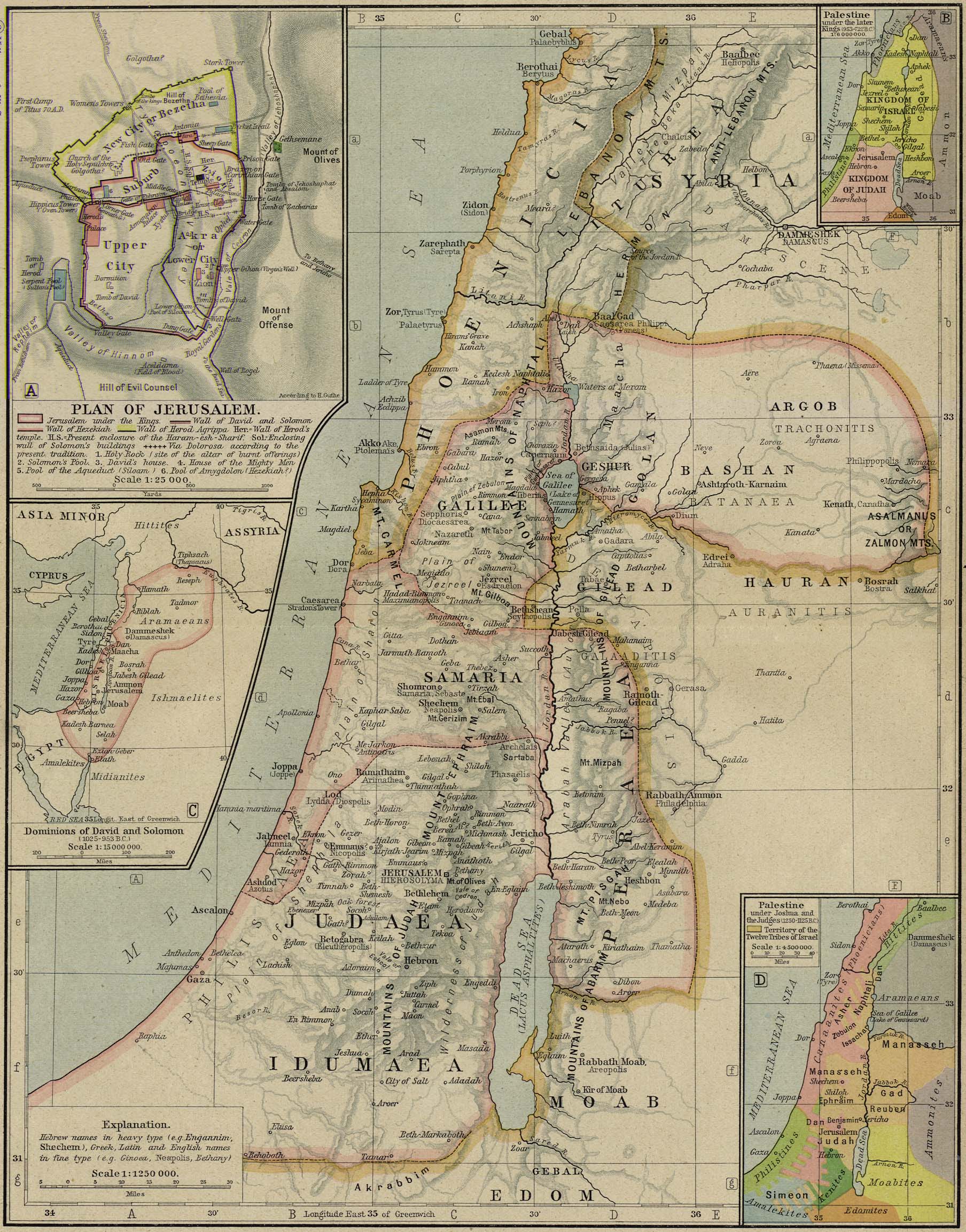
- 1Hebron, He was born there and was proclaimed king there. 2 Samuel 15:10
- 2Geshur, His mother's land, where he lived three years. 2 Samuel 13:38
- 3Jerusalem, He met those who sought judgment at its gate and took its palace. 2 Samuel 16:22
- 4Mount of Olives, David went up it weeping as he fled. 2 Samuel 15:30
- 5Mahanaim, David's refuge while Absalom camped in Gilead. 2 Samuel 17:24
Not placed: Geshur (2), Mahanaim (5).
Base map: Reference map of ancient Palestine, Rand McNally reference map (1926), public domain. Each place stands at its place page's coordinates, set on the plate by Jerusalem and Damascus, as the plate prints them.
Three of the five places stand west of the Jordan.
Questions His Life Raises
Three questions answered from the text and its commentators
Four years or forty?2 Samuel 15:7; Keil and Delitzsch and H. P. Smith
After four years had passed, Absalom said to the king, “Please let me go to Hebron to fulfill a vow I have made to the LORD.The Hebrew of this verse reads forty years, and the Berean text prints four. Keil and Delitzsch judge forty unsuitable and accept four from the Syriac and the Vulgate. H. P. Smith names the Lucianic Greek, Josephus and Theodoret for the same reading.
Was it his hair that caught him?2 Samuel 14:26 and 2 Samuel 18:9
Second Samuel 14:26 tells of the weight of his hair, two hundred shekels a year by the royal standard. Second Samuel 18:9 says that his head was caught in the oak and names no hair.
Is the monument in the Kidron Valley his pillar?2 Samuel 18:18; Keil and Delitzsch and H. P. Smith
A tomb in the Kidron Valley east of Jerusalem bears the name Absalom's Tomb. Keil and Delitzsch judge it to be of Greek origin. H. P. Smith states that the place of Absalom's own pillar is unknown.
What the Text Leaves Unsaid
Two things the text does not tell about him
The text does not name his three sons or tell what became of them.
It does not say whether Absalom made the vow he named at Hebron.
How Scripture Reads Him
Psalm 3 is David's prayer from the days of the revolt.
In 2 Samuel 17:14 the narrator credits the LORD with Absalom's fall.
O LORD, how my foes have increased! How many rise up against me! Many say of me, “God will not deliver him.” Selah But You, O LORD, are a shield around me, my glory, and the One who lifts my head.The title names Absalom as the son David fled from.
Voices on Absalom
Ambrose and Charles Spurgeon wrote on his father's grief.
Ambrose of Milan (died 397)
On the Decease of His Brother Satyrus, Book 2.28
Ambrose of Milan set David's tears for Absalom beside his calm at the death of his infant son.
“But that same David, that the difference of his actions may not perhaps disturb those who cling to the words of Scripture; that same David, I say, who had not wept for the innocent infant, wept for the parricide when dead. For at the last, when he was wailing and mourning, he said, ‘O my son Absalom, my son Absalom! Who will grant me to die for thee!’”
on 2 Samuel 18:33Patristic
Charles Spurgeon (1834 to 1892)
The Treasury of David, Vol. 1
Charles Spurgeon heard in Psalm 3 the complaint of a father whose enemies multiplied.
“The poor broken-hearted father complains of the multitude of his enemies: and if you turn to 2 Samuel 15:12, you will find it written that ‘the conspiracy was strong; for the people increased continually with Absalom, ‘ while the troops of David constantly diminished! ‘Lord how are they increased that trouble me!’ Here is a note of exclamation to express the wonder of woe which amazed and perplexed the fugitive father. Alas! I see no limit to my misery, for my troubles are enlarged! There was enough at first to sink me very low; but lo! my enemies multiply.”
on Psalm 3:1Particular Baptist
Three Sons, or No Son?
Second Samuel 14:27 gives him three sons, and 2 Samuel 18:18 has him say he had none.
During his lifetime, Absalom had set up for himself a pillar in the King’s Valley, for he had said, “I have no son to preserve the memory of my name.” So he gave the pillar his name, and to this day it is called Absalom’s Monument.Genesis 14:17 names the King's Valley in the days of Abram.
The sons died youngKeil and Delitzsch
Keil and Delitzsch hold that the sons are not named because they died in infancy.
The objection is that 2 Samuel 14:27 says nothing of their deaths, as H. P. Smith notes.
Two notices from two sourcesH. P. Smith
H. P. Smith holds that the two verses conflict and judges 2 Samuel 18:18 the more likely to be original.
Keil and Delitzsch answer that the pillar was raised when no son of his was living.
Books to Read Next
Both works are in the public domain, and each has a free copy to read.
Biblical Commentary on the Books of Samuel
C. F. Keil and F. Delitzsch · 1880
Keil explains the Hebrew of his story in his notes on 2 Samuel 13 to 18.
Read at the Internet ArchiveA Critical and Exegetical Commentary on the Books of Samuel
Henry Preserved Smith · 1899
Smith weighs the readings of 2 Samuel 15:7 and sets 2 Samuel 14:27 against 2 Samuel 18:18.
Read at the Internet ArchiveThe Son His Father Would Have Died For
David wished he had died in Absalom's place and could not. The Son of David died for those who had risen against Him.
For if, when we were enemies of God, we were reconciled to Him through the death of His Son, how much more, having been reconciled, shall we be saved through His life!Romans 5:8 says that Christ died for us while we were still sinners.
Sources
Scripture is the Berean Standard Bible.
- C. F. Keil and F. Delitzsch, Biblical Commentary on the Books of Samuel, T. and T. Clark, 1880, pp. 412, 415 to 416 and 440.
- Henry Preserved Smith, A Critical and Exegetical Commentary on the Books of Samuel, T. and T. Clark, 1899, pp. 339, 342 and 359.
- Matthew Henry, Commentary on the Whole Bible, 1710, on 2 Samuel 13:22 and 18:14.
- Ambrose of Milan, On the Decease of His Brother Satyrus, Book 2.28.
- Charles Spurgeon, The Treasury of David, Vol. 1, 1869, on Psalm 3:1.
Keep Studying
Read it4
Studies8
Trials of life2