
Genesis 1 to 5 · Person · Featured Study
Adam
The life of Adam from his forming in Genesis 2 to his death in Genesis 5, with the readings of him in Romans 5 and 1 Corinthians 15.
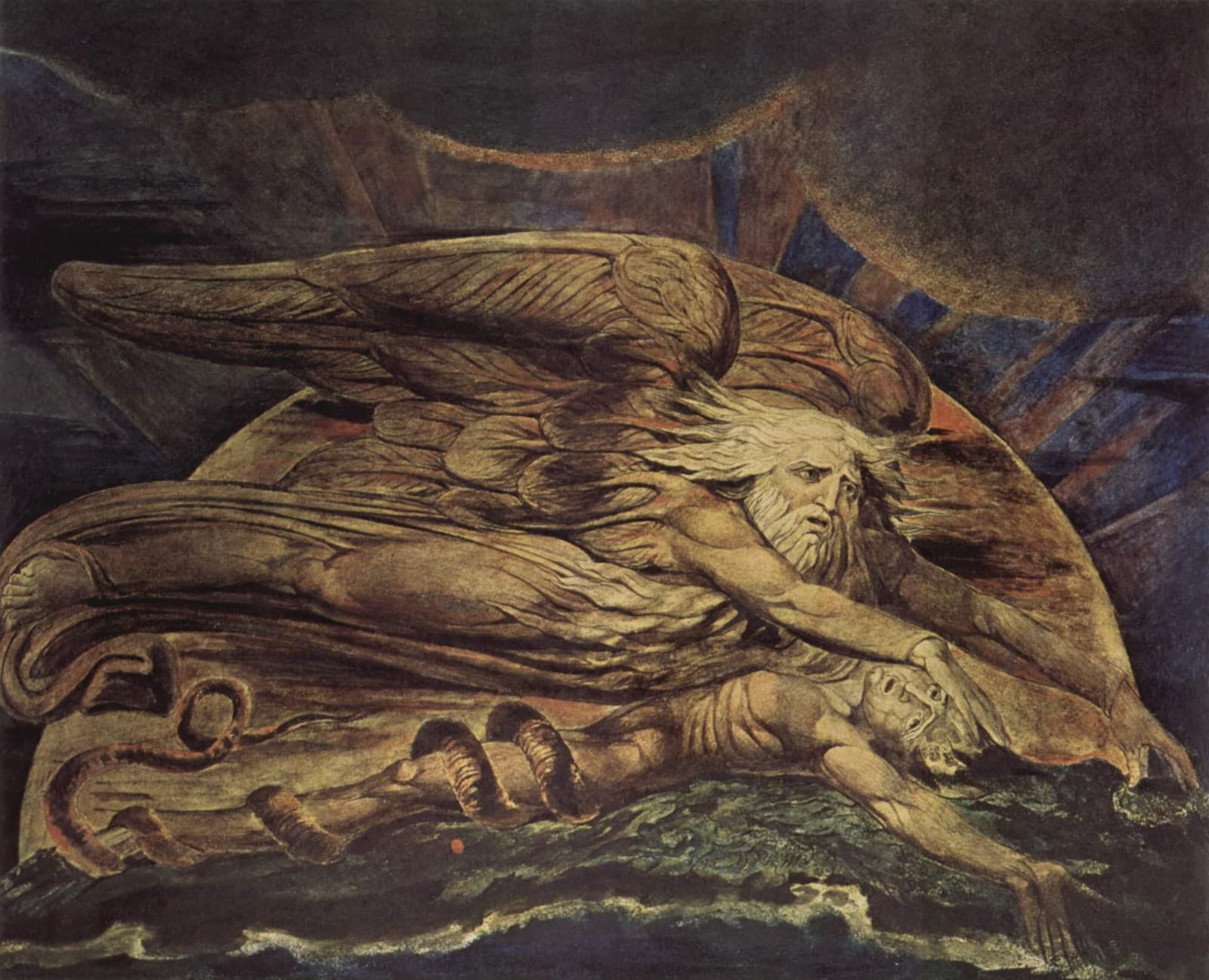
William Blake, Elohim Creating Adam, 1795, colour print finished in ink and watercolour, Tate, London. Public domain by date (made 1795); the photograph from The Yorck Project, public domain, via Wikimedia Commons, File:William_Blake_008.jpg.
THE ARTWORKBlake set the Creator above the first man with His hand on Adam's head, and he coiled a serpent about Adam's leg, so the fall of Genesis 3 is already in the picture.
Luke ends the ancestry of Jesus with Adam, and Paul calls Adam a pattern of the One to come.
Summary
Adam is the first man of Genesis, formed by the LORD God from the dust of the ground and placed in the Garden of Eden with one command.
- His first recorded words, in Genesis 2:23, greet the woman God made from his rib.
- He ate from the forbidden tree, and God sentenced him to toil until he returned to the dust.
- He fathered Cain, Abel and Seth and other sons and daughters, and he died at 930.
- Paul names Christ the last Adam and sets the two men against each other in Romans 5 and 1 Corinthians 15.
Where Adam Stands in Scripture
His first verse and his last
Before Genesis gives him a name, it records God's counsel to make man.
Then God said, “Let Us make man in Our image, after Our likeness, to rule over the fish of the sea and the birds of the air, over the livestock, and over all the earth itself and every creature that crawls upon it.”This is the first verse of Scripture to name man, and it names his image and his rule.
Jude names him in the last book before Revelation.
Enoch, the seventh from Adam, also prophesied about them: “Behold, the Lord is coming with myriads of His holy onesJude counts Enoch the seventh from Adam, the count of Genesis 5.
The Life, Turn by Turn
Each turn with its place, its day or his years where Genesis gives them
- Made in the image of Godthe sixth dayGenesis 1:27
- Formed from the dust and given the breath of lifethe groundGenesis 2:7
- Placed in the garden to cultivate and keep itthe Garden of EdenGenesis 2:15
- Given the one commandthe Garden of EdenGenesis 2:17
- Names the creaturesthe Garden of EdenGenesis 2:20
- Receives the woman made from his ribthe Garden of EdenGenesis 2:22
- Eats the fruit his wife gives himthe tree in the middle of the gardenGenesis 3:6
- Hides and answers Godamong the trees of the gardenGenesis 3:10
- Hears his sentencethe Garden of EdenGenesis 3:17
- Names his wife Evethe Garden of EdenGenesis 3:20
- Banished to work the groundout of the Garden of EdenGenesis 3:23
- Fathers Cain and Abeloutside the gardenGenesis 4:1
- Fathers Sethat 130 yearsGenesis 5:3
- Lives on after the birth of Seth800 yearsGenesis 5:4
- Diesat 930 yearsGenesis 5:5
The timeline draws fifteen turns of the life.
From the Dust to the Dust
Genesis 2:7 to 5:5
In Genesis 2 the man lives in a garden in Eden, in the east, with work to do and a law to keep.
The serpent speaks to the woman, she takes the fruit and shares it with her husband, and the LORD God comes to call them to account.
Outside Eden, Eve bears three sons, and Genesis 5 counts Adam's years from the birth of Seth to his death.
Formed from the dustGenesis 2:7 to 17
Then the LORD God formed man from the dust of the ground and breathed the breath of life into his nostrils, and the man became a living being.The man is made before the garden is planted, and then he is placed in it.
“Man is a little world, consisting of heaven and earth, soul and body. Now here we have an account of the origin of both and the putting of both together: let us seriously consider it, and say, to our Creator's praise, We are fearfully and wonderfully made, Ps. cxxxix.”
Matthew Henry · Commentary on the Whole Bible · on Genesis 2:7Puritan
Rashi, who wrote his commentary in Troyes in the eleventh century, reads the double letter in the Hebrew word for formed as two formations, one for this world and one for the resurrection. He also reports that God gathered the man's dust from the whole earth, so that the earth would receive him for burial wherever he died.
And the LORD God commanded him, “You may eat freely from every tree of the garden, but you must not eat from the tree of the knowledge of good and evil; for in the day that you eat of it, you will surely die.”The command gives him every tree but one and names the penalty in the same sentence.
The names and the womanGenesis 2:18 to 25
The man gave names to all the livestock, to the birds of the air, and to every beast of the field. But for Adam no suitable helper was found.The naming of the creatures ends with the finding that no suitable helper is there for him.
And the man said: “This is now bone of my bones and flesh of my flesh; she shall be called ‘woman,’ for out of man she was taken.”He calls her bone of his bones because she was taken out of him.
Jesus quotes the next verse, Genesis 2:24, when the Pharisees ask Him about divorce in Matthew 19:5.
The eatingGenesis 3:1 to 7
And the eyes of both of them were opened, and they knew that they were naked; so they sewed together fig leaves and made coverings for themselves.Their eyes are opened as the serpent said, and the first thing they know is that they are naked.
The serpent's words to the woman are taught verse by verse on The Fall.
The question and the answerGenesis 3:8 to 13
But the LORD God called out to the man, “Where are you?”God's first words to the man after the eating are a question.
And the man answered, “The woman whom You gave me, she gave me fruit from the tree, and I ate it.”Rashi hears ingratitude in this reply.
“Adam was afraid, because he was naked; not only unarmed, and therefore afraid to contend with God, but unclothed, and therefore afraid so much as to appear before him. We have reason to be afraid of approaching to God if we be not clothed and fenced with the righteousness of Christ, for nothing but this will be armour of proof and cover the shame of our nakedness.”
Matthew Henry · Commentary on the Whole Bible · on Genesis 3:10Puritan
Toil and the dustGenesis 3:14 to 20
And to Adam He said: “Because you have listened to the voice of your wife and have eaten from the tree of which I commanded you not to eat, cursed is the ground because of you; through toil you will eat of it all the days of your life.The sentence names his fault: he listened to his wife and ate from the tree he was commanded to leave.
By the sweat of your brow you will eat your bread, until you return to the ground—because out of it were you taken. For dust you are, and to dust you shall return.”His toil ends only when he returns to the dust.
And Adam named his wife Eve, because she would be the mother of all the living.He gives his wife the name Eve after the sentence of death has been spoken over him.
Outside the gardenGenesis 3:22 to 5:5
Therefore the LORD God banished him from the Garden of Eden to work the ground from which he had been taken.The work he was made for goes on outside the garden under the curse.
So He drove out the man and stationed cherubim on the east side of the Garden of Eden, along with a whirling sword of flame to guard the way to the tree of life.This is the last time Genesis shows him at the garden.
Eve bears Cain and Abel, and after Cain kills Abel she bears Seth. Cain and Abel have a page together, and Seth has his own.
When Adam was 130 years old, he had a son in his own likeness, after his own image; and he named him Seth.Seth is born in Adam's likeness, as Adam was made in God's likeness in Genesis 5:1.
So Adam lived a total of 930 years, and then he died.Genesis 5 closes his life, the first of its line, with the words and then he died.
Records Behind the Retelling
Five records from Genesis and Revelation
WORK BEFORE THE CURSE
He was placed in the garden to cultivate and keep it before the ground was cursed in Genesis 3:17.
THE COMMAND CAME BEFORE THE WOMAN
The LORD God gave the man the command in Genesis 2:16 to 17, and the woman was made in Genesis 2:22.
THE FRUIT IS NAMED BY ITS TREE
Genesis calls it the fruit of the tree of the knowledge of good and evil, which stood in the middle of the garden.
WITH HER AT THE TREE
She also gave some to her husband who was with her, and he ate it.
REVELATION NAMES THE SERPENT
Genesis 3 calls the serpent crafty, and Revelation 12:9 calls the devil that ancient serpent.
The Name Adam and the Line of Genesis 5
The Hebrew word adam, the heading of Genesis 5, and what Jewish writings outside Scripture say of him
Adam and adamah
The Hebrew word adam means man or humankind, and adamah means the ground. Genesis 2:7 forms the adam from the dust of the adamah, and Genesis 3:19 sends him back to it.
In Genesis 5:2 God gives the man and the woman together the one name man, so the word is his name and the name of the race.
The book of the generations of Adam
This is the book of the generations of Adam. In the day that God created man, He made him in His own likeness.The heading of his line repeats that God made man in His own likeness.
The Hebrew word toledot, the account or generations, heads the account of the heavens and the earth in Genesis 2:4 and the account of Noah in Genesis 6:9.
Rashi and Radak on his 130 years
Jewish writings beside Genesis
2 Esdras is a Jewish apocalypse outside the canon whose central chapters are commonly dated to the late first century AD. In 7:48 it cries out that Adam did not fall alone and that all who come from him fell with him.
The Wisdom of Solomon, a Greek Jewish work outside the canon, is one of the earliest surviving texts to say that death came into the world through the envy of the devil, at 2:24.
The Babylonian Talmud was completed between about AD 500 and 600. At Sanhedrin 38b it reports the teaching of Rav that the first man spanned the world from end to end and was made smaller after he sinned. The teaching is read from Deuteronomy 4:32 and Psalm 139:5.
The Family of Adam
Six ties, each with its verse
| Person | Tie to Adam | Verse |
|---|---|---|
| Eve | His wife, the mother of all the living. | Genesis 3:20 |
| Cain | His firstborn son, a tiller of the soil. | Genesis 4:1 |
| Abel | His second son, a keeper of sheep, killed by Cain. | Genesis 4:2 |
| Seth | His son born at 130 in his own likeness. | Genesis 5:3 |
| Other sons and daughters | Children born to him after Seth. | Genesis 5:4 |
| Enosh | His grandson, the son of Seth. | Genesis 4:26 |
Questions the Life Raises
Five questions answered from their verses
Did Adam die on the day he ate?Ambrose of Milan, On Paradise; Augustine of Hippo, City of God 13.12
Genesis 2:17 warns of death in the day he eats, and Genesis 5:5 counts the whole span of his life. Ambrose asks what the doubled wording of the command adds.
“What is the difference between saying 'ye shall die' and 'ye shall die the death'? We ought to point out that there is nothing superfluous in the command of God. Here is my solution. Since life and death are contradictory ideas, in unaffected language we say 'we live in life' and 'die in death.'”
Ambrose of Milan · On Paradise · on Genesis 2:17Patristic
Augustine answers that the death threatened was every death, the death of the soul without God and the death of the body.
Why does Paul say Adam was not deceived?1 Timothy 2:14; Augustine of Hippo, City of God 14.11
And it was not Adam who was deceived, but the woman who was deceived and fell into transgression.Paul sets the woman, who was deceived, apart from Adam.
In Genesis 3:13 the woman says the serpent deceived her, and in Genesis 3:12 Adam says only that she gave and he ate.
Augustine reads Adam as yielding to the woman from the bond between them, and he says Adam was no less guilty for it, since he sinned with his eyes open.
What were the garments of skin?Genesis 3:21; Adam Clarke, Commentary on the Bible (1832)
And the LORD God made garments of skin for Adam and his wife, and He clothed them.Their own covering of fig leaves gives way to one God provides.
Is Hosea 6:7 about Adam?Hosea 6:7; Job 31:33
But they, like Adam, have transgressed the covenant; there they were unfaithful to Me.Hosea charges Israel with transgressing the covenant as Adam did.
if I have covered my transgressions like Adam by hiding my guilt in my heart,Job speaks of hiding guilt in the heart as Adam hid.
In both verses the Hebrew can be read as the name Adam or as the word for men, and the Berean Standard Bible renders both as Adam.
Why does Luke call Adam the son of God?Ambrose of Milan
the son of Enosh, the son of Seth, the son of Adam, the son of God.Luke's list of fathers runs back through Adam and ends with God.
Ambrose ties the ending of the list to the baptism Luke tells just before it.
“Therefore Luke also thought that his origin should be traced back to God. Because God is the true Father of Christ, either the Father according to the true generation or the Author of the mystical gift—according to the regeneration of baptism. Furthermore, he did not start by describing his generation but first set forth his baptism. He desired to show him as God, the Author of all, weaving everything together through baptism.”
Ambrose of Milan · Exposition of the Gospel of Luke 3.11 · on Luke 3:38Patristic
What the Text Leaves Unsaid
His years in the garden, his last words and his daughters' names
A Pattern of the One to Come
Genesis 3:15, Romans 5, 1 Corinthians 15, Ephesians 5 and Revelation 2 and 22 point from Adam to Christ
Nevertheless, death reigned from Adam until Moses, even over those who did not sin in the way that Adam transgressed. He is a pattern of the One to come.Here Paul's argument turns from Adam's sin to the One he prefigures.
The two men are unequal in Paul's reckoning: the gift is not like the trespass, and where sin increased, grace increased all the more.
So it is written: “The first man Adam became a living being;” the last Adam a life-giving spirit.Paul quotes Genesis 2:7 of the first man and calls Christ the last Adam.
One man's disobedience and one man's obedienceRomans 5:15 to 19; Irenaeus
For just as through the disobedience of the one man the many were made sinners, so also through the obedience of the one man the many will be made righteous.Paul sets the many made sinners beside the many who will be made righteous.
Irenaeus sets the soil Adam was formed from beside the virgin Christ was born of.
“For as by the disobedience of the one man who was originally moulded from virgin soil, the many were made sinners, and forfeited life; so was it necessary that, by the obedience of one man, who was originally born from a virgin, many should be justified and receive salvation. Thus, then, was the Word of God made man, as also Moses says: ‘God, true are His works.’ But if, not having been made flesh, He did appear as if flesh, His work was not a true one.”
Irenaeus · Against Heresies Book III · on Romans 5:19Patristic
The first man and the second1 Corinthians 15:21 to 22 and 45 to 49; Athanasius; John Wesley
For since death came through a man, the resurrection of the dead comes also through a man.Paul's case for the hope of the body rests on this parallel of two men.
“For by the sacrifice of his own body he both put an end to the law which was against us and made a new beginning of life for us, by the hope of resurrection which he has given us. For since from man it was that death prevailed over men, for this cause conversely, by the Word of God being made man has come about the destruction of death and the resurrection of life.”
Athanasius of Alexandria · On the Incarnation of the Word 10 · on 1 Corinthians 15:21Patristic
“He himself made the heavens, and by descending from thence showed himself to us as the Lord. Christ was not the second man in order of time; but in this respect, that as Adam was a public person, who acted in the stead of all mankind, so was Christ. As Adam was the first general representative of men, Christ was the second and the last.”
John Wesley · Explanatory Notes upon the New Testament · on 1 Corinthians 15:47Evangelical
The seed of the womanGenesis 3:15
And I will put enmity between you and the woman, and between your seed and her seed. He will crush your head, and you will strike his heel.”The promise is spoken to the serpent in Adam's hearing, before his own sentence.
The Fall teaches the promise and its readings in full.
The church and the brideEphesians 5:31 to 32; Ambrose of Milan; Jerome
Paul quotes Genesis 2:24 in Ephesians 5:31 and says the mystery is about Christ and the church.
“If the union of Adam and Eve is a great mystery in Christ and in the church, it is certain that as Eve was bone of the bones of her husband and flesh of his flesh, we also are members of Christ's body, bones of his bones and flesh of his flesh.”
Ambrose of Milan · Letters · on Genesis 2:24Patristic
“‘God took a rib from the side of Adam and made it into a woman.’ Here Scripture said aedificavit (‘built’). The concept of building intends to denote the construction of a great house; consequently Adam's rib fashioned into a woman signifies, by apostolic authority, Christ and the church, and that is why Scripture said he formed (aedificavit) a woman from the rib. We have heard about the first Adam; let us come now to the second Adam and see how the church is made (aedificatur) from his side.”
Jerome · HOMILIES 66 · on Genesis 2:22Patristic
The tree of life given backRevelation 2:7 and 22:2
He who has an ear, let him hear what the Spirit says to the churches. To the one who overcomes, I will grant the right to eat from the tree of life in the Paradise of God.The one who overcomes is granted the tree the cherubim guarded.
down the middle of the main street of the city. On either side of the river stood a tree of life, bearing twelve kinds of fruit and yielding a fresh crop for each month. And the leaves of the tree are for the healing of the nations.The last chapter of the Bible returns to the tree of the garden.
Voices on Adam
Six teachers in their own words, from the fourth century to the nineteenth
Gregory of Nyssa finds the dignity of man in God's counsel before making him. Matthew Henry reads the first man's name as a lesson in humility about where he came from.
“This same language was not used for (the creation) of other things. The command was simple when light was created; God said, ‘let there be light.’ Heaven was also made without deliberation.… These, though, were before (the creation of) humans. For humans, there was deliberation. He did not say, as he did when creating other things, ‘Let there be a human.’ See how worthy you are! Your origins are not in an imperative. Instead, God deliberated about the best way to bring to life a creation worthy of honor.”
Gregory of Nyssa · On the Origin of Man · on Genesis 1:26Patristic
“Adam had himself named the rest of the creatures, but he must not choose his own name, lest he should assume some glorious pompous title. But God gave him a name which would be a continual memorandum to him of the meanness of his original, and oblige him to look unto the rock whence he was hewn and the hole of the pit whence he was digged, Isa. li.”
Matthew Henry · Commentary on the Whole Bible · on Genesis 5:2Puritan
Four more voicesAthanasius, Ambrose of Milan, John Wesley, Albert Barnes
Athanasius reads the command and the garden as the guard God set on His gift. Ambrose hears God's question to Adam as a reproof, and Wesley measures the banishment against what Adam deserved. Barnes notes that Adam knew the woman for what she was the moment he saw her.
“Knowing once more how the will of man could sway to either side, in anticipation God secured the grace given them by a command and by the place where he put them. For he brought them into his own garden and gave them a law so that, if they kept the grace and remained good, they might still keep the life in paradise without sorrow or pain or care, besides having the promise of incorruption in heaven.”
Athanasius of Alexandria · On the Incarnation of the Word 3.4 · on Genesis 2:16 to 17Patristic
“What then does he mean by ‘Adam, where art thou?’ Does he not mean ‘in what circumstance’ are you; not, ‘in what place?’ It is therefore not a question but a reproof. From what condition of goodness, beatitude and grace, he means to say, have you fallen into this state of misery? You have forsaken eternal life. You have entombed yourself in the ways of sin and death.”
Ambrose of Milan · On Paradise, 14.70 · on Genesis 3:9Patristic
“He might justly have chased him out of the world, Job xviii, 18, but he only chased him out of the garden: he might justly have cast him down to hell, as the angels that sinned were, when they were shut out from the heavenly paradise, 2 Pet. ii, 4, but man was only sent to till the ground out of which he was taken. He was only sent to a place of toil, not to a place of torment.”
John Wesley · Explanatory Notes upon the Old Testament · on Genesis 3:24Evangelical
“Whether the primeval man was conscious of the change in himself, and of the work of the Supreme Being while it was going on, or received supernatural information of the event when he awoke, does not appear. But he is perfectly aware of the nature of her who now for the first time appears before his eyes.”
Albert Barnes · Notes, Explanatory and Practical, on the Old and New Testaments (1832-1869) · on Genesis 2:23Evangelical
How Readers Hold Adam's History and His Sin
Whether Adam was one historical first man, and how his sin reaches his descendants
A historical first man and a real fallC. John Collins; Hugh Ross
This reading rests on the New Testament's treatment of Adam as one man set beside one Man, Christ. C. John Collins, in Did Adam and Eve Really Exist? (Crossway, 2011), holds a real, individual Adam and a real fall. Hugh Ross, in The Genesis Question (NavPress, 1998), holds the same on an old earth.
A historical man in a text of ancient formWilliam Lane Craig; John H. Walton
William Lane Craig, in In Quest of the Historical Adam (Eerdmans, 2021), reads Genesis 1 to 11 as a genre that is literarily mythic but refers to real people. John H. Walton, in The Lost World of Adam and Eve (IVP, 2015), reads Adam and Eve as historical persons who also stand as archetypes for all humanity.
Creation through evolutionFrancis Collins; the BioLogos Foundation
Francis Collins, in The Language of God (Free Press, 2006), and the BioLogos Foundation hold that God created through evolutionary processes. They read Genesis 1 to 3 as theological truth in the idiom of its own culture.
Federal headshipCharles Spurgeon; John Wesley
Charles Spurgeon, preaching on Romans 5 in his sermon The One and the Many, held that all were represented by Adam in the garden and fell by his disobedience. Wesley, in his note on Romans 5:12, calls Adam the representative of mankind.
Natural headshipAugustine of Hippo
Augustine writes in City of God 13.14 that the whole race was in the one man who sinned, since the seminal nature from which all were to be born was already in him.
Inherited mortality and corruptionAthanasius of Alexandria
Athanasius teaches in On the Incarnation 4 and 5 that by the transgression men came under the law of death and corruption, and that this plight is why the Word took a body.
Books to Read Next
Four books, from the second century to the eighteenth
Against Heresies
Irenaeus · about 180
Irenaeus reads Christ as undoing on a tree the disobedience that came by a tree in his fifth book.
READ IT FREE AT NEW ADVENT →On the Incarnation
Athanasius · fourth century
Athanasius opens his account of the Word made man with the creation and the fall of the first man.
READ IT FREE AT CCEL →City of God
Augustine of Hippo · about 413 to 426
Augustine gives two books of the work to death and to Adam's sin.
READ IT FREE AT NEW ADVENT →Explanatory Notes upon the Old Testament
John Wesley · 1765
Wesley comments on Genesis 2 and 3 verse by verse.
READ IT FREE AT CCEL →The Last Adam
The man formed from the dust returned to it, as Genesis 3:19 said, and Paul says that as in Adam all die, so in Christ all will be made alive.
Those who have borne the likeness of the earthly man are promised the likeness of the heavenly man. Paul says that those who receive the abundance of grace and the gift of righteousness will reign in life through the one man, Jesus Christ.
Keep studying
Read it5
Studies5
Doctrines8
Peoples and groups2