
Numbers · Group · Featured Study
The Sons of Korah
Korah, their father, was a Levite of the clan of Kohath.
The titles of eleven psalms, Psalm 42 and Psalm 46 among them, name the sons of Korah, the Levite who rose against Moses and Aaron.
- Began
- With Korah son of Izhar, of the clan of Kohath (Exodus 6:21 and 24)
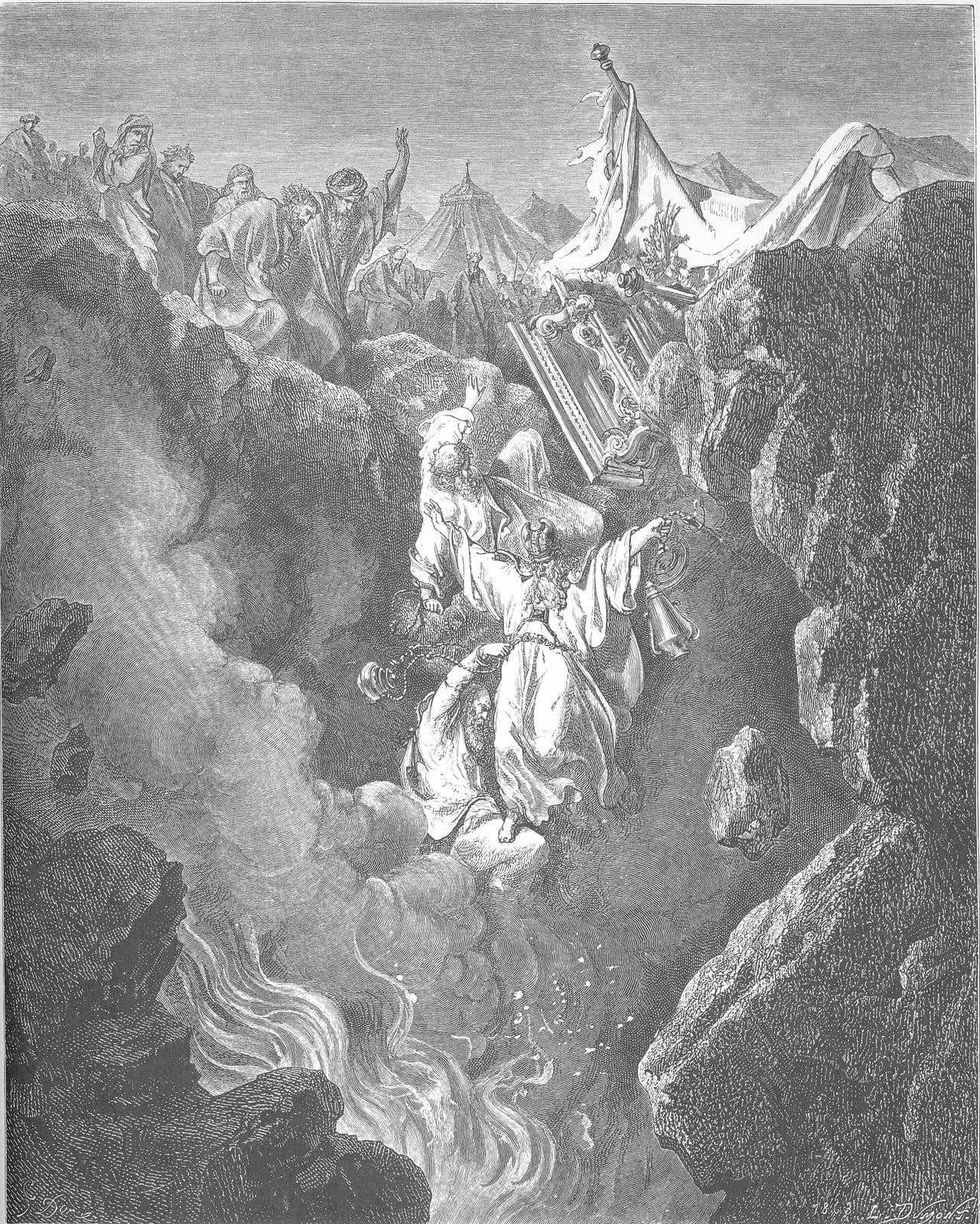
Gustave Doré, The Death of Korah, Dathan and Abiram, wood engraving, 1866. Public domain by date (published before 1930), via Wikimedia Commons.
THE ARTWORKDoré drew the ground opening under Korah's company, with the censers of the rebellion falling into the fire below. This is the judgment from which Korah's line was kept.
Summary
The sons of Korah were the descendants of Korah son of Izhar, whose line did not die out when the LORD judged his company.
- Exodus 6:24 names Korah's three sons, Assir, Elkanah and Abiasaph, as the clans of the Korahites.
- The Chronicler counts Heman the singer and his grandfather Samuel in Korah's line.
- Korahite gatekeepers guarded the thresholds of the Tent, and the gates of the house of the LORD were assigned by lot to their families and to the Merarites.
The Line of Korah Did Not Die Out
Numbers 26 recalls the judgment of Korah's company and adds one sentence about his line.
However, the line of Korah did not die out.The sentence sets Korah's line apart from the company that died with him.
These were the families of the Levites: The Libnite clan, the Hebronite clan, the Mahlite clan, the Mushite clan, and the Korahite clan. Now Kohath was the father of Amram,The second census, taken on the plains of Moab, shows the clan still standing after the judgment.
Why Numbers 26 tells the judgment again
Matthew Henry gives the reason the judgment stands in a list of families.
“Though the story had been largely related but a few chapters before, yet here it comes in again, as fit to be had in remembrance and thought of by posterity, whenever they looked into their pedigree and pleased themselves with the antiquity of their families and the glory of their ancestors, that they might call themselves a seed of evil doers.”
Matthew Henry · Commentary on the Whole Bible · on Numbers 26:9 to 11Puritan
Korah himself, in the earth or in the fire
And the earth opened its mouth and swallowed them along with Korah, whose followers died when the fire consumed 250 men. They serve as a warning sign.Both readings of Korah's end begin from this verse.
Adam Clarke, in his Commentary on the Bible, cites the Samaritan text, which says that Korah was burnt with the 250 men. John Wesley, in his Explanatory Notes upon the Old Testament, gives both readings of the verse. Matthew Henry, in his Commentary on Numbers 16:35, thinks it most probable that Korah kept his post at the door of the tabernacle and was consumed with the 250.
From Levi to Heman
Exodus 6 and 1 Chronicles 6 carry the line from Levi through Korah to one of David's singers.
The line told twice in 1 Chronicles 6
The descendants of Kohath: Amminadab his son, Korah his son, Assir his son, Elkanah his son, Ebiasaph his son, Assir his son,The first list puts Amminadab where Exodus 6:21 and 1 Chronicles 6:38 have Izhar as Korah's father.
John Gill, in his Exposition of the Old Testament, takes Amminadab for Izhar and reads the two lists as one line under other names. By his reading Uriel is Zephaniah, Uzziah is Azariah, Shaul is Joel, Ahimoth is Mahath and Zophai is Zuph.
Singers and Gatekeepers
The Chronicler gives the Korahites two offices at the house of the LORD, its music and its gates.
These are the men David put in charge of the music in the house of the LORD after the ark rested there. They ministered with song before the tabernacle, the Tent of Meeting, until Solomon built the house of the LORD in Jerusalem. And they performed their duties according to the regulations given them.The verses place the office of Heman's line in the years between the ark's rest and Solomon's house.
Shallum son of Kore, the son of Ebiasaph, the son of Korah, and his relatives from the Korahites were assigned to guard the thresholds of the Tent, just as their fathers had been assigned to guard the entrance to the dwelling of the LORD.The office passed down within Korah's family, as the verse's own genealogy shows.
And the Levites from the Kohathites and Korahites stood up to praise the LORD, the God of Israel, shouting in a very loud voice.The singers' office in Korah's line still stood in the reign of Jehoshaphat.
Twenty-four Levites stood guard at the gates each day, six of them on the east.
- Shelemiah's family
- Obed-edom's family
- Shuppim and Hosah
The 6 guards each day as a table
| Post | Guards each day | Family by lot | Verse |
|---|---|---|---|
| The East Gate | 6 | Shelemiah's family | 1 Chronicles 26:17 |
| The North Gate | 4 | Shelemiah's family | 1 Chronicles 26:17 |
| The South Gate | 4 | Obed-edom's family | 1 Chronicles 26:17 |
| The storehouse, two pairs | 4 | Obed-edom's family | 1 Chronicles 26:17 |
| The highway, west | 4 | Shuppim and Hosah | 1 Chronicles 26:18 |
| The court, west | 2 | Shuppim and Hosah | 1 Chronicles 26:18 |
Each bar is a post, coloured by the family whose lot fell on it; the text gives counts and no measures.
The lots for the gates
They cast lots for each gate, according to their families, young and old alike. The lot for the East Gate fell to Shelemiah. Then lots were cast for his son Zechariah, a wise counselor, and the lot for the North Gate fell to him.The lots of these verses decided each post in the bars above.
The Chronicler counts Meshelemiah's house among the Korahites and Hosah among the Merarites. Albert Barnes, in his Notes on 1 Chronicles 9:19, takes Shallum, Shelemiah and Meshelemiah for one Levite of David's time, whose descendants kept his name.
Twenty-four guards and four thousand gatekeepers
4,000 are to be gatekeepers, and 4,000 are to praise the LORD with the instruments I have made for giving praise.”David's number of gatekeepers is far larger than the twenty-four guards of 1 Chronicles 26:17 to 18.
Albert Barnes, in his Notes on 1 Chronicles 26:19, suggests that twenty-four of the chief porters were always on guard as officers, with others of the four thousand on duty under them each day.
Appointed by David and Samuel
The number of those chosen to be gatekeepers at the thresholds was 212. They were registered by genealogy in their villages. David and Samuel the seer had appointed them to their positions of trust.The verse names Samuel the seer beside David, and the Chronicler's line of Korah also carries a Samuel (1 Chronicles 6:34).
Albert Barnes draws from the verse that David planned the order of the gates while Saul still reigned.
“The porters, like the singers Neh 12:29, dwelt for the most part in the villages round Jerusalem. They were the descendants of those originally selected for the work by David. David’s arrangements are here regarded as having had the sanction of Samuel - which would imply that he planned them in the lifetime of Saul, while he was still a fugitive and an outlaw.”
Albert Barnes · Notes, Explanatory and Practical, on the Old and New Testaments (1832-1869) · on 1 Chronicles 9:22Evangelical
Matthew Henry gives David's part in the singers' office.
“David was raised up on high to be the sweet psalmist of Israel ( 2 Sam. xxiii. 1 ), not only to pen psalms, but to appoint the singing of them in the house of the Lord (not so much because he was musical as because he was devout), and this he did after that the ark had rest.”
Matthew Henry · Commentary on the Whole Bible · on 1 Chronicles 6:31Puritan
Eleven Psalms of the Sons of Korah
Seven of the eleven psalms stand in Book II of the Psalter and four in Book III.
| Psalm | Verses | Its subject |
|---|---|---|
| Psalm 42, Book II | 11 | A soul thirsts for God far from His house. |
| Psalm 44, Book II | 26 | The nation asks why God has rejected it. |
| Psalm 45, Book II | 17 | The singer recites his verses to the king and the princess led to him. |
| Psalm 46, Book II | 11 | God is the refuge of His city. |
| Psalm 47, Book II | 9 | God reigns as King of all the earth. |
| Psalm 48, Book II | 14 | Zion is the city of the great King. |
| Psalm 49, Book II | 20 | Rich and poor alike die and leave their wealth. |
| Psalm 84, Book III | 12 | A pilgrim longs for the courts of the LORD. |
| Psalm 85, Book III | 13 | The people ask God to revive them again. |
| Psalm 87, Book III | 7 | The peoples are recorded as born in Zion. |
| Psalm 88, Book III | 18 | A man near the Pit cries out, and the title also names Heman the Ezrahite. |
For better is one day in Your courts than a thousand elsewhere. I would rather be a doorkeeper in the house of my God than dwell in the tents of the wicked.A psalm of the sons of Korah prefers the post of a doorkeeper in God's house, the office the Chronicler gives their line at the Tent.
Psalm 43 read with Psalm 42
Why are you downcast, O my soul? Why the unease within me? Put your hope in God, for I will yet praise Him, my Savior and my God.The refrain of Psalm 42:5 and Psalm 42:11 returns at the close of Psalm 43, which has no title naming its singer.
Theodoret of Cyrus judged from the refrain that the two psalms have one meaning.
“From this it is clear that both psalms have the same meaning. Those using them encourage themselves to have stronger hope, overcome the feeling of discouragement and await the salvation from God that will doubtless be given them.”
Theodoret of Cyrus · Commentary on the Psalms 43:5 · on Psalm 43:5Patristic
What the Text Leaves Unsaid
Numbers, Chronicles and the Psalms leave these questions about Korah's line open.
Numbers does not say how the sons of Korah were kept alive.
Numbers 16:27 names the households of Dathan and Abiram standing at their tents, and the chapter does not say where Korah's sons stood.
1 Chronicles 6:23 sets Assir, Elkanah and Ebiasaph one after another, each called his son, where Exodus has them as three brothers, and 1 Chronicles 6:37 makes Ebiasaph the son of Korah. The text does not say how the lists join.
Psalm 84 does not say whether its singer kept a door of the house he longs for.
Sheol in Numbers and in Their Psalms
Numbers names the place of the dead in Korah's judgment, and two psalms of his sons speak of it in their own prayers.
They went down alive into Sheol with all they owned. The earth closed over them, and they vanished from the assembly.Sheol enters the story of Korah's line here, as the place his company went down alive.
For my soul is full of troubles, and my life draws near to Sheol.Psalm 88 sets the word in the prayer of a man who expects to die.
But God will redeem my life from Sheol, for He will surely take me to Himself. SelahThe psalm sets this hope against the riches that cannot ransom a life (Psalm 49:7 to 8).
Spurgeon on Psalm 49:15
Charles Spurgeon, in The Treasury of David, reads the verse as the hope of a believer who will come out of the grave like his risen Head, redeemed by the blood of Christ.
Three Voices on the Psalms of the Sons of Korah
Origen wrote in the third century, Jerome in the fifth and Matthew Henry in the eighteenth.
Origen hears Korah's three sons speaking with one voice in Psalm 42.
“For though there were three sons of Korah whose names we find in the book of Exodus—Aser, which is, by interpretation, ‘instruction,’ and the second Elkana, which is translated ‘possession of God,’ and the third Abiasaph, which in the Greek tongue might be rendered ‘congregation of the father’—yet the prophecies were not divided but were both spoken and written by one spirit and one voice and one soul, which worked in true harmony. And the three speak as one, ‘As the hart pants after the springs of the water, so pants my soul after you, O God.’”
Origen of Alexandria · Commentary on the Gospel of Matthew 14.1 · on Exodus 6:24Patristic
Jerome gives a rule for every psalm whose title names the sons of Korah.
“To the choirmaster, for the winepresses, a psalm of the sons of Korah. There are three psalms which are inscribed ‘for the winepresses’: the eighth, the eightieth, and the eighty-third. The eighth is inscribed to David, the eightieth is inscribed to Asaph, the eighty-third is inscribed as of the sons of Korah. I give you a certain rule, so that you may know what you ought to observe in the Scriptures. Whatever psalm is inscribed as of the sons of Korah has nothing sad in it, but always signifies joyful things.”
Jerome · Homily 16, on Psalm 83 · on Psalm 84:1Patristic
Psalm 88 tests that rule, and Matthew Henry finds in its thirteenth verse a prayer that will not wait for the dawn.
“‘My prayer shall present itself before thee, and be betimes with thee, and shall not stay for the encouragement of the beginning of mercy, but reach towards it with faith and expectation even before the day dawns.’ God often prevents our prayers and expectations with his mercies; let us prevent his mercies with our prayers and expectations.”
Matthew Henry · Commentary on the Whole Bible · on Psalm 88:13Puritan
Three Questions about the Line
How the sons were kept, what the psalm titles mean by their name, and how Samuel's family came into Korah's line.
Kept apart from Korah's companyAlbert Barnes; John Wesley
Albert Barnes, in his Notes on Numbers 16:32, reads all Korah's men as those who had joined him in the rebellion, and he sets the sons apart by Numbers 26:11. John Wesley, in his Explanatory Notes on Numbers 26:10, reads what went down as Korah's tent, goods and family, his children excepted.
The objection: Numbers 16:32 says the earth swallowed the rebels' households, all Korah's men, and names no son of Korah as spared there.
Kept in a place set apart in GehinnomRashi
Rashi, on Numbers 26:11 in the translation of Rosenbaum and Silbermann, holds that the sons were in the plot at first and had thoughts of repentance when the rebellion broke out. A high place was fenced round for them in Gehinnom, and they stayed there; he cites the Talmud, Sanhedrin 110a, for the reading.
The objection: Numbers gives neither the repentance nor the place, and the reading rests on the tradition Rashi cites.
The sons of Korah as the writers of the psalmsOrigen; John Gill; Rashi
John Gill, in his Exposition on 1 Chronicles 6:33, calls Heman the chief of the singers, who composed psalms and hymns that are in the book of Psalms. Rashi, in his note on Psalm 42:1 in the Judaica Press translation of A. J. Rosenberg, holds that the sons composed these psalms in the place left for them within the mouth of the earth. Origen's Commentary on Matthew 14.1 takes the same view.
The objection: a title may name the singers who carried a psalm, and its words do not say who wrote it.
The psalms set for the Korahite singersAlbert Barnes; Rashi
Albert Barnes, in his Notes on Numbers 26:11, writes that several psalms appear from their titles to have been composed for the sons of Korah. Rashi, on the title of Psalm 88, says that the sons of Korah set that psalm for Heman to recite on the platform.
The objection: the titles name the sons of Korah where other titles of the Psalter name David as the writer.
Elkanah of 1 Samuel 1 in the line of KorahAlbert Barnes; John Gill; Jamieson, Fausset and Brown
Albert Barnes, in his Notes on 1 Samuel 1:1, takes the Zophim of Ramathaim-zophim for the sons of Zuph, whom 1 Chronicles 6:26 calls Zophai. John Gill, in his Exposition of the Old Testament, and Jamieson, Fausset and Brown, in their Commentary Critical and Explanatory on the Whole Bible, read the Samuel of the Chronicler's line as the prophet.
Now there was a man named Elkanah who was from Ramathaim-zophim in the hill country of Ephraim. He was the son of Jeroham, the son of Elihu, the son of Tohu, the son of Zuph, an Ephraimite.The objection stands in this verse, which calls Samuel's father Elkanah an Ephraimite and names no tribe of Levi.
Books to Read Next
Three works on the sons of Korah and their psalms, from about 420 to 1885
Homilies on the Psalms
Jerome · about 420
His sixteenth and seventeenth homilies treat Psalms 84 and 85, which he numbers 83 and 84.
Notes, Explanatory and Practical, on the Old Testament
Albert Barnes · 1832 to 1869
His notes on 1 Chronicles 9 and 26 weigh the gatekeepers' names and numbers.
The Treasury of David
Charles Spurgeon · 1869 to 1885
Its second volume holds his notes on Psalms 42 to 49, and its fourth his notes on Psalms 84 to 88.
Christ, His People and the Man Who Trusts
Hebrews reads a psalm of the sons of Korah of Christ, Romans reads another of His people, and Psalm 84 ends with a word for every reader.
But about the Son He says: “Your throne, O God, endures forever and ever, and justice is the scepter of Your kingdom.The words "Your throne, O God" of Psalm 45:6 become in Hebrews God's word about the Son.
As it is written: “For Your sake we face death all day long; we are considered as sheep to be slaughtered.”Paul sets the words of Psalm 44:22 over the sufferings of those whom nothing can separate from the love of God in Christ.
O LORD of Hosts, how blessed is the man who trusts in You!This is the last verse of the psalm whose singer would rather keep a door in God's house, and it ends on a blessing.
Keep studying
Read it6