
Skip to content
mannafest.faith
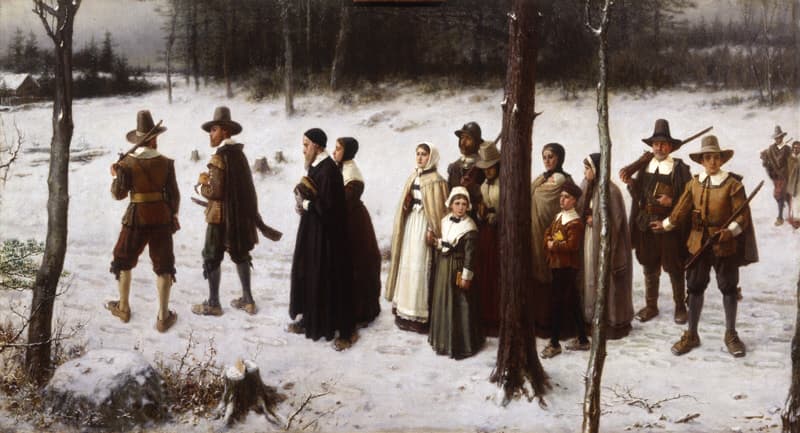
Pilgrims Going to Church

Pilgrims Going to Church, George Henry Boughton, 1867. Public domain.

The Great Cloud of Witnesses, era 6 of 10 · Church history · Featured Study

The Puritans & Pietists

The Reformation had opened the Bible. Now came the harder question: has it opened you? This is the century of the examined heart, the family altar, and the prayer meeting that would not quit.

Span
1600–1730
Boundary
The span closes at 1730 because the Awakening begins in the decade after.

Two movements made the same complaint.

Summary

A church can be right on paper and dead in life. They answered with plain preaching, small meetings, and a great deal of printed English.

  • The King James Bible came out in 1611.
  • The Westminster Assembly sat from 1643 and wrote the confession.
  • About two thousand ministers gave up their livings in 1662 rather than conform.
  • Bunyan wrote The Pilgrim's Progress in jail. It was printed in 1678.
  • Spener's Pia Desideria of 1675 began German Pietism.

The era's own voice

Why he wrote it: Bunyan wrote the book in Bedford jail, where he spent twelve years for preaching without a licence from the established church. The dream frame is how a tinker with no university could write theology and have it read.

What else says so: The Bedfordshire gaol records and his own Grace Abounding to the Chief of Sinners, published in 1666, carry the imprisonment and its grounds.

“As I walked through the wilderness of this world, I lighted on a certain place where was a den, and laid me down in that place to sleep: and, as I slept, I dreamed a dream.”

John Bunyan (1628–1688) · The Pilgrim's Progress, Part I, opening lines (1678)English Puritan

The turning points

The era hangs on these moments, each with a document a reader can open.

  1. 1611The King James Bible is finishedIt gave the English-speaking church one text for three hundred years, and it shaped the language itself.The King James Bible, 1611
  2. 1643The Westminster Assembly meetsIt produced the confession most English-speaking Presbyterian and Reformed churches still subscribe, and the catechism many were taught from.The Westminster Confession and the Shorter and Larger Catechisms, 1646 to 1647
  3. August 24, 1662The Great EjectionAbout two thousand ministers left their parishes in one day, and English nonconformity dates from it.The Act of Uniformity, 1662
  4. 1678The Pilgrim's Progress is publishedWritten by a tinker in prison, it taught the Christian life to more ordinary readers than any book of the century except the Bible.John Bunyan, The Pilgrim's Progress, 1678
  5. 1675Spener's Pia DesideriaIt set out the Pietist programme of small groups, lay Bible reading and a living faith, and Herrnhut, Halle and the Wesleys all come out of it.Philipp Jakob Spener, Pia Desideria, 1675

The 5 turning points of The Puritans & Pietists, 1600–1730, in order, each with the document that records it and why it earned its place.

The story

A Londoner in 1662 could be fined for missing his parish church, and two thousand ministers lost their livings in a single day for refusing to use one prayer book. Which service a man attended was a matter for the law.

Start by throwing out the cartoon. "Puritan" was an insult before it was a label, and the picture most of us inherited, sour people in tall hats hunting for joy to forbid, comes mostly from writers three centuries later. The people themselves were pastors, farmers, poets, and mothers who believed the Reformation had done only half its work. Luther and Tyndale had opened the Bible. The question left was whether it had opened you.

All these people died in faith, without having received the things they were promised. However, they saw them and welcomed them from afar. And they acknowledged that they were strangers and exiles on the earth.
Hebrews 11:13BSB

"Strangers and pilgrims on the earth": the verse that gave Bunyan his title, his hero, and the whole era its picture of the Christian life as a journey toward a city not yet in sight.

So this becomes the century of the examined heart. Richard Baxter came to Kidderminster, a rough weaving town of a couple thousand souls, and set out to visit every family in it, sitting in kitchens, catechizing children, praying with the parents. He kept it up for years, and the church had to build galleries for the crowds. His Reformed Pastor (1656) is still the plainest book ever written on what a shepherd actually owes his people.

Their spirituality was homemade and daily. The father led family worship at the table, a psalm, a chapter, prayer, which is where most Puritan children learned the Bible. John Owen wrote the era's hardest and most useful book on sin, with a sentence people still quote: "Be killing sin or it will be killing you." And the Sabbath, which the cartoon makes a day of gloom, they defended as the week's delight, the one day the shop was shut, the family was together, and God had their whole attention.

For if you live according to the flesh, you will die; but if by the Spirit you put to death the deeds of the body, you will live.
Romans 8:13BSB

John Owen built his classic on the daily war with sin directly on this verse, and on the Spirit as the only power that wins it.

Then the state pressed on the conscience. When the monarchy returned in 1660, the Act of Uniformity gave every minister until St. Bartholomew's Day, August 24, 1662, to accept the revised Prayer Book without reservation. Close to two thousand refused. They walked out of pulpits they had filled for decades and out of the houses and salaries that came with them, into a life of fines, spies, and jail, and they went knowing exactly what it would cost.

One preacher had been jailed even before that. John Bunyan, a Bedfordshire tinker with almost no schooling, was arrested in November 1660 for preaching without a license and told he could go home the moment he promised to stop. He would not, and he stayed twelve years. He made shoelace tags in his cell to send money home to a wife and four children, one of them a blind daughter named Mary, and later wrote that parting from her felt like pulling the flesh from his bones. He also wrote. In 1666 came his testimony, Grace Abounding; in 1678, a dream about a man with a burden on his back, The Pilgrim's Progress, which for two hundred years sat beside the Bible in English-speaking homes.

But when you pray, go into your inner room, shut your door, and pray to your Father, who is unseen. And your Father, who sees what is done in secret, will reward you.
Matthew 6:6BSB

The shut door and the Father who sees in secret is the Puritan and Pietist practice in one sentence: religion tested where no one is watching.

North of the border the cost was blood. Scottish Covenanters had sworn in 1638 to keep the church's worship under Christ alone; after 1660 their outdoor gatherings were outlawed, and preachers held services on the moors with lookouts posted on the ridges. The years around 1680 to 1688 are still called the Killing Time: Richard Cameron cut down at Airds Moss in 1680, James Renwick executed in 1688. Local memory adds the two women of Wigtown, tied to stakes in the tidal flats in 1685, a story the monuments keep, though some historians question the details. What is not in question is that people died on those hills rather than let a king tell them how to worship.

Across the Atlantic the same convictions were building a society, with all the mixture that implies. Plymouth's Pilgrims had come in 1620 to advance the gospel in remote parts of the world, as Governor William Bradford put it; Harvard was voted into being in 1636 so the churches would not be left an unlearned ministry; Anne Bradstreet wrote real poems about grief, marriage, and a burned house. And then in 1692 the same colony hanged nineteen neighbors at Salem on evidence no court should ever have heard. It is fair to say it plainly, and fair to add that in 1697 Judge Samuel Sewall stood up in Old South Church while his written confession of guilt was read aloud over him.

As the deer pants for streams of water, so my soul longs after You, O God.
Psalm 42:1BSB

The thirsting deer is the note under everything Spener, Francke, and the Moravians wrote, not more correct doctrine, but a heart actually longing for God.

Meanwhile Germany was a graveyard. The Thirty Years' War (1618–1648) had killed perhaps a third of the population in some regions, and the churches that survived it were often precise about doctrine and cold about God. Philipp Jakob Spener, a Frankfurt pastor, began holding meetings in his house, where he went over his sermons and passages of the New Testament with those who came. In 1675 he set out his case in Pia Desideria: get the Bible into ordinary hands, let believers meet in small groups, train ministers for godliness and not only for argument, and preach to the heart. Same fire as the Puritans, another language.

His student took it further. August Hermann Francke, teaching at the new university in Halle and pastoring a poor parish next door, opened a school for beggar children in 1695 with a handful of coins someone had dropped in the poor box. It grew into an orphanage (1698), then schools, a hospital, a pharmacy, and a Bible press that put Scripture into German homes at prices working families could pay. In 1706 two young men trained in that atmosphere, Ziegenbalg and Plütschau, sailed for Tranquebar in India, the first Protestant missionaries most historians count.

The era's writings, 1 to 3 of 10: each with its date and one line on what it holds.

WritingDateWhat it holds
The King James Bible1611The English Bible that became the common possession of the whole English-speaking church; its preface says translation is what opens the window to let in the light.
The Westminster Confession and Catechisms1646–1647The most influential summary of Reformed faith in English, and the source of the line generations learned by heart: man's chief end is to glorify God and to enjoy Him forever.
Richard Baxter, The Reformed Pastor1656A working pastor's account of what shepherding actually costs: knowing every family in the parish by name and sitting down with each one.

Then a Saxon estate caught fire. Count Nikolaus von Zinzendorf, a nobleman shaped by Halle, let refugee Moravian families, spiritual descendants of Jan Hus, three hundred years after his burning, settle on his land in 1722. They named the village Herrnhut, "the Lord's watch," and promptly fell to quarreling over doctrine and leadership. On August 13, 1727, at a communion service in the Berthelsdorf church, the quarrel broke and the community came away one; they said the Holy Spirit had visited them, and never explained it any other way. Two weeks later, 24 men and 24 women divided the clock into hours of prayer. The church's historian J. E. Hutton writes that the watch “is said to have lasted without interruption for over a hundred years.”

The era's writings, 4 to 6 of 10: each with its date and one line on what it holds.

WritingDateWhat it holds
John Owen, The Mortification of Sin in Believers1656The Puritans' deepest theologian on the daily war with sin, "be killing sin or it will be killing you."
Samuel Rutherford, Letterswritten 1630s; published 1664Letters written mostly from forced exile in Aberdeen, gathered after his death; the warmest devotional writing the Puritan movement produced.
John Bunyan, Grace Abounding to the Chief of Sinners1666Bunyan's own testimony, written in prison, a man's inner life laid open with unusual honesty about doubt and despair.

Within five years the praying village started sending. In 1732 Leonard Dober and David Nitschmann left for the slave plantations of St. Thomas in the Caribbean; Greenland followed in 1733; before long Moravians were in Suriname, South Africa, and Labrador, a community of a few hundred producing missionaries at a rate no state church came near. At the same time the Huguenots scattered by Louis XIV in 1685 were carrying their trades and their family Bibles into England, Holland, Prussia, the colonies, and the Cape. Persecution kept behaving like a seed dispersal.

The era's writings, 7 to 9 of 10: each with its date and one line on what it holds.

WritingDateWhat it holds
John Milton, Paradise Lost1667 (twelve-book edition 1674)The great Puritan epic: creation, the fall, and the promise of a Redeemer, dictated by a poet who had gone blind.
Philipp Jakob Spener, Pia Desideria1675"Pious Desires": six reform proposals that launched German Pietism and, with its small gatherings for Bible and prayer, effectively invented the modern small group.
Brother Lawrence, The Practice of the Presence of Godcompiled and published 1692Conversations and letters of a Carmelite lay brother who washed dishes in a Paris kitchen and learned to talk with God there; a Catholic voice on the same century's theme, read gratefully by Protestants ever since.

So the era ends with the spring wound tight. Isaac Watts had just given the English church new songs to sing (1707). Halle was printing Bibles and training preachers. Herrnhut was praying around the clock. And in 1735 a nervous young Anglican named John Wesley boarded a ship for Georgia, hit an Atlantic storm that terrified him, and watched a group of Moravian passengers sing calmly through it. He asked himself, in his journal, who would convert him. The answer to that question is the next era.

The era's writings, 10 to 10 of 10: each with its date and one line on what it holds.

WritingDateWhat it holds
Isaac Watts, Hymns and Spiritual Songs1707The book that opened English worship to freshly written hymns, and handed the coming revivals something to sing.

Matthew 6:6, Psalm 42:1

Why these years

The span closes at 1730 because the Awakening begins in the decade after. Halle's Pietism runs straight into it through the Moravians and the Wesleys. It opens at 1600, with the Puritan pressure inside the English church under James I. Neither date marks an event. A witness hangs where he was formed, so men who lived into the 1740s stand here.

What did not change

The household did not change. On both sides of the Channel and on both sides of the Atlantic the father read the Bible and prayed with his house morning and evening, and that daily hour carried the teaching further than any pulpit did.

The hard part

New England's Puritans built a colony where the church and the magistrate were the same interest, and they used it. Four Quakers were hanged on Boston Common between 1659 and 1661 for returning after banishment. Roger Williams and Anne Hutchinson were driven out for disagreeing. At Salem in 1692 nineteen people were hanged and one was pressed to death, on evidence a minister could see was worthless. Samuel Sewall, one of the judges, stood up in church five years later and read out his own confession of guilt.

The record with the Native peoples is worse and less often told. King Philip's War of 1675 to 1676 killed a large share of the native people of southern New England. It ended with captives sold into slavery in the Caribbean. John Eliot translated the whole Bible into Massachusett in 1663, the first Bible printed in North America. It belongs to the same colony and the same decades. Both facts are the record.

What this page leaves out

This page follows England, Scotland, New England and the German lands. It leaves out the Dutch Further Reformation, the details of the English civil wars, and the colonial treatment of native peoples except where a source on this page names it.

What it handed the church

Personal devotions, family worship, and the small group all come to us from these people; when a church puts believers around a table with an open Bible, it is running Spener's playbook and the Puritans'.

They handed the English-speaking world its Bible (1611), its confession and catechism, its first great hymnbook, and in The Pilgrim's Progress a story that taught the Christian life to readers who could barely read.

The Great Ejection and the Covenanters' moors settled a costly principle in practice, not theory: conscience before Christ is not the king's to license.

Halle and Herrnhut invented the machinery of Protestant missions, trained senders, cheap Bibles, sustained prayer, and ordinary tradesmen willing to go, a generation before William Carey was born.

Their honest self-examination is their gift and their warning: the same movement produced Baxter's kitchens and Salem's gallows, and its best men said so first.

Everything the Awakenings did next, the field preaching, the hymns, the accountability bands, the missionary societies, was drawn from wells these people dug.

The dated line14 dated moments of the era in order, the turning points included

Every dated moment of The Puritans & Pietists in order, 14 in all, the turning points included.

YearMomentWhat happened
1611The King James Bible is finishedAbout four dozen scholars, working in six companies at Westminster, Oxford, and Cambridge, complete a translation built largely on Tyndale's English. Its rhythms will shape how English speakers hear Scripture for the next three hundred years.
1620The Mayflower sailsRoughly a hundred passengers, about half of them from a separatist congregation that had already fled to Holland, cross to a cold New England coast in November. Close to half die before spring.
1628John Bunyan is born at ElstowA tinker's son in a Bedfordshire village, baptized that November. He will have almost no formal schooling and will write the most-read book in English after the Bible.
1636Harvard is founded to train ministersThe Massachusetts Bay colony votes money for a college because, as an early account put it, they dreaded leaving an unlearned ministry to the churches once the first pastors were in the dust. It is named in 1639 for John Harvard, who willed it his library.
1643–1646The Westminster Assembly meetsCalled by Parliament, some 120 ministers and 30 laymen sit in Westminster Abbey through the English Civil War. They produce the Westminster Confession (1646) and the Larger and Shorter Catechisms (1647).
Aug 24, 1662The Great EjectionThe Act of Uniformity requires every minister to accept the revised Prayer Book by St. Bartholomew's Day. Close to two thousand refuse and walk out of their pulpits, homes, and incomes, the single heaviest price English conscience ever paid in one day.
1675Spener's Pia DesideriaPhilipp Jakob Spener, a pastor in Frankfurt, publishes six plain proposals: more Bible in laypeople's hands, believers meeting in small groups, faith that shows up in life, gentler argument, ministers trained for godliness, preaching aimed at the heart. The book names a movement: Pietism.
1678The Pilgrim's Progress is publishedBunyan had spent twelve years (1660–1672) in Bedford jail rather than promise to stop preaching, making shoelace tags to feed his family, including a blind daughter. Out of those years came the dream of a man with a burden on his back, running toward a distant light.
1679–1688Scotland's Killing TimeCovenanters who kept preaching in open fields after outdoor worship was outlawed are hunted across the moors of the southwest. Richard Cameron falls at Airds Moss in 1680; James Renwick, the last of them executed, dies in 1688.
Oct 1685The Edict of Nantes is revokedLouis XIV cancels the protection French Protestants had held since 1598. Estimates vary, but somewhere around 150,000 to 200,000 Huguenots flee France for England, Holland, Prussia, Switzerland, the American colonies, and the Cape.
1698Francke's orphanage opens at HalleAugust Hermann Francke had started a school for poor children in 1695 with a few coins left in a parish box. Halle grows into orphanage, schools, hospital, and a Bible press.
1707Watts publishes Hymns and Spiritual SongsIsaac Watts, a dissenting pastor with a weak body and an enormous ear, argues that Christians may sing new words and not only metrical Psalms. The book carries "When I Survey the Wondrous Cross" and effectively begins English hymn-singing.
Jun 17, 1722Herrnhut is foundedChristian David fells the first tree on Count Zinzendorf's Saxon estate, making a refuge for Moravian families, spiritual descendants of Jan Hus, fleeing persecution in Bohemia and Moravia. The name means "the Lord's watch."
Aug 13, 1727The Moravian Pentecost and the prayer watchA quarrelsome, divided community goes to communion at Berthelsdorf and comes away united; they described it as a visitation of the Holy Spirit. Two weeks later, 24 men and 24 women take hourly turns in prayer, a watch that, in J. E. Hutton's words, “is said to have lasted without interruption for over a hundred years.”

1675, 1678, 1679–1688, Oct 1685, 1698, 1707, Jun 17, 1722, Aug 13, 1727

Books to Read Next

The Pilgrim's Progress
John Bunyan (1678)

Start here. An allegory a child can follow and an adult can live in, and free, public domain, in print and online everywhere.

The Letters of Samuel Rutherford
Samuel Rutherford (published 1664)

Read a few at a time, not straight through; this is the era's warmest devotional writing, sent from exile to ordinary people by name. Free, public domain.

The Reformed Pastor
Richard Baxter (1656)

If you want to know what these people believed a pastor owes a congregation, read the man who walked Kidderminster house by house. Free, public domain.

Of Plymouth Plantation
William Bradford

The Pilgrims in their own governor's hand, storms, hunger, graves, and gratitude, with none of the pageant later generations added. Free, public domain.

Pia Desideria
Philipp Jakob Spener (1675)

Six short proposals that started Pietism and still describe most healthy small-group churches; the German original is public domain, and readable modern English translations are in print.

A Quest for Godliness: The Puritan Vision of the Christian Life
J. I. Packer

The best modern guide to what the Puritans were actually after, written by a scholar who loved them without excusing them.

Sources

Scripture is the Berean Standard Bible.

  1. John Bunyan, Grace Abounding to the Chief of Sinners (1666), primary.
  2. Samuel Rutherford, Letters (published 1664), primary.
  3. Philipp Jakob Spener, Pia Desideria (1675), primary.
  4. William Bradford, Of Plymouth Plantation (written 1630–1651, first printed 1856), primary.
  5. The Westminster Confession of Faith and Shorter Catechism (1646–1647), primary.
  6. Philip Schaff, History of the Christian Church, vols. 7–8 (1888), carried over onto the post-Reformation era.
  7. J. I. Packer, A Quest for Godliness: The Puritan Vision of the Christian Life (1990), cited.
  8. Arnold Dallimore, George Whitefield, vol. 1 (1970), cited for background on the era that fed the Awakening.
  9. A. J. Lewis, Zinzendorf the Ecumenical Pioneer (1962), cited on Herrnhut and the prayer watch.

Every cited work: the sources registry →