
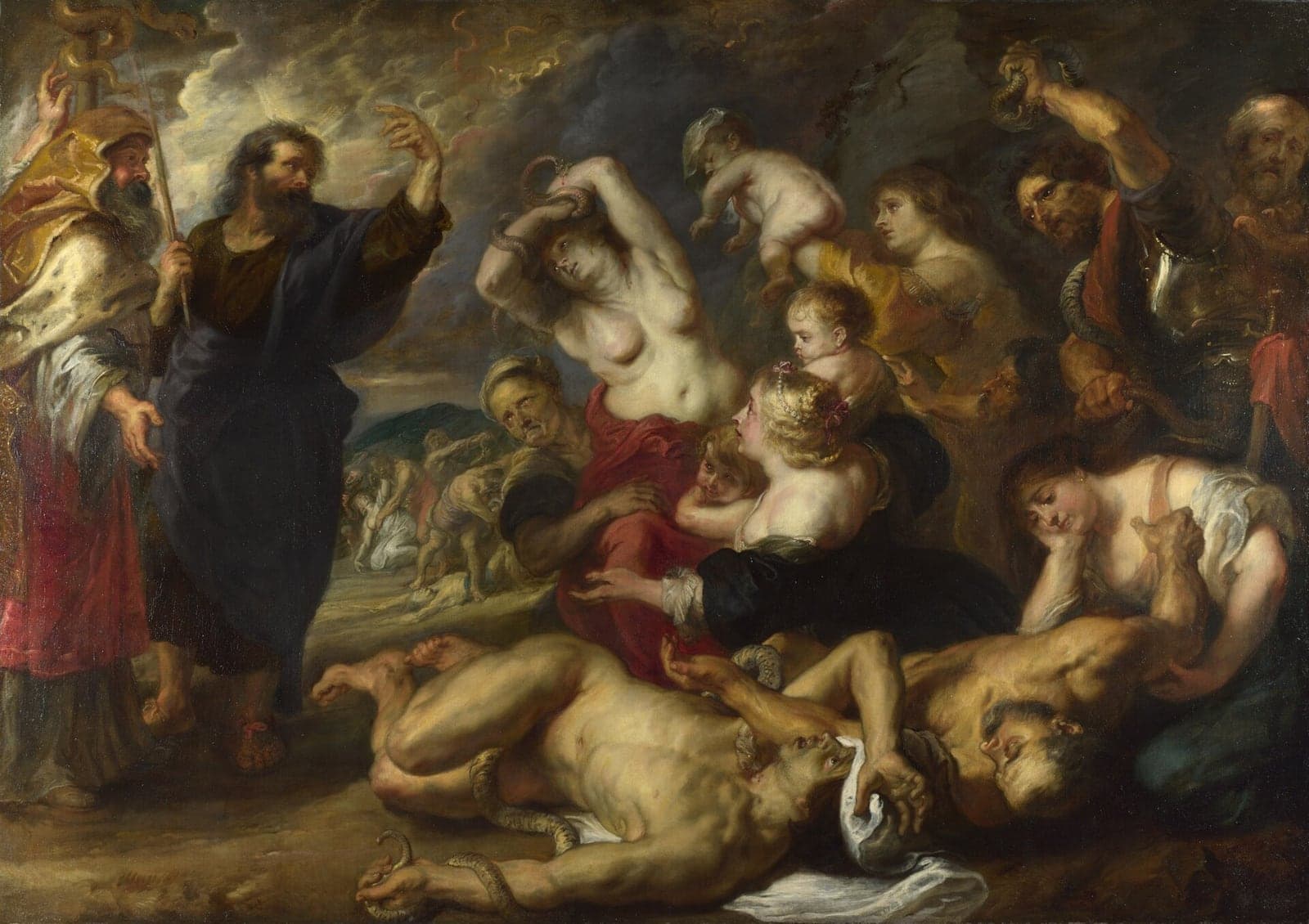
Peter Paul Rubens, The Brazen Serpent, c. 1635-1640. Public domain.
Numbers 21 · Doctrine · Featured Study
The Bronze Serpent
Numbers 21:4 to 9 records the bronze snake Moses set on a pole in the wilderness, and in John 3 Jesus compares His own lifting up to it.
Jesus chose this healing in the wilderness as the picture of His own death on the cross.
Then they set out from Mount Hor along the route to the Red Sea, in order to bypass the land of Edom. But the people grew impatient on the journey and spoke against God and against Moses: “Why have you led us up out of Egypt to die in the wilderness? There is no bread or water, and we detest this wretched food!”
- First taught
- Numbers 21:8 to 9 “…live.” So Moses made a bronze snake and…”
- Fullest statement
- John 3:14 to 15 “Just as Moses lifted up the snake in…”
Jesus chose this healing in the wilderness as the picture of His own death on the cross.
Summary
When venomous snakes bit the Israelites on the road around Edom, the LORD told Moses to set a bronze snake on a pole, and whoever was bitten and looked at it lived.
- Jesus told Nicodemus that the Son of Man must be lifted up in the same way, so that everyone who believes in Him may have eternal life.
- Three times in John's Gospel Jesus speaks of being lifted up, and John 12:33 says the words showed how He would die.
- Centuries later King Hezekiah broke the bronze snake, because the Israelites had been burning incense to it.
- The church has read the snake in three ways: as a likeness of Christ, as a contrast with Him, and as a sign that pointed to Him.
The Snakes on the Road Around Edom
Numbers 21:4 to 9 tells of the people's complaint, the snakes the LORD sent, the confession, and the cure set on a pole.
Edom had refused Israel passage through its land in Numbers 20:21, so the people set out from Mount Hor by a longer road around it.
Then they set out from Mount Hor along the route to the Red Sea, in order to bypass the land of Edom. But the people grew impatient on the journey and spoke against God and against Moses: “Why have you led us up out of Egypt to die in the wilderness? There is no bread or water, and we detest this wretched food!”The detour wore down their patience, and their complaint reached past their leader to heaven.
So the LORD sent venomous snakes among the people, and many of the Israelites were bitten and died. Then the people came to Moses and said, “We have sinned by speaking against the LORD and against you. Intercede with the LORD so He will take the snakes away from us.” So Moses interceded for the people.The snakes come as judgment, and the people confess their sin and ask Moses to pray for them.
Then the LORD said to Moses, “Make a fiery serpent and mount it on a pole. When anyone who is bitten looks at it, he will live.” So Moses made a bronze snake and mounted it on a pole. If anyone who was bitten looked at the bronze snake, he would live.The cure comes by the LORD's word, and Moses carries it out at once.
The Berean Standard Bible reads fiery serpent in verse 8 and bronze snake in verse 9. The Hebrew of verse 8 is saraph, a burning one, and verse 9 has nechash nechoshet, a snake of bronze, two words of nearly the same sound.
Edom had refused Israel passage through its land in Numbers 20:21, so the people set out from Mount Hor by a longer road around it.
So the LORD sent venomous snakes among the people, and many of the Israelites were bitten and died. Then the people came to Moses and said, “We have sinned by speaking against the LORD and against you. Intercede with the LORD so He will take the snakes away from us.” So Moses interceded for the people.The snakes come as judgment, and the people confess their sin and ask Moses to pray for them.
Then the LORD said to Moses, “Make a fiery serpent and mount it on a pole. When anyone who is bitten looks at it, he will live.” So Moses made a bronze snake and mounted it on a pole. If anyone who was bitten looked at the bronze snake, he would live.The cure comes by the LORD's word, and Moses carries it out at once.
The Berean Standard Bible reads fiery serpent in verse 8 and bronze snake in verse 9. The Hebrew of verse 8 is saraph, a burning one, and verse 9 has nechash nechoshet, a snake of bronze, two words of nearly the same sound.
Numbers 21:8, the words of the command1 quotation
Adam Clarke, in his Commentary on the Bible, gives the Hebrew of the command and of the pole.
“Make thee a fiery serpent - Literally, make thee a seraph. And put it upon a pole - על נס al nes, upon a standard or ensign.”
Adam Clarke · Commentary on the Bible · on Numbers 21:8Evangelical
The word for the pole is nes, a banner or standard, the word Isaiah 11:10 uses of the Root of Jesse standing as a banner for the peoples.
Deuteronomy 8:15 and 1 Corinthians 10:9, the snakes remembered2 passages
He led you through the vast and terrifying wilderness with its venomous snakes and scorpions, a thirsty and waterless land. He brought you water from the rock of flint.Moses later reminds Israel that the wilderness was full of venomous snakes and scorpions.
We should not test Christ, as some of them did, and were killed by snakes.Paul names the snakes of Numbers 21 as a warning to the church against testing Christ.
From the Pole to the Cross
Eight texts follow the bronze snake from the road around Edom to Jesus' words about His death.
The snake Moses lifted up for the bitten became Jesus' picture of His own lifting up.
- What the text says
- they blame Moses and despise the manna
- What the text says
- many of the bitten Israelites die
- What the text says
- Moses prays for them
- What the text says
- a snake on a pole for the bitten to look at
- What the text says
- Moses makes the snake of bronze
- What the text says
- Hezekiah breaks the snake called Nehushtan
- What the text says
- He tells Nicodemus how He must be lifted up
- What the text says
- it showed the kind of death He would die
Eight steps from Numbers 21 to John 12, each with its verse.
Jesus names the likeness, John explains the lifting up
Lifted Up in John's Gospel
John records three sayings in which Jesus speaks of the Son of Man being lifted up.
1. John 3:14 to 15, the saying to Nicodemus1 passage
Just as Moses lifted up the snake in the wilderness, so the Son of Man must be lifted up, that everyone who believes in Him may have eternal life.Jesus sets the snake on the pole beside the Son of Man, and the look of the bitten beside belief in Him.
2. John 8:28, when you have lifted up the Son of Man1 passage
So Jesus said, “When you have lifted up the Son of Man, then you will know that I am He, and that I do nothing on My own, but speak exactly what the Father has taught Me.Jesus' hearers will do the lifting up, and it will show who He is.
3. John 12:32 to 34, I will draw everyone to Myself1 passage
And I, when I am lifted up from the earth, will draw everyone to Myself.” He said this to indicate the kind of death He was going to die. The crowd replied, “We have heard from the Law that the Christ will remain forever. So how can You say that the Son of Man must be lifted up? Who is this Son of Man?”The words point to the cross, and the listeners cannot fit them with their hope of a Messiah who lives on.
The Greek verb in all three sayings is hypsoo, used for raising a thing high and for exalting a person, and the King James Version renders it both lift up and exalt.
Nehushtan: The Sign Kept Past Its Purpose
In 2 Kings 18 the reform of King Hezekiah reaches the object Moses made.
And he did what was right in the eyes of the LORD, just as his father David had done. He removed the high places, shattered the sacred pillars, and cut down the Asherah poles. He also demolished the bronze snake called Nehushtan that Moses had made, for up to that time the Israelites had burned incense to it.The writer counts the breaking of the bronze snake among the right acts of Hezekiah, with the removal of the high places and the Asherah poles.
Second Kings dates the start of Hezekiah's reign by two reckonings, in 18:1 and 18:13, and both place it late in the eighth century BC.
The name Nehushtan stands only in this verse, and it echoes nechoshet, the Hebrew for bronze or copper.
Adam Clarke describes what the snake had become by Hezekiah's day.
“Brake in pieces the brazen serpent - The history of this may be seen in Num 21:8 (note), Num 21:9 (note). We find that this brazen serpent had become an object of idolatry, and no doubt was supposed to possess, as a telesm or amulet, extraordinary virtues, and that incense was burnt before it which should have been burnt before the true God. And he called it Nehushtan - נהשתן. Not one of the versions has attempted to translate this word.”
Adam Clarke · Commentary on the Bible · on 2 Kings 18:4Evangelical
Matthew Henry, on the same verse, explains why Israel turned to this object in particular.
“But in process of time, when they began to worship the creature more than the Creator, those that would not worship images borrowed from the heathen, as some of their neighbours did, were drawn in by the tempter to burn incense to the brazen serpent, because that was made by order from God himself and had been an instrument of good to them.”
Matthew Henry · Commentary on the Whole Bible · on 2 Kings 18:4Puritan
John Wesley, in his Explanatory Notes upon the Old Testament, writes that the snake had been kept as a memorial of God's mercy and was destroyed once it was commonly abused to superstition.
Justin Martyr and the Mishnah on the sign2 readings
Justin Martyr, in his Dialogue with Trypho, chapter 94, in the second century, asks why the God who forbade every image had Moses make the bronze snake. He answers that God set it up as a sign by which the bitten were saved, pointing to the One who would break the serpent's power.
The Mishnah, at Rosh Hashanah 3:8, asks whether the snake killed or kept alive, and answers that Israel was healed when the people looked upward and gave their hearts to their Father in heaven.
The copper serpent found at Timna1 find
A copper serpent about five inches long, with traces of gilding, was found at Timna in the southern Arabah, in the excavations of a shrine to the Egyptian goddess Hathor. The Biblical Archaeology Society's caption places it in a Midianite temple of the thirteenth or twelfth century BC.
The find is consistent with the use of copper serpents in worship in the region of Numbers 21.
What the Text Leaves Unsaid
Numbers 21 and 2 Kings 18 leave three things about the bronze snake unrecorded.
Numbers 21:9 records that the bitten who looked lived and gives no account of how the look healed them.
Numbers 21 says that many Israelites died and gives no number.
The account of Hezekiah names no place where the snake was kept and no date when the incense began.
The Likeness Jesus Named
Jesus' words to Nicodemus make the bronze snake a picture of the cross, and Paul explains how the cursed thing could heal.
Jesus drew the comparison Himself, in His conversation with Nicodemus by night.
Jamieson, Fausset and Brown set the two cures side by side.
“Yet was the warrant in both cases to expect a cure equally rational and well grounded. As the serpent was God's ordinance for the cure of every bitten Israelite, so is Christ for the salvation of every perishing sinner--the one however a purely arbitrary ordinance, the other divinely adapted to man's complicated maladies.”
Jamieson, Fausset & Brown · Commentary Critical and Explanatory on the Whole Bible · on John 3:14 to 16Reformed
John Wesley, on John 3:15, compares the look of the bitten with the look of faith.
“That whosoever - He must be lifted up, that hereby he may purchase salvation for all believers: all those who look to him by faith recover spiritual health, even as all that looked at that serpent recovered bodily health.”
John Wesley · Explanatory Notes upon the New Testament · on John 3:15Evangelical
For what the law was powerless to do in that it was weakened by the flesh, God did by sending His own Son in the likeness of sinful man, as an offering for sin. He thus condemned sin in the flesh,Paul writes that God sent His Son in the likeness of sinful man.
Christ redeemed us from the curse of the law by becoming a curse for us. For it is written: “Cursed is everyone who is hung on a tree.”Paul quotes the law of Deuteronomy 21:23 to show what Jesus bore at His death.
God made Him who knew no sin to be sin on our behalf, so that in Him we might become the righteousness of God.Paul states the exchange: the sinless One made sin, so that in Him we might become the righteousness of God.
Henry, in his comment on Numbers 21, notes that the thing which cured was shaped in the likeness of the thing which wounded.
Romans 8:3, Galatians 3:13, 2 Corinthians 5:21
Voices on the Bronze Serpent
Preachers from the fourth century to the nineteenth teach the look of faith from this text.
1662 to 1714 · Matthew Henry
Henry, in his comment on the saying to Nicodemus, begins with what the snakes' bite shows of sin.
“It was the last miracle that passed through the hand of Moses before his death. Now in this type of Christ we may observe, First, The deadly and destructive nature of sin, which is implied here. The guilt of sin is like the pain of the biting of a fiery serpent; the power of corruption is like the venom diffused thereby.”
Matthew Henry · Commentary on the Whole Bible · on John 3:14Puritan
Martin Luther, in a sermon of his House Postil (1544), taught that the bitten had no remedy but to look up to the snake God ordered made. In like manner, he said, there is no way to salvation but to look in faith to Christ, who sacrificed Himself for our sins.
Augustine, in his twelfth Tractate on John, says that Christ endured death and hanged death itself on the cross, so that mortal men are delivered from it.
John Chrysostom, in his twenty-seventh Homily on John, sets the type beside the reality: there the Jews escaped a death in time, and here believers escape the eternal one.
Charles Spurgeon preached on the bronze snake in sermons 153 (1857), 285 (1859), 1500 (1879) and 1722 (1883), and he preached Hezekiah's breaking of the snake in the sermon Iconoclast (No. 960, 1870).
Likeness, Contrast or Sign
Writers who agree that Jesus named the type have read the bronze snake in three ways.
A likeness of Christ1 quotation, 3 paragraphs
John Wesley, on Numbers 21:8, reads the snake as Christ in the likeness of sinful flesh, with the outward shape of the snakes and none of their poison.
“The serpent signified Christ, who was in the likeness of sinful flesh, though without sin, as this brazen serpent had the outward shape, but not the inward poison, of the other serpents: the pole resembled the cross upon which Christ was lifted up for our salvation: and looking up to it designed our believing in Christ.”
John Wesley · Explanatory Notes upon the Old Testament · on Numbers 21:8Evangelical
Ambrose of Milan, in On the Holy Spirit, calls the bronze serpent a type of the cross. He says a brazen serpent was hung because the Lord took the likeness of a sinner while being without sin.
The objection, put by Justin Martyr in chapter 91 of his Dialogue, is that God had cursed the serpent from the beginning, an unlikely likeness for the sinless Christ.
A contrast with Christ1 quotation, 2 paragraphs
Gregory of Nazianzus, in his Oration 45, reads the snake as death hung up and defeated, set against Christ as a contrast.
“That brazen serpent was hung up as a remedy for the biting serpents, not as a type of him that suffered for us but as a contrast. It saved those that looked upon it, not because they believed it to live but because it was killed, and killed with it were the powers that were subject to it, being destroyed as it deserved. And what is the fitting epitaph for it from us? ‘O death, where is your sting? O grave, where is your victory?’ You are overthrown by the cross.”
Gregory of Nazianzus · ORATION 45.22 · on Numbers 21:9Patristic
The objection is that Jesus joins the two with just as and so, the words of a likeness.
A sign that pointed to the crucified3 paragraphs
Justin Martyr, in his Dialogue with Trypho, chapter 91, holds that the Spirit never taught Israel to believe in the serpent, which God had cursed from the beginning. He reads it instead as a sign of salvation through the One who would be crucified.
Ephrem the Syrian, in his Commentary on the Diatessaron, sees in bronze that cannot suffer a sign of the One who suffered on the cross though by nature He cannot die.
The objection is that Jesus puts Himself where the bronze stood, which says more than a sign.
Look and Live
Jesus promises eternal life and the resurrection to everyone who looks to the Son and believes in Him.
In John 6 Jesus speaks of looking to Him once more, and joins it to the promise of the resurrection.
For it is My Father’s will that everyone who looks to the Son and believes in Him shall have eternal life, and I will raise him up at the last day.”The verse joins looking to the Son with believing in Him, as Numbers 21:9 joined looking with living.
Sources
Scripture is the Berean Standard Bible.
- The King James Version (1611), public domain.
- Adam Clarke, Commentary on the Bible (1832)
- Matthew Henry, Commentary on the Whole Bible (1710)
- John Wesley, Explanatory Notes upon the Old Testament (1765) and upon the New Testament (1755)
- Robert Jamieson, A. R. Fausset and David Brown, Commentary Critical and Explanatory on the Whole Bible (1871)
- Justin Martyr, Dialogue with Trypho, chapters 91 and 94 (second century), Ante-Nicene Fathers, vol. 1.
- Mishnah Rosh Hashanah 3:8, the William Davidson Edition in English (CC BY-NC), paraphrased.
- Ambrose of Milan, On the Holy Spirit 3.8.50 (fourth century)
- Gregory of Nazianzus, Oration 45.22 (fourth century)
- Ephrem the Syrian, Commentary on Tatian's Diatessaron 14.15 (fourth century)
- Augustine, Tractates on the Gospel of John 12 (fifth century)
- John Chrysostom, Homilies on the Gospel of John 27 (fourth century)
- Martin Luther, House-Postil (1544), English translation, Columbus, Ohio, 1884, vol. 2, pp. 51 to 52.
- Charles Spurgeon, The New Park Street Pulpit, sermons 153 and 285, and The Metropolitan Tabernacle Pulpit, sermons 960, 1500 and 1722, CCEL edition.
- Biblical Archaeology Society, image caption for the Timna copper serpent, credit Israel Antiquities Authority; Creighton University, Timna virtual tour, introduction.
Keep Studying
Studies8
Places3
Symbols3
Doctrines8
Subjects3