
Around 1609 to today · The churches · Featured Study
The Baptist Churches
A family of churches with confessions of its own since 1644, now in conventions and unions across many countries.
In 1612 Thomas Helwys told King James that the king's power over the consciences of his subjects was “none at all.”
- Began
- Around 1609 in Amsterdam, as Weaver gives it (probable)
- Bodies
- The Baptist World Alliance, The Southern Baptist Convention
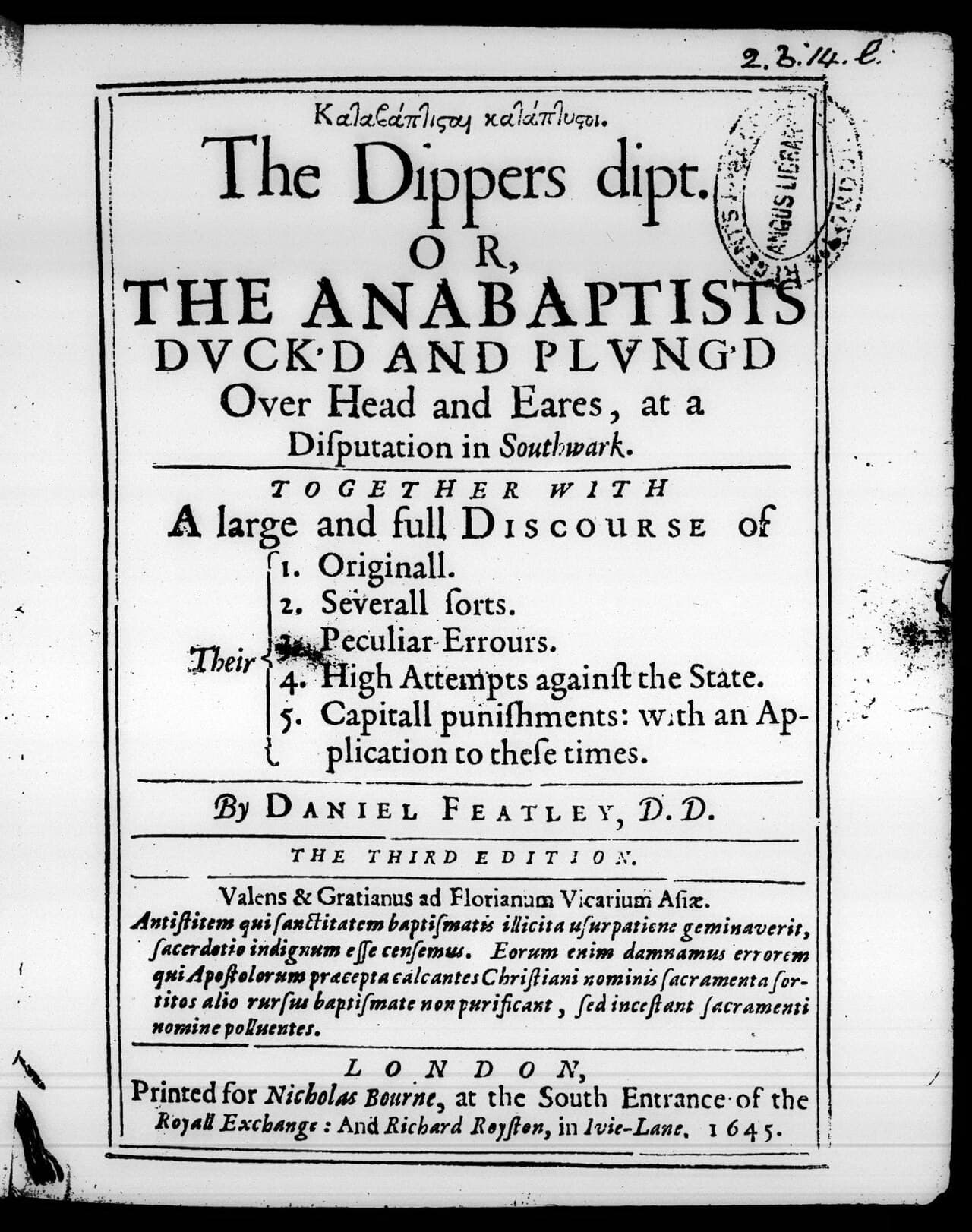
Daniel Featley, The Dippers Dipt, 1645. Public domain.
We were therefore buried with Him through baptism into death, in order that, just as Christ was raised from the dead through the glory of the Father, we too may walk in newness of life.
Summary
Baptist churches baptize only those who confess faith in Christ. They began among English exiles in Amsterdam and London from 1609 to 1612.
- At first they poured the water, and by 1644 the London churches dipped.
- Their two London confessions, of 1644 and 1689, are Calvinist.
- Successionists trace their churches to the apostles, and the record of the 1640s does not bear it out.
- In 1995 Southern Baptists apologized for racism and named slavery in their start.
The Texts the Baptists Stand On
The texts come from Romans 6, Colossians 2, Matthew 28 and Acts 8.
The Baptist confessions printed in London cite these texts as proofs on baptism.
Baptism as burial with Christ
Or aren’t you aware that all of us who were baptized into Christ Jesus were baptized into His death? We were therefore buried with Him through baptism into death, in order that, just as Christ was raised from the dead through the glory of the Father, we too may walk in newness of life.
The Confession of 1689 cites it first in its chapter on baptism.
And having been buried with Him in baptism, you were raised with Him through your faith in the power of God, who raised Him from the dead.
The same chapter cites it beside Romans 6 as its second proof.
The command and the first baptism on a road
Therefore go and make disciples of all nations, baptizing them in the name of the Father, and of the Son, and of the Holy Spirit,
It heads the proofs of article 39 of the 1644 Confession, on who may be baptized.
As they traveled along the road and came to some water, the eunuch said, “Look, here is water! What is there to prevent me from being baptized?”
Both London Confessions cite the eunuch's question among their proofs on baptism.
Acts 8:36BSB
Matthew 28:19, Acts 8:36
The Baptist Branch of the Family of Churches
The branch runs from a Separatist church of about 1602 to the resolution of 1995.
The Baptists grew out of the English Separatists and divided into conventions and unions.
About 1602
- Smyth's Separatist church at Gainsborough
- The English Separatists
1605 to 1609
- Smyth's church in Amsterdam
- The Scrooby church, later the Pilgrims
1612
- Helwys's church at Spitalfields
- A plea for liberty of conscience
1644
- The Particular Baptists of London
- Baptism by dipping
1677 to 1689
- The Second London Confession
- The Regular or Calvinistic Baptists
1834 to 1848
- The Free-will Baptists of America
- Their confession, revised
1845
- The Southern Baptist Convention
1905
- The Baptist World Alliance
1995
- The resolution on slavery and racism
Each generation is dated from the record that names it.
The other families of the churches stand together with the dates on which each began.
How the Baptist Churches Began
The record runs from Amsterdam around 1609 to Spitalfields in 1612 and the hostile press of 1645.
Doug Weaver, writing in Baylor Magazine in 2008, tells the beginning. Around 1609 in Amsterdam, John Smyth “disbanded his congregation of about 40 persons, baptized himself by pouring water over his head, and then baptized his fellow believers.”
Most of Smyth's church then sought to join the Mennonites, and Thomas Helwys opposed it. Weaver writes that Helwys led his congregation home in 1612 and founded the first Baptist church in England, at Spitalfields.
Daniel Featley, an opponent writing to Parliament after a disputation in Southwark, attacked them in The Dippers Dipt in 1645. His epistle says they “flock in great multitudes” to their meetings, and that “both Sexes” go into the river to be dipped.
The common root with the Pilgrims1 paragraph
Williston Walker, in The Creeds and Platforms of Congregationalism (1893), dates Smyth's Separatist church at Gainsborough “probably about 1602” in his account. The Scrooby group, later the Pilgrims of Plymouth, separated from it in 1605 or 1606, and the rest went with Smyth to Amsterdam in 1606.
Did the Baptists begin in 1609, or with the apostles?2 paragraphs
J. M. Carroll's The Trail of Blood (1931), building on J. R. Graves and the Landmark Baptists, holds that baptistic churches run in an unbroken line from the apostles. That is the thesis of Baptist successionism, and its holders name persecuted dissenters who baptized believers in many centuries.
The London churches of 1644 printed their confession for churches “commonly (though falsly) called” Anabaptists, refusing the name. That refusal and Smyth's contact with the Mennonites are what the printed record shows, and it does not bear the chain out.
The Truth They Recovered: Believers' Baptism and a Free Conscience
They gave baptism on a confession of faith, by dipping, and denied the magistrate any rule over conscience.
The Baptists read baptism as a burial with Christ, so they gave it to those who could confess faith and gave it by dipping.
Thomas Helwys, a Baptist pastor writing to the king in A Short Declaration of the Mistery of Iniquity (1612), denied that the earthly power may punish anyone for religion. One line of the 1612 print reads, “Let them be heretikes, Turcks, Jewes.”
But just as Paul was about to speak, Gallio told the Jews, “If this matter involved a wrongdoing or vicious crime, O Jews, it would be reasonable for me to hear your complaint. But since it is a dispute about words and names and your own law, settle it yourselves. I refuse to be a judge of such things.”Helwys cites Gallio's refusal at Corinth in the margin of his plea.
Weaver calls the book “the first treatise in England to call for complete religious liberty for all people.”
Featley's answer on dipping, 16451 paragraph
Featley answered that Christ requires baptizing and nowhere requires dipping. He argued from the lexicons he names that the word means no more than washing, and he held that the Baptists' second baptism divides the church.
Their Own Statements of Faith
Two confessions printed in London speak here article by article.
Matthew Simmons printed the first of them in Aldersgate Street in 1644, subscribed “by the appointment of seven Congregations.”
The second “appeared first in London, 1677, then again in 1688 and 1689,” Philip Schaff notes in The Creeds of Christendom (1877). He calls it “the most generally accepted Confession of the Regular or Calvinistic Baptists,” that is, the Particular Baptists.
The two Confessions agree that baptism is for those who profess faith, by dipping, and the second sets the conscience free of men.
| Where | The words |
|---|---|
| 1644, article 39 | Baptism is to be dispensed “only upon persons professing faith, or that are Disciples, or taught.” |
| 1644, article 40 | The Scripture holds out “dipping or plunging the whole body under water.” |
| 1689, chapter 29, section 4 | “Immersion, or dipping of the person in water, is necessary to the due administration of this ordinance.” |
| 1689, chapter 21, section 2 | “God alone is Lord of the conscience, and hath left it free from the doctrines and commandments of men which are in any thing contrary to his word, or not contained in it.” |
| 1689, chapter 26, section 8 | The officers of a church are “bishops or elders and deacons.” |
The Baptist Churches Today
The Alliance and the Southern Baptist Convention each give a count of their own members.
Lifeway Research reports that the Convention's membership fell by more than 3 percent from 2024 to 2025.
Only the Southern Baptist count gives its year, and neither states a method beyond its own reporting.
| Body | The count | Who counted, and how | Year |
|---|---|---|---|
| The Baptist World Alliance | 283 conventions and unions in 138 countries and territories, 53 million baptized believers in 180,000 churches | The Alliance, on its members page, with no method stated | Not given |
| The Southern Baptist Convention | 12,331,954 members | Lifeway Research, from the Annual Church Profile the churches report through the Baptist state conventions | 2025 |
Where the Baptists Went
The record reaches Bedford, Philadelphia and the Free-will Baptists of America.
John Bunyan, a Bedford Separatist pastor whom Baptists claim, records his twelve years in Bedford gaol in Grace Abounding to the Chief of Sinners.
In America the Philadelphia Association adopted the Second London Confession early in the eighteenth century, Schaff writes. He also prints a confession of the Free-will Baptists of America of 1834, revised in 1848.
The Founding of 1845 and the Apology of 1995
The Convention's own resolution names slavery in its founding.
The Convention was founded in 1845. Messengers to its sesquicentennial meeting in Atlanta, from 20 to 22 June 1995, adopted a resolution on racial reconciliation.
The resolution says, “Our relationship to African-Americans has been hindered from the beginning by the role that slavery played in the formation of the Southern Baptist Convention.”
The messengers resolved “That we apologize to all African-Americans for condoning and/or perpetuating individual and systemic racism in our lifetime.” The resolution cites Matthew 28:19 among its grounds.
Books to Read Next
A Short Declaration of the Mistery of Iniquity
Thomas Helwys · 1612
Helwys pleads with the king for liberty of conscience.
Free at the Internet ArchiveThe Creeds of Christendom, volume 3
Philip Schaff · 1877
Schaff prints the Baptist Confession of 1688 and the Free-will Baptist confession.
Free at the Christian Classics Ethereal LibraryThe Dippers Dipt
Daniel Featley · 1645
Featley makes the case against the Baptists of London.
Free at the Internet ArchiveThe Creeds and Platforms of Congregationalism
Williston Walker · 1893
Walker traces the Separatist churches Smyth and the Pilgrims came from.
Free at the Internet ArchiveWhat the Baptists Hold
From the 1640s to today the Baptist churches have kept a church of confessing believers and a conscience no magistrate rules. One of their conventions has set slavery beside its own founding in its own words.
Sources
Scripture is the Berean Standard Bible.
- The Holy Bible, Berean Standard Bible (read 2026)
- Doug Weaver, The Baptist Story, Baylor Magazine, 24 November 2008.
- Williston Walker, The Creeds and Platforms of Congregationalism (New York: Scribner, 1893), pages 82 to 83.
- Thomas Helwys, A Short Declaration of the Mistery of Iniquity (1612), the passage on the king and conscience with its margin, at lines 4040 to 4080 of the Internet Archive transcription.
- The First London Confession of Faith (London: Matthew Simmons, 1644), title page, preface and articles 39 and 40.
- The Second London Confession of Faith (1677, 1688 and 1689), chapters 21, 26 and 29.
- Philip Schaff, The Creeds of Christendom, volume 3 (1877), The Baptist Confession of 1688, headnote and chapter XXVI, section 8 (lines 32332 to 32420 of the CCEL text), and the Free-will Baptist confession, headnote (lines 32995 to 32999)
- Daniel Featley, The Dippers Dipt (London, 1645), the epistle to Parliament and the discourse on dipping.
- Baptist World Alliance, Members (undated; read 2026)
- Lifeway Research, news release on the Annual Church Profile, 5 May 2026.
- Southern Baptist Convention, Resolution On Racial Reconciliation On The 150th Anniversary Of The Southern Baptist Convention (Atlanta, June 1995)
- John Bunyan, Grace Abounding to the Chief of Sinners (1666; the enlarged text of about 1672), section 319, Religious Tract Society edition (1905)
- J. M. Carroll, The Trail of Blood (1931), Baptist successionism as its holders state it.
Keep Studying
Studies5
Doctrines2
Subjects1
Trials of life1
Church history2