
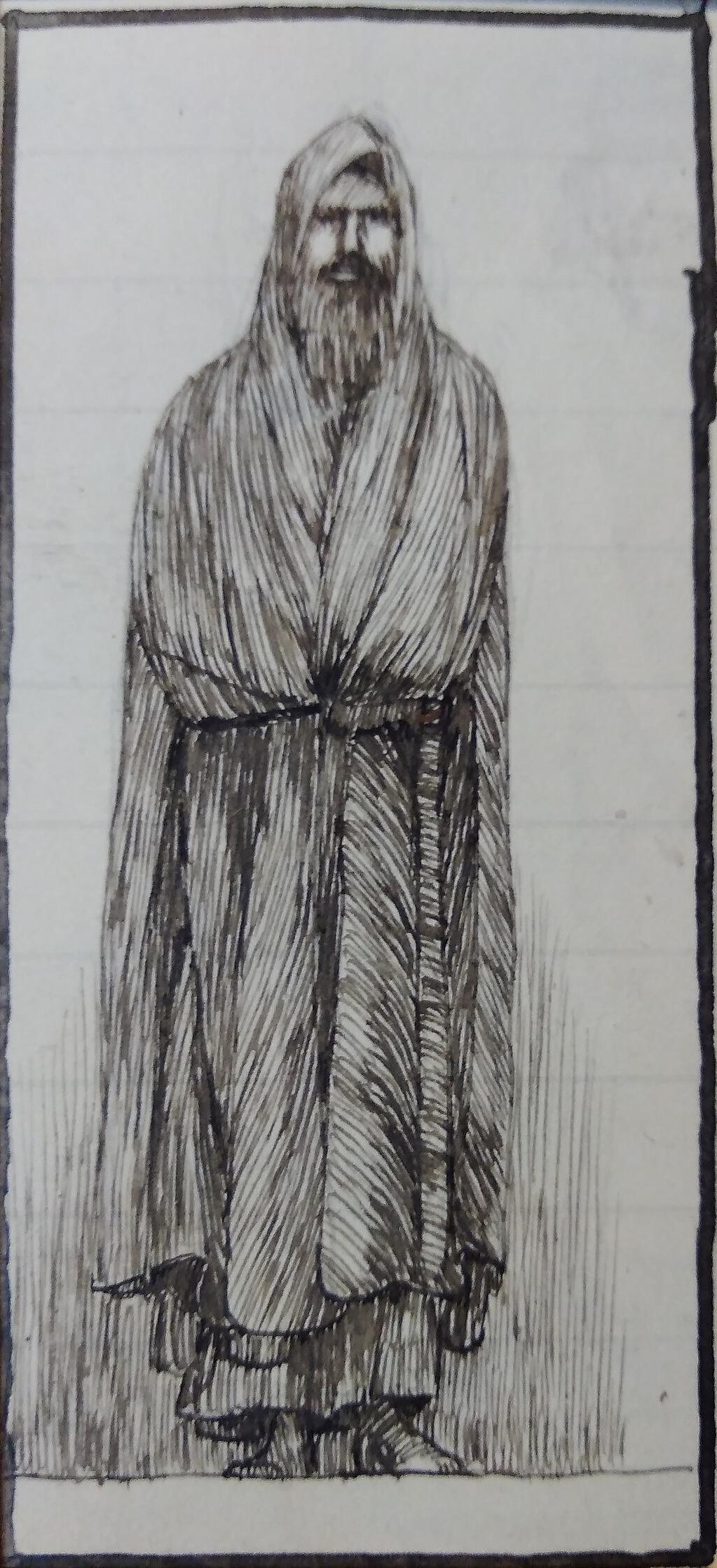
James Tissot, Malachi, 1902. Public domain.
Malachi 4:2 · Doctrine · Featured Study
The Sun of Righteousness
Christian readers since the early church have heard Malachi's name for the coming light as a name of Christ.
The same day that burns the arrogant like stubble dawns on the faithful like the sun.
“But for you who fear My name, the sun of righteousness will rise with healing in its wings, and you will go out and leap like calves from the stall.
“But for you who fear My name, the sun of righteousness will rise with healing in its wings, and you will go out and leap like calves from the stall.
- First taught
- Psalm 84:11 “…the LORD God is a sun and a…”
- Fullest statement
- Malachi 4:2 “…who fear My name, the sun of righteousness…”
Summary
The promise of Malachi 4:2 answers the faithful of Malachi 3:16, who honored the LORD's name. They will go out free, like calves let out of the stall.
- Theodoret of Cyrus found the first coming and the second in the one sunrise.
- Ambrose of Milan and John of Damascus called Christ the sun of justice.
- Readers who see Christ in the sun tie it to His first coming, His second, or both.
One Day, Two Ends
The verses on either side of the promise name the arrogant and the faithful.
“For behold, the day is coming, burning like a furnace, when all the arrogant and every evildoer will be stubble; the day is coming when I will set them ablaze,” says the LORD of Hosts. “Not a root or branch will be left to them.”The furnace comes first, so the sunrise of Malachi 4:2 stands against it.
At that time those who feared the LORD spoke with one another, and the LORD listened and heard them. So a scroll of remembrance was written before Him regarding those who feared the LORD and honored His name.The scroll of remembrance shows the LORD marking the people He will spare on that day.
Malachi 4:3 says they will trample the wicked on the day the LORD is preparing.
The LORD as Light
Light rises on God's people from the Psalms to the last chapter of Revelation.
Each step names the LORD or Christ as light.
- The light
- The LORD God is a sun and a shield.
- The light
- The LORD rises upon Zion while darkness covers the earth.
- The light
- Malachi names the sun of righteousness.
- The light
- On the mountain His face shines like the sun.
- The light
- Jesus calls Himself the light of the world.
- The light
- The morning star rises in the hearts of believers.
- The light
- John sees His face like the sun at its brightest.
- The light
- Jesus names Himself the bright Morning Star.
Eight steps, in the order of the books.
Revelation 1:16, Revelation 22:16
Healing in Its Wings
The word behind the wings names more than a bird's wing.
James Strong's Hebrew dictionary gives kanaph as the wing of a bird, the flap of a garment and a quarter of the earth. In Malachi 4:2 the wings belong to the sun, and the Berean renders them its wings.
“Speak to the Israelites and tell them that throughout the generations to come they are to make for themselves tassels for the corners of their garments, with a blue cord on each tassel.Here the word names the edge of the clothes, where the blue cord was tied.
The Words of Malachi 4:2
Four Hebrew words carry the promise of the rising sun.
shemesh
134 uses in the canon
Shemesh is the sun, whose rising and setting mark the bounds of the earth in Malachi 1:11.
tsedaqah
157 uses in the canon
Tsedaqah is righteousness or justice, the quality of the offerings Malachi 3:3 promises.
marpe
16 uses in the canon
Marpe is healing or a cure, what the rising sun carries.
kanaph
109 uses in the canon
Kanaph is the word behind the wings of the rising sun.
Voices on the Sun of Righteousness
Two teachers, Ambrose of Milan and John of Damascus, compare Christ with the sun.
Ambrose of Milan (died 397)
Ambrose of Milan praised the Maker above the sun He made.
“But when you see this, consider its author: when you marvel at this, praise first the creator himself. If the sun, a partner and sharer of creation, is so pleasing, how good is that sun of justice! If this one is so swift, to roam all things with swift courses day and night, how great is he who is everywhere always, and with his majesty fills all things? If the one who is commanded to go forth is admirable, how much more above admiration is he who speaks to the sun, and it does not rise, as we read? If someone is great who travels to different places every day by the hour, what can be said of someone who even when he empties himself so that we can see him, is the true light that enlightens every person coming into this world? If he is the most excellent one, who often suffers setbacks for the sake of the world; how majestic is he who says: 'Once more I will shake the earth'? The earth hides him; its motion cannot endure unless supported by the substance of his will. If it is a loss for a blind person to not see the grace of the sun; how much more is it a loss for a sinner, deprived of the gift of true light, to endure the darkness of perpetual night?”
Ambrose of Milan · The Six Days of Creation · on Malachi 4:2Patristic
John Damascene (died 749)
John of Damascus gave the name as a reason Christians faced east to pray.
“It is not without any reason or by any chance that we worship toward the east. On the contrary, since we are composed of a visible and an invisible nature, of an intellectual nature and a sensitive one, that is, we also offer a twofold worship to the Creator. It is just as we also sing both with our mind and our bodily lips, and as we are baptized both in water and in the spirit, and as we are united to the Lord in two ways when we receive the sacrament and the grace of the spirit. And so, since God is spiritual light and Christ in sacred Scripture is called ‘Sun of justice’ and ‘Orient,’ the east should be dedicated to his worship. For everything beautiful should be dedicated to God, from whom everything that is good receives its goodness. Also, the divine David says, ‘Sing to God, you kingdoms of the earth; sing you to the Lord, who mounts above the heaven of heavens, to the east.’ And still again, Scripture says, ‘And the Lord had planted a paradise in Eden to the east; wherein he placed man whom he had formed,’ and whom he cast out, when he had transgressed, ‘and made him to live over against the paradise of pleasure,’ or in the west. Thus when we worship God, we long for our ancient homeland and gaze toward it. The tabernacle of Moses had the veil and the propitiatory altar to the east; and the tribe of Judah, as being the more honorable, pitched their tents on the east; and in the celebrated temple of Solomon the gate of the Lord was set to the east. As a matter of fact, when the Lord was crucified, he looked toward the west, and so we worship gazing toward him. And when he was taken up, he ascended to the east, and thus the apostles worshiped him. […]”
John Damascene · Orthodox Faith 4:12 · on Malachi 4:2Patristic
When the Sun Rises
Spurgeon, Theodoret and Barnes each set the rising at a different time.
At His first comingCharles Spurgeon
Charles Spurgeon preached that the promise was fulfilled when the Lord came, to people like Simeon and Anna who were waiting for it.
At both His comingsTheodoret of Cyrus; Jamieson, Fausset and Brown
Theodoret of Cyrus applied the verse to both comings of the Savior. In the first He rose like a sun on those who sat in darkness and freed them from sin.
Jamieson, Fausset and Brown set the verse beside Ephesians 5:14 and 2 Peter 1:19, and called the church the moon that reflects His light.
At His second coming above allAlbert Barnes
Albert Barnes held that Malachi speaks first of the Lord's second coming. He set the verse beside Psalm 84:11 and Isaiah 60:19 to 20, where the LORD Himself is the sun and the everlasting light. He also heard Zechariah speak of John in the words of Malachi.
The Dawn from on High
Zechariah, the father of John the Baptist, sang of a Dawn from on high.
to shine on those who live in darkness and in the shadow of death, to guide our feet into the path of peace.”Zechariah sang this at the birth of John, the forerunner Malachi promised.
The promise calls the reader to honor the name of the LORD and to wait for His light.
Sources
Scripture is the Berean Standard Bible.
- The Hebrew text of Malachi 1:11, 3:3 and 4:2 and Numbers 15:38, word by word, with Strong's numbers.
- Strong's Hebrew lexicon, the counts of uses.
- The notes of the commentators and the fathers on Malachi 1 to 4.
- Ambrose of Milan, The Six Days of Creation (397)
- John of Damascus, An Exact Exposition of the Orthodox Faith 4:12 (749)
- Charles Spurgeon, The Metropolitan Tabernacle Pulpit, Sermon 3172, Bright Prospects for Young Believers (1909)
- Theodoret of Cyrus, Commentary on Malachi (458), on Malachi 4:2.
- Jamieson, Fausset and Brown, Commentary Critical and Explanatory on the Whole Bible (1871), on Malachi 4:2.
- Albert Barnes, Notes, Explanatory and Practical (1832 to 1869), on Malachi 4:2.
Keep Studying
People and groups2