
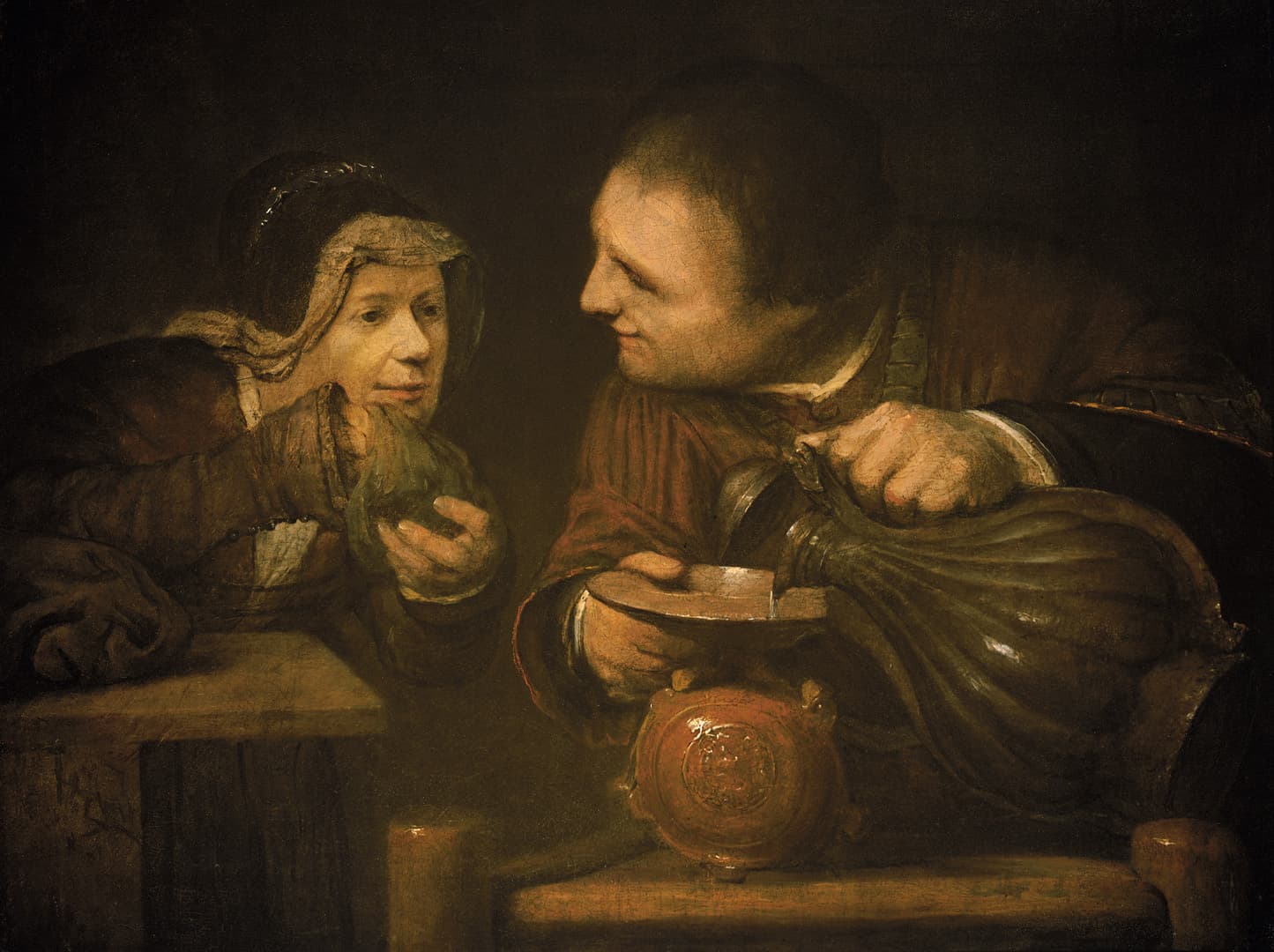
2 Kings 4:1 to 7 · Story · Money and Want
The Widow's Oil
The account stands in 2 Kings 4:1 to 7, the first of the deeds of Elisha told in that chapter.
The Hebrew word for the widow's debt, neshi, stands in one verse of the Bible, the verse in which Elisha tells her to pay it.
She went and told the man of God, and he said, “Go, sell the oil, and pay your debt. Then you and your sons can live on the remainder.”
- Who
- Elisha
- When
- The days of Elisha's ministry in Israel (2 Kings 4:1)
Summary
The widow's oil meets the trial of want inside one household. A member of the company of prophets had died in debt, and the custom of the day gave his creditor a claim on the family. Elisha's answer used the little the widow had, so God's provision came through ordinary things as well as through a miracle.
- The widow told Elisha that her husband had feared the LORD, so the account charges the man who died in debt with no fault (2 Kings 4:1).
- The oil stopped only when no empty jar was left, so the size of the gift matched the number of jars the widow had gathered (2 Kings 4:6).
- Elisha's word put the creditor first and the family second, and the oil covered both the debt and the household's living (2 Kings 4:7).
A Widow and Her Creditor
A widow of one of the sons of the prophets brought her debt to Elisha.
The widow's oil is a story of the trial of money and want, from the days of the prophet Elisha. The study asks what Elisha told a widow in debt to do and what the story gives a household that cannot meet what it owes.
It sets out the account in its scenes and gives the law behind the creditor with the Hebrew words for the creditor and the jar. It reads the story beside Elijah's widow at Zarephath and the other deeds of Elisha. It reports the tradition that named the widow, and it weighs how readers have taken the miracle and what kind of record it is.
Five Scenes from the Cry to the Last Jar
Six verses take the widow from her cry for help to the last full jar.
The rescue moved from a cry for help to a house full of borrowed jars.
- The widow cries out to Elisha"his creditor is coming to take my two children as his slaves!"2 Kings 4:1
- Elisha asks what she has"Your servant has nothing in the house but a jar of oil."2 Kings 4:2
- Elisha sends her to borrow jars"borrow jars, even empty ones, from all your neighbors. Do not gather just a few."2 Kings 4:3
- She shuts the door and pours"they kept bringing jars to her, and she kept pouring"2 Kings 4:5
- The jars run out and the oil stops"Then the oil stopped flowing."2 Kings 4:6
A timeline of five scenes, each with a phrase of the Berean text and its verse.
What Scripture Says of Want
Scripture ties want to sloth in one place and to oppression in another.
Proverbs 6:10 to 11 ties poverty to sloth, and Amos 2:6 to 7 ties the selling of the needy to the oppression of the powerful. Charles Spurgeon, preaching on 2 Kings 4 in The Filling of Empty Vessels (1889), said that "The best of men may die in poverty".
The Law Behind the Creditor
Israel's law allowed a debtor's household to be sold into service and set limits on it.
The law of Moses let a destitute Israelite be sold for what he owed and set him free in the seventh year (Exodus 21:2 and Deuteronomy 15:12). Leviticus 25:39 to 41 forbids forcing such a man into slave labor and releases him and his children at the Year of Jubilee.
Centuries later the people of Judah told Nehemiah that they had borrowed to pay the king's tax and were subjecting their sons and daughters to slavery (Nehemiah 5:4 to 5).
The creditor of 2 Kings 4:1 is a participle of nashah, a Hebrew verb meaning to lend, which stands in 11 verses of the Hebrew Bible. The jar of 2 Kings 4:2 is asuk, an oil flask, a noun found in that verse alone.
Among the Sons of the Prophets
The widow belonged to the company of prophets who gathered around Elisha.
The sons of the prophets were companies of prophets who came out to meet Elisha at Bethel and at Jericho (2 Kings 2:3 and 2 Kings 2:15). In a later chapter they told him that the place where they met with him had grown too small (2 Kings 6:1). The widow's husband was one of them, so the company married and kept households of its own.
The deeds that follow in 2 Kings 4 stay close to the same company. At Gilgal in a famine Elisha made a poisoned stew fit to eat for the sons of the prophets (2 Kings 4:38 to 41). He then fed a hundred men with twenty loaves of barley bread (2 Kings 4:42 to 44). In 2 Kings 6:5 one of the company lost an axe head in the Jordan and cried out, "it was borrowed!"
The account of the woman of Shunem begins in the next verse (2 Kings 4:8).
A Widow Without a Name
Of the people in the account the text names Elisha alone, and a later tradition supplied the widow's name.
Flavius Josephus named the widow in his Antiquities of the Jews, book 9, chapter 4, section 2. In William Whiston's translation he wrote, "For they say that the widow of Obadiah" came to Elisha. In his telling her husband "had borrowed money for their maintenance", the hundred prophets he hid from Jezebel.
The tradition draws on 1 Kings 18:3 to 4, where Obadiah, who greatly feared the LORD, hid a hundred prophets and fed them. Against it, the same verses make Obadiah the man in charge of Ahab's palace, and 2 Kings 4:1 makes the widow's husband one of the sons of the prophets.
Two Widows and Their Oil
Elijah and Elisha each met a widow's want through her jar of oil.
The jar of flour was not exhausted and the jug of oil did not run dry, according to the word that the LORD had spoken through Elijah.Elijah's miracle for the widow of Zarephath turned on a jug of oil, and it stands behind Elisha's miracle for the widow in debt.
Both widows were told to act before they saw the supply. The widow of Zarephath made Elijah's small cake of bread first (1 Kings 17:13), and Elisha's widow borrowed jars for oil she did not yet have (2 Kings 4:3).
The LORD protects foreigners; He sustains the fatherless and the widow, but the ways of the wicked He frustrates.The psalm names the widow among those the LORD sustains, and the oil of 2 Kings 4 is one such act of sustaining.
How Readers Have Taken the Widow's Oil
Readers differ on what the miracle teaches and on what kind of record the Elisha stories are.
God's provision, with the debt paid in fullAdam Clarke
Adam Clarke held that Elisha left the creditor unrebuked, since the law and custom of the country gave him his authority. Rather than let a poor honest widow's children be sold, "he would work a miracle to pay a debt which, in the course of providence, it was out of her power to discharge".
Against this reading, the account states no rule about creditors, and Elisha's first answer to the widow's cry asks only what she has (2 Kings 4:2).
The prophet's care for the households of his companyMatthew Henry
Matthew Henry asked of the widow, "to whom therefore should she apply, but to him that was a father to the sons of the prophets".
Against this reading, the oil came from the widow's own jar and her own borrowing, and Elisha gave her nothing of his own (2 Kings 4:2 to 3).
A picture of grace that fills every empty vesselJohn Wesley
John Wesley wrote on 2 Kings 4:7, "We are never straiten'd in God, and in his power and bounty, and the riches of his grace. All our straitness is in ourselves."
Against this reading, the text gives the end of the jars as the reason the oil stopped and draws no lesson about faith from it (2 Kings 4:6).
A double of Elijah's miracleWilliam Robertson Smith and Stanley Arthur Cook
In the Encyclopaedia Britannica (1911), William Robertson Smith and Stanley Arthur Cook held that several of Elisha's miracles "were merely repetitions or doubles of those of his predecessor". Among them they named "the increase of the widow's pot of oil".
Against this reading, the two accounts differ in the need and in the sign. Zarephath had a famine and a jar of flour, and 2 Kings 4 a debt and borrowed jars (1 Kings 17:12 to 14).
The record of a real debt under a real lawAlbert Barnes
Albert Barnes, in his Notes on the Old Testament, wrote that "The Law of Moses, like the Athenian and the Roman law, recognized servitude for debt". He judged that the creditor had waited while the father lived, and "now on his death he claimed their services, to which he was by law entitled".
Against this reading, the account names no king and no town, so no record outside it can fix the event in time.
Help Beside Prayer
God used ordinary means close at hand.
The widow went first to the man of God, and her neighbors lent the jars the rescue needed. Where a debt cannot be paid today, the help of a church's deacons and of a qualified debt adviser belongs beside prayer. Where want wears on the body or the mind, medical care belongs beside prayer as well.
Sources
Scripture is the Berean Standard Bible.
- STEP Bible TBESH lexicon and TAHOT tagged Hebrew text (Tyndale House, CC BY 4.0)
- Matthew Henry, Commentary on the Whole Bible (1710), on 2 Kings 4:1.
- John Wesley, Explanatory Notes upon the Old Testament (1765), on 2 Kings 4:7.
- Charles Spurgeon, The Filling of Empty Vessels, Metropolitan Tabernacle Pulpit, Sermon No. 2063 (1889)
- Adam Clarke, Commentary on the Bible (1832), on 2 Kings 4:7.
- Albert Barnes, Notes, Explanatory and Practical, on the Old and New Testaments (1832 to 1869), on 2 Kings 4:1.
- Flavius Josephus, Antiquities of the Jews, book 9, chapter 4, section 2, written in the thirteenth year of Domitian, translated by William Whiston.
- William Robertson Smith and Stanley Arthur Cook, "Elisha", Encyclopaedia Britannica, eleventh edition (1911), volume 9.
Keep Studying
In this trial5
People and groups10