
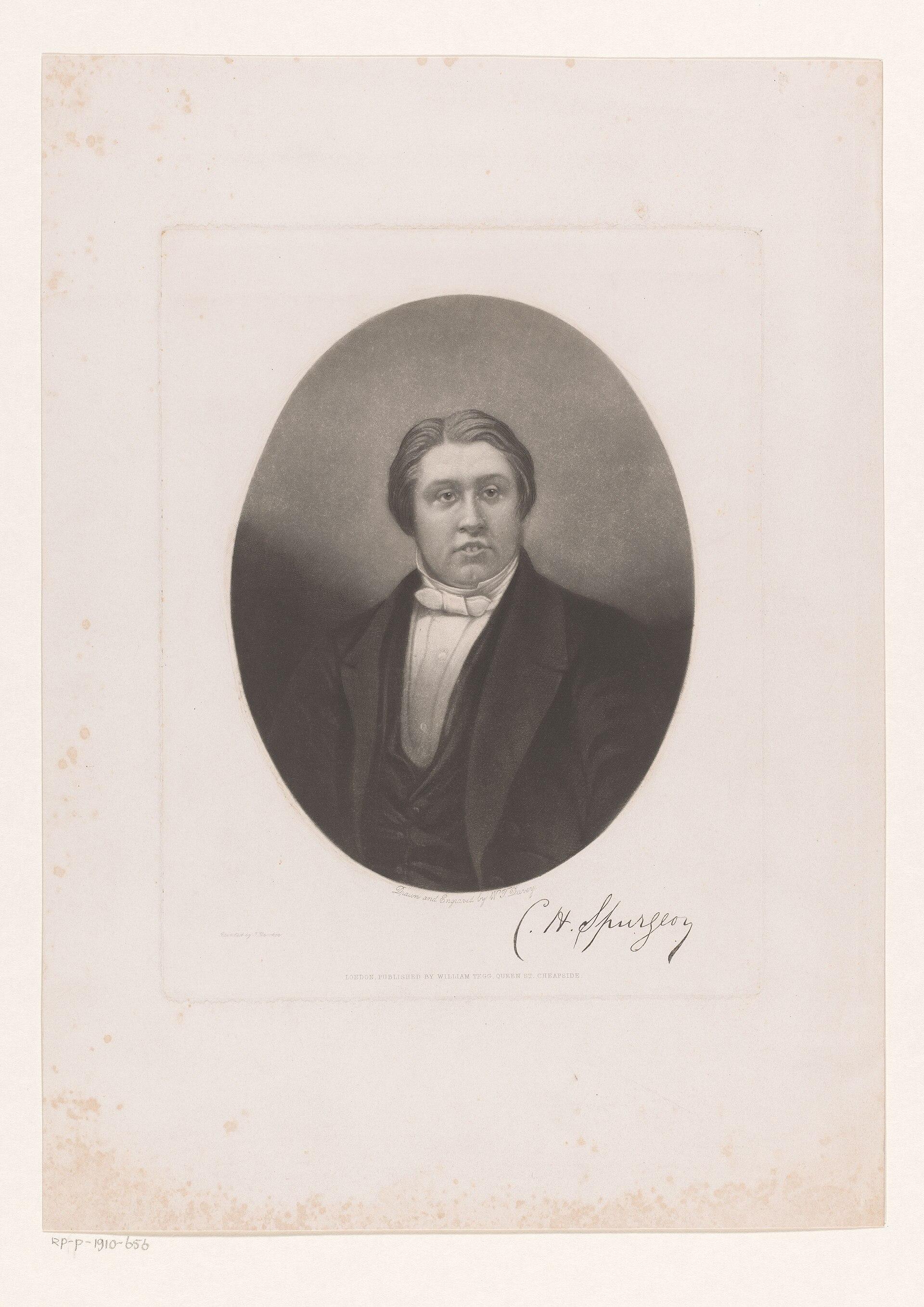
William Turner Davey, Portrait of Charles Spurgeon, 1840 to 1877. CC0.
Essex, Cambridgeshire and London, to 1892 · Person · Featured Study
Charles Spurgeon
He heard the sermon that turned him as a boy and preached in London for thirty-eight years.
A snowstorm turned a boy of fifteen into a side street, and a thin lay preacher in a chapel of a dozen people told him to look.
Turn to Me and be saved, all the ends of the earth; for I am God, and there is no other.
Turn to Me and be saved, all the ends of the earth; for I am God, and there is no other.
- Born
- 19 June 1834 at Kelvedon, Essex
- Died
- 31 January 1892 at Mentone, France
- Family
- grandfather: James Spurgeon
- Places
- Kelvedon, Stambourne, Colchester, Waterbeach, London, Mentone
Summary
Charles Spurgeon was born in Essex in 1834 and spent his early childhood with his grandfather, the minister at Stambourne. In a Colchester chapel a lay preacher told him to look to Christ, and he did. He was baptized that May and preached his first sermon at sixteen. A church in Southwark called him at nineteen.
- His own account of his conversion stands in the first volume of his Autobiography.
- His sermons were printed in two series that ran to 63 volumes.
- In his last years he left the Baptist Union in the Down-Grade Controversy.
The Text in the Snow
A lay preacher took Isaiah 45:22 for his text, and Spurgeon thought of the bronze serpent.
On a Sunday morning in January 1850, snow stopped the boy on his way to another place of worship. He turned into a Primitive Methodist chapel where the minister had not come. A man he took for a shoemaker or a tailor went up to preach on Isaiah 45:22.
The question of this life is how a word to look became the message of a preacher whose sermons filled 63 volumes. Most of what is known of his early years comes from his own telling, gathered after his death by his wife and his secretary.
So Moses made a bronze snake and mounted it on a pole. If anyone who was bitten looked at the bronze snake, he would live.He wrote that he looked and was healed, as the people who looked at the bronze serpent were.
The Life in Order
The four volumes of his Autobiography give the life year by year.
He was a London pastor at nineteen.
- 19 June 1834Born in an Essex villageThe tree of his family
- ChildhoodEarly years at StambourneVolume 1, chapter 3
- 6 January 1850The sermon on Isaiah 45:22 at ColchesterVolume 1, page 106 and its note
- 3 May 1850Baptism in the river at IslehamHis diary for May 1850
- 1850First sermon, in a cottage at TevershamVolume 1, the plates
- 1851Invited to the chapel at WaterbeachHis letter of 1851
- April 1854Elected pastor at New Park Street, SouthwarkHis own note, volume 1
- 8 January 1856His weddingA London paper of 9 January
- August 1887The first Down-Grade papers in his magazineVolume 4, chapter 99
- April 1888The censure confirmed at the City TempleMrs. Spurgeon, volume 4
- 31 January 1892Death at Mentone, five minutes past eleven at nightVolume 4, the last chapter
Each step of the life stands with its witness.
April 1854, 8 January 1856, August 1887, April 1888, 31 January 1892
From Kelvedon to Mentone
He tells the early years himself, and his widow tells the end.
Charles Haddon Spurgeon was an English Baptist preacher who served one London congregation from 1854 until he died in 1892, first at New Park Street Chapel and then at the Metropolitan Tabernacle.
He was born in Kelvedon, Essex, and raised by his Independent grandfather Rev. James Spurgeon. He was converted at age 15 in a snow-bound Primitive Methodist chapel, under a text whose King James wording is "Look unto Me, and be ye saved."
He went to Isleham that May and was baptized at the ferry there. He preached his first sermon at 16, took his first pastorate at 17, and was called to London at 19.
While the chapel in Southwark was enlarged he preached in Exeter Hall, and later in the Music Hall of the Royal Surrey Gardens. The church then built the Metropolitan Tabernacle. He married on 8 January 1856.
His sermons, published from 1855 as the New Park Street Pulpit and from 1861 as the Metropolitan Tabernacle Pulpit, ran to 63 volumes, the last printed in 1917.
He founded the Pastors' College and the Stockwell Orphanage, and a colportage society sold good books from door to door. The Autobiography names the College and the Orphanage as the chief of the works that grew up around his church.
His final years were marked by the Down-Grade Controversy, from 1887 until his death, in which he left the Baptist Union over what he saw as its drift on biblical authority and the gospel.
In his later years he went to Mentone in the south of France for rest. He died there and was buried at Norwood in London.
The Down-Grade
His papers in The Sword and the Trowel led to his withdrawal from the Union and to its censure.
From August 1887 to February 1892, his widow wrote, hardly a number of his magazine The Sword and the Trowel appeared without some reference to the controversy. She wrote that some who had gone far down the slope were stopped, and that evangelical doctrine was preached more clearly for a time.
He withdrew from the Baptist Union, and its Council passed a vote of censure on him. At the City Temple in April 1888 the Union's assembly made the censure its own, with seven voting against.
Mrs. Spurgeon chose to give the story from his side and to leave most of the papers of the dispute unprinted. She wrote that he never regretted the step, and that he felt bound as Luther did when he said he could do no other.
In Their Own Words
Three sayings from his own account of his conversion, his diary and his lectures to students.
Charles Spurgeon (1834 to 1892)
Autobiography, volume 1, Revell issue (1898), page 106
He looked
“Oh! I looked until I could almost have looked my eyes away. There and then the cloud was gone, the darkness had rolled away, and that moment I saw the sun […]”
Particular Baptist
About this saying1 paragraph
He told the morning of 6 January 1850 in his own words, printed in the first volume of the Autobiography.
Charles Spurgeon
Diary, 3 May 1850, volume 1
Buried with Him
“In the afternoon, I was privileged to follow my Lord, and to be buried with Him in baptism. Blest pool! Sweet emblem of my death to all the world! May I, henceforward, live alone for Jesus!”
Particular Baptist
About this saying1 paragraph
He wrote this in his diary on 3 May 1850, his mother's birthday, after his baptism at Isleham.
Charles Spurgeon
Lectures to My Students, first series, Lecture 11, The Minister's Fainting Fits, the opening
Fits of depression
“As it is recorded that David, in the heat of battle, waxed faint, so may it be written of all the servants of the Lord. Fits of depression come over the most of us. Usually cheerful as we may be, we must at intervals be cast down.”
Particular Baptist
About this saying1 paragraph
In 1875 he spoke of low spirits to his students.
The People Around Him
The witnesses name his family, the preacher he never identified and those who wrote his life.
A grandfather's manse and an unnamed lay preacher shaped his start.
| Person | Tie to Spurgeon | The witness |
|---|---|---|
| James Spurgeon | His grandfather, minister of the Independent meeting-house at Stambourne. | The family tree; chapter 3 |
| John Spurgeon | His father, born in 1810. | Volume 1, the opening pages |
| The lay preacher | The thin man in the pulpit at Colchester, whose name is lost. | The footnote on the preacher |
| Mr. Candow | He went with him to Isleham for his baptism. | His diary, 3 May 1850 |
| T. W. Medhurst | The first student of the Pastors' College. | Volume 2, on the College |
| His wife | She compiled the Autobiography with his private secretary. | The title page |
| Dr. Culross | The President of the Baptist Union who wrote to him in the controversy. | Volume 4, the Down-Grade chapter |
The Places of His Life
His life runs from the villages of Essex to a London pulpit and a winter town in France.
After 1854 his work stayed in south London.
| Place | What the witnesses say | The witness |
|---|---|---|
| Kelvedon | The Essex village of his birth. | The plate of his birthplace |
| Stambourne | The village where he spent his early childhood. | Volume 1, chapters 3 to 5 |
| Colchester | The Primitive Methodist chapel in Artillery Street. | The plate on page 107 |
| Isleham | The ferry where he was baptized. | The plate on page 147 |
| Waterbeach | A large village near Cambridge, his first charge. | Volume 1, on Waterbeach |
| Southwark | New Park Street Chapel, where the church once met under Gill and Rippon. | His note of 1854 |
| Mentone | The winter refuge in France where he died. | Volume 4, chapters 104 to 106 |
| Norwood | The cemetery where his tomb stands. | Volume 4, the plates |
Mentone, Norwood
Look and Live
He preached that a sinner is saved by looking to Christ, as he had been.
The lay preacher told him he had nothing to do but to look and live. Spurgeon wrote that he had been waiting to do fifty things, and when he heard the word Look he saw the way of salvation at once.
Six years to the day later, on 6 January 1856, he preached at New Park Street on the same verse. He told the congregation that at that very hour, six years before, he had been led to look to Christ by a sermon on that text.
How the Key Verse Was Taught
Jerome, Matthew Henry and Jamieson, Fausset and Brown read the call to the ends of the earth.
Jerome (died 420)
Commentary on Isaiah
Jerome read the verse with the Lord who made the heavens and the earth.
“(Vers. 18 seqq.) Because this is what the Lord says, the one who created the heavens, the one who formed the earth and made it, the one who established it; he did not create it in vain, but formed it to be inhabited. I am the Lord, and there is no other. I did not speak in secret, in a dark place on the earth. I did not say to the offspring of Jacob, 'Seek me in vain.' I am the Lord, speaking truth, declaring what is right.”
on Isaiah 45:18 to 25Patristic
Matthew Henry (1662 to 1714)
Commentary on the Whole Bible
Matthew Henry compared the look of faith to the Israelites' look at the bronze serpent.
“They shall all be invited to look unto him, as the stung Israelites did to the brazen serpent; and so strong is the eye of faith that by divine grace it will reach the Saviour and fetch in salvation by him even from the ends of the earth; for he is God, and the is none else.”
on Isaiah 45:22Puritan
Jamieson, Fausset & Brown (1802 to 1910)
Commentary Critical and Explanatory on the Whole Bible
Their commentary of 1871 saw in the verse the look of faith and of conversion.
“Not do something, but look to the Saviour”
on Isaiah 45:22Reformed
The rest4 more paragraphs
(Ac 16:30, 31). Believers look by faith, the eye of the soul. The look is that of one turning (see Margin) to God, as at once "Just and the Saviour"
(Isa 45:21),
that is, the look of conversion
(Ps 22:27).
What the Witnesses Leave Open
Readers differ on the preacher of 1850, the Down-Grade and what it cost him.
Who preached that morningthe Autobiography's note; three claimants
The Autobiography notes that three men claimed to have been the preacher, and Spurgeon recognised none of them as the man he heard.
The Down-GradeCharles Spurgeon; the Council of the Baptist Union; his widow
In his view the Union had made room for the decline. His widow called the vote against him unjust and said that little was gained in the Union itself.
What the fight cost himCharles Spurgeon; his widow
His widow wrote that in a note written days before his death he said what those nearest him already knew, that his fight for the faith had cost him his life. The note is his own reckoning, and the volume gives no physician's word on it.
Books to Read Next
C. H. Spurgeon's Autobiography, volume 1
His wife and his private secretary · 1897
This volume gives his childhood, his conversion and his first years of preaching in his own words.
Read volume 1 free at the Internet ArchiveC. H. Spurgeon's Autobiography, volume 4
The same compilers · 1900
This volume gives the Down-Grade from his side and the last months at Mentone.
Read volume 4 free at the Internet ArchiveWhat Spurgeon Left
He left a college for preachers, an orphanage and the printed sermons.
Sources
Scripture is the Berean Standard Bible.
- The Holy Bible, Berean Standard Bible (read 2026)
- C. H. Spurgeon's Autobiography, compiled from his diary, letters and records by his wife and his private secretary, 4 volumes (1897 to 1900)
- Jerome, Commentary on Isaiah, on Isaiah 45:22.
- Matthew Henry, Commentary on the Whole Bible, on Isaiah 45:22.
- Jamieson, Fausset & Brown, Commentary Critical and Explanatory on the Whole Bible, on Isaiah 45:22.
- Charles Spurgeon, Lectures to My Students, first series, Lecture 11, The Minister's Fainting Fits (1875)
Keep Studying
Studies5
People and groups6