
1 Samuel 9 to 31 · Person · Featured Study
Saul
Israel's first king, from his anointing by Samuel to his death in battle with the Philistines.
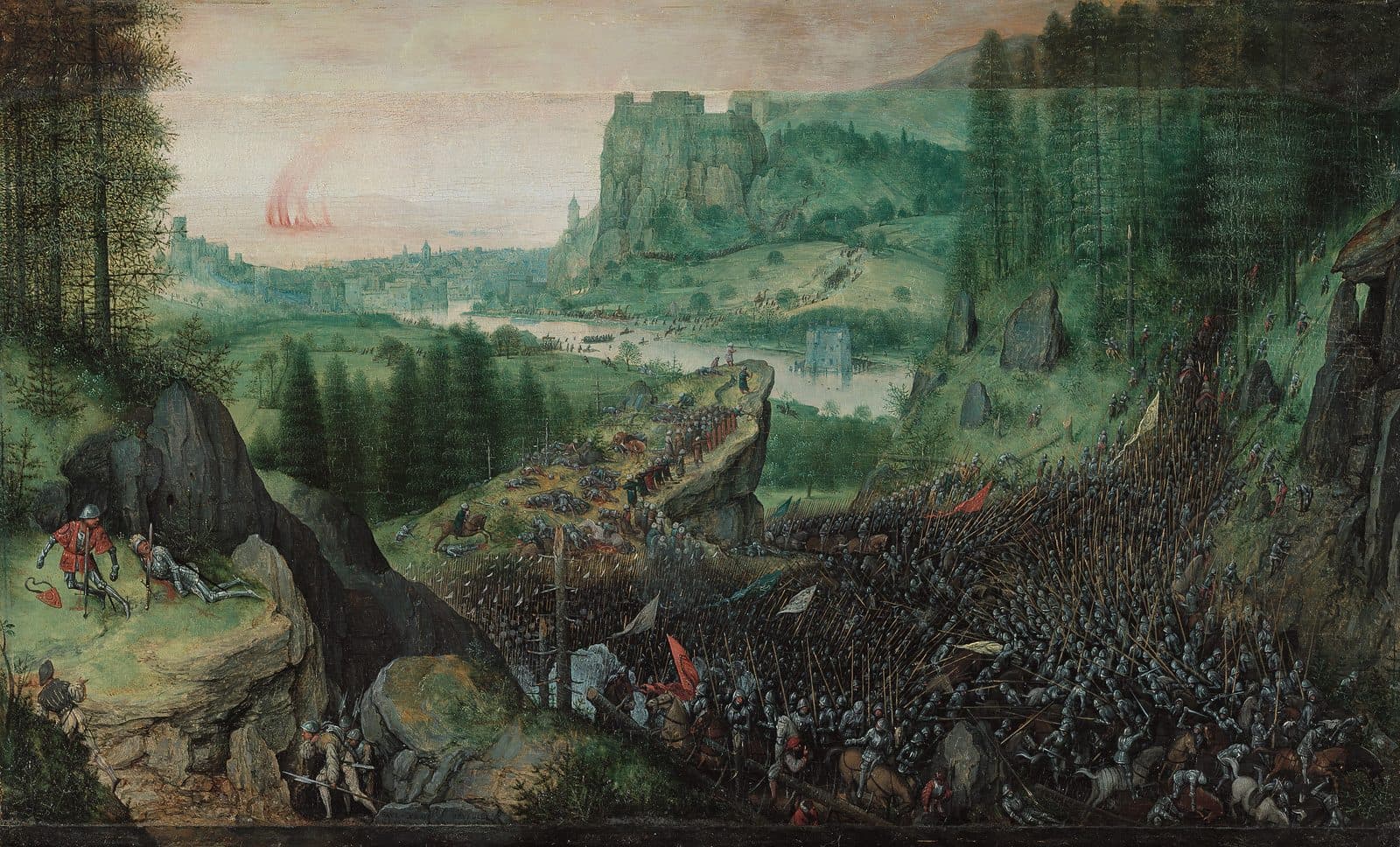
Pieter Bruegel the Elder, The Suicide of Saul, 1562, Kunsthistorisches Museum, Vienna. Public domain, via Wikimedia Commons.
THE ARTWORKBruegel set the death of the king small in one corner and gave the rest of the panel to the armies crossing the mountains of Gilboa.
Saul began his reign hidden among the baggage and ended it on his own sword.
Summary
Saul son of Kish, a Benjamite, was the king God gave Israel when the people asked for one like the other nations had.
- The lot at Mizpah chose him in public, and the people confirmed him at Gilgal.
- He offered a burnt offering at Gilgal without Samuel and lost the promise of a lasting dynasty.
- He spared Agag and the best of the Amalekite flocks, and God rejected him as king.
- He hunted David for years and killed the priests of Nob.
- He died with three of his sons on Mount Gilboa.
Where Saul Stands in Scripture
From his first appearance in 1 Samuel 9 to Paul's sermon in Acts 13
First Samuel describes how he looked before it tells anything he did.
And he had a son named Saul, choice and handsome, without equal among the Israelites—a head taller than any of the people.When the LORD chooses the next king in 1 Samuel 16:7, He weighs the heart above the looks and height this verse records.
The book's last verse returns to Jabesh-gilead, the town of 1 Samuel 11.
Then they took their bones and buried them under the tamarisk tree in Jabesh, and they fasted seven days.The Reign, Turn by Turn
Fourteen turns of the reign, from Zuph to Mount Gilboa
- Sent to find his father's donkeysthe land of Zuph, 1 Samuel 9:5
- Anointed by Samuel in privateSamuel's town, 1 Samuel 10:1
- Chosen by lot, hiding among the baggageMizpah, 1 Samuel 10:21
- Rescues the town from NahashJabesh-gilead, 1 Samuel 11:11
- Confirmed as kingGilgal, 1 Samuel 11:15
- Offers before Samuel comesGilgal, 1 Samuel 13:9
- Vows death on Jonathannear Michmash, 1 Samuel 14:44
- Spares Agag and is rejectedGilgal, 1 Samuel 15:28
- The Spirit departs; David plays for himhis court, 1 Samuel 16:23
- Hurls his spear at Davidhis house, 1 Samuel 18:11
- Has the priests of Nob killedGibeah, 1 Samuel 22:18
- Spared by David in a caveEn-gedi, 1 Samuel 24:3
- Seeks out a mediumEndor, 1 Samuel 28:7
- Falls on his own swordMount Gilboa, 1 Samuel 31:4
Three of the fourteen turns take place at Gilgal.
From the Lost Donkeys to Gilboa
1 Samuel 9 to 31
Twice he sets aside the word the LORD gave through Samuel, first at Gilgal and then against Amalek, and twice Samuel tells him the kingdom will pass from him.
Chosen three times1 Samuel 9 to 11
“At this time tomorrow I will send you a man from the land of Benjamin, and you are to anoint him leader over My people Israel; he will save them from the hand of the Philistines. For I have looked upon My people, because their cry has come to Me.”The LORD names the king's task while Saul is still out looking for donkeys.
Then Samuel took a flask of oil, poured it on Saul’s head, kissed him, and said, “Has not the LORD anointed you ruler over His inheritance?The anointing is private, and Saul keeps it from his uncle in 1 Samuel 10:16.
At Mizpah the lot falls on Benjamin, then on the clan of Matri, then on Saul, and he cannot be found.
Charles Spurgeon, in his sermon Hiding Among the Stuff, holds that Saul hid at Mizpah because he already knew Samuel had anointed him.
So again they inquired of the LORD, “Has the man come here yet?” And the LORD replied, “Behold, he has hidden himself among the baggage.”The lot at Mizpah is the second of the three choosings.
When Nahash the Ammonite besieges Jabesh-gilead, the Spirit of God rushes on Saul. He musters Israel by sending out the pieces of a yoke of oxen, and he scatters the Ammonites at the morning watch.
So all the people went to Gilgal and confirmed Saul as king in the presence of the LORD. There they sacrificed peace offerings before the LORD, and Saul and all the Israelites rejoiced greatly.The people's confirmation of Saul is the third of the three choosings.
The offering at Gilgal1 Samuel 13
Saul's troops begin to slip away while he waits seven days at Gilgal for Samuel.
I thought, ‘Now the Philistines will descend upon me at Gilgal, and I have not sought the favor of the LORD.’ So I felt compelled to offer the burnt offering.”This reason is what Samuel answers with the loss of the kingdom in the next verse.
“You have acted foolishly,” Samuel declared. “You have not kept the command that the LORD your God gave you; if you had, the LORD would have established your kingdom over Israel for all time. But now your kingdom will not endure; the LORD has sought a man after His own heart and appointed him ruler over His people, because you have not kept the command of the LORD.”Amalek and the torn robe1 Samuel 15
Saul and his troops spared Agag, along with the best of the sheep and cattle, the fat calves and lambs, and the best of everything else. They were unwilling to destroy them, but they devoted to destruction all that was despised and worthless.1 Samuel 15:3 had ordered all of it destroyed.
Saul sets up a monument for himself at Carmel and tells Samuel the best animals were kept to sacrifice to the LORD.
But Samuel declared: “Does the LORD delight in burnt offerings and sacrifices as much as in obedience to His voice? Behold, obedience is better than sacrifice, and attentiveness is better than the fat of rams. For rebellion is like the sin of divination, and arrogance is like the wickedness of idolatry. Because you have rejected the word of the LORD, He has rejected you as king.”Saul confesses that he feared the people and obeyed their voice. As Samuel turns away, Saul grabs the hem of his robe and it tears.
So Samuel said to him, “The LORD has torn the kingdom of Israel from you today and has given it to your neighbor who is better than you.The neighbor is David, whom Samuel anoints in the next chapter.
Saul and David1 Samuel 16 to 26
After the Spirit of the LORD had departed from Saul, a spirit of distress from the LORD began to torment him.The Spirit leaves Saul in the chapter where it rushes on David.
His servants bring David to play the harp for him, and Saul admires him greatly and makes him his armor-bearer.
And as the women danced, they sang out: “Saul has slain his thousands, and David his tens of thousands.” And Saul was furious and resented this song. “They have ascribed tens of thousands to David,” he said, “but only thousands to me. What more can he have but the kingdom?” And from that day forward Saul kept a jealous eye on David.The first of Saul's attempts on David's life comes the day after this song, in 1 Samuel 18:10 to 11.
He sets a bride price of a hundred Philistine foreskins hoping David will die, and orders Jonathan and his servants to kill him.
When the priest Ahimelech helps David, Saul orders the priests killed, and Doeg the Edomite strikes down eighty-five of them.
So he said to his men, “The LORD forbid that I should do such a thing to my master, the LORD’s anointed. May I never lift my hand against him, since he is the LORD’s anointed.”David answers his men after he has cut off only a corner of Saul's robe.
Then Saul replied, “I have sinned. Come back, David my son. I will never harm you again, because today you considered my life precious. I have played the fool and have committed a grave error!”David has spared him a second time, in the wilderness of Ziph, and the two men never meet again.
The last night and Mount Gilboa1 Samuel 28 and 31
He inquired of the LORD, but the LORD did not answer him by dreams or Urim or prophets.The silence of the LORD is why he seeks out a medium in the next verse.
He goes in disguise to a medium at Endor, though he had removed the mediums from the land, and hears that he and his sons will be with Samuel the next day.
Then Saul said to his armor-bearer, “Draw your sword and run it through me, or these uncircumcised men will come and run me through and torture me!” But his armor-bearer was terrified and refused to do it. So Saul took his own sword and fell on it.His fear of torture by the Philistines is the last thing Saul says in 1 Samuel.
The men of Jabesh-gilead journey all night, carry the bodies of Saul and his sons to Jabesh, and burn them there.
What Scripture Sets Beside the Fall
Six things 1 and 2 Samuel record in his favor
HUMBLE AT THE START
He calls Benjamin the smallest tribe of Israel and his clan the least of its clans.
SILENT BEFORE HIS DESPISERS
When some worthless men ask how he can save them and bring him no gifts, he says nothing.
A CHANGED HEART
As he turned to leave Samuel, God changed his heart, and every sign Samuel gave came to pass that day.
HIS FIRST ALTAR
After the battle at Michmash he builds an altar to the LORD, the first he had built.
VICTORIES ON EVERY SIDE
He fought Moab, Ammon, Edom, the kings of Zobah and the Philistines, and routed them wherever he turned.
MOURNED BY DAVID
David's lament asks the daughters of Israel to weep for the king who clothed them in scarlet.
The World of His Reign
The Philistine wars and Saul's home at Gibeah
The Philistines held an outpost at Geba in Benjamin, and Jonathan's attack on it opens the war of 1 Samuel 13.
First Samuel says the war with the Philistines was fierce all the days of Saul, and that he enlisted every strong or brave man he saw.
Now the Philistines assembled to fight against Israel with three thousand chariots, six thousand horsemen, and troops as numerous as the sand on the seashore. They went up and camped at Michmash, east of Beth-aven.Against an army this size the men of Israel hid in caves and thickets, as 1 Samuel 13:6 tells.
Gibeah of Saul and Tell el-FulW. F. Albright, 1924
W. F. Albright dug the mound of Tell el-Ful as the Gibeah of Saul named in 1 Samuel 15:34. In his report of 1924 he ascribed its second fortress to Saul and dated it to the second half of the eleventh century BC.
The ascription rests on Albright's identification of the site and on the pottery he dated.
The Family of Saul
Thirteen ties, from his father to his grandson
Generation 1
- KishHis father, a Benjamite and a powerful man, 1 Samuel 9:1
Generation 2
Generation 3
- JonathanHis son, David's friend, 1 Samuel 14:49
- IshviHis son, named in the first list of his sons, 1 Samuel 14:49
- MalchishuaHis son, killed with him on Gilboa, 1 Samuel 31:2
- AbinadabHis son, killed with him on Gilboa, 1 Samuel 31:2
- Ish-boshethHis son, whom Abner made king after him, 2 Samuel 2:8
- MerabHis elder daughter, whom he offered to David, 1 Samuel 18:17
- MichalHis younger daughter, who loved David and married him, 1 Samuel 18:20
- DavidHis son-in-law and armor-bearer, whom Samuel anointed king, 1 Samuel 16:21
Generation 4
- MephiboshethHis grandson, Jonathan's son, lame from the age of five, 2 Samuel 4:4
Each card gives one tie with the verse that names it.
The Places of His Reign
Nine places in the key, four of them marked on the map
50 km (31 miles)
- 1Mizpah, Samuel gathered the people of Israel here to name their first king. 1 Samuel 10:17
- 2Gibeah, Saul went home to Gibeah after he was chosen, and men of valor went with him. 1 Samuel 10:26
- 3Jabesh-gilead, David blessed its men for the kindness they showed Saul when they buried him. 2 Samuel 2:5
- 4Gilgal, Samuel put to death there Agag, the king Saul had spared. 1 Samuel 15:33
- 5Michmash, Saul's son Jonathan crossed the pass between Michmash and Geba, by the cliffs Bozez and Seneh, to reach the Philistine outpost. 1 Samuel 14:4 to 5
- 6Nob, Doeg, at Saul's order, put the city of the priests to the sword with its men, women and children. 1 Samuel 22:19
- 7Endor, Saul's servants named it as the town where a medium lived. 1 Samuel 28:7
- 8Mount Gilboa, David's lament asks that no dew or rain fall on it, for there the shield of Saul was defiled. 2 Samuel 1:21
- 9Beth-shan, The Philistines hung his body on the town's wall. 1 Samuel 31:10
Not located: Mizpah, Jabesh-gilead, Michmash, Endor, Beth-shan.
The coastline is simplified; each place stands at its place page's coordinates.
Each place in the key carries the verse that ties it to his reign.
Questions the Reign Raises
Four questions answered from their verses
Why did one offering cost him the dynasty?1 Samuel 13; John Wesley
In 1 Samuel 13:11 Saul himself names the appointed time Samuel had set.
John Wesley measures what Saul lost by how Scripture uses the words for all time.
“For ever - The phrase, forever, in scripture often signifies only a long time. So this had been abundantly verified, if the kingdom had been enjoyed by Saul, and by his son, and by his son's son; after whom the kingdom might have come to Judah.”
John Wesley · Explanatory Notes upon the Old Testament · on 1 Samuel 13:13Evangelical
Did God change His mind about Saul?1 Samuel 15:11, 1 Samuel 15:29 and 1 Samuel 15:35; Tertullian
In 1 Samuel 15:11 the LORD says He regrets making Saul king.
Moreover, the Glory of Israel does not lie or change His mind, for He is not a man, that He should change His mind.”The same chapter says both, and 1 Samuel 15:35 repeats the regret.
Tertullian answers Marcion, who took the LORD's regret over Saul as proof of a fickle God.
“Furthermore, with respect to the repentance which occurs in his conduct you interpret it with similar perverseness just as if it were with fickleness and improvidence that he repented, or on the recollection of some wrongdoing; because he actually said, ‘I repent that I have set up Saul to be king,’ very much as if he meant that his repentance savored of an acknowledgment of some evil work or error. Well, this is not always implied.”
Tertullian · Against Marcion 2.24 · on 1 Samuel 15:11Patristic
What was the spirit that troubled him?1 Samuel 16:14 to 23; Adam Clarke; Albert Barnes
The question turns on the words from the LORD in 1 Samuel 16:14.
And whenever the spirit from God came upon Saul, David would pick up his harp and play, and Saul would become well, and the spirit of distress would depart from him.The relief did not last: the spirit came on him again in 1 Samuel 18:10 and 1 Samuel 19:9.
Adam Clarke sets two readings of the evil spirit side by side and leaves the choice open.
“The Spirit of the Lord departed from Saul - He was thrown into such a state of mind by the judgments of God, as to be deprived of any regal qualities which he before possessed. God seems to have taken what gifts he had, and given them to David; and then the evil spirit came upon Saul; for what God fills not, the devil will. An evil spirit from the Lord - The evil spirit was either immediately sent from the Lord, or permitted to come.”
Adam Clarke · Commentary on the Bible · on 1 Samuel 16:14Evangelical
Albert Barnes reads it as a messenger God sent to carry out His purpose.
“The ‘evil’ or ‘melancholy’ spirit here spoken of was ‘the Spirit of God,’ or ‘of Jehovah,’ as being God’s messenger and minister, sent by Him to execute His righteous purpose upon Saul (see 1Ki 22:19-22 note).”
Albert Barnes · Notes, Explanatory and Practical, on the Old and New Testaments (1832-1869) · on 1 Samuel 16:15Evangelical
Who killed Saul?1 Samuel 31; 2 Samuel 1; 1 Chronicles 10
Three books tell his death, and they differ on who struck the blow.
So I stood over him and killed him, because I knew that after he had fallen he could not survive. And I took the crown that was on his head and the band that was on his arm, and I have brought them here to my lord.”The Amalekite claims the killing for himself, where 1 Samuel 31:4 says Saul fell on his own sword.
David has the man put to death on the words of his own mouth.
1 Chronicles 10:4 tells the death as 1 Samuel 31:4 does.
What the Text Leaves Unsaid
Three things, from his motive at Gilgal to his silence before God at the end
How Scripture Reads His Reign
1 Chronicles 10, Acts 13 and Hosea 13
Of all his reign the Chronicler tells only the last battle.
So Saul died for his unfaithfulness to the LORD, because he did not keep the word of the LORD and even consulted a medium for guidance, and he failed to inquire of the LORD. So the LORD put him to death and turned the kingdom over to David son of Jesse.Acts 13: Paul's sermon at Pisidian AntiochActs 13:21 to 23
Then the people asked for a king, and God gave them forty years under Saul son of Kish, from the tribe of Benjamin. After removing Saul, He raised up David as their king and testified about him: ‘I have found David son of Jesse a man after My own heart; he will carry out My will in its entirety.’ From the descendants of this man, God has brought to Israel the Savior Jesus, as He promised.Paul names Saul in one verse and then passes to David.
Hosea 13: a king in angerHosea 13:11
So in My anger I gave you a king, and in My wrath I took him away.Hosea spoke to the northern kingdom long after Saul, and his line recalls Israel's first request for a king in 1 Samuel 8.
Voices on Saul
Athanasius, Matthew Henry, and Jamieson, Fausset and Brown
Athanasius takes Saul as his example of a man the Spirit of God leaves after he falls.
“Therefore, when a person falls from the Spirit for any wickedness, if he repents after his fall, the grace remains irrevocably to the one who is willing; otherwise he who has fallen is no longer in God (because that Holy Spirit and Paraclete which is in God has deserted him), but this sinner shall be in him to whom he has subjected himself, as took place in Saul's instance; for the Spirit of God departed from him and an evil spirit was afflicting him.”
Athanasius of Alexandria · Discourses Against the Arians 3.25.25 · on 1 Samuel 16:14 to 15Patristic
Matthew Henry ranks obedience above sacrifice by the law each one belongs to.
“Obedience is enjoyed by the eternal law of nature, but sacrifice only by a positive law. Obedience was the law of innocency, but sacrifice supposes sin come into the world, and is but a feeble attempt to take that away which obedience would have prevented. God is more glorified and self more denied by obedience than by sacrifice.”
Matthew Henry · Commentary on the Whole Bible · on 1 Samuel 15:22 to 23Puritan
Jamieson, Fausset and Brown explain why the people first looked at Saul's height.
“Saul, a choice young man, and a goodly--He had a fine appearance; for it is evident that he must have been only a little under seven feet tall. A gigantic stature and an athletic frame must have been a popular recommendation at that time in that country.”
Jamieson, Fausset & Brown · Commentary Critical and Explanatory on the Whole Bible · on 1 Samuel 9:2Reformed
How Old Was Saul, and How Long Did He Reign?
Two readings with their holders
Word for word, the Hebrew gives the age as 'a son of a year' and the reign as 'two years'.
Saul was thirty years old when he became king, and he reigned over Israel forty-two years.The Berean text supplies both numbers.
A number has fallen out of the textKeil and Delitzsch, 1880; Josephus
Josephus, in his Antiquities of the Jews, gives Saul eighteen years while Samuel lived and twenty-two after, forty in all as in Paul. In a later book he gives twenty years, so the witnesses to this reading disagree.
A figure for innocenceRashi, from Yoma 22b
Rashi carries the reading of the Talmud that Saul came to the throne like a one-year-old who had not tasted sin. He gives a second reading: in his first year as king Saul chose his three thousand men, and he reigned two years.
Keil and Delitzsch answer that the verse has the form Scripture uses elsewhere for a king's age and reign, and that the wars of 1 Samuel 14:47 need more than two years.
Books to Read Next
Five books: ancient, classic and archaeological
Antiquities of the Jews, Book 6
Flavius Josephus, translated by William Whiston · about 94
Josephus retells the years from the death of Eli to the death of Saul.
READ IT FREE AT PROJECT GUTENBERG →Commentary on the Whole Bible
Matthew Henry · 1710
Henry goes verse by verse through the whole of 1 Samuel.
READ IT FREE AT CCEL →Biblical Commentary on the Books of Samuel
C. F. Keil and F. Delitzsch · 1880
Keil comments on the Hebrew of each verse, with the Septuagint beside it.
READ IT FREE AT THE INTERNET ARCHIVE →Excavations and Results at Tell el-Ful (Gibeah of Saul)
W. F. Albright · 1924
The report sets out the mound's fortresses one period after another.
READ IT FREE AT THE INTERNET ARCHIVE →Commentary Critical and Explanatory on the Whole Bible
Robert Jamieson, A. R. Fausset and David Brown · 1871
The commentary explains the text verse by verse.
The Kingdom Given to a Man After His Own Heart
Keep studying
Studies7
Peoples and groups1