
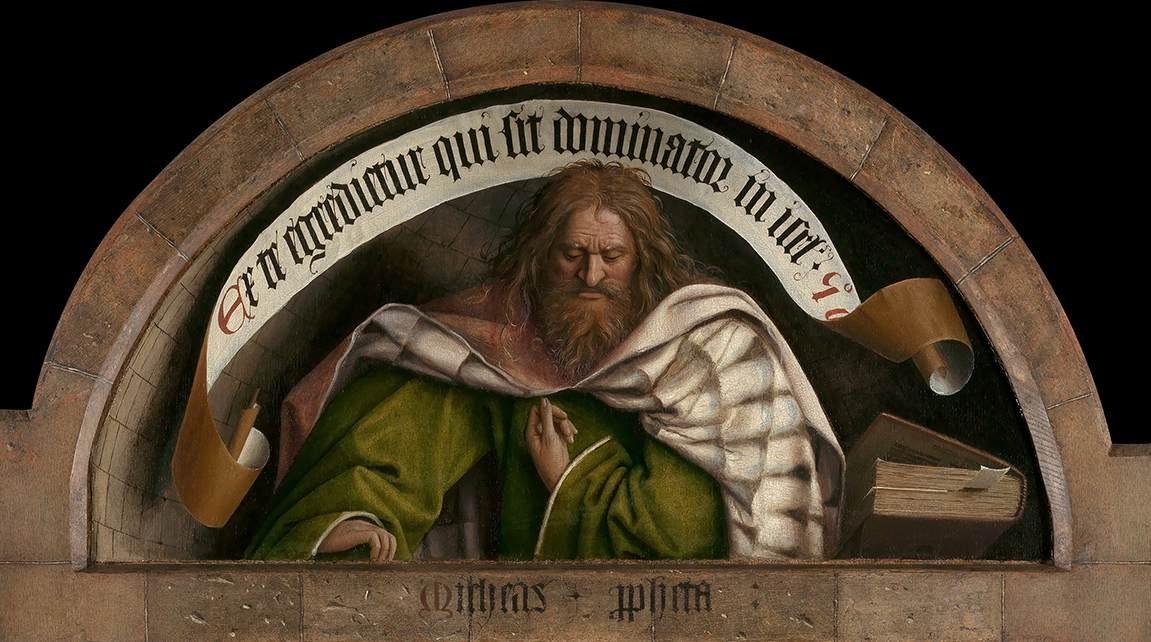
Jan van Eyck, The Prophet Micah, 1432. Public domain.
Micah 1:8 to 16 · Passage · Featured Study
The Lament over the Lowland Towns
In Micah 1:10 to 15 the prophet mourns ten towns of the lowland and keeps the news from an eleventh, Gath.
For her wound is incurable; it has reached even Judah; it has approached the gate of my people, as far as Jerusalem itself.
- The passage
- Micah 1:8 to 16
- Book
- Micah
- When
- the reigns of Jotham, Ahaz and Hezekiah, kings of Judah
- Hold in memory
- Micah 1:9
The towns of the lament run from Gath to Adullam, the two places David reached when he fled from Saul.
Summary
Micah's lament follows his word against Samaria. Both are in the first chapter of his book. Jerome and later commentators hear a warning in the sound or sense of most of the town names he gives.
- The towns stand in the low hills between Jerusalem and the coastal plain.
- Commentators name both Moresheth-gath and Mareshah as Micah's home.
- Readers differ over which invasion the lament looks ahead to.
The Prophet Mourns
Micah 1:8 to 9 gives the prophet's grief and its cause.
Because of this I will lament and wail; I will walk barefoot and naked. I will howl like a jackal and mourn like an ostrich.The prophet takes on the dress and the cries of a mourner before he names a single town.
Micah 1:6 warned that Samaria, the capital of the northern kingdom, would become a heap of rubble.
A lament is a song of mourning, sung over the dead or over a ruined city. Micah sings his over the towns of the Shephelah. The Shephelah is the band of low hills between the mountains of Judah and the coastal plain, which the Berean text calls the foothills.
These were in the foothills: Eshtaol, Zorah, Ashnah, Zanoah, En-gannim, Tappuah, Enam, Jarmuth, Adullam, Socoh, Azekah,Adullam, the last town of the lament, stands in this list of the towns of the foothills.
The Lowland Towns on the Map
Jerusalem stands on the map for a bearing beside the towns of the lament.
Gath, Lachish and Mareshah are the three towns of the lament whose sites the OpenBible.info data scores 850 or more of 1,000.
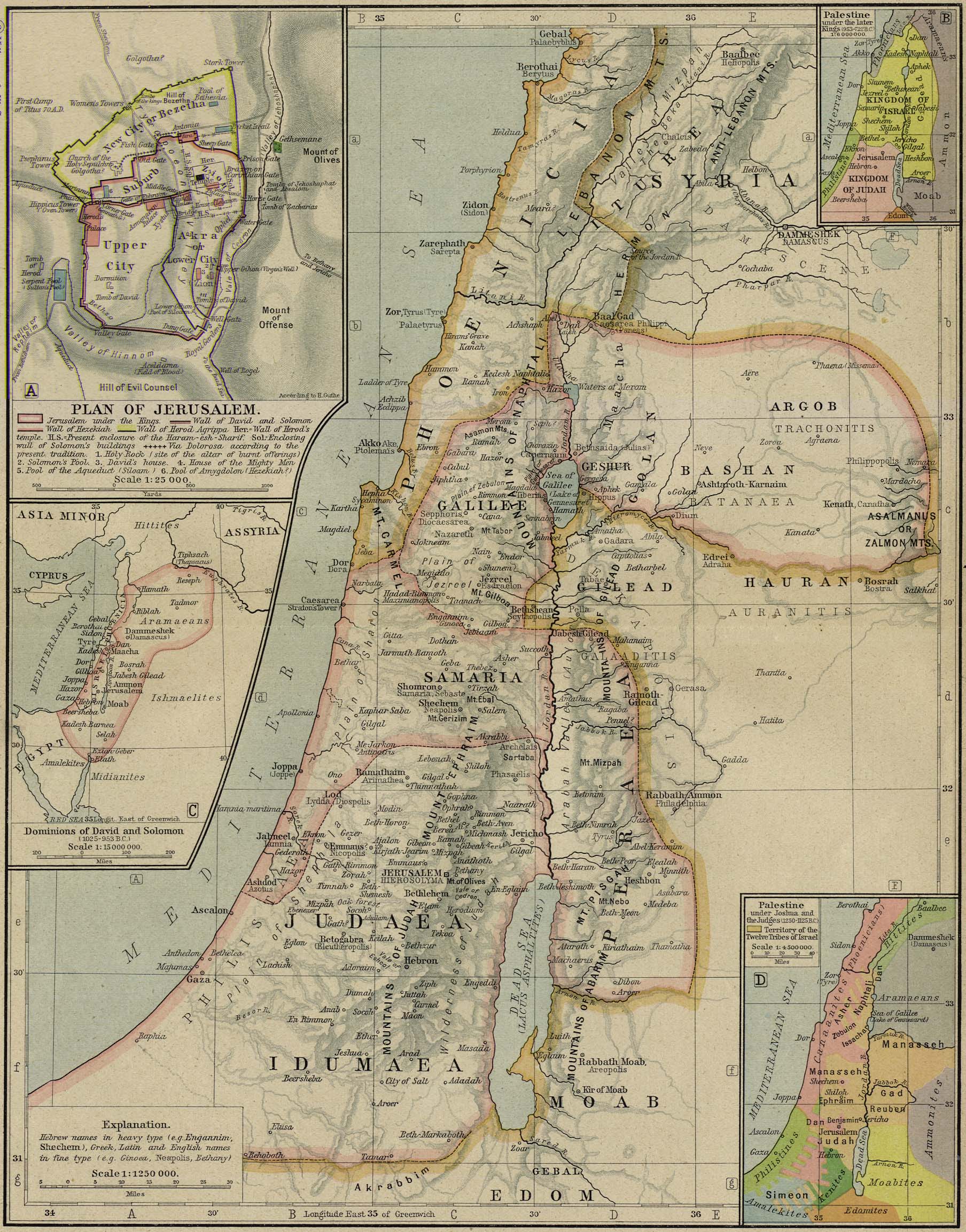
- 1Jerusalem, Calamity came down from the LORD to its gate. Micah 1:12
- 2Gath, The news is to be kept from it. Micah 1:10
- 3Lachish, Its people are told to harness the chariot horses. Micah 1:13
- 4Mareshah, God will bring a conqueror against it. Micah 1:15
Base map: Reference map of ancient Palestine, Rand McNally reference map (1926), public domain. Places with a place page stand at its coordinates and the others at the point cited for each, set on the plate by Jerusalem and Damascus, as the plate prints them.
The other eight towns score lower in the same data. Adullam scores 737 and Achzib 536, and Moresheth-gath, Beth-ezel, Beth-leaphrah, Shaphir and Maroth score under 500. Zaanan is placed only within 12 kilometres of Lachish.
Town by Town, Name by Name
Jerome, Clarke, Barnes and Jamieson, Fausset and Brown trace a play on words in nine of the eleven town names of Micah 1:10 to 15.
Nine names of the lament, each with the sense its commentators read in it.
| Town | The name means or sounds like | Micah's line | Noted by |
|---|---|---|---|
| Gath | the Hebrew word for declare | Do not tell it | Jamieson, Fausset and Brown |
| Beth-leaphrah | house of dust | Roll in the dust | Adam Clarke; Jerome |
| Shaphir | fair | Depart in shameful nakedness | Albert Barnes; Jerome |
| Zaanan | the Hebrew for came forth | Will not come out | Jamieson, Fausset and Brown; Jerome |
| Beth-ezel | neighbouring | Its support is taken from you | Jerome |
| Maroth | bitterness | Pined for good | Jamieson, Fausset and Brown; Charles Spurgeon; Jerome |
| Moresheth-gath | inheritance | Send farewell gifts | Albert Barnes |
| Achzib | a winter brook that fails in summer | Will prove deceptive | Albert Barnes |
| Mareshah | an inheritance, the place of an heir | I will again bring a conqueror | Jamieson, Fausset and Brown; Adam Clarke |
Moresheth-gath, Achzib, Mareshah
Do not tell it in Gath; do not weep at all. Roll in the dust in Beth-leaphrah. Depart in shameful nakedness, O dwellers of Shaphir. The dwellers of Zaanan will not come out. Beth-ezel is in mourning; its support is taken from you.Commentators find five of the plays on names in these two verses.
Matthew Henry traces the first words of Micah 1:10 to David's lament over Saul and Jonathan. He reads them as a wish that the uncircumcised should not triumph over Israel's tears.
Tell it not in Gath; proclaim it not in the streets of Ashkelon, lest the daughters of the Philistines rejoice, and the daughters of the uncircumcised exult.This is the line Henry hears at the head of the list of towns.
Adam Clarke heard the Hebrew of the same verse as roll in the dust in the house of dust.
Farewell Gifts to Moresheth-gath
Commentators read the gifts of Micah 1:14 in two ways, and they disagree over where Micah himself came from.
Therefore, send farewell gifts to Moresheth-gath; the houses of Achzib will prove deceptive to the kings of Israel.This is the one line of the lament that sends a gift in place of a cry of mourning.
Albert Barnes reads the gifts as a dowry, the gifts a father sent with a daughter who left his house and did not come back. In his reading Judah must part with Moresheth, the inheritance God gave her.
Jamieson, Fausset and Brown and John Wesley read presents sent to buy help. Wesley names Lachish as the giver and the Philistines as the help it sought.
Micah 1:1 calls the prophet the Moreshite, and Jeremiah 26:18 remembers him by that name. John Gill reports that many thought Mareshah was his birthplace. Wesley reads Moresheth-gath as a city of the Philistines, named so to tell it from a town of the same name in Judah.
Sennacherib at Lachish
The history of Hezekiah's reign in 2 Kings shows what became of Lachish, the town Micah 1:13 addresses.
In the fourteenth year of Hezekiah’s reign, Sennacherib king of Assyria attacked and captured all the fortified cities of Judah. So Hezekiah king of Judah sent word to the king of Assyria at Lachish, saying, “I have done wrong; withdraw from me, and I will pay whatever you demand from me.” And the king of Assyria exacted from Hezekiah king of Judah three hundred talents of silver and thirty talents of gold.2 Kings dates this campaign within Micah's lifetime, in the reign of the last king named in Micah 1:1.
Matthew Henry draws a warning from the charge for any town that leads others into sin.
“Note, Those that help to bring sin into a country do but thereby prepare for the throwing of themselves out of it. Those must expect to be first in the punishment who have been ringleaders in sin. The transgressions of Israel were found in thee; when they came to be traced up to their original they were found to take rise very much from that city.”
Matthew Henry · Commentary on the Whole Bible · on Micah 1:13Puritan
Two Voices on the Towns
Charles Spurgeon and Jamieson, Fausset and Brown each drew a lesson from one of the names.
Charles Spurgeon (1834 to 1892)
Spurgeon read the name Maroth as the story of a hope that failed.
“The village of the bitter spring, for that is probably the meaning of this name, Maroth, experienced a bitter disappointment. At the time when the Assyrians invaded the land, the inhabitants expected that deliverance would come to them from some quarter or other. From the context, I judge that they placed some sort of reliance upon the Philistines. They possibly had some hope that the king of Egypt would come up to attack Sennacherib.”
Charles Spurgeon · The Metropolitan Tabernacle Pulpit, Sermon No. 3184: “Maroth—or, the Disappointed” (lightly modernized text, CCEL edition) · on Micah 1:12Particular Baptist
Jamieson, Fausset & Brown (1802 to 1910)
Jamieson, Fausset and Brown carry the name Mareshah from the town to the reader.
“Other heirs will supplant us in every inheritance but that of heaven. There is a play upon the meaning of Mareshah, ‘an inheritance’: there shall come the new heir of the inheritance. Adullam the glory of Israel--so called as being superior in situation; when it and the neighboring cities fell, Israel's glory was gone.”
Jamieson, Fausset & Brown · Commentary Critical and Explanatory on the Whole Bible · on Micah 1:15Reformed
Which Invasion Does Micah Foresee?
The lament names no invader, and two readings of its army stand in the commentaries.
Sennacherib's march on JudahJamieson, Fausset and Brown; Albert Barnes
Jamieson, Fausset and Brown, in their commentary of 1871, read Micah 1:9 as Micah seeing Sennacherib come to the gate of Jerusalem. Barnes, in his Notes, names Sennacherib as the heir God brings against Mareshah in Micah 1:15.
The objection: Adam Clarke wrote that the closing verses speak of events the history books do not record, so their reference can only be guessed.
The war of Pekah against AhazAdam Clarke, Commentary on the Bible
In his Commentary on the Bible of 1832, Clarke suggests that King Ahaz sent to these towns for help. He places the appeal at the time when Pekah, king of Israel, pressed Ahaz. He reads the kings of Israel in Micah 1:14 in that light.
The objection: Jamieson, Fausset and Brown read Israel in Micah 1:14 as the kingdom of Judah.
They Will Go into Exile
Shave yourselves bald and cut off your hair in mourning for your precious children; make yourselves as bald as an eagle, for they will go from you into exile.Jamieson, Fausset and Brown read this last command as spoken to the whole land, mourning like a mother for her children.
Micah began with his own mourning in Micah 1:8, and he ends by calling the whole land to mourn with him.
Sources
Scripture is the Berean Standard Bible.
- Jerome, Commentary on Micah (died 420), on Micah 1:10 to 15.
- Matthew Henry, Commentary on the Whole Bible (1710), on Micah 1:10 to 13.
- John Wesley, Explanatory Notes upon the Old Testament (1765), on Micah 1:13 to 14.
- John Gill, Exposition of the Old Testament (1748-1763), on Micah 1:15.
- Adam Clarke, Commentary on the Bible (1832), on Micah 1:10 to 15.
- Albert Barnes, Notes, Explanatory and Practical, on the Old and New Testaments (1832-1869), on Micah 1:11 to 15.
- Jamieson, Fausset and Brown, Commentary Critical and Explanatory on the Whole Bible (1871), on Micah 1:9 to 16.
- Notes and sermons on Micah 1:8 to 16, from Jerome to Charles Spurgeon.
- Charles Spurgeon, Maroth, or the Disappointed, Metropolitan Tabernacle Pulpit, Sermon No. 3184 (1910)
- OpenBible.info, Bible-Geocoding-Data, ancient.jsonl, identification scores.
Keep Studying
Symbols1
People and groups4
Go further7