
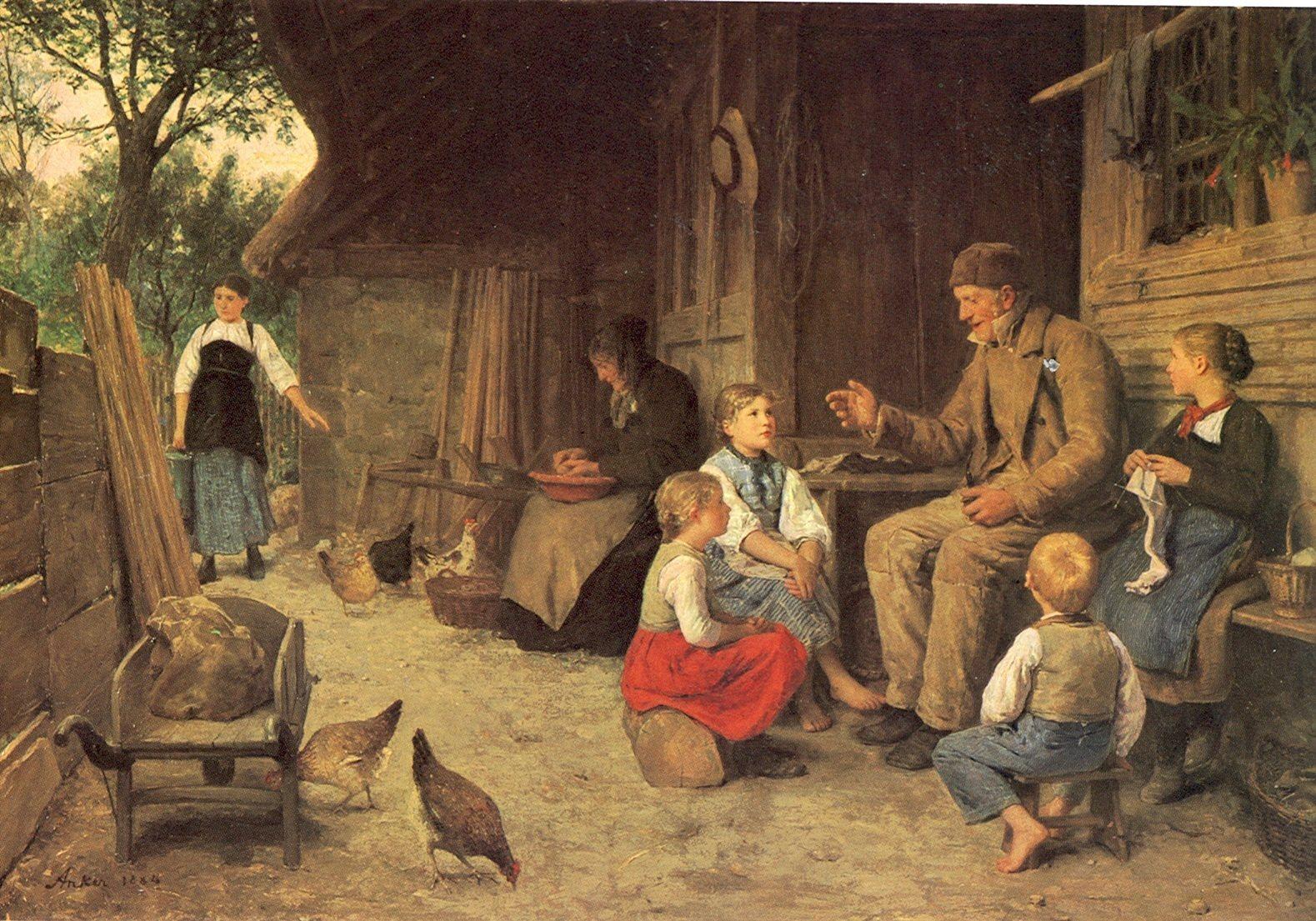
Albert Anker, The Grandfather Tells a Story, 1884. Public domain.
Proverbs 22 · Subject · Featured Study
Train Up a Child: Proverb or Promise
Proverbs 22:6 is a proverb, and its readers ask whether a proverb states a rule that holds in every case.
Train up a child in the way he should go, and when he is old he will not depart from it.
- Book
- Proverbs
- Hold in memory
- Proverbs 26:4 to 5
Albert Barnes notes that some rabbis questioned the place of Proverbs in the canon, because two of its verses disagree.
Summary
This saying tells a parent to train a child, and it says the child will keep that way when old. The Hebrew word for a proverb means a short, pithy saying. The book itself sets some of its sayings side by side.
- Proverbs 1:6 names proverbs with parables, sayings and riddles.
- Proverbs 1:1 and Proverbs 10:1 head the book's sayings with the word proverbs.
- Bede called the verse a proverb and named those who change in old age.
- Spurgeon asked what rule there is without an exception.
A Book of Proverbs
The first verse of the book calls its sayings proverbs.
Is the saying a pledge from God to every parent, or a saying that holds as a rule? The answer starts with what kind of words the verse is.
by understanding the proverbs and parables, the sayings and riddles of the wise.The reader is to understand each kind, the proverb among them.
The Hebrew word for proverb is mashal, which James Strong numbers H4912 and defines as a pithy maxim, usually of metaphorical nature.
Sayings and Their Cases
Readers have set three sayings beside cases the reader must weigh with them.
Three sayings of Proverbs stand beside cases that go another way.
| The saying | The case beside it |
|---|---|
| “Do not answer a fool according to his folly, or you yourself will be like him.” (Proverbs 26:4) | The verse after it, Proverbs 26:5 |
| “The righteous man walks with integrity; blessed are his children after him.” (Proverbs 20:7) | The sons of the prophet Samuel (1 Samuel 8:3) |
| “he who looks after his master will be honored” (Proverbs 27:18) | Some faithful servants met with ungenerous treatment. |
Two Sides of a Truth
Barnes and Bede read the two commands as one teaching.
Answer a fool according to his folly, lest he become wise in his own eyes.The command comes with its reason, so the reader can tell when it applies.
Barnes called the pair two sides of a truth. To answer the fool in Proverbs 26:4 is to sink to his level of anger and abuse. To answer him in Proverbs 26:5 is to say the right word at the right time.
Bede, in his Commentary on Proverbs, wrote that the two commands should not be seen as contradicting each other.
A Rule and Its Exceptions
Bede and Spurgeon wrote of sayings that hold with exceptions.
Bede opened his note on the training of a child with the words, “It is a proverb”. He wrote that many turn from the vices of their youth in old age, by the gift of the Lord. He added that the reverse happens to some whom the Lord deserts.
On Proverbs 20:7 Bede wrote that the verse cannot always stand according to the letter. He named Samuel, a just man whose sons were unlike him. He named Ahaz, a wicked king who left a blessed son, Hezekiah.
But his sons did not walk in his ways; they turned aside toward dishonest gain, accepting bribes and perverting justice.Samuel's sons are the case Bede set against the promise of Proverbs 20:7.
Spurgeon preached on Proverbs 27:18 in his sermon The Way to Honor (1873). He asked, “But what rule is there without an exception?” The rule, he said, was that the faithful servant received honor.
The Way He Should Go
The book that gives the command also names the One who directs every path.
A man’s heart plans his course, but the LORD determines his steps.The proverb sets every plan a parent makes under the LORD.
Sources
Scripture is the Berean Standard Bible.
- James Strong, Exhaustive Concordance of the Bible, entry H4912, with every verse that carries it.
- Albert Barnes, Notes on the Old Testament, on Proverbs 26:4; Bede, Commentary on Proverbs, on Proverbs 20:7, Proverbs 22:6 and Proverbs 26:4; Charles Spurgeon, The Way to Honor, Metropolitan Tabernacle Pulpit, Sermon No. 1118 (1873)
Keep Studying
Trials of life1