
Joshua 15:63 · Place · Featured Study
Jebusite Jerusalem before David
Scripture calls the city Salem in Genesis, Jebus in Judges and the fortress of Zion when David took it.
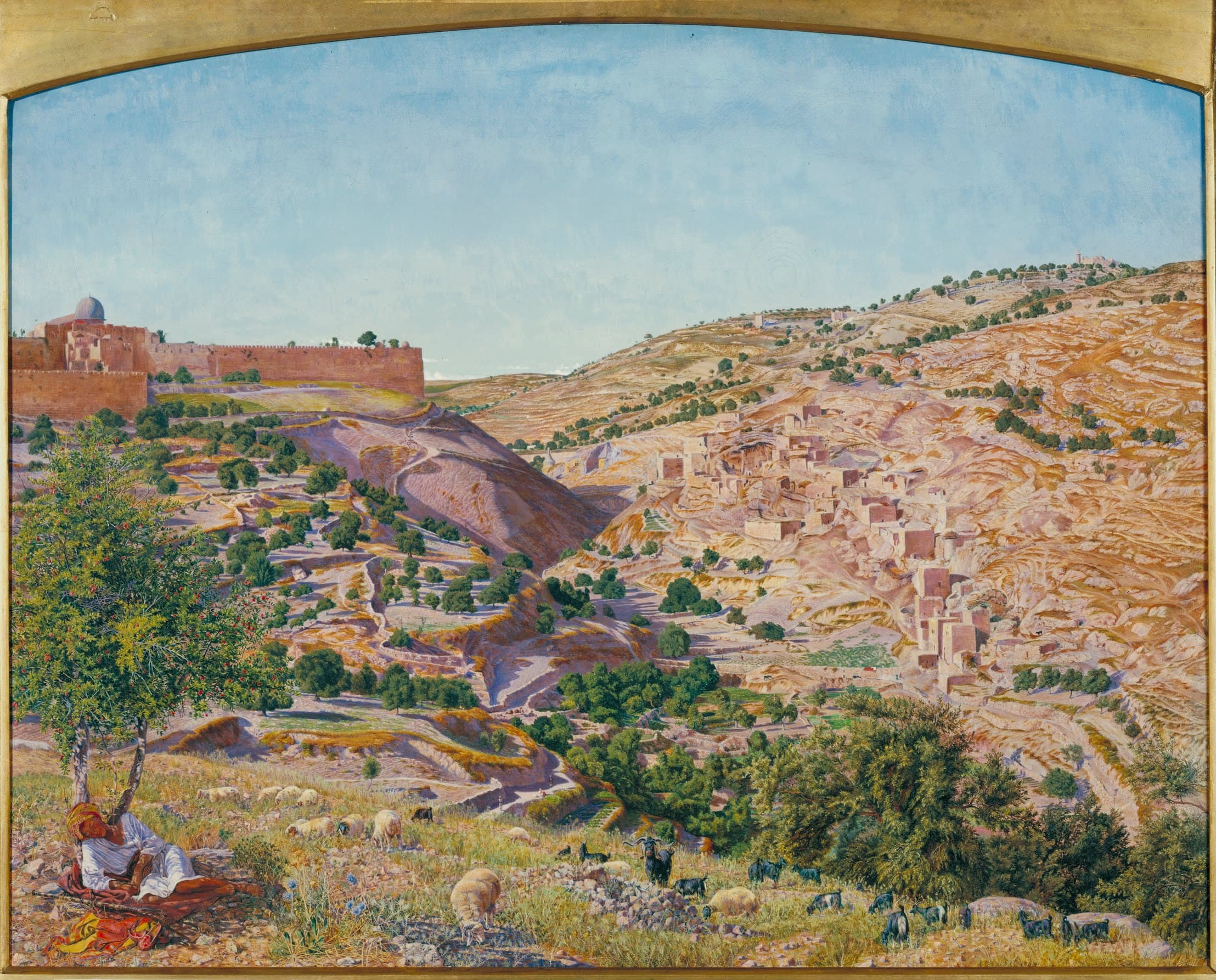
Thomas Seddon, Jerusalem and the Valley of Jehoshaphat from the Hill of Evil Counsel, about 1854, Tate, London. Public domain, via Wikimedia Commons.
THE ARTWORKThomas Seddon painted the Kidron valley from the hill south of the city, with the walls above the old ridge and the village of Siloam across the valley.
Joshua killed the king of Jerusalem, yet the city stayed in Jebusite hands until David's men took its fortress.
Summary
Before Israel came, Jerusalem was a Canaanite city of the hill country, and Scripture names two of its kings.
- Melchizedek was king of Salem in the days of Abram, and Adoni-zedek was king of Jerusalem when Joshua took Ai.
- The border between Judah and Benjamin ran along the Valley of Hinnom below the city, and Jebus fell in Benjamin's share.
- In the days of the judges the city was still foreign ground, and a Levite would not stop there for the night.
- David took the fortress of Zion and later bought the threshing floor of Araunah the Jebusite, where Solomon built the temple.
The Jebusites Who Stayed
Joshua and Judges each end the account of a tribe's share with the Jebusites still living in the city.
But the descendants of Judah could not drive out the Jebusites living in Jerusalem. So to this day the Jebusites live there among the descendants of Judah.The account of Judah's cities closes on the one city the tribe could not take.
The Benjamites, however, failed to drive out the Jebusites living in Jerusalem. So to this day the Jebusites live there among the Benjamites.Judges repeats the failure for Benjamin, whose allotment held the city.
Judah or BenjaminJoshua 15:63 and Judges 1:21
Albert Barnes, in his Notes on the Old Testament, thinks Judges 1:21 first read Judah, and that a later hand wrote Benjamin because Jebus lay inside Benjamin's border.
Adam Clarke, in his Commentary on the Bible, places Jerusalem on the frontier of Judah and Benjamin and gives each tribe a part of it.
Why they could notJoshua 15:63
John Wesley, in his Explanatory Notes upon the Old Testament, finds the cause in the people's unbelief, sloth and cowardice, and compares the Gospels, where Christ did few mighty works because of unbelief.
John Gill, in his Exposition of the Old Testament, points to the strength of the place, since neither tribe alone nor both together could drive the Jebusites from it.
Jebus Among the Hill Cities
Hebron and Lachish answered the call of Jerusalem's king, and the Levite of Judges 19 passed the city on his way north.
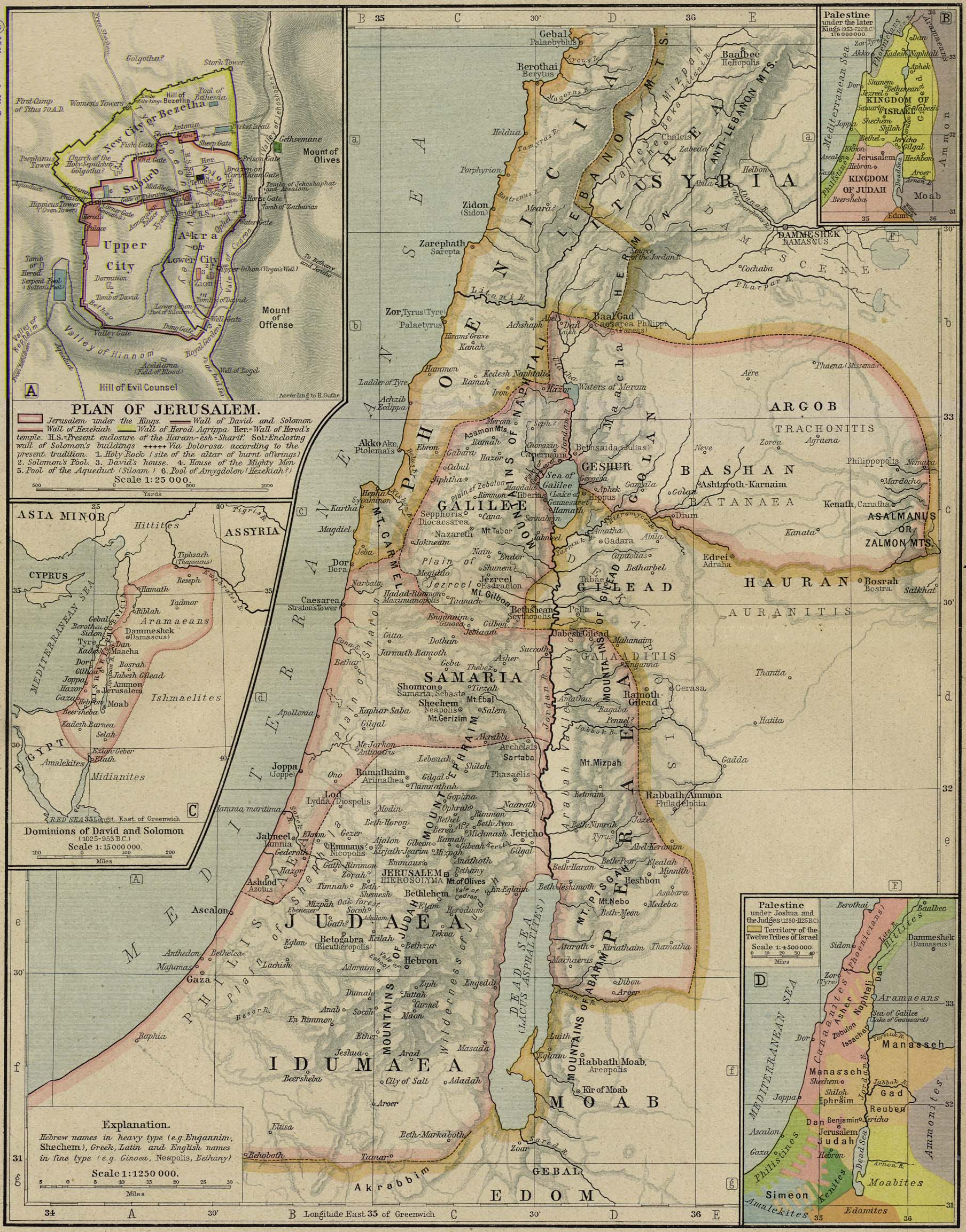
about 50 km (31 miles)
- 1Jerusalem, Its king sent from here to call the southern kings to arms. Joshua 10:3
- 2Hebron, Its king Hoham joined the march on Gibeon. Joshua 10:3
- 3Lachish, Its king Japhia marched with them. Joshua 10:3
- 4Bethlehem, The Levite left it late in the day and came opposite Jebus. Judges 19:10
- 5Gibeah, The Levite went on to lodge among Israelites. Judges 19:12
Base map: Reference map of ancient Palestine, Rand McNally reference map (1926), public domain. Each place stands at its place page's coordinates, set on the plate by Jerusalem and Damascus, as the plate prints them.
Five places with their verses: Jerusalem, two cities of Adoni-zedek's league, and the two towns of the Levite's road in Judges 19.
The City from Abram to Solomon
Eight events trace the city from Melchizedek's meeting with Abram to the temple on the Jebusite's threshing floor.
The Jebusites kept the city through the days of the judges, and Israel held it from the reign of David.
- The days of AbramMelchizedek king of Salem brings out bread and wine to AbramGenesis 14:18
- The reign of Akhenaten, by Petrie's datingAbdi-Heba writes to the king of Egypt from Urusalim
- Joshua's southern warAdoni-zedek leads five kings against Gibeon and dies at Joshua's handJoshua 10:26
- After Joshua's deathThe men of Judah take Jerusalem and set it on fireJudges 1:8
- The days of the judgesA Levite refuses to lodge in Jebus, a city of foreignersJudges 19:12
- David's first years over all IsraelDavid captures the fortress of Zion2 Samuel 5:7
- Late in David's reignDavid buys the threshing floor of Araunah the Jebusite2 Samuel 24:24
- Solomon's reignSolomon builds the temple on that threshing floor2 Chronicles 3:1
Eight events in order, seven with their verse and one from the Amarna letters.
Adoni-zedek and the five kingsJoshua 10:1 to 5 and Joshua 10:23 to 26
Now Adoni-zedek king of Jerusalem heard that Joshua had captured Ai and devoted it to destruction—doing to Ai and its king as he had done to Jericho and its king—and that the people of Gibeon had made peace with Israel and were living near them.This is the first verse of Scripture to name Jerusalem, and its king's alarm begins the southern war.
Albert Barnes reads the name Adoni-zedek as lord of righteousness, sets it beside Melchizedek, king of righteousness, and takes it as probably an official title of the Jebusite kings.
After this, Joshua struck down and killed the kings, and he hung their bodies on five trees and left them there until evening.The king died outside his city, and Joshua 10 records no siege of Jerusalem among the cities taken after the battle.
The city burned and the city keptJudges 1:8 and Judges 19:12
Then the men of Judah fought against Jerusalem and captured it. They put the city to the sword and set it on fire.Judah burned the city after Joshua's death, and Judges 1:21 still finds Jebusites living there.
Adam Clarke suggests that the burning touched the lower city, and that the Jebusites kept the fortress on Mount Zion until David took it.
But his master replied, “We will not turn aside to the city of foreigners, where there are no Israelites. We will go on to Gibeah.”His words show that no Israelites lived in Jebus at the time.
Albert Barnes reads the phrase as proof that the Jebusites had shut out Judah and Benjamin completely.
Three Verses on the Jebusites
Three verses outside the main accounts place the Jebusites in the hills, count their king among the defeated and name the city's Canaanite birth.
THE JEBUSITES LIVED IN THE HILL COUNTRY
The spies reported the Jebusites in the hill country with the Hittites and Amorites. Jabin of Hazor later sent to them in the same hills when he gathered his kings against Joshua.
THE KING OF JERUSALEM IS COUNTED ONCE
The list of the thirty-one kings Joshua defeated counts the king of Jerusalem right after the kings of Jericho and Ai.
EZEKIEL NAMES THE CITY'S CANAANITE BIRTH
The LORD tells Jerusalem through Ezekiel that her origin was in the land of the Canaanites, with an Amorite father and a Hittite mother.
The Border Along the Valley of Hinnom
Joshua 15 and 18 trace the same valley twice, once as Judah's northern edge and once as Benjamin's southern edge.
From there the border went up the Valley of Hinnom along the southern slope of the Jebusites (that is, Jerusalem) and ascended to the top of the hill that faces the Valley of Hinnom on the west, at the northern end of the Valley of Rephaim.Judah's northern border passes the southern slope of the Jebusite city, so the city lay just outside Judah.
Zelah, Haeleph, Jebus (that is, Jerusalem), Gibeah, and Kiriath-jearim—fourteen cities, along with their villages. This was the inheritance of the clans of the tribe of Benjamin.Benjamin's list of cities names Jebus and explains the old name by the new one.
Who Hinnom wasJoshua 15:8 and Joshua 18:16
Then it went down to the foot of the hill that faces the Valley of Hinnom at the northern end of the Valley of Rephaim and ran down the Valley of Hinnom toward the southern slope of the Jebusites and downward to En-rogel.Benjamin's southern border runs down the same valley in the opposite direction, toward En-rogel.
Adam Clarke writes that no one knows who Hinnom was or why the valley bore his name. John Gill reports that Jerome placed the valley to the east of Jerusalem and that the Dutch scholar Reland placed it rather to the south.
Jebusi, the name in the border listsSmith's Dictionary of the Bible, 1863
William Smith's Dictionary of the Bible notes that the border lists alone call the city Jebusi, the Jebusite, naming the town by its people. The same list names other towns the same way, as Zemaraim and Avim.
Jerusalem in the Written Record
Letters to Egypt, the history of Josephus and the explorers of 1867 each add to what Scripture records of the city.
| Name | Where it stands | What the name tells |
|---|---|---|
| Salem | Genesis 14:18 and Psalm 76:2 | Hebrews 7:2 takes it to mean peace |
| Urusalim | Petrie, 1898, letters 233 and 234 | The form the Amarna tablets give in cuneiform |
| Jerusalem | Joshua 10:1 and throughout | Barnes reads it as foundation of peace |
| Jebusi, the Jebusite | The border lists of Joshua 15:8 and Joshua 18:16 | The city called after its people |
| Jebus | Judges 19:10 to 11 and 1 Chronicles 11:4 to 5 | Smith counts it only twice in Scripture |
| The fortress of Zion | 2 Samuel 5:7 and 1 Chronicles 11:5 | The Jebusite stronghold on the ridge |
| The City of David | 2 Samuel 5:9 and 1 Chronicles 11:7 | The name David gave the fortress |
Abdi-Heba's letters from UrusalimPetrie, Syria and Egypt from the Tell el Amarna Letters, 1898
Among the clay letters found at Tell el Amarna in Egypt are several from Abdi-Heba, whom Flinders Petrie calls Abdkhiba, king of Urusalim. Petrie's summaries have him protest that he was set up by the king of Egypt and was no hereditary chief, and beg for troops before the Khabiri took the land.
Petrie judged from these letters that Jerusalem had been the capital of the south from early times, and he dated the letters he could fix between about 1379 and 1366 BC by his own reckoning.
Josephus on the siegeAntiquities of the Jews 7.3.1 to 3
He adds that Araunah, a wealthy Jebusite, was spared in the siege for his good will toward the Hebrews and toward David.
Warren's shaft at the Virgin's FountWarren, The Recovery of Jerusalem, 1871
In October 1867 Charles Warren's party cleared a passage from the spring called the Virgin's Fount and reached the bottom of a shaft cut in the rock. Warren judged it at least 40 feet high, and he climbed it on scaffolding with Sergeant Birtles.
What the Text Leaves Unsaid
Scripture names no Jebusite king after Adoni-zedek and gives no measure of the city.
Between Judges 1:8 and David's siege the record passes over the city, apart from the Levite's evening on the road outside it. Adam Clarke says it is unknown how the Jebusites got possession again by David's day.
David took the head of the Philistine and brought it to Jerusalem, and he put Goliath’s weapons in his own tent.Clarke reads this verse as a sign that Israel held at least part of the city in Saul's time.
Where Scripture Returns to Salem and the Threshing Floor
A psalm keeps the old name Salem, Hebrews reads its meaning, and the Jebusite's floor became the place of the altar.
His tent is in Salem, His dwelling place in Zion.The old name of Melchizedek's day survives in Israel's worship, set in parallel with Zion.
and Abraham apportioned to him a tenth of everything. First, his name means “king of righteousness.” Then also, “king of Salem” means “king of peace.”Hebrews reads Melchizedek's title as king of peace and builds its account of Christ's priesthood on it.
The threshing floor bought at a price2 Samuel 24:16 to 25
But when the angel stretched out his hand to destroy Jerusalem, the LORD relented from the calamity and said to the angel who was destroying the people, “Enough! Withdraw your hand now!” At that time the angel of the LORD was by the threshing floor of Araunah the Jebusite.The plague stopped at the threshing floor of a Jebusite who still lived beside the city.
“No,” replied the king, “I insist on paying a price, for I will not offer to the LORD my God burnt offerings that cost me nothing.” So David bought the threshing floor and the oxen for fifty shekels of silver.The ground of the later temple passed from a Jebusite to David by sale.
Jamieson, Fausset and Brown take the silver of 2 Samuel as the cost of the oxen, the wooden tools and the place where they stood. They take the six hundred shekels of gold in 1 Chronicles 21:25 as the price paid later for the whole hill.
Caesarius of Arles reads the choice of the place for the Gentiles.
“Notice, brothers, that no place in the land of the Jews was found worthy for the altar of the Lord to be built; but in the land of the Gentiles a place is chosen where the angel is seen and the altar of the Lord …”
Caesarius of Arles · SERMON 122.1 · on 2 Samuel 24:18 to 21Patristic
Araunah the Jebusite2 Samuel 24:18 and 2 Chronicles 3:1
Then Solomon began to build the house of the LORD in Jerusalem on Mount Moriah, where the LORD had appeared to his father David. This was the place that David had prepared on the threshing floor of Ornan the Jebusite.Chronicles joins the Jebusite's floor to Moriah, the land where Abraham was sent to offer Isaac.
Jamieson, Fausset and Brown suppose that Araunah had turned to the worship of the LORD and so kept his house and land, and they place him on Mount Moriah outside the town of that day.
Three Voices on the City
Jerome, Matthew Henry and Charles Spurgeon read the names Salem and Zion.
Jerome traces the city through its three names and ties the first to Melchizedek.
“And his place was made in peace: which in Hebrew is said ‘in Salem.’ So it seems, according to the letter, to speak of Jerusalem, that is, Salem, which formerly was called Salem, and afterward Jebus, and then was called Jerusalem. This is that Salem in which Melchizedek was king. We read, ‘Thou art a priest for ever after the order of Melchizedek.’ He did not say, after the order of Aaron, but of Melchizedek. What did he mean to say, Thou art a priest for ever after the order of Melchizedek?”
Jerome · Homily 9, on Psalm 75 · on Psalm 76:2Patristic
Matthew Henry reads David's capture of the fortress as a picture of Christ taking His church.
“The church is called Sion, and the city of the living God. The Jebusites, Christ's enemies, must first be conquered and dispossessed, the blind and the lame taken away, and then Christ divides the spoil, sets up his throne there, and makes it his residence by the Spirit.”
Matthew Henry · Commentary on the Whole Bible · on 2 Samuel 5:9Puritan
Charles Spurgeon reads Salem as the peaceful city where God has pitched His tent.
“In Salem also is his tabernacle. In the peaceful city he dwells, and the peace is perpetuated, because there his sacred tent is pitched. The church of God is the place where the Lord abides and he is to her the Lord and giver of peace. And his dwelling place in Zion. Upon the chosen hill was the palace of Israel's Lord. It is the glory of the church that the Redeemer inhabits her by his Holy Spirit. Vain are the assaults of the enemy, for they attack not us alone, but the Lord himself.”
Charles Spurgeon · The Treasury of David, Vol. 3 · on Psalm 76:2
Salem, the Water Shaft and the Fortress
Readers dispute whether Melchizedek's Salem was Jerusalem, what Joab climbed and where the fortress stood.
Was Salem Jerusalem?Genesis 14:18 and Psalm 76:2
Josephus, in Antiquities 1.10.2, says that Salem was afterward called Jerusalem. Smith's Dictionary reports the same view in the Targum and in Jewish commentators down to Kalisch, on the ground of Psalm 76:2.
The objection: the same article judges that a poet's use of an old name proves no identity. It reports that Jerome, in his letter to Evangelus, placed Melchizedek's Salem near Scythopolis, eight Roman miles from that city, and it calls any identification uncertain.
The article also weighs the distance from Sodom, more than eighty miles to Jerome's Salem, as a point in favour of Jerusalem.
What did Joab climb?2 Samuel 5:8 and 1 Chronicles 11:6
Now David had said, “Whoever is the first to strike down a Jebusite will become chief commander.” And Joab son of Zeruiah went up first, and he became the chief.Chronicles names Joab as the first man up and supplies what 2 Samuel 5:8 leaves out.
W. F. Birch, in the Quarterly Statement of the Palestine Exploration Fund for 1878, took the tzinnor of 2 Samuel 5:8 as the passage Warren found above the spring. On his reading Joab went through the water channel and climbed the shaft into the fortress.
The objection: Josephus, writing long before Warren's find, has the soldiers cross the ditches beneath the citadel and climb up to it. John Wesley reads the gutter as the top of the fort, and Albert Barnes as a channel worn by water.
Where did the fortress of Zion stand?2 Samuel 5:7 and 2 Chronicles 32:30
Birch set the fortress of Jebus near the southern end of the narrow ridge between the Kidron and the valley west of it, above the spring.
It was Hezekiah who blocked the upper outlet of the Spring of Gihon and channeled it down to the west side of the City of David. And Hezekiah prospered in all that he did.This verse is the plainest text tying the old fortress to the spring below the ridge.
The objection: Albert Barnes took the ancient Zion as the hill on which the temple stood. Smith's Dictionary reports Ewald and Stanley placing Jebus on the southwestern hill, and judges that reading very doubtful.
Books on the City
All four of these works can be read free online.
Syria and Egypt from the Tell el Amarna Letters
W. M. Flinders Petrie · 1898
Petrie summarizes each letter of Abdi-Heba and dates the series by the reign of Akhenaten.
Read at archive.orgThe Recovery of Jerusalem
Charles Wilson and Charles Warren · 1871
Its chapter on the waters of Jerusalem prints Warren's own reports from the excavation.
Read at archive.orgA Dictionary of the Bible, volume 1, the articles Jebus and Jebusite
William Smith, editor · 1863
The articles gather what Scripture says of the city and its people under each name.
Read at archive.orgThe Antiquities of the Jews
Flavius Josephus, translated by William Whiston · 1737
Its seventh book recounts how David besieged the city and spared Araunah.
Read at gutenberg.orgThe City David Made His Own
The city Judah and Benjamin could not take became the seat of David's kingdom.
And David became greater and greater, for the LORD God of Hosts was with him.David's rise follows straight on the capture of the Jebusite fortress.
For the LORD has chosen Zion; He has desired it for His home:The stronghold taken from the Jebusites became the hill Israel's worship calls chosen.
Keep studying
Studies6
Places9
Symbols1
Doctrines1
Peoples and groups1