
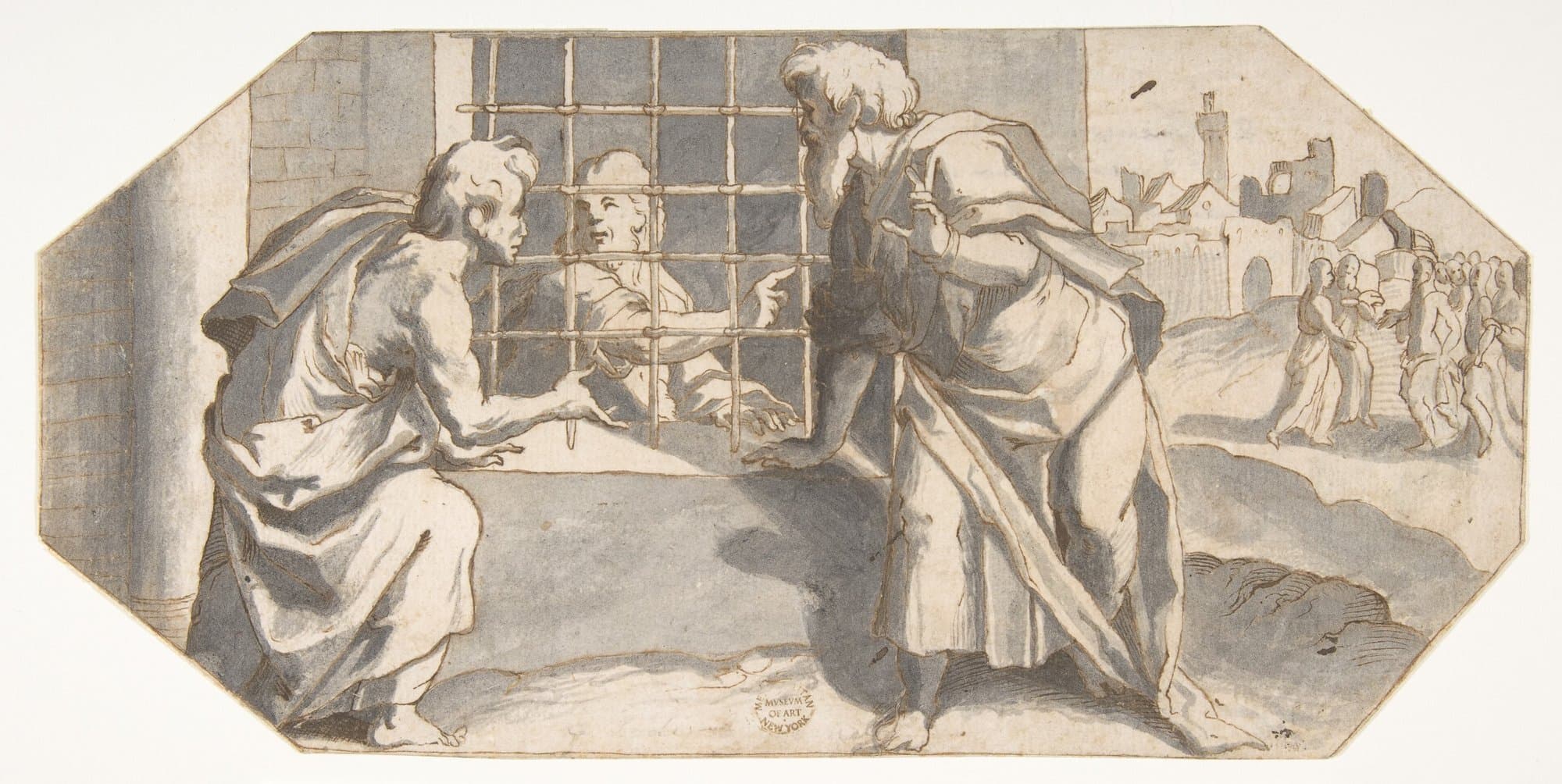
Matthew 11:2 to 6 · Story · Doubt
Are You the One Who Was to Come?
Matthew 11:2 to 19 tells of John's messengers, the reply Jesus sent from His works and His praise of John.
The prophet who baptized Jesus later questioned Him from a prison cell.
to ask Him, “Are You the One who was to come, or should we look for someone else?”
- Where
- Herod's prison, Machaerus in Josephus, Galilee
- Who
- John the Baptist, Jesus of Nazareth
- When
- While John was in prison under Herod (Matthew 11:2 and Matthew 14:3)
Summary
Herod Antipas had shut John the Baptist in prison for condemning his marriage to Herodias. There John heard of the works of Christ and sent his disciples with a question. Jesus gave them no title for Himself. He sent them back to report the healings and the preaching they had witnessed, works the prophet Isaiah had promised, and He blessed the one who does not stumble over Him. Then He praised John before the crowds.
- Matthew and Luke both tell the exchange, and Josephus names the fortress where John was held.
- John's title for the Messiah, the Coming One, is the word he had used of Jesus at the Jordan.
- Commentators since the fourth century have disagreed whether John asked for his own sake or for his disciples.
The Question from Prison
John had been in Herod's custody since the start of Jesus' ministry in Galilee.
Are You the One Who Was to Come? studies what John the Baptist asked Jesus from his cell and how Jesus answered him. John's question is one of the honest doubts the New Testament records, brought by a faithful man to Christ Himself, and Jesus met it with evidence and a blessing.
The question it answers is what John asked, how Jesus replied, and why a prophet who had pointed others to Jesus would ask at all. It sets the reply beside the prophecies of Isaiah it echoes, explains the title John used, and gives the three readings of John's motive with the teachers who hold each.
Herod had arrested John "on account of Herodias, his brother Philip’s wife", because John had been telling him, "It is not lawful for you to have her" (Matthew 14:3 to 4).
Matthew does not name the prison. Josephus names it in the eighteenth book of his Antiquities of the Jews, in William Whiston's translation. He writes that John "was sent a prisoner, out of Herod's suspicious temper, to Macherus, the castle I before mentioned, and was there put to death".
Meanwhile John heard in prison about the works of Christ, and he sent his disciplesMatthew places the question in the prison and ties it to what John heard of Christ's works, which are the works Jesus will name in His answer.
Luke tells the same exchange and adds, "At that very hour Jesus healed many people of their diseases, afflictions, and evil spirits, and He gave sight to many who were blind" (Luke 7:21).
The Works and the Prophet
Jesus' list of works echoes two chapters of Isaiah and goes past them.
Four of the six works Jesus named stand in Isaiah 35 and 61.
| The work in Matthew 11:5 | Isaiah's words |
|---|---|
| "The blind receive sight" | Isaiah 35:5, "Then the eyes of the blind will be opened and the ears of the deaf unstopped." |
| "the lame walk" | Isaiah 35:6, "Then the lame will leap like a deer and the mute tongue will shout for joy." |
| "the lepers are cleansed" | Neither Isaiah 35 nor Isaiah 61 names a leper. |
| "the deaf hear" | Isaiah 35:5, "the ears of the deaf unstopped" |
| "the dead are raised" | Neither Isaiah 35 nor Isaiah 61 names one raised from the dead. |
| "the good news is preached to the poor" | Isaiah 61:1, "The Spirit of the Lord GOD is on Me, because the LORD has anointed Me to preach good news to the poor." |
The Answer and the Blessing
Jesus sent the messengers back with what they had heard and seen and one beatitude.
Jesus replied, “Go back and report to John what you hear and see:Jesus answers a question about who He is by sending the messengers back as witnesses of what He does.
Blessed is the one who does not fall away on account of Me.”The beatitude closes the reply and speaks to anyone, John included, who finds Jesus other than he expected.
The verb rendered "fall away" is skandalizo, which Strong's defines as to entrap or trip up, and figuratively to stumble.
Matthew Henry, in his Commentary on the Whole Bible (1710), set the works beside "the words of the prophet" and added, "Faith, though confirmed by seeing, comes by hearing."
The One Who Was to Come
John's question uses the word he had used in his own preaching.
The Greek of Matthew 11:3 is ho erchomenos, the coming one, a present participle of erchomai, to come. John had used the same participle at the Jordan when he said, "after me will come One more powerful than I" (Matthew 3:11).
“Behold, I will send My messenger, who will prepare the way before Me. Then the Lord whom you seek will suddenly come to His temple—the Messenger of the covenant, in whom you delight—see, He is coming,” says the LORD of Hosts.Malachi promises a messenger who prepares the way and the Lord who comes after him, the order John had preached.
Psalm 118:26 blesses the one who comes: "Blessed is he who comes in the name of the LORD". Albert Barnes, in his Notes on Matthew 11:3, wrote that the Messiah "was familiarly described as “he that was to come.”"
More Than a Prophet
As the messengers left, Jesus spoke to the crowds about the man who had sent them.
Jesus asked the crowds three times what they had gone out into the wilderness to see. He offered a reed swaying in the wind, a man in fine clothes and a prophet, and answered, "Yes, I tell you, and more than a prophet" (Matthew 11:7 to 9).
Truly I tell you, among those born of women there has risen no one greater than John the Baptist. Yet even the least in the kingdom of heaven is greater than he.Jesus' highest praise of John comes in the same hour as John's question, so the question cost John none of his standing.
Why John Asked
Three readings of John's motive, each with its holders and the objection raised against it.
John asked for his disciples' sakeJohn Chrysostom, Hilary of Poitiers and John Charles Ryle
John Chrysostom, in his thirty-sixth homily on Matthew, wrote that "John's disciples were starting aside from Jesus" and "had always a jealous feeling towards Him", so John sent them to see for themselves. John Charles Ryle, in his Expository Thoughts on the Gospels (1856), wrote, "This question did not arise from doubt or unbelief on the part of John."
“It is indeed certain, that he who as forerunner proclaimed Christ's coming, as prophet knew Him when He stood before him, and worshipped Him as Confessor when He came to him, could not fall into error from such abundant knowledge. Nor can it be believed that the grace of the Holy Spirit failed him when thrown into prison, seeing He should hereafter minister the light of His power to the Apostles when they were in prison.”
Hilary of Poitiers · Catena Aurea by Aquinas · on Matthew 11:3Patristic
The objection is that Luke says John's disciples had already told him "about all these things" (Luke 7:18), and Jesus addressed His reply to John.
John himself wavered while his faith heldAdam Clarke and a reading Ambrose of Milan reports
Adam Clarke, in his Commentary on the Bible (1832), judged it "very probable that John now began, through the length of his confinement, to entertain doubts, relative to his kingdom".
Ambrose of Milan, as the Catena Aurea gives him on Luke 7:19, reported a reading in which John "doubted therefore though not in faith, yet in love".
The objection is that John had already told his own disciples, "He must increase; I must decrease" (John 3:30). Charles Spurgeon, preaching on Matthew 11:6 in 1878, hardly thought John was "under a fainting fit of unbelief".
John asked whether Christ would go down to the deadJerome and Gregory the Dialogist
Jerome, in his Letter 121, read John's question as asking whether Christ too would descend into hell, where John himself was soon to go. Gregory the Dialogist took the same line in his sixth homily on the Gospels. He held that John asked "in order to know whether he who had come into the world by himself would also descend by himself to the prison of hell".
The objection is that John's question asks whether to look for someone else and says nothing of the dead (Matthew 11:3).
Brought to the One He Asked About
John took his uncertainty to Jesus, and Jesus answered it with what He was doing.
Whatever moved the question, it went to the right person, and the reply came as works to be weighed and a blessing to be kept. A reader in doubt may do the same and bring the question to Christ in prayer and in the reading of what He has done. Where doubt comes with depression or with fears that will not leave, a physician or a counsellor is sought beside prayer and never in its place.
Sources
Scripture is the Berean Standard Bible.
- STEP Bible, Translators Amalgamated Greek New Testament, the tagged Greek text (Tyndale House, Cambridge), CC BY 4.0.
- STEP Bible TBESG lexicon of Extended Strongs for Greek (Tyndale House, Cambridge), CC BY 4.0, with the definitions of James Strong, Strong's Exhaustive Concordance of the Bible (1890)
- Flavius Josephus, Antiquities of the Jews, translated by William Whiston (1737), Project Gutenberg ebook 2848.
- John Chrysostom, Homilies on the Gospel of Matthew, Homily 36, on Matthew 11:2 to 6 (Nicene and Post-Nicene Fathers, first series, volume 10)
- Thomas Aquinas, Catena Aurea on the Gospels (English translation, Oxford, 1841 to 1845), printing Hilary of Poitiers on Matthew 11:3 and Ambrose of Milan on Luke 7:19.
- J. C. Ryle, Expository Thoughts on the Gospels: Matthew (1856), on Matthew 11:1 to 15.
- Adam Clarke, Commentary on the Bible (1832), on Matthew 11:3.
- Charles Spurgeon, The Metropolitan Tabernacle Pulpit, Sermon 1398, "Offended Because of Christ?" (1878)
- Jerome, Letter 121, to Algasia, chapter 1.
- Gregory the Dialogist (Gregory the Great), Forty Gospel Homilies, Homily 6.
- Matthew Henry, Commentary on the Whole Bible (1710), on Matthew 11:4 to 6.
- Albert Barnes, Notes, Explanatory and Practical, on the Old and New Testaments (1832 to 1869), on Matthew 11:3.
Keep Studying
Read it4
In this trial5
People and groups15