
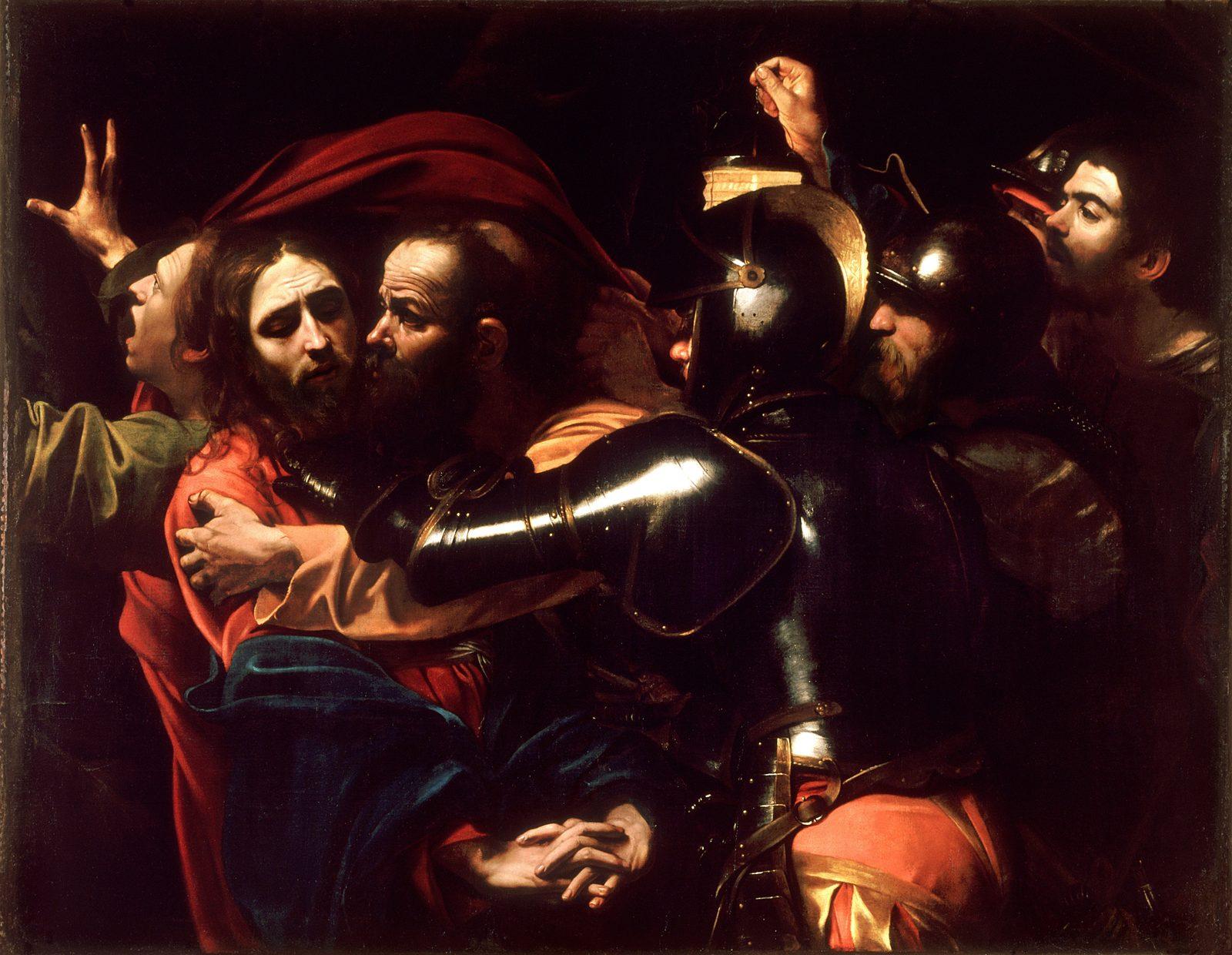
Caravaggio, The Taking of Christ, about 1602. Public domain.
Zechariah 13:7 to 9 · Subject · Featured Study
Strike the Shepherd, and the Sheep Will Be Scattered
In Zechariah 13:7 the LORD calls a sword against His own shepherd, the man He names His Companion.
Awake, O sword, against My Shepherd, against the man who is My Companion, declares the LORD of Hosts. Strike the Shepherd, and the sheep will be scattered, and I will turn My hand against the little ones.
- Books
- Zechariah, Matthew, Mark
- Hold in memory
- Zechariah 13:7
On the night He was betrayed, Jesus told His disciples they would all fall away, and gave the prophet's words as the reason.
Summary
Zechariah 13 closes with a short poem. The flock scatters, two parts of the land perish, and a third is refined and called the LORD's people.
- Two other shepherds stand in Zechariah 11, one paid and one worthless.
- The disciples fled from the garden the same night.
- Readers differ on when the third part is brought through the fire.
The Poem of the Sword
The poem closes Zechariah 13 with a sword, a scattered flock and a refined remnant.
And in all the land, declares the LORD, two-thirds will be cut off and perish, but a third will be left in it.The second verse moves from the shepherd to the people.
This third I will bring through the fire; I will refine them like silver and test them like gold. They will call on My name, and I will answer them. I will say, ‘They are My people,’ and they will say, ‘The LORD is our God.’”Readers have set this verse in different times, as the readings below show.
Three Shepherds in Zechariah
Zechariah 11 and 13 name a shepherd paid off, a worthless shepherd and the LORD's own Shepherd.
The three shepherds stand within three chapters of each other.
| Shepherd | What the text says | Verse |
|---|---|---|
| The shepherd of the flock marked for slaughter | He is paid thirty pieces of silver and throws them to the potter. | Zechariah 11:12 to 13 |
| The worthless shepherd | He deserts the flock, and the prophet calls for a sword on his arm and his right eye. | Zechariah 11:17 |
| My Shepherd, My Companion | The LORD's sword strikes him, and the sheep are scattered. | Zechariah 13:7 |
Jamieson, Fausset and Brown render the man who is My Companion literally as the man of my union. John Wesley read the phrase as Christ, man with us and God with His Father.
This Very Night
Mark gives the quotation and the promise that follows it, as Matthew 26:31 to 32 does.
Then Jesus said to them, “You will all fall away, for it is written: ‘I will strike the Shepherd, and the sheep will be scattered.’ But after I have risen, I will go ahead of you into Galilee.”Jesus adds His rising to the prophet's words.
Then everyone deserted Him and fled.The verse shows the quotation coming true the same night.
In Zechariah the LORD says Strike the Shepherd, and in the Gospels Jesus says I will strike the Shepherd. Jerome noted that the Gospel gives the words differently from the prophet.
Justin Martyr made the verse part of his case to Trypho that the prophets foretold the suffering of Christ.
“Moreover, the prophet Zechariah foretold that this same Christ would be smitten, and His disciples scattered: which also took place. For after His crucifixion, the disciples that accompanied Him were dispersed, until He rose from the dead, and persuaded them that so it had been prophesied concerning Him, that He would suffer; and being thus persuaded, they went into all the world, and taught these truths. Hence also we are strong in His faith and doctrine, since we have [this our] persuasion both from the prophets, and from those who throughout the world are seen to be worshippers of God in the name of that crucified One. The following is said, too, by Zechariah: ‘O sword, rise up against My Shepherd, and against the man of My people, saith the Lord of hosts. Smite the Shepherd, and His flock shall be scattered.’”
Justin Martyr · Dialogue with Trypho, Chapter LIII · on Zechariah 13:7Patristic
Spurgeon on the Struck Shepherd
Spurgeon preached on the verse in his sermon The Storm and the Shower.
He said he was sure he understood the passage, because the Lord Jesus Christ had applied it to Himself.
The Third Through the Fire
Commentators have read the cutting off and the refining of Zechariah 13:8 to 9 in three ways.
The Roman war, with the believers sparedAdam Clarke, Commentary on the Bible (1832), on Zechariah 13:8
Clarke read the two parts cut off as the war with the Romans. He held that those who believed on Jesus were kept alive and that none of them perished in the siege.
The trials of the churchMatthew Henry, Commentary on the Whole Bible (1710), on Zechariah 13:9
Henry wrote that the Christians of Judea fled to Pella beyond the Jordan when Jerusalem fell. He read the verse as the trials and then the triumphs of the church and all its faithful members.
An hour of trial still to comeJohn Gill, Exposition of the Old Testament (1748 to 1763), on Zechariah 13:9
Gill cited the Targum and Kimchi for the fire as great distress. He read it as the hour of temptation of Revelation 3, in a church age still ahead of him.
The Good Shepherd Lays Down His Life
John 10 gives the shepherd's death as a choice the shepherd makes.
I am the good shepherd. The good shepherd lays down His life for the sheep.Jesus speaks here as the shepherd Himself.
Sources
Scripture is the Berean Standard Bible.
- John Wesley, Explanatory Notes upon the Old Testament (1765), on Zechariah 13:7; Jamieson, Fausset and Brown, Commentary Critical and Explanatory on the Whole Bible (1871), on Zechariah 13:7; Justin Martyr, Dialogue with Trypho 53; Jerome, Commentary on Matthew, on Matthew 26:31; Charles Spurgeon, Metropolitan Tabernacle Pulpit, Sermon 3088, The Storm and the Shower.
- Adam Clarke, Commentary on the Bible (1832), on Zechariah 13:8; Matthew Henry, Commentary on the Whole Bible (1710), on Zechariah 13:9; John Gill, Exposition of the Old Testament (1748 to 1763), on Zechariah 13:9.
Keep Studying
People and groups1
Doctrines1
Go further7