
Luke 2 · Story · Death and Dying
Simeon: Now Dismiss Your Servant
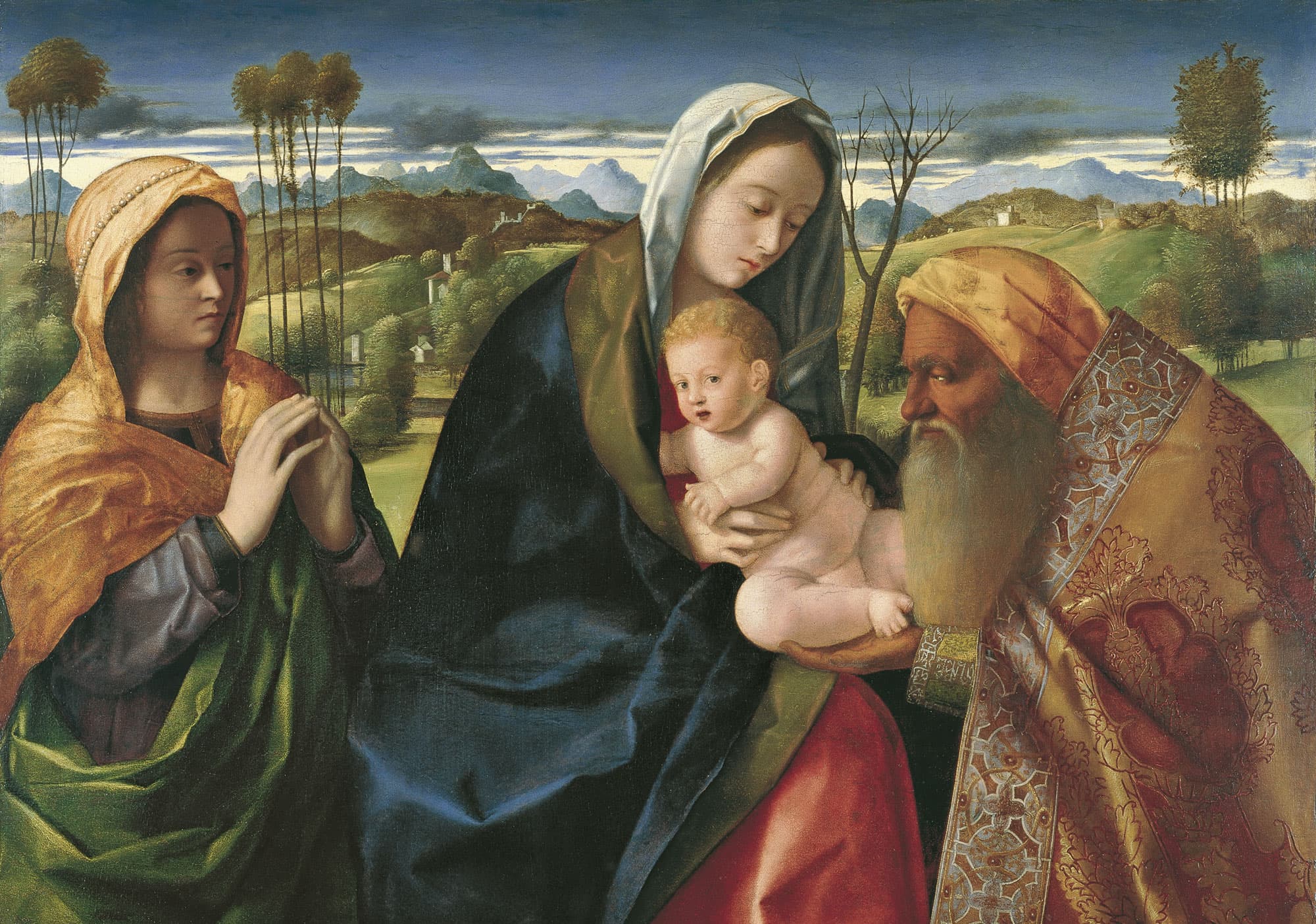
Luke 2:25 to 35 tells of Simeon, the first of two witnesses whom Luke sets beside the infant Jesus, before Anna.
Simeon took a child of a few weeks in his arms and called what he saw the salvation God had prepared for every people.
“Sovereign Lord, as You have promised, You now dismiss Your servant in peace.
- Where
- Jerusalem, The Temple
- Who
- Simeon, Mary, Mother of Jesus, Joseph of Nazareth, Anna
Summary
Simeon appears once in Scripture. The Holy Spirit had told him that he would live to see the Lord's Christ, and the song he spoke when he saw Him has been sung in the church's evening prayer. Luke sets his song beside the songs of Mary and Zechariah in the first two chapters of his Gospel.
- Before the scene begins, Luke calls Simeon righteous and devout and says that the Holy Spirit was upon him (Luke 2:25).
- Simeon's song (Luke 2:29 to 32) takes up the light for the nations promised to the Servant in Isaiah 49:6.
- Simeon also warned Mary that her child would divide Israel and that grief would reach her own soul (Luke 2:34 to 35).
- Luke gives no age, office or family for Simeon and does not record his death.
A Man Ready to Die
The story stands in the temple courts at Jerusalem in the first weeks of Jesus' life.
Simeon's story belongs to death and dying, the trial every person faces, because he spoke of his own death in peace once God had kept His promise to him.
The question it answers is what made Simeon ready to die. It is written for a reader who fears death or sits beside someone near it. The story sets his day on a timeline and tells each scene with its verses. It reads the words of his prayer and the passages of Isaiah behind his song, gives the song's place in the church's evening prayer, and names what Luke leaves unsaid and what readers dispute.
Simeon's Day in Eight Events
Luke tells the events of one visit to the temple, from the parents' arrival to Anna's thanks.
Simeon's part in the presentation of Jesus runs from his waiting in Jerusalem to his word to Mary, and Anna closes the scene.
- Joseph and Mary bring the child to the temple"His parents brought Him to Jerusalem to present Him to the Lord"Luke 2:22
- Simeon waits in Jerusalem"He was waiting for the consolation of Israel"Luke 2:25
- The Spirit leads Simeon into the temple courts"Led by the Spirit, he went into the temple courts."Luke 2:27
- Simeon takes the child and blesses God"Simeon took Him in his arms and blessed God"Luke 2:28
- Simeon gives thanks for what he has seen"For my eyes have seen Your salvation"Luke 2:30
- The parents marvel at his words"The Child’s father and mother were amazed"Luke 2:33
- Simeon speaks to Mary of a sword"a sword will pierce your soul as well."Luke 2:35
- Anna comes forward and gives thanks"Coming forward at that moment, she gave thanks to God"Luke 2:38
Eight events of Luke 2:22 to 38, in the order Luke tells them.
Simeon speaks to Mary of a sword, Anna comes forward and gives thanks
The Story Told in Order
Luke tells six scenes in eighteen verses, and each scene gives what was said and done.
The parents came to do what the Law asked for a firstborn sonLuke 2:21 to 24
Jesus was circumcised and named on the eighth day (Luke 2:21). When the days of purification were complete, Joseph and Mary went up to consecrate their firstborn son and to bring the offering the Law required (Luke 2:22 to 24).
But if she cannot afford a lamb, she shall bring two turtledoves or two young pigeons, one for a burnt offering and the other for a sin offering. Then the priest will make atonement for her, and she will be clean.’”The Law names this offering for a mother who cannot afford a lamb, so the scene places the family among the poor of Israel.
The Spirit had promised Simeon a sight before his deathLuke 2:25 to 26
Luke introduces Simeon by his city, his character and the Spirit upon him (Luke 2:25).
The Holy Spirit had revealed to him that he would not see death before he had seen the Lord’s Christ.This promise set the limit of Simeon's life, so that seeing the Christ and being free to die belonged together.
Simeon came in at the hour the child arrivedLuke 2:27 to 28
Simeon entered at the same time as the parents came to do for the child what was customary under the Law (Luke 2:27). The same Spirit who had given the promise brought him to the place where it was kept.
Simeon's song is the last of the songs in Luke's opening chaptersLuke 2:29 to 32
Simeon's words to God run from his own release in Luke 2:29 to "a light for revelation to the Gentiles, and for glory to Your people Israel" in Luke 2:32.
Mary, Zechariah and the angels sing the three songs before it (Luke 1:46 to 55, Luke 1:68 to 79 and Luke 2:14).
He blessed the parents and warned MaryLuke 2:33 to 35
Joseph and Mary marvelled at what was said about their son (Luke 2:33).
Then Simeon blessed them and said to His mother Mary: “Behold, this Child is appointed to cause the rise and fall of many in Israel, and to be a sign that will be spoken against,Simeon's blessing carries a warning that the child would divide Israel, so the salvation he praised would be refused by many.
He ended with a word to Mary alone (Luke 2:35).
What Simeon Said of His Own Death
Simeon's first sentence to God speaks of release, a master and a servant.
The verb of Luke 2:29 is apolyo, which the STEP Bible's Brief lexicon defines as to free fully, to release or dismiss, and in a figure to let die. Luke writes it in the present tense, so Simeon speaks of a release God is granting as he speaks.
Simeon calls God despotes, a master or absolute ruler, and himself doulos, a servant. A servant does not leave his post until his master lets him go, and Simeon says that his master is letting him go now.
Adam Clarke, in his Commentary on the Bible, read the verb as loosing Simeon from life. He wrote, "Though Simeon means his death, yet the thing itself is not mentioned". He gave as the reason that death has lost its sting and its name "to those who have, even by faith, seen the Lord’s anointed."
The Consolation of Israel
Simeon's hope and the words of his song come from Israel's Scriptures.
John Wesley, in his Explanatory Notes upon the New Testament (1755), explained the consolation of Israel as "A common phrase for the Messiah". Simeon's waiting is the hope that waits for God's help before it comes.
The cross references of OpenBible.info, ranked by readers' votes, set Isaiah 49:6 beside Luke 2:30 and Luke 2:32. John Gill, in his Exposition of the New Testament (1746 to 1748), heard Isaiah 42 in the light to the Gentiles of Luke 2:32.
He says: “It is not enough for You to be My Servant, to raise up the tribes of Jacob, and to restore the protected ones of Israel. I will also make You a light for the nations, to bring My salvation to the ends of the earth.”Its light for the nations stands behind Simeon's words in Luke 2:32, "a light for revelation to the Gentiles".
Bonaventure, in his Commentary on Luke, tied Simeon's words about all people to Isaiah 52.
The LORD has bared His holy arm in the sight of all the nations; all the ends of the earth will see the salvation of our God.Its words "in the sight of all the nations" stand close to Luke 2:31, "in the sight of all people".
The same cross references set beside Simeon's prayer the words of Jacob when he saw Joseph alive in Egypt: "Finally I can die, now that I have seen your face" (Genesis 46:30). Both men speak of dying once their eyes have seen the one they longed to see.
The Song in the Church's Evening Prayer
Two works record Simeon's words in the church's prayer at the end of the day.
Book 7, chapter 48 of the Apostolic Constitutions gives Simeon's words in full in its evening prayer. James Donaldson's translation of it stands in the Ante-Nicene Fathers, volume 7 (1886).
Hugh Henry's article on the Nunc Dimittis in The Catholic Encyclopedia, volume 11 (1911), records that "In the Roman Office, the canticle is assigned to Complin". The same article gives the canticle a prominent place in the blessing of the candles on the feast of the Purification of the Blessed Virgin, which it calls Candlemas.
What Luke Leaves Unsaid
Luke leaves Simeon's age, his office and his death untold.
Luke gives Anna's father, her tribe, her years of marriage and her widowhood (Luke 2:36 to 37), and he gives no age for Simeon.
Luke records no office or family for Simeon. Albert Barnes, in his Notes, Explanatory and Practical (1832 to 1869), reports the guess that he was a son of the teacher Hillel. Barnes answers that "nothing is certainly known of him but what is here related."
Luke does not record Simeon's death or say how long he lived after that day.
Teachers on a Peaceful Departure
Origen and Bede wrote on Simeon's words of peace in Luke 2:29.
died 735 · Bede
Bede, in On the Gospel of Luke, read Simeon's words as proof that the just of the Old Testament also "had the desire of future life in hope".
died 1274 · Thomas Aquinas
Origen, as gathered in Thomas Aquinas's Catena Aurea, asked who departs from this world in peace, and answered that it is the one "who has nothing hostile to God".
What Readers Ask of Simeon
Commentators have read Simeon and his words in three ways.
Simeon was an old man near deathJamieson, Fausset and Brown, Commentary Critical and Explanatory on the Whole Bible (1871), on Luke 2:26
Jamieson, Fausset and Brown wrote, "He was, probably, by this time, advanced in years." Barnes also calls him "an aged man".
Simeon asked God to let him dieCosmas Indicopleustes, The Christian Topography, book 8
Cosmas wrote that Simeon "prayed God to be allowed to depart from this life".
Simeon's words describe the believer's deathCharles Spurgeon, Simeon's Swan Song, Sermon No. 2293
Spurgeon preached, "See what death is to the Believer. It is only a departure! It is a departure after a day of service."
Ready Because He Had Seen
Simeon's peace in the face of death came from what he had seen.
Sources
Scripture is the Berean Standard Bible.
- STEP Bible TAGNT and TBESG, Tyndale House, CC BY 4.0, the Brief lexicon based on Abbott-Smith (1922)
- OpenBible.info cross references, ranked by votes.
- Adam Clarke, Commentary on the Bible.
- John Wesley, Explanatory Notes upon the New Testament (1755)
- John Gill, Exposition of the New Testament (1746 to 1748)
- Bonaventure, Commentary on Luke, chapter 2.
- Apostolic Constitutions, book 7, chapter 48, translated by James Donaldson, Ante-Nicene Fathers, volume 7 (1886)
- Hugh Henry, Nunc Dimittis, The Catholic Encyclopedia, volume 11 (1911)
- Albert Barnes, Notes, Explanatory and Practical, on the Old and New Testaments (1832 to 1869)
- Origen, on Luke 2:29, as gathered in Thomas Aquinas, Catena Aurea.
- Bede, On the Gospel of Luke.
- Jamieson, Fausset and Brown, Commentary Critical and Explanatory on the Whole Bible (1871)
- Cosmas Indicopleustes, The Christian Topography, book 8.
- Charles Spurgeon, Simeon's Swan Song, The Metropolitan Tabernacle Pulpit, Sermon No. 2293 (1893)
Keep Studying
Read it1
Studies2
In this trial6
People and groups12