
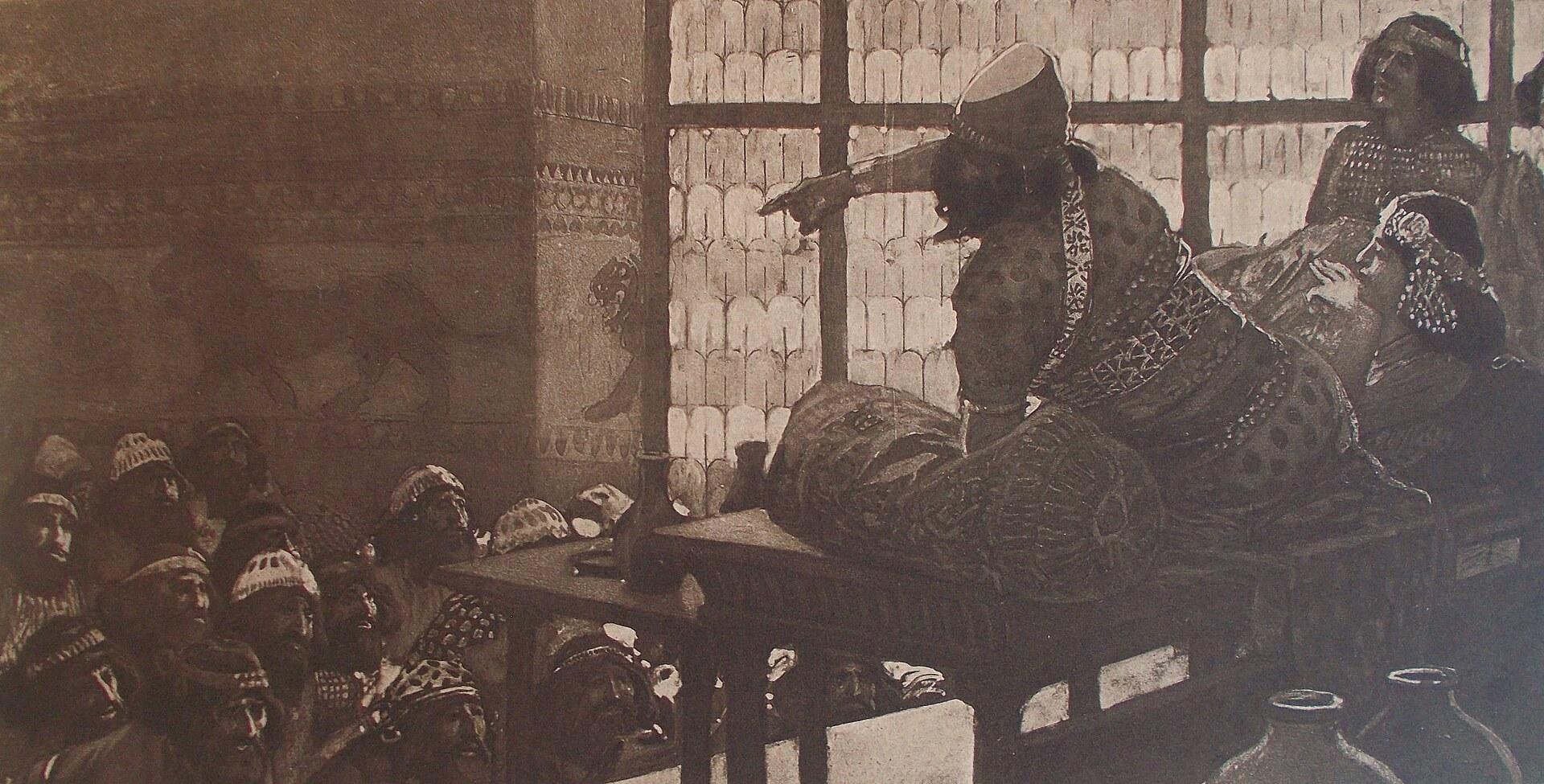
James Tissot, The Feast of Adoni-bezek, 1904. Photograph by Phillip Medhurst, CC BY-SA 4.0.
Obadiah 1:15 and Psalm 7:16 · Subject · Featured Study
The Deed Returned on the Doer
Obadiah 1:15 states a rule of God's judgment that the Psalms, the Proverbs, the stories and the Gospels also teach.
For the Day of the LORD is near for all the nations. As you have done, it will be done to you; your recompense will return upon your own head.
- Books
- Obadiah, Psalms, Proverbs, Judges, Esther, Matthew, Galatians
- Hold in memory
- Galatians 6:7
In Scripture the harm a person plans for another often comes back on the one who planned it.
Summary
Obadiah warned Edom that its deeds would come back on Edom itself. God repays such deeds, and He often repays them in kind.
- In the Book of Judges a captured king named God as the one who paid him back.
- Proverbs pictures a stone that rolls back on the one who starts it.
- Jesus warned that the measure a person uses will be used on him.
As You Have Done
Obadiah speaks the rule to Edom and then sets it over every nation on the Day of the LORD.
The word for recompense is gemul (H1576), a deed of good or ill and what is paid back for it. It stands in seventeen verses, among them Joel 3:4 and Joel 3:7.
Matthew Henry widened the verse beyond Edom.
“The righteous God will render both to nations and to particular persons according to their works; and the punishment is often made exactly to answer to the sin, and those that have abused others come to be themselves abused in like manner.”
Matthew Henry · Commentary on the Whole Bible · on Obadiah 1:15Puritan
Caught by Their Own Deed
Scripture shows a king, a royal minister, a band of accusers and a nation caught by what they did to others.
Four cases from Judges to Obadiah.
| Who | What he did | What came back |
|---|---|---|
| Adoni-bezek | Cut off the thumbs and big toes of seventy kings | His own thumbs and big toes cut off |
| Haman | Prepared a gallows for Mordecai | Hanged on that gallows |
| Daniel's accusers | Brought Daniel to the lions | Thrown into the den themselves |
| Edom | Looted Judah on the day of its disaster | Pillaged in its turn |
Matthew Henry contrasted Haman's morning with his end.
“The enemies of God's church have often been thus taken in their own craftiness. In the morning Haman was designing himself for the robes and Mordecai for the gallows; but the tables are turned: Mordecai has the crown, Haman the cross. The Lord is known by such judgments.”
Matthew Henry · Commentary on the Whole Bible · on Esther 7:10Puritan
The Pit and the Stone
Two psalms and a proverb give the rule in pictures from daily life.
He has dug a hole and hollowed it out; he has fallen into a pit of his own making. His trouble recoils on himself, and his violence falls on his own head.The psalm gives the rule in the words of a man under attack.
He who digs a pit will fall into it, and he who rolls a stone will have it roll back on him.Here the one who harms is caught by his own work.
The nations have fallen into a pit of their making; their feet are caught in the net they have hidden. The LORD is known by the justice He brings; the wicked are ensnared by the work of their hands. Higgaion SelahThe psalm widens the rule from one man to whole nations.
Charles Spurgeon piled up homely pictures of the same rule.
“The rod which he lifted on high, has smitten his own back. He shot an arrow upward, and it has ‘returned upon his own head.’ He hurled a stone at another and it has ‘come down upon his own pate.’ Curses are like young chickens, they always come home to roost. Ashes always fly back in the face of him that throws them. ‘As he loved cursing, so let it come unto him.’ (Psalm 109:17.) How often has this been the case in the histories of both ancient and modern times.”
Charles Spurgeon · The Treasury of David, Vol. 1 · on Psalm 7:16Particular Baptist
Who Repays the Deed
The Law sets the measure for a judge, and the prophets give the repaying of nations to the LORD.
If anyone injures his neighbor, whatever he has done must be done to him: fracture for fracture, eye for eye, tooth for tooth. Just as he injured the other person, the same must be inflicted on him.The Law limits the penalty to the harm done.
Behold, I will rouse them from the places to which you sold them; I will return your recompense upon your heads.Joel speaks against the nations who sold Judah's people.
Cyril of Alexandria saw God's own justice at work in Obadiah's rule.
“Again the time of war is predicted [as in Joel] when the neighboring nations will join together against Edom to inflict bitter punishment. That day is truly called the Day of the Lord. For God the Lord was the one who handed them over to the Israelites in their wickedness and injustice. So that he might affirm that their divine punishment is just he says, ‘As you have done, so it will be done to you.’ For nature is so arranged that everybody receives just treatment, and entirely equal wages are repaid to those who have undertaken similar actions.”
Cyril of Alexandria · Commentary on Obadiah · on Obadiah 1:15Patristic
The Measure You Use
The Gospels and Galatians carry the rule into the teaching of Jesus and of Paul.
For with the same judgment you pronounce, you will be judged; and with the measure you use, it will be measured to you.The warning stands in the Sermon on the Mount.
“Put your sword back in its place,” Jesus said to him. “For all who draw the sword will die by the sword.Jesus says it on the night He is arrested.
Do not be deceived: God is not to be mocked. Whatever a man sows, he will reap in return.Paul writes it to the churches of Galatia.
Matthew Henry drew from it a lesson about the present time.
“Our present time is seed-time: in the other world there will be a great harvest; and, as the husbandman reaps in the harvest according as he sows in the seedness, so we shall reap then as we sow now.”
Matthew Henry · Commentary on the Whole Bible · on Galatians 6:7Puritan
The Cup Returned
Revelation closes the canon with the same rule spoken over Babylon the great.
Give back to her as she has done to others; pay her back double for what she has done; mix her a double portion in her own cup.The verse gives the rule as a command to Babylon's judges.
Sources
Scripture is the Berean Standard Bible.
- Strong's Concordance, entry H1576 (gemul)
- Matthew Henry, Commentary on the Whole Bible (1710), on Obadiah 1:15, Esther 7:10 and Galatians 6:7.
- Charles Spurgeon, The Treasury of David, volume 1, on Psalm 7:16.
- Cyril of Alexandria, Commentary on Obadiah, on Obadiah 1:15.
Keep Studying
Studies4
People and groups5
Places1
Subjects1
Symbols2
Doctrines1