
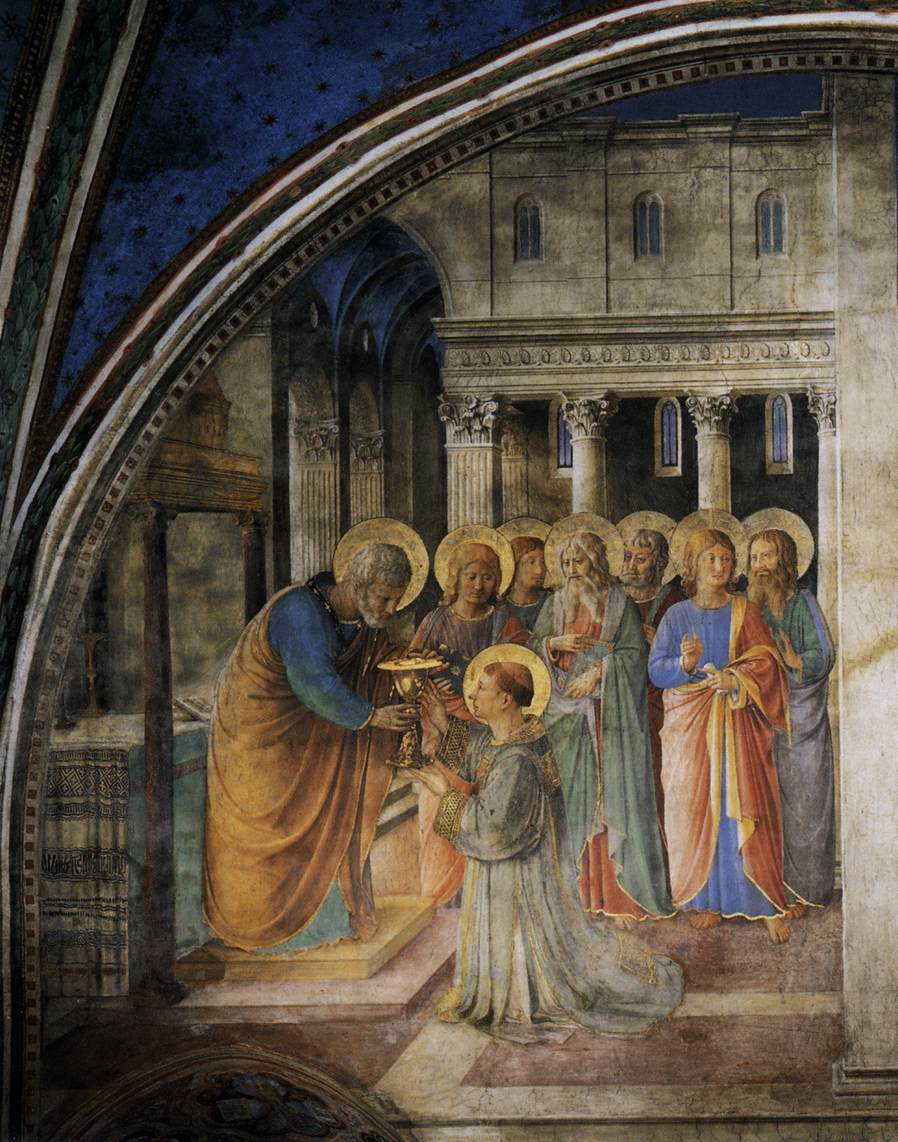
Fra Angelico, 1447 to 1449. Public domain.
Acts 6 to 8 · Subject · Featured Study
The Hellenists and the Seven
Greek-speaking Jewish believers in Jerusalem spoke up for their widows, and the church chose seven men to serve them.
Men chosen to wait on tables were soon preaching, and one of them died for it.
Therefore, brothers, select from among you seven men confirmed to be full of the Spirit and wisdom. We will appoint this responsibility to them
Summary
Many Jews who spoke Greek had moved to Jerusalem from other lands, and some of them came to believe in Jesus. The apostles chose to give their time to prayer and to preaching. Stephen soon faced Jews from Cyrene, Alexandria, Cilicia and Asia.
- The apostles prayed and laid their hands on the seven men.
- Many priests came to the faith after the seven were chosen.
- Greek-speaking Jews later tried to kill Saul after he believed.
The Texts on the Hellenists
Four verses mark the complaint, the choice, the scattering and the turn to the Greeks.
Luke tells of the Hellenists in Acts 6 and follows the scattered believers in Acts 8 and 11.
In those days when the disciples were increasing in number, the Grecian Jews among them began to grumble against the Hebraic Jews because their widows were being overlooked in the daily distribution of food.This is the first verse of Acts to name the Hellenists.
This proposal pleased the whole group. They chose Stephen, a man full of faith and of the Holy Spirit, as well as Philip, Prochorus, Nicanor, Timon, Parmenas, and Nicolas from Antioch, a convert to Judaism.The list shows whom the whole church chose to answer the Hellenists' complaint.
Those who had been scattered preached the word wherever they went.The scattering is the bridge Luke builds from Stephen's death to Philip and to Antioch.
But some of them, men from Cyprus and Cyrene, went to Antioch and began speaking to the Greeks as well, proclaiming the good news about the Lord Jesus.Luke marks the step at Antioch that carried the word beyond the Jews.
Acts 8:4, Acts 11:20
From the Dispersion and Back Out
The Hellenists came from Greek-speaking cities, and the scattered believers carried the word back toward them.
The Freedmen's synagogue drew Jews from cities such as Cyrene and Alexandria, and the scattered believers preached from Samaria to Antioch.
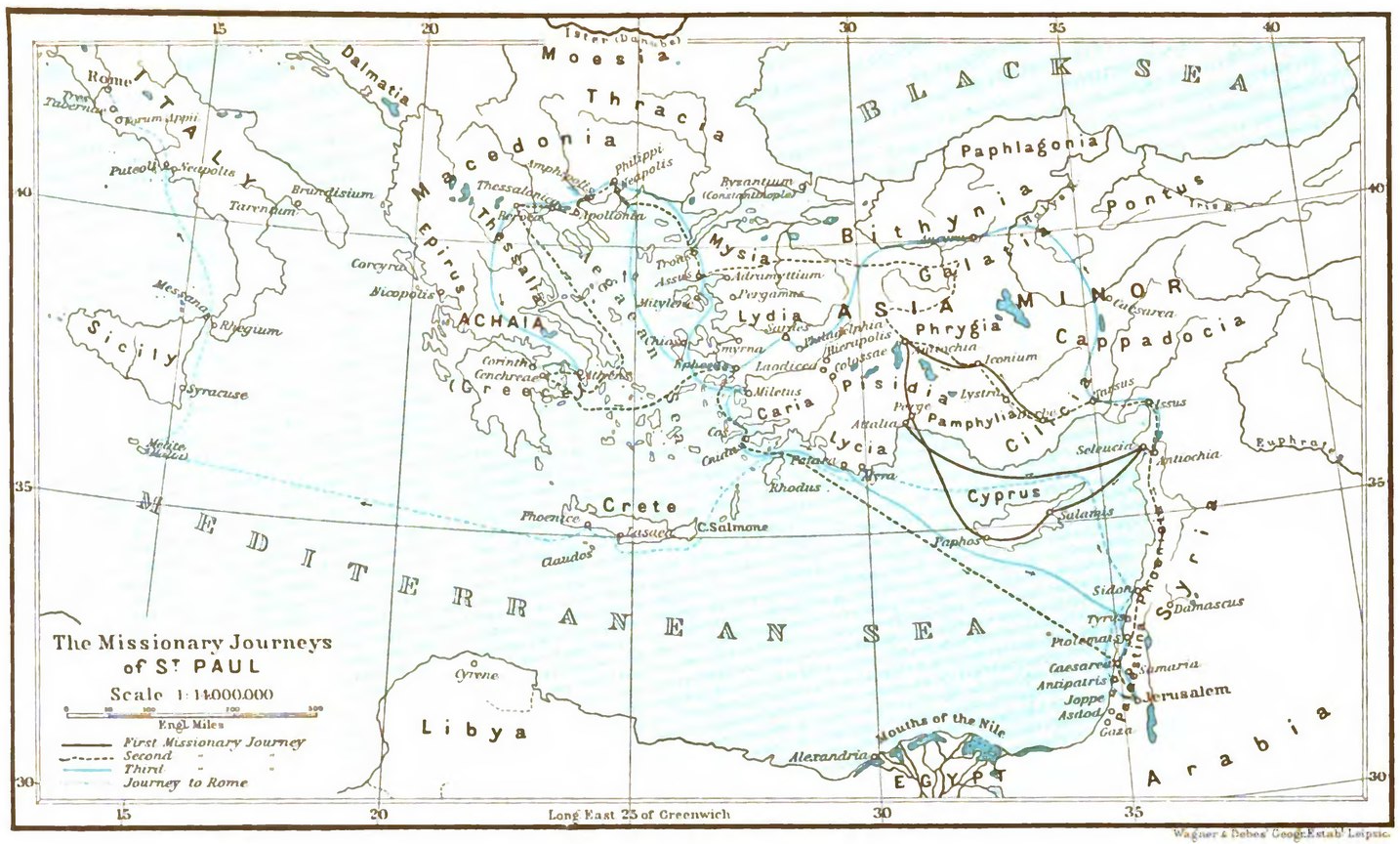
- 1Cyrene, Home of some in the Freedmen's synagogue and of men who preached at Antioch Acts 11:20
- 2Alexandria, Home of others in the same synagogue Acts 6:9
- 3Jerusalem, Where the widows were overlooked Acts 6:1
- 4Samaria, Philip proclaimed the Christ there Acts 8:5
- 5Gaza, Philip took the desert road toward it Acts 8:26
- 6Azotus, Philip appeared here after the baptism Acts 8:40
Caesarea, Phoenicia, Cyprus, Antioch
- 7Caesarea, Philip preached his way to it and later lived there Acts 21:8
- 8Phoenicia, Some of the scattered went this far Acts 11:19
- 9Cyprus, Others reached the island Acts 11:19
- 10Antioch, Men of Cyprus and Cyrene spoke to Greeks Acts 11:20
Base map: The missionary journeys of St. Paul, F. J. Knecht, Practical Commentary on Holy Scripture, public domain.
Ten places on Knecht's plate of Paul's journeys. Each scores 1,000 of 1,000 in the OpenBible identification data.
What the Seven Did Next
Luke follows Stephen to his death and Philip from Samaria to Caesarea.
Stephen argued with men of the Freedmen's synagogue, who came from Greek-speaking lands abroad. They stirred up the people and brought him before the council, where he spoke and was stoned.
but they could not stand up to his wisdom or the Spirit by whom he spoke.The Spirit's part in Stephen's answers sets up the anger that ends in his death.
After Stephen's death a great persecution broke out, and all but the apostles were scattered. Philip went down to Samaria, and the crowds there listened to him.
But when they believed Philip as he preached the gospel of the kingdom of God and the name of Jesus Christ, they were baptized, both men and women.Philip's baptisms in Samaria show one of the Seven doing the work of an evangelist.
An angel then sent Philip to the desert road toward Gaza, where he met the Ethiopian official. Afterward he preached in every town from Azotus to Caesarea.
Leaving the next day, we went on to Caesarea and stayed at the home of Philip the evangelist, who was one of the Seven.Long after the choosing, Luke still calls Philip one of the Seven.
Eusebius quotes Polycrates, who said that Philip, one of the twelve apostles, sleeps at Hierapolis in Asia with his daughters, and Proclus, who spoke of four prophetesses, daughters of Philip, buried there. Eusebius set beside them Luke's account of Philip of the Seven at Caesarea.
He had four unmarried daughters who prophesied.Eusebius cited this verse to place the daughters of Luke's Philip at Caesarea.
Others of the scattered went as far as Phoenicia, Cyprus and Antioch, at first speaking only to Jews.
The hand of the Lord was with them, and a great number of people believed and turned to the Lord.Luke closes the Hellenists' part of Acts with the Lord's blessing on the turn to the Greeks.
Acts 21:8, Acts 21:9, Acts 11:21
Who the Hellenists Were
The Hellenists were Jews who spoke Greek, many of them from homes outside the land of Israel.
John Chrysostom took the Hellenists to be those who spoke Greek. R. J. Knowling, in 1900, called them Jews who had settled in Greek-speaking lands and used Greek in place of Aramaic. He held that their language set them apart.
R. B. Rackham, in 1901, read the Freedmen of Stephen's opponents as Roman freedmen. He traced them to Jewish captives Pompey took to Rome and later set free.
A Greek inscription found in Jerusalem in December 1913 by Raymond Weill names Theodotus as the builder of a synagogue for reading the Law, with rooms for visitors from abroad. Wikipedia reports that his father's Latin name may point to a family from Italy, and it calls this uncertain.
What Luke Leaves Unsaid
Luke's later chapters follow only two of the Seven.
After Acts 6:5 Luke never names Prochorus, Nicanor, Timon, Parmenas or Nicolas again. He records no further complaint about the widows.
The Voices
Two preachers on the office of the Seven and on the scattering.
John Wesley (1703 to 1791)
Explanatory Notes upon the New Testament
Their office was the care of the poor
“And whatever time they had to spare from this, they employed in works of spiritual mercy. But their proper office was, to take care of the poor. And when some of them afterward preached the Gospel, they did this not by virtue of their deaconship, but of another commission, that of evangelists, which they probably received, not before, but after they were appointed deacons.”
on Acts 6:2Evangelical
Charles Spurgeon (1834 to 1892)
The Metropolitan Tabernacle Pulpit, Sermon No. 2044: “All At It” (lightly modernized text, CCEL edition)
Persecution scattered the holy seed
“I have often heard the argument, ‘Do not have too many out-stations, keep up a strong central force.’ But God's plan was that the holy force should be distributed—the holy seed must be sown. To do this the Lord made use of the rough hand of persecution. The disciples could not stay in Jerusalem—Saul made them run for their lives, or, if they did not, he shut them up in prison. And prisons in those days were so foul and noisome as to be the vestibules of the grave. One went this way and one went the other way.”
on Acts 8:4 to 5Particular Baptist
Where Readers Differ
Three questions about the Seven, with the writers who answer them.
Were the Seven the first deacons?2 paragraphs
Irenaeus called Stephen the first deacon chosen by the apostles. Knowling reports that the earliest tradition of the church spoke of Stephen and Nicolas as ordained to the diaconate.
Chrysostom held that the Seven were neither deacons nor presbyters, and that they were ordained for this one task. Rackham agreed, since Acts never calls them deacons, and he saw in them the ancestors of both later orders.
Did the Nicolaitans begin with Nicolas?1 quotation, 1 paragraph
Irenaeus traced the Nicolaitans, a sect whose works the Lord says He hates in Revelation 2:6, back to Nicolas of the Seven. Clement of Alexandria defended Nicolas, and Eusebius later copied the defence. Rackham called the link a mere conjecture.
“Such also are those who say that they follow Nicolaus, quoting an adage of the man, which they pervert, ‘that the flesh must be abused.’ But the worthy man showed that it was necessary to check pleasures and lusts, and by such training to waste away the impulses and propensities of the flesh.”
Clement of Alexandria · The Stromata Book 2 · on Acts 6:5Patristic
Was the church split into two parties?2 paragraphs
Knowling answered that the apostles could hardly have acted from partiality. Chrysostom blamed the neglect on the carelessness of a crowd and saw no malice in it.
Books to Read Next
Two works, each free to read online.
Homilies on the Acts of the Apostles, Homily 14
John Chrysostom, in the Nicene and Post-Nicene Fathers, first series, volume 11 · fourth century
Chrysostom preaches on the complaint, the choosing and the office of the Seven.
Free at New AdventThe Acts of the Apostles
R. B. Rackham, Westminster Commentaries · 1901
Rackham weighs the names, the office and the Freedmen in his notes on Acts 6.
Free at the Internet ArchiveSources
Scripture is the Berean Standard Bible.
- The Holy Bible, Berean Standard Bible (read 2026)
- John Chrysostom, Homily 14 on Acts, Nicene and Post-Nicene Fathers, first series, volume 11.
- R. J. Knowling, The Acts of the Apostles, in The Expositor's Greek Testament, volume 2 (1900)
- R. B. Rackham, The Acts of the Apostles, Westminster Commentaries (1901)
- Irenaeus, Against Heresies 1.26.3 and 3.12.10, Ante-Nicene Fathers, volume 1.
- Eusebius, Church History 3.29 and 3.31, Nicene and Post-Nicene Fathers, second series, volume 1 (1890)
- Clement of Alexandria, The Stromata.
- F. C. Baur, Paul the Apostle of Jesus Christ, volume 1, edited by E. Zeller, translated by A. Menzies (1876)
- Wikipedia, Theodotos inscription.
- John Wesley, Explanatory Notes upon the New Testament (1755)
- Charles Spurgeon, The Metropolitan Tabernacle Pulpit, Sermon 2044, All At It.
- OpenBible.info, Bible-Geocoding-Data, ancient.jsonl.
- F. J. Knecht, Practical Commentary on Holy Scripture, the plate The Missionary Journeys of St. Paul.
Keep Studying
Read it1
Doctrines1
Subjects1
Church history2