
Genesis 5 to 9 · Person · Featured Study
Noah
The life of Noah from his naming by Lamech to his death after the flood, told in Genesis 5 to 9 and recalled by the prophets, by Jesus and by the apostles.
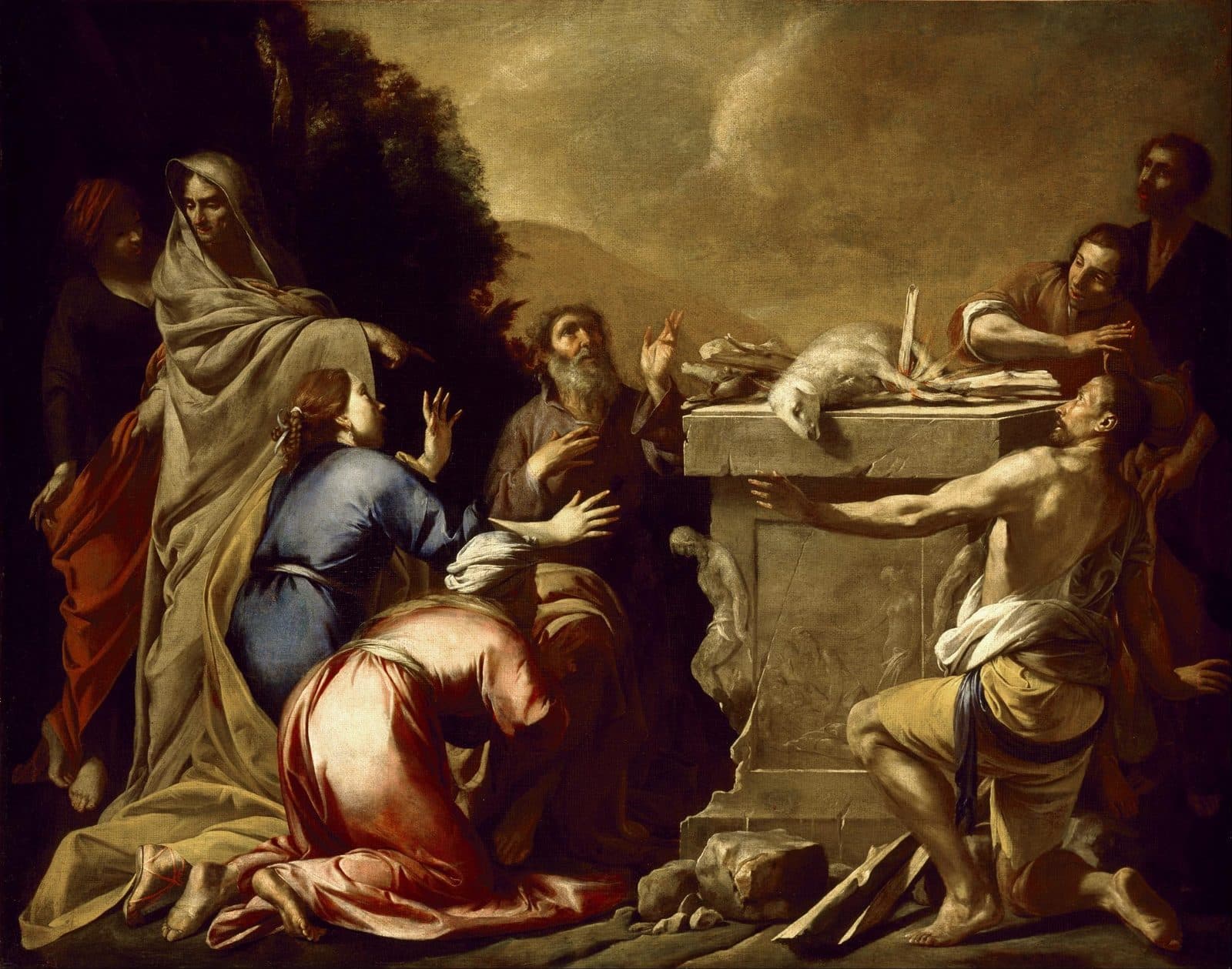
Attributed to Antonio de Bellis, The Sacrifice of Noah, between 1640 and 1655. Public domain by date, painted before 1930. Via Wikimedia Commons.
THE ARTWORKThe painter set Noah between the altar and his family with his face turned up, and gave each of the eight people of the ark a place around the offering.
Genesis says Noah found favor in the eyes of the LORD one verse before it calls him righteous.
Summary
Noah, the son of Lamech, built the ark at God's command and came through the flood with his household of eight.
- God shut him in, remembered him and brought him out in his six hundred and first year.
- After the flood God made a covenant with him, his descendants and every living creature, with the rainbow as its sign.
- He planted a vineyard, became drunk, and then cursed Canaan and blessed Shem and Japheth.
- He lived 350 years after the flood and died at 950.
Where Noah Stands in Scripture
His naming in Genesis 5 and his last mention in 2 Peter 2
His name first stands in the genealogy of Genesis 5, at the birth his father marked with a prayer.
And he named him Noah, saying, “May this one comfort us in the labor and toil of our hands caused by the ground that the LORD has cursed.”Lamech asks relief from the ground the LORD cursed in Genesis 3:17.
The last letter to name him uses his rescue to show that the Lord knows how to rescue the godly.
if He did not spare the ancient world when He brought the flood on its ungodly people, but preserved Noah, a preacher of righteousness, among the eight;Peter alone in Scripture calls Noah a preacher of righteousness.
The Life by His Years
Each turn with Noah's age, counted from the years Genesis gives
- Born to Lamech and named0, in Lamech's 182nd year, Genesis 5:28 to 29
- Lamech dies at 777595, Genesis 5:30 to 31
- Shem, Ham and Japheth are bornafter 500, Genesis 5:32
- Methuselah dies at 969the year of the flood, Genesis 5:25 to 27
- The flood begins600, second month, day 17, Genesis 7:11
- The ark rests on the mountains of Ararat600, seventh month, day 17, Genesis 8:4
- The earth is fully dry601, second month, day 27, Genesis 8:14
- He dies950, Genesis 9:28 to 29
The timeline draws eight turns of the life with Noah's age at each.
From Lamech's Son to the Father of Nations
Eight scenes of Genesis 5:28 to 10:32
Named by LamechGenesis 5:28 to 32
Lamech's word for comfort in Genesis 5:29 is nacham, while the name Noah sounds like nuach, to rest. Adam Clarke held it more likely that the name comes from nuach, and asked what is more comfortable than rest after toil.
Rashi, the eleventh-century commentator of Troyes, reads Lamech's word as easing the toil of their hands, and tells from the Tanchuma that Noah prepared tools for working the ground. He adds that a name from nacham would have been Menachem.
Righteous and blameless in his generationGenesis 6:8 to 12
This is the account of Noah. Noah was a righteous man, blameless in his generation; Noah walked with God.Genesis describes Noah with tsaddiq, a just man, and tamim, a man whole and sound, before it names his sons again.
Rashi reads the order of the verse, the account of Noah followed at once by his righteousness and not by his sons, as teaching that the true offspring of the righteous are their good deeds.
Now the earth was corrupt in the sight of God, and full of violence. And God looked upon the earth and saw that it was corrupt; for all living creatures on the earth had corrupted their ways.God gives this corruption as His reason when He speaks to Noah in Genesis 6:13.
The ark and the covenant promisedGenesis 6:13 to 22
But I will establish My covenant with you, and you will enter the ark—you and your sons and your wife and your sons’ wives with you.God promises His covenant before the water comes and names the seven who will enter with Noah.
“God could have secured Noah by the ministration of angels, without putting him to any care, or pains, or trouble, himself; but he chose to employ him in making that which was to be the means of his preservation, both for the trial of his faith and obedience and to teach us that none shall be saved by Christ but those only that work out their salvation.”
Matthew Henry · Commentary on the Whole Bible · on Genesis 6:14 to 16Puritan
The flood yearGenesis 7:1 to 8:19
But God remembered Noah and all the animals and livestock that were with him in the ark. And God sent a wind over the earth, and the waters began to subside.God's remembering of Noah turns the waters from rising to falling.
On the first day of the first month of his six hundred and first year Noah removed the covering of the ark and saw that the surface of the ground was dry. He left the ark when God told him to come out.
“We would go out of the ark before the ground is dried: and perhaps, if the door be shut, are ready to remove the covering, and to climb up some other way; but we should be satisfied that God's time of showing mercy is certainly the best time, when the mercy is ripe for us and we are ready for it.”
Matthew Henry · Commentary on the Whole Bible · on Genesis 8:14Puritan
The altar and the blessingGenesis 8:20 to 9:7
Then Noah built an altar to the LORD. And taking from every kind of clean animal and clean bird, he offered burnt offerings on the altar.Noah's first act on dry ground is an offering from the clean animals and birds.
God had told Noah to take seven pairs of every clean animal and bird into the ark, beside a pair of every unclean animal.
“But what was the use of the seventh? It was manifestly reserved for sacrifice; and so that both during Noah's residence in the ark, and after his return to dry land, provision was made for celebrating the rites of worship according to the religion of fallen man.”
Jamieson, Fausset & Brown · Commentary Critical and Explanatory on the Whole Bible · on Genesis 7:2Reformed
Whoever sheds the blood of man, by man his blood will be shed; for in His own image God has made mankind.God grounds the penalty for shedding man's blood in His own image in mankind.
The covenant with every living creatureGenesis 9:8 to 17
“Behold, I now establish My covenant with you and your descendants after you, and with every living creature that was with you—the birds, the livestock, and every beast of the earth—every living thing that came out of the ark.God names Noah, his descendants and every creature that came out of the ark as the parties of the covenant.
The sign God sets in the clouds is the qeshet, the Hebrew word for a bow, which stands 76 times in the Old Testament.
The vineyard and the tentGenesis 9:18 to 24
Now Noah, a man of the soil, proceeded to plant a vineyard. But when he drank some of its wine, he became drunk and uncovered himself inside his tent.The man Genesis called blameless lies drunk and uncovered in his tent.
And Ham, the father of Canaan, saw his father’s nakedness and told his two brothers outside. Then Shem and Japheth took a garment and placed it across their shoulders, and walking backward, they covered their father’s nakedness. Their faces were turned away so that they did not see their father’s nakedness.What Noah learns of this when he wakes is the ground of the curse and the blessings that follow.
“That the fairest copy that ever mere man wrote since the fall had its blots and false strokes. It was said of Noah that he was perfect in his generations ( ch. vi. 9 ), but this shows that it is meant of sincerity, not a sinless perfection.”
Matthew Henry · Commentary on the Whole Bible · on Genesis 9:21Puritan
The blessings and the nationsGenesis 9:26 to 10:32
He also declared: “Blessed be the LORD, the God of Shem! May Canaan be the servant of Shem. May God expand the territory of Japheth; may he dwell in the tents of Shem, and may Canaan be his servant.”Noah blesses the LORD as the God of Shem, whose line Genesis 11:10 to 26 follows to Abram.
Genesis 10 counts the nations by his three sons and says that the nations of the earth spread out from them after the flood.
What Genesis Says Plainly
Four records from Genesis 6 to 9
HE DID AS HE WAS COMMANDED
Genesis says four times that what was done was done as God commanded Noah, in Genesis 6:22, Genesis 7:5, Genesis 7:9 and Genesis 7:16.
THE LORD SHUT THE DOOR
When every creature had entered, the LORD shut Noah in.
THE BOW IS FOR GOD TO SEE
God says that when the rainbow appears He will see it and remember the everlasting covenant.
THE CURSE NAMES CANAAN
Noah's curse falls on Canaan, and his blessings name Shem and Japheth.
The World Behind the Text
The line from Adam, the ark's measure and the year in the ark
The tenth from AdamGenesis 5
The ark at an eighteen-inch cubitGenesis 6:15
The year in the arkAdam Clarke
Adam Clarke reckoned the stay in the ark from the seventeenth day of the second month to the twenty-seventh day of the second month a year later, a complete solar year.
The Family of Noah
Nine ties, each with its verse
| Person | Tie to Noah | Verse |
|---|---|---|
| Enoch | His great-grandfather, who walked with God and was taken. | Genesis 5:24 |
| Methuselah | His grandfather, who lived 969 years. | Genesis 5:27 |
| Lamech | His father, who named him. | Genesis 5:29 |
| His wife | She entered and left the ark with him. | Genesis 7:7 |
| Shem | His son, whose God Noah blessed. | Genesis 9:26 |
| Ham | His son, the father of Canaan. | Genesis 9:18 |
| Japheth | His son, for whom Noah asked room. | Genesis 9:27 |
| His sons' wives | Three, who entered the ark with their husbands. | Genesis 7:13 |
| Canaan | His grandson, Ham's son. | Genesis 10:6 |
- Person
- Enoch
- Tie to Noah
- His great-grandfather, who walked with God and was taken.
- Verse
- Genesis 5:24
- Person
- Methuselah
- Tie to Noah
- His grandfather, who lived 969 years.
- Verse
- Genesis 5:27
- Person
- Lamech
- Tie to Noah
- His father, who named him.
- Verse
- Genesis 5:29
- Person
- His wife
- Tie to Noah
- She entered and left the ark with him.
- Verse
- Genesis 7:7
- Person
- Shem
- Tie to Noah
- His son, whose God Noah blessed.
- Verse
- Genesis 9:26
- Person
- Ham
- Tie to Noah
- His son, the father of Canaan.
- Verse
- Genesis 9:18
- Person
- Japheth
- Tie to Noah
- His son, for whom Noah asked room.
- Verse
- Genesis 9:27
- Person
- His sons' wives
- Tie to Noah
- Three, who entered the ark with their husbands.
- Verse
- Genesis 7:13
- Person
- Canaan
- Tie to Noah
- His grandson, Ham's son.
- Verse
- Genesis 10:6
Questions the Life Raises
Two questions on the favor of Genesis 6:8 and the curse of Genesis 9:25
What did the favor of Genesis 6:8 rest on?Matthew Henry; Tertullian
Matthew Henry answers from Paul's words in 1 Corinthians 15:10 that Noah was no better than the grace of God made him. He calls Noah a just man, justified before God by faith in the promised seed.
Tertullian argues from a law that stood before the law of Moses.
“For what wonder if He extends a discipline who institutes it? if He advances who begins? In short, before the Law of Moses, written in stone-tables, I contend that there was a law unwritten, which was habitually understood naturally, and by the fathers was habitually kept. For whence was Noah ‘found righteous,’ if in his case the righteousness of a natural law had not preceded? Whence was Abraham accounted ‘a friend of God,’ if not on the ground of equity and righteousness, (in the observance) of a natural law?”
Tertullian · An Answer to the Jews · on Hebrews 11:7Patristic
Why is Canaan cursed for what Ham did?Genesis 9:22 to 25
Justin Martyr answered the question in the second century.
“For another mystery was accomplished and predicted in the days of Noah, of which you are not aware. It is this: in the blessings wherewith Noah blessed his two sons, and in the curse pronounced on his son's son. For the Spirit of prophecy would not curse the son that had been by God blessed along with [his brothers]. But since the punishment of the sin would cleave to the whole descent of the son that mocked at his father's nakedness, he made the curse originate with his son.”
Justin Martyr · Dialogue with Trypho, Chapter CXXXIX · on Genesis 9:22 to 25Patristic
Adam Clarke notes that the Arabic version alone reads Ham the father of Canaan in Genesis 9:25 to 27, and he calls the reading a gloss.
Augustine observes in City of God 19.15 that the word slave first appears in Scripture in Noah's curse on his son's sin, and he calls it a name brought in by sin.
What the Text Leaves Unsaid
The names of the women, Ham's act and Noah's preaching
Genesis never names Noah's wife or the wives of his sons.
The text says Ham saw his father's nakedness and told his brothers, and it says nothing more of what he did.
Genesis records no word Noah spoke to his generation. The first words of his it gives are the curse and the blessings that follow the vineyard.
Where Noah Points
Isaiah, Jesus and the apostles return to his faith, his rescue and his generation
By faith Noah, when warned about things not yet seen, in godly fear built an ark to save his family. By faith he condemned the world and became heir of the righteousness that comes by faith.Hebrews places Noah in its roll of faith between Enoch and Abraham.
who disobeyed long ago when God waited patiently in the days of Noah while the ark was being built. In the ark a few people, only eight souls, were saved through water. And this water symbolizes the baptism that now saves you also—not the removal of dirt from the body, but the pledge of a clear conscience toward God—through the resurrection of Jesus Christ,Peter writes to believers who suffer for doing good and points them to the rescue of Noah's household.
Charles Spurgeon, preaching on Genesis 8:21 in 1865 in a sermon printed in The Metropolitan Tabernacle Pulpit, read the ark as a sentence of condemnation followed by death, burial and resurrection.
The days of NoahMatthew 24:37 to 39; Luke 17:26 to 29
For in the days before the flood, people were eating and drinking, marrying and giving in marriage, up to the day Noah entered the ark. And they were oblivious, until the flood came and swept them all away. So will it be at the coming of the Son of Man.Jesus names ordinary life carried on up to the day of the flood by people unaware of it.
Luke gives the same saying and sets the days of Lot beside the days of Noah.
J. C. Ryle warned in his Expository Thoughts on the Gospels (1856) that the passage speaks of the second coming of Christ and is misapplied when it is read of death.
An ark already preparedGenesis 7:1; Genesis 8:21
Matthew Henry, in his Commentary on the Whole Bible (1710), read God's call to Noah to go into the ark as the call of the gospel, with Christ an ark already prepared.
He read the pleasing aroma of Noah's offering in Genesis 8:21 as a figure of Christ's sacrifice of Himself.
Rest, and the One who gives itGenesis 5:29; Matthew 11:28
Come to Me, all you who are weary and burdened, and I will give you rest.Jesus promises rest to the weary, the rest the name Noah sounds like.
“Their parents' piety often procures them temporal salvation, as here; and it furthers them in the way to eternal salvation, if they improve the benefit of it. God here makes Noah a great blessing to the world, and herein makes him an eminent type of the Messiah, though not the Messiah himself, as his parents expected, ch. v. 29 .”
Matthew Henry · Commentary on the Whole Bible · on Genesis 6:18Puritan
The oath after the floodIsaiah 54:9 to 10
“For to Me this is like the days of Noah, when I swore that the waters of Noah would never again cover the earth. So I have sworn that I will not be angry with you or rebuke you. Though the mountains may be removed and the hills may be shaken, My loving devotion will not depart from you, and My covenant of peace will not be broken,” says the LORD, who has compassion on you.God makes His oath to Noah the measure of His covenant of peace with His people.
The judgment that remains2 Peter 3:6 to 7
through which the world of that time perished in the flood. And by that same word, the present heavens and earth are reserved for fire, being kept for the day of judgment and destruction of ungodly men.Peter sets the fire reserved for the day of judgment beside the water that ended the world of Noah's day.
Voices on Noah
Three teachers in their own words, from Irenaeus to Ambrose of Milan
“And He changed the food of men, giving them leave to eat flesh: for from Adam the first-formed until the Flood men ate only of seeds and the fruit of trees, and to eat flesh was not permitted to them.”
Irenaeus · The Demonstration of the Apostolic Preaching, Section 22 · on Genesis 9:3 to 6Patristic
“The chaste son could not endure looking upon the immodest nakedness of a good man; chastity covered over what drunkenness had exposed in a transgression committed in ignorance but manifest to all.”
Clement of Alexandria · The Instructor Book 2 · on Genesis 9:23Patristic
“And therefore, since all earthly things perish in the flood, but the just alone remains forever, it is said to him: I will establish my covenant with thee; for he is the heir of divine grace, he is the heavenly possessor of the inheritance, the sharer in the most blessed goods.”
Ambrose of Milan · On Noah and the Ark, Chapter X · on Genesis 6:18Patristic
Where Readers Differ
Three matters read in more than one way, each reading with its holders
Until comparatively recent times nearly all Christians read the flood as universal, as S. R. Driver records, and the Flood page sets out both readings of its extent at length.
Genesis 5 to 9 as a record of yearsMatthew Henry, 1710
Matthew Henry, in his Commentary on the Whole Bible (1710), counted the flood 1656 years from creation by the ages of Genesis 5, so that by his count Noah was born in the year 1056.
The ages and the flood beyond historyS. R. Driver, 1904
S. R. Driver held in The Book of Genesis (1904) that the ages of Genesis 5, or most of them, cannot be historical and that a flood over the whole globe is beyond physical possibility.
A flood over the whole earthJamieson, Fausset and Brown, 1871
Jamieson, Fausset and Brown argue the case in their Commentary Critical and Explanatory on the Whole Bible (1871). They read the fifteen cubits of Genesis 7:20 as a depth above the summits of the highest hills, and held that the language cannot fit a partial flood.
The land known to manAlbert Barnes, 1832 to 1869
Albert Barnes argues the case in his Notes, Explanatory and Practical, on the Old and New Testaments (1832 to 1869). He read the land of Genesis 7:19 as the part of the earth known to man, and held that Scripture warrants no more than that.
The preacher in Noah's dayJohn Wesley, 1755
John Wesley gives this reading in his Explanatory Notes upon the New Testament (1755). He read 1 Peter 3:19 as Christ preaching by His Spirit through the ministry of Noah to the men of his day, who are now held for the judgment.
A descent to the deadIrenaeus; Athanasius of Alexandria
Irenaeus, in Against Heresies book 4, and Athanasius, in his Letter 59, place a preaching of Christ among the dead after His death.
Books to Read Next
Five books, from the fourth century to the twentieth
On Noah and the Ark
Ambrose of Milan · fourth century
Ambrose wrote a whole treatise on the account of Noah and the ark.
Commentary on the Whole Bible
Matthew Henry · 1710
Henry takes Genesis 5 to 9 verse by verse and draws the gospel from the ark.
READ IT FREE AT CCEL →Commentary on the Bible
Adam Clarke · 1810 to 1826
Clarke gives the ark's measure, the year in the ark and the readings of the old versions.
Commentary Critical and Explanatory on the Whole Bible
Jamieson, Fausset and Brown · 1871
The commentary reads the flood's provision for worship and names the mountain tradition points to as the ark's resting place.
The Book of Genesis, with Introduction and Notes
S. R. Driver · 1904
Driver sets out the critical reading of the ages and of the flood.
READ IT FREE AT ARCHIVE.ORG →Warned of Things Not Yet Seen
Noah took God's warning as true when nothing of it could yet be seen, and his household was brought through the water. The text asks the reader to believe God's word about the judgment to come and to come to Christ, whose resurrection Peter names as the way through it.
Keep studying
Studies7
Places1
Doctrines7
Peoples and groups2