
1 Chronicles 1 to 9 · Subject · Featured Study
The Genealogies
Nine chapters and 407 verses of names open 1 Chronicles, before its story begins at the death of Saul.
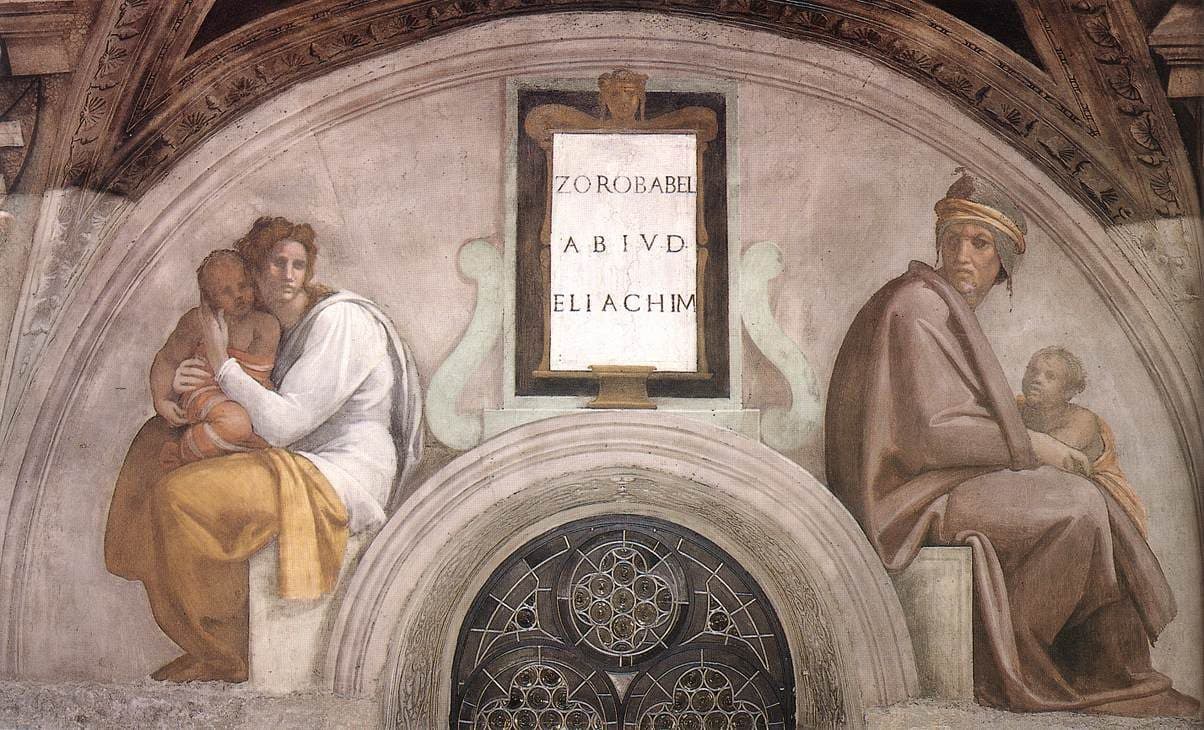
Michelangelo, Zerubbabel, Abiud, Eliakim, lunette of the ancestors of Christ, 1511 to 1512, Sistine Chapel, Vatican. Public domain, via Wikimedia Commons.
THE ARTWORKMichelangelo painted the ancestors of Christ in the half-moons above the chapel windows, each family under a tablet of names. Here a mother in white holds her child at left, and a man in a turban sits wrapped in his cloak at right. The tablet names Zerubbabel, who stands in 1 Chronicles 3:19 among the heirs of David.
Inside the lists stand a prayer God answered, eastern tribes carried into exile and an Egyptian servant married into Judah.
Summary
A genealogy in Scripture is a written list of descent that shows who belongs to a family, a tribe or an office.
- 1 Chronicles 1 to 9 runs from Adam through the twelve sons of Israel to the people who resettled Jerusalem after the exile.
- Judah comes first among the tribes because a ruler came from Judah, and Levi's list carries the high priests from Aaron to the exile.
- The lists pass over generations: Ezra 7 leaves out six high priests that 1 Chronicles 6 names.
- Short notes break the lists, among them the death of Judah's firstborn and the reason Reuben lost his birthright.
- After the exile, priests who could not find their family records were kept from serving.
The Nine Chapters in Order
Six passages show how the lists are built and what turns on them.
Adam, Seth, Enosh, Kenan, Mahalalel, Jared, Enoch, Methuselah, Lamech. The sons of Noah: Shem, Ham, and Japheth.The Chronicler's record of Israel reaches back past every patriarch to the beginning of the race.
These were the sons of Israel: Reuben, Simeon, Levi, Judah, Issachar, Zebulun, Dan, Joseph, Benjamin, Naphtali, Gad, and Asher.Naming every son first lets the reader see which tribes the later chapters leave out.
The descendants of Jeconiah the captive: Shealtiel his son, Malchiram, Pedaiah, Shenazzar, Jekamiah, Hoshama, and Nedabiah. The sons of Pedaiah: Zerubbabel and Shimei. The children of Zerubbabel: Meshullam and Hananiah, their sister Shelomith, and five others: Hashubah, Ohel, Berechiah, Hasadiah, and Jushab-hesed.The line outlives the throne here, since a king taken captive still has sons to record.
These were the sons of Reuben the firstborn of Israel. Though he was the firstborn, his birthright was given to the sons of Joseph son of Israel, because Reuben defiled his father’s bed. So he is not reckoned according to birthright. And though Judah prevailed over his brothers and a ruler came from him, the birthright belonged to Joseph.This aside answers why Judah, and not Reuben the firstborn, leads the tribes.
Azariah was the father of Seraiah, and Seraiah was the father of Jehozadak. Jehozadak went into captivity when the LORD sent Judah and Jerusalem into exile by the hand of Nebuchadnezzar.The priestly line is carried to the exile, so the priests who returned could trace their office to Aaron.
Now the first to resettle their own property in their cities were Israelites, priests, Levites, and temple servants.Here the lists turn from the tribes before the exile to the families who lived in the land again.
From Adam to the Return
The lists narrow from all mankind to the tribes of Israel.
| Verses | Whose line | What it records |
|---|---|---|
| 1 Chronicles 1:1 to 27 | Adam to Abraham | All mankind comes first, through Noah and Shem. |
| 1 Chronicles 1:28 to 54 | Abraham's sons, Esau and the kings of Edom | The families beside the line of promise are named. |
| 1 Chronicles 2:1 to 2 | The twelve sons of Israel | These names set the frame the tribal lists fill. |
| 1 Chronicles 2:3 to 4:23 | Judah | David's house is traced from Judah to the return. |
| 1 Chronicles 4:24 to 43 | Simeon | Their towns and their wars are recorded. |
| 1 Chronicles 5:1 to 26 | Reuben, Gad and half of Manasseh | The tribes east of the Jordan go into exile in Assyria. |
| 1 Chronicles 6:1 to 81 | Levi | The high priests, the singers and the Levites' towns are named. |
| 1 Chronicles 7:1 to 40 | Issachar, Benjamin, Naphtali, Manasseh, Ephraim and Asher | The clans and the fighting men of each tribe are counted. |
| 1 Chronicles 8:1 to 40 | Benjamin | Saul's family is traced. |
| 1 Chronicles 9:1 to 34 | The settlers after the exile | Israelites, priests, Levites and temple servants live in Jerusalem. |
| 1 Chronicles 9:35 to 44 | Saul's family again | The repeat leads straight into the narrative of chapter 10. |
- Verses
- 1 Chronicles 1:1 to 27
- Whose line
- Adam to Abraham
- What it records
- All mankind comes first, through Noah and Shem.
- Verses
- 1 Chronicles 1:28 to 54
- Whose line
- Abraham's sons, Esau and the kings of Edom
- What it records
- The families beside the line of promise are named.
- Verses
- 1 Chronicles 2:1 to 2
- Whose line
- The twelve sons of Israel
- What it records
- These names set the frame the tribal lists fill.
- Verses
- 1 Chronicles 2:3 to 4:23
- Whose line
- Judah
- What it records
- David's house is traced from Judah to the return.
- Verses
- 1 Chronicles 4:24 to 43
- Whose line
- Simeon
- What it records
- Their towns and their wars are recorded.
- Verses
- 1 Chronicles 5:1 to 26
- Whose line
- Reuben, Gad and half of Manasseh
- What it records
- The tribes east of the Jordan go into exile in Assyria.
- Verses
- 1 Chronicles 6:1 to 81
- Whose line
- Levi
- What it records
- The high priests, the singers and the Levites' towns are named.
- Verses
- 1 Chronicles 7:1 to 40
- Whose line
- Issachar, Benjamin, Naphtali, Manasseh, Ephraim and Asher
- What it records
- The clans and the fighting men of each tribe are counted.
- Verses
- 1 Chronicles 8:1 to 40
- Whose line
- Benjamin
- What it records
- Saul's family is traced.
- Verses
- 1 Chronicles 9:1 to 34
- Whose line
- The settlers after the exile
- What it records
- Israelites, priests, Levites and temple servants live in Jerusalem.
- Verses
- 1 Chronicles 9:35 to 44
- Whose line
- Saul's family again
- What it records
- The repeat leads straight into the narrative of chapter 10.
How to Read the Lists
A list of descent can leave out names and still be true.
William Henry Green of Princeton drew this from the line of priests in Ezra 7 and 1 Chronicles 6, in 1890.
Ezra gives his own line back to Aaron in fewer names than 1 Chronicles 6.
| High priest | 1 Chronicles 6 | Ezra 7:1 to 5 |
|---|---|---|
| Meraioth | 1 Chronicles 6:6 | named |
| Amariah | 1 Chronicles 6:7 | not named |
| Ahitub | 1 Chronicles 6:7 | not named |
| Zadok | 1 Chronicles 6:8 | not named |
| Ahimaaz | 1 Chronicles 6:8 | not named |
| Azariah | 1 Chronicles 6:9 | not named |
| Johanan | 1 Chronicles 6:9 | not named |
| Azariah | 1 Chronicles 6:10 | named |
| Amariah | 1 Chronicles 6:11 | named |
- High priest
- Meraioth
- 1 Chronicles 6
- 1 Chronicles 6:6
- Ezra 7:1 to 5
- named
- High priest
- Amariah
- 1 Chronicles 6
- 1 Chronicles 6:7
- Ezra 7:1 to 5
- not named
- High priest
- Ahitub
- 1 Chronicles 6
- 1 Chronicles 6:7
- Ezra 7:1 to 5
- not named
- High priest
- Zadok
- 1 Chronicles 6
- 1 Chronicles 6:8
- Ezra 7:1 to 5
- not named
- High priest
- Ahimaaz
- 1 Chronicles 6
- 1 Chronicles 6:8
- Ezra 7:1 to 5
- not named
- High priest
- Azariah
- 1 Chronicles 6
- 1 Chronicles 6:9
- Ezra 7:1 to 5
- not named
- High priest
- Johanan
- 1 Chronicles 6
- 1 Chronicles 6:9
- Ezra 7:1 to 5
- not named
- High priest
- Azariah
- 1 Chronicles 6
- 1 Chronicles 6:10
- Ezra 7:1 to 5
- named
- High priest
- Amariah
- 1 Chronicles 6
- 1 Chronicles 6:11
- Ezra 7:1 to 5
- named
Three kings Matthew passes overMatthew 1:8 and 1 Chronicles 3:11 to 12
Asa was the father of Jehoshaphat, Jehoshaphat the father of Joram, and Joram the father of Uzziah.Matthew calls Joram the father of Uzziah, his great-great-grandson, so father here reaches past three generations.
Abijah was his son, Asa his son, Jehoshaphat his son, Joram his son, Ahaziah his son, Joash his son, Amaziah his son, Azariah his son, Jotham his son,This fuller line is the measure by which Matthew's is seen to be abridged.
Shebuel, a descendant of Gershom1 Chronicles 26:24
Shebuel, a descendant of Gershom son of Moses, was the officer in charge of the treasuries.Shebuel served in David's reign, generations after Gershom, so the verse passes over every name between them.
The Records Behind the Lists
Written records of descent stood behind the lists, in the tribes and among the priests.
The Chronicler names his source for the tribes, the Book of the Kings of Israel. David's line in chapter 3 runs several generations past Zerubbabel, so the lists were finished after the return.
Zerubbabel was governor of Judah in the second year of King Darius.
These men searched for their family records, but they could not find them and so were excluded from the priesthood as unclean.This verse proves the records were in use after the return, deciding who could serve as a priest.
Josephus on the priests' recordsAgainst Apion 1.7
Josephus wrote that the priests sent their records of descent to Jerusalem from wherever they lived, and drew up new tables from the old records after every war.
Herod and the recordsEusebius, Church History 1.7
Julius Africanus, quoted by Eusebius, says the archives had kept the lines of Hebrews and of proselytes until Herod's day, and that Herod was ashamed of his own descent.
Who compiled the listsBava Batra 15a; Rashi on 1 Chronicles 9:1
The rabbis on the listsPesachim 62b; Megillah 13a
The Talmud tells of a lost Book of Genealogies that expounded Chronicles. Mar Zutra said, as an exaggeration, that its comments on the passage from Azel's first list to his second would load four hundred camels.
Azel had six sons, and these were their names: Azrikam, Bocheru, Ishmael, Sheariah, Obadiah, and Hanan. All these were the sons of Azel.Its names come back at 1 Chronicles 9:44, the close of the second list of Saul's house.
Rabbi Shimon ben Pazi began his teaching on Chronicles by telling the book that all its words are one and that the rabbis know how to expound them.
Rashi says the nations are listed only so the line can reach Abraham.
Jerome on the worth of ChroniclesLetter 53, to Paulinus, 394, section 8
Jerome held that no one could claim to know Scripture without Chronicles, since its names throw light on Kings and on the Gospel.
The Genealogies of Scripture, Book by Book
The main lists of descent in eight books beside 1 Chronicles, from Genesis 5 to Luke 3.
Genesis (6 lists)
This is the book of the generations of Adam. In the day that God created man, He made him in His own likeness.Here the ten generations from Adam to Noah begin, the line the Chronicler copies in 1 Chronicles 1:1 to 4.
This is the account of Noah’s sons Shem, Ham, and Japheth, who also had sons after the flood.The nations descend from Noah's three sons.
This is the account of Shem. Two years after the flood, when Shem was 100 years old, he became the father of Arphaxad.The line runs from Shem to Abram.
This is the account of Abraham’s son Ishmael, whom Hagar the Egyptian, Sarah’s maidservant, bore to Abraham.Ishmael's sons become twelve princes.
This is the account of Esau (that is, Edom).Edom's kings are listed before Israel had any, as Genesis 36:31 says.
Now these are the names of the sons of Israel (Jacob and his descendants) who went to Egypt: Reuben, Jacob’s firstborn.Jacob's family is named as it goes down to Egypt.
Exodus (1 list)
These were the heads of their fathers’ houses: The sons of Reuben, the firstborn of Israel, were Hanoch and Pallu, Hezron and Carmi. These were the clans of Reuben.The heads of Reuben, Simeon and Levi are named, leading to Moses and Aaron.
Numbers (1 list)
“Take a census of the whole congregation of Israel by the houses of their fathers—all those twenty years of age or older who can serve in the army of Israel.”This count by family decided how the land would be divided, as Numbers 26:53 commands.
Ruth (1 list)
Now these are the generations of Perez: Perez was the father of Hezron,Ten names run from Perez to David.
Ezra (2 lists)
Now these are the people of the province who came up from the captivity of the exiles carried away to Babylon by Nebuchadnezzar its king. They returned to Jerusalem and Judah, each to his own town,The returning families are counted town by town, so each could settle again in its own town.
These are the family heads and genealogical records of those who returned with me from Babylon during the reign of King Artaxerxes:A second company came back with Ezra, decades after the first came with Zerubbabel.
Nehemiah (2 lists)
Then my God put it into my heart to assemble the nobles, the officials, and the people to be enrolled by genealogy. I found the genealogical register of those who had first returned, and I found the following written in it:Nehemiah's census rests on the earlier register, so the first list still decided who belonged.
Now these are the priests and Levites who went up with Zerubbabel son of Shealtiel and with Jeshua: Seraiah, Jeremiah, Ezra,These names give the priestly houses that served again after the exile.
Matthew (1 list)
This is the record of the genealogy of Jesus Christ, the son of David, the son of Abraham:Matthew's list runs forward from Abraham in three sets of fourteen generations.
Luke (1 list)
Jesus Himself was about thirty years old when He began His ministry. He was regarded as the son of Joseph, the son of Heli,Luke traces Jesus from Joseph back to Adam.
The Words of Descent
The Hebrew and Greek words behind genealogy, son and father.
YACHAS (HEBREW, H3187)
A verb that means to enroll by pedigree, the word the Chronicler uses for the record of all Israel.
TOLEDAH (HEBREW, H8435)
A noun for descent or family, and in a wider sense a history, the generations of Genesis 5:1.
BEN (HEBREW, H1121)
The word for son, used in the widest sense, of a grandson or any descendant; the Berean renders it descendant at 1 Chronicles 26:24.
AB (HEBREW, H1)
The word for father, used of a father in the immediate sense or of a remote forefather.
GENEALOGIA (GREEK, G1076)
A noun for tracing by generations, the word of Paul's warning in 1 Timothy 1:4.
What the Text Leaves Unsaid
Five matters the book leaves unexplained.
The book never names the person who compiled the lists.
It gives no reason why Dan and Zebulun have no list of their own.
Its lists do not give a father's age at his son's birth, so they fix no date.
It calls Zerubbabel a son of Pedaiah, where Ezra and Haggai call him a son of Shealtiel, and it does not explain the difference.
Of Jabez it gives two verses and nothing more.
What the Lists Teach
The lists answer who belongs to Israel and where the line of David leads.
The settlers of chapter 9 include people from Judah, Benjamin, Ephraim and Manasseh, so the community that came back stood for the whole of Israel.
They keep the promise to David in view, carrying his line past the exile to Zerubbabel's children.
After the exile to Babylon: Jeconiah was the father of Shealtiel, Shealtiel the father of Zerubbabel,Matthew's third set of fourteen opens with the two names the Chronicler records in 1 Chronicles 3:17 to 19.
the son of Joanan, the son of Rhesa, the son of Zerubbabel, the son of Shealtiel, the son of Neri,Luke names the same two men, so both Gospels join the Chronicler's line to Jesus.
The notes inside the lists tell of judgment, of mercy and of outsiders written into Israel's families.
ER
Judah's firstborn was wicked in the sight of the LORD, who put him to death.
ACHAR
Achar brought trouble upon Israel by violating the ban on devoted things.
JABEZ
Jabez asked the God of Israel to bless him and keep him from harm, and God granted his request.
A CRY IN BATTLE
The eastern tribes cried out to God in battle and were helped, because they trusted in Him.
AN EXILE
The same tribes were unfaithful, and God stirred up the king of Assyria to carry them away.
JARHA THE EGYPTIAN
Sheshan had no sons, so he gave his daughter in marriage to his Egyptian servant.
BITHIAH
Pharaoh's daughter Bithiah bore children to Mered of Judah.
SHEERAH
Ephraim's daughter Sheerah built Lower and Upper Beth-horon.
Paul warns Timothy against those who devote themselves to endless genealogies, which promote speculation rather than the stewardship of God's work. Chronicles ends its own lists with the priests, Levites and gatekeepers at their work in the house of God.
Voices on the Genealogies
Two voices of the eighteenth century, on the line of promise and on the end of every life.
Matthew Henry on the line of promise
“The great promise of the Messiah (says bishop Patrick) was translated from Adam to Seth, from him to Shem, from him to Eber, and so to the Hebrew nation, who were entrusted, above all nations, with that sacred treasure, till the promise was performed and the Messiah had come, and then that nation was made not a people.”
Matthew Henry · Commentary on the Whole Bible · on 1 Chronicles 1:17 to 23Puritan
John Wesley on the chiefs of Edom
“All these and all theirs had their day; many of them made a mighty noise in the world; until their day came to fall, and their place knew them no more. The paths of death are trodden paths. How soon are we to tread them?”
John Wesley · Explanatory Notes upon the Old Testament · on 1 Chronicles 1:54Evangelical
Where Readers Differ
Four readings, on dating the lists and on the missing tribes, each with its holder and the objection to it.
Every name one generation, so the lists give a dateJames Ussher, The Annals of the World · Church of Ireland
James Ussher, archbishop of Armagh, reckoned the years of Scripture in his Annals. He concluded that 4003 years, seventy days and six hours ran from the first day of creation to the start of the Christian era.
The objection is Green's: a gap anywhere in a line breaks the sum, and the priests' line has one.
A record of descent, which may pass over generationsWilliam Henry Green, Primeval Chronology · Princeton Theological Seminary
Green held that the lists of Genesis were not given to build a chronology.
The objection is Ussher's own method: his Annals date each birth from the ages Genesis 11 gives. Shelah is born when Arphaxad is thirty-five, and a gap there would break the sum the text provides.
Dan and Zebulun fell out because the sources were incompleteC. F. Keil, Commentary on the Books of the Chronicles · German Old Testament scholarship
Keil found the tribal lists imperfect in content and fragmentary in plan, and he took the gap in the tribes as the first sign of it. He called the Hushites of 1 Chronicles 7:12 enigmatical and took them, with caution, as a family of Benjamin.
The objection is Bertheau's: the next verse closes with the descendants of Bilhah, whose sons were Dan and Naphtali, so Dan should stand there.
Dan is hidden under the name AherErnst Bertheau, Commentary on Chronicles, as Keil reports it · German Old Testament scholarship
Bertheau held that Aher, which means the other, was a covering word for Dan, whose name was avoided because the tribe set up its own worship. Hushim was Dan's son in Genesis 46:23.
The objection is Keil's: Dan is named openly in 1 Chronicles 2:2 and 12:35, so no fear of the name can explain its absence.
Books to Read Next
Six works on Chronicles, its lists and their dating, each free to read.
Biblical Commentary on the Books of the Chronicles
C. F. Keil, translated by Andrew Harper · 1872
Keil works through every list of 1 Chronicles 1 to 9 with the parallel texts beside it.
Read at the Internet ArchivePrimeval Chronology
William Henry Green · 1890
Green writes against those who date creation by the ages of Genesis.
Read in Bibliotheca Sacra at the Internet ArchiveThe Annals of the World
James Ussher · 1658
Ussher dates the events of Scripture year by year, from creation to the fall of Jerusalem to Rome.
Read at the Internet ArchiveAgainst Apion
Flavius Josephus, translated by William Whiston · 1737
Josephus's reply to Apion defends the age and the records of the Jewish people.
Read at Project GutenbergLetter 53, to Paulinus
Jerome · 394
Jerome's letter gives a short account of each book of both Testaments.
Read at New AdventThe Prayer of Jabez, Sermon 994
Charles Spurgeon · 1871
Spurgeon's sermon of 1871 takes 1 Chronicles 4:10 as its text.
Read at the Christian Classics Ethereal LibraryThe Names and the Name
Matthew begins the New Testament with a list of the same kind, and its last name is Jesus, who is called Christ.
These chapters ask the reader to trust that God records His people by name, to take the notes of judgment as warnings, and to pray as Jabez prayed. They point the reader to Jesus, the King the line of David was kept for.
Keep studying
People12
Doctrines2