
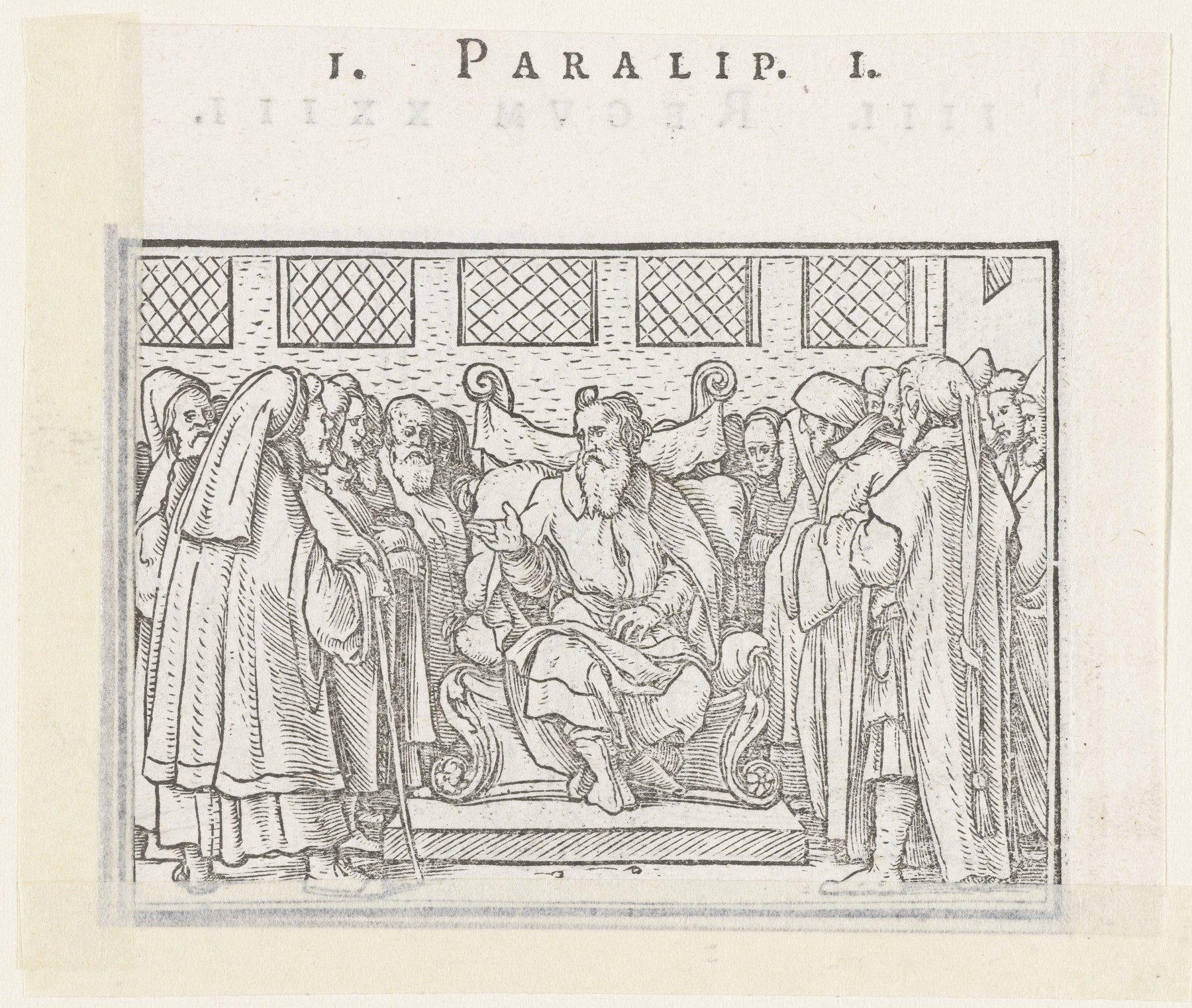
Hans Holbein, Old men round their forefather's throne, 1538. Public domain.
1 Chronicles 4:9 to 10 · Passage · Featured Study
The Prayer of Jabez
Two verses in the lists of Judah record the prayer of Jabez and God's answer to it.
A name given in pain stands over a prayer to be free from pain.
And Jabez called out to the God of Israel, “If only You would bless me and enlarge my territory! May Your hand be with me and keep me from harm, so that I will be free from pain.” And God granted the request of Jabez.
- The passage
- 1 Chronicles 4:9 to 10
- Book
- 1 Chronicles
- Hold in memory
- 1 Chronicles 4:10
Summary
Jabez stands among the families of Judah in 1 Chronicles 4. The page reads his two verses through their Hebrew, their place in the list, the old versions and three readings of the prayer.
- The Berean text names Jabez in three verses, all of them in 1 Chronicles.
- The Greek, Syriac and Arabic versions each change the words of the prayer.
- Commentators read the prayer three ways, each with its own objection.
A Name Born in Pain
The name Jabez echoes the Hebrew word for pain that his mother spoke over him.
Now Jabez was more honorable than his brothers. His mother had named him Jabez, saying, “Because I bore him in pain.”His mother's words give the name its meaning.
The Hebrew name is Ya'betz, and his mother says she bore him be'otzev, in pain. Jabez takes up the sound again at the end of his prayer, where he asks that harm not hurt him.
The Request in Four Clauses
Jabez makes four requests, and the verse closes with God's answer.
Each clause asks God to act: to bless, to enlarge, to be with him and to keep him.
| Clause | What Jabez asks, in brief | The Hebrew |
|---|---|---|
| 1 Blessing | God's blessing on him | 'im barekh tevarakheni, if You will truly bless me |
| 2 Territory | More land | gevuli, my territory |
| 3 Presence | God's help at his side | vehayetah yadkha 'immi, Your hand will be with me |
| 4 Keeping | Safety from harm and from the pain of his name | 'otzbi, to hurt me |
| The answer | Granted | vayyave 'Elohim 'et 'asher sha'al, God brought what he had asked |
Where the Two Verses Stand
The prayer breaks into a list of the families of Judah between Koz and Chelub.
The verses before and after the prayer are lists of fathers and sons.
- 1 Chronicles 2:55The clans of the scribes who lived at a town called Jabez1 Chronicles 2:55
- 1 Chronicles 4:1The descendants of Judah begin: Perez, Hezron, Carmi, Hur and Shobal1 Chronicles 4:1
- 1 Chronicles 4:8Koz, the father of Anub and Zobebah1 Chronicles 4:8
- The two versesJabez, his name and his prayer1 Chronicles 4:9 to 10
- 1 Chronicles 4:11Chelub the brother of Shuhah, and the list goes on1 Chronicles 4:11
The verses around the prayer, in the order of 1 Chronicles 2 and 4.
C. F. Keil says that whether Jabez was the lord of the town of the scribes cannot be determined. He notes that the older commentators made Jabez a son or a brother of Koz. They drew it from the words more honorable than his brothers.
The Old Versions of the Prayer
Adam Clarke printed the Greek, Syriac, Arabic and Aramaic forms of the two verses one after another.
In Clarke's English of the Septuagint, the old Greek translation, Jabez is called Igabes, and he asks God to give him understanding. The Syriac and the Arabic give the child the name My Eye, and in them a parent speaks the blessing over the child.
Clarke says the Targum, the old Aramaic rendering, differs from all the rest.
What the Text Leaves Unsaid
The two verses give Jabez no father's name, no age and no land.
Matthew Henry notes that the text does not say whose son Jabez was or in what age he lived. The verse also leaves untold how the answer came.
The God of Israel Answered
Keil and Jamieson, Fausset and Brown read the man's life from God's answer.
Keil reads the answer as the reason the prayer was handed down. In his reading God so fulfilled the wish that the life of Jabez contradicted his name. The son of sorrow lived free from pain and more honored than his brothers.
Jamieson, Fausset and Brown write that God proved Himself here the answerer of prayer as well as its hearer.
Voices on Jabez
Albert Barnes and Charles Spurgeon wrote on the man behind the prayer.
How this text has been taught2 voices, Albert Barnes and Charles Spurgeon
Albert Barnes, in his Notes, supposes that the first readers of Chronicles knew Jabez by tradition or by writings since lost.
Charles Spurgeon, in his sermon The Prayer of Jabez, began from the sorrow of the name. He taught that where the most sorrow goes before, the most pleasure sometimes follows, as clear sunshine follows a storm.
What Kind of Prayer Was It?
Commentators read the words of Jabez as a vow, as a prayer before a hard task, or as the prayer of a teacher.
A vow with its promise left outC. F. Keil, after Ernst Bertheau
Keil reads the words as a vow, of which only the conditions are given, with no then I will do this to follow. He compares Jacob's vow of Genesis 28:20, which opens with the same if and goes on to a promise. With Bertheau he hears echoes of Genesis in the name given for a birth and in the prayer to the God of Israel.
The objection: the verb is the common word for calling on God, and the verse uses no word for a vow.
A prayer before a hard undertakingJohn Wesley
John Wesley wrote his Explanatory Notes upon the Old Testament in 1765. He places the prayer when Jabez was taking up some great and dangerous service. He reads the enlarged border as the driving out of the Canaanites whom Israel was commanded to remove.
The objection: the two verses name no war and no Canaanites.
Jabez is Othniel, praying for disciplesThe Aramaic Targum, as Adam Clarke prints it
The Targum makes Jabez the judge Othniel, skilled in the law. In its reading he asks for children and for disciples, and for help against evil desire.
The objection: 1 Chronicles 4:13 lists Othniel in another family from the one around Jabez.
God Granted His Request
The list resumes with Chelub, and no later verse names Jabez again.
Sources
Scripture is the Berean Standard Bible.
- The Hebrew text of 1 Chronicles 4:9 to 10 tagged word by word, and Strong's dictionary entries h3258, h6090 and h6087.
- Albert Barnes, Notes, Explanatory and Practical, on the Old and New Testaments (1832 to 1869), on 1 Chronicles 4:9.
- Adam Clarke, Commentary on the Bible (1832), on 1 Chronicles 4:9, with the Septuagint, Syriac, Arabic and Chaldee in his English.
- Matthew Henry, Commentary on the Whole Bible (1710), on 1 Chronicles 4:9.
- John Wesley, Explanatory Notes upon the Old Testament (1765), on 1 Chronicles 4:10.
- Jamieson, Fausset and Brown, Commentary Critical and Explanatory on the Whole Bible (1871), on 1 Chronicles 4:10.
- Charles Spurgeon, The Metropolitan Tabernacle Pulpit, Sermon 994, The Prayer of Jabez (1871)
- C. F. Keil and F. Delitzsch, Biblical Commentary on the Old Testament, on 1 Chronicles 4:8 to 10, with Ernst Bertheau's note.
- Hans Holbein (II), cut by Veit Rudolf Specklin, Oude mannen verenigd rond een troon met stamvader, woodcut, 1538, Rijksmuseum RP-P-OB-4511Y(V); the museum marks it with the Public Domain Mark 1.0.
Keep Studying
People and groups5
Symbols1
Go further6
Values1