
Genesis 12:1 to 3 · Subject · Featured Study
The Call of Abraham
The LORD's call of Abram, which Joshua, Nehemiah, Stephen, Paul and the letter to the Hebrews each recall.
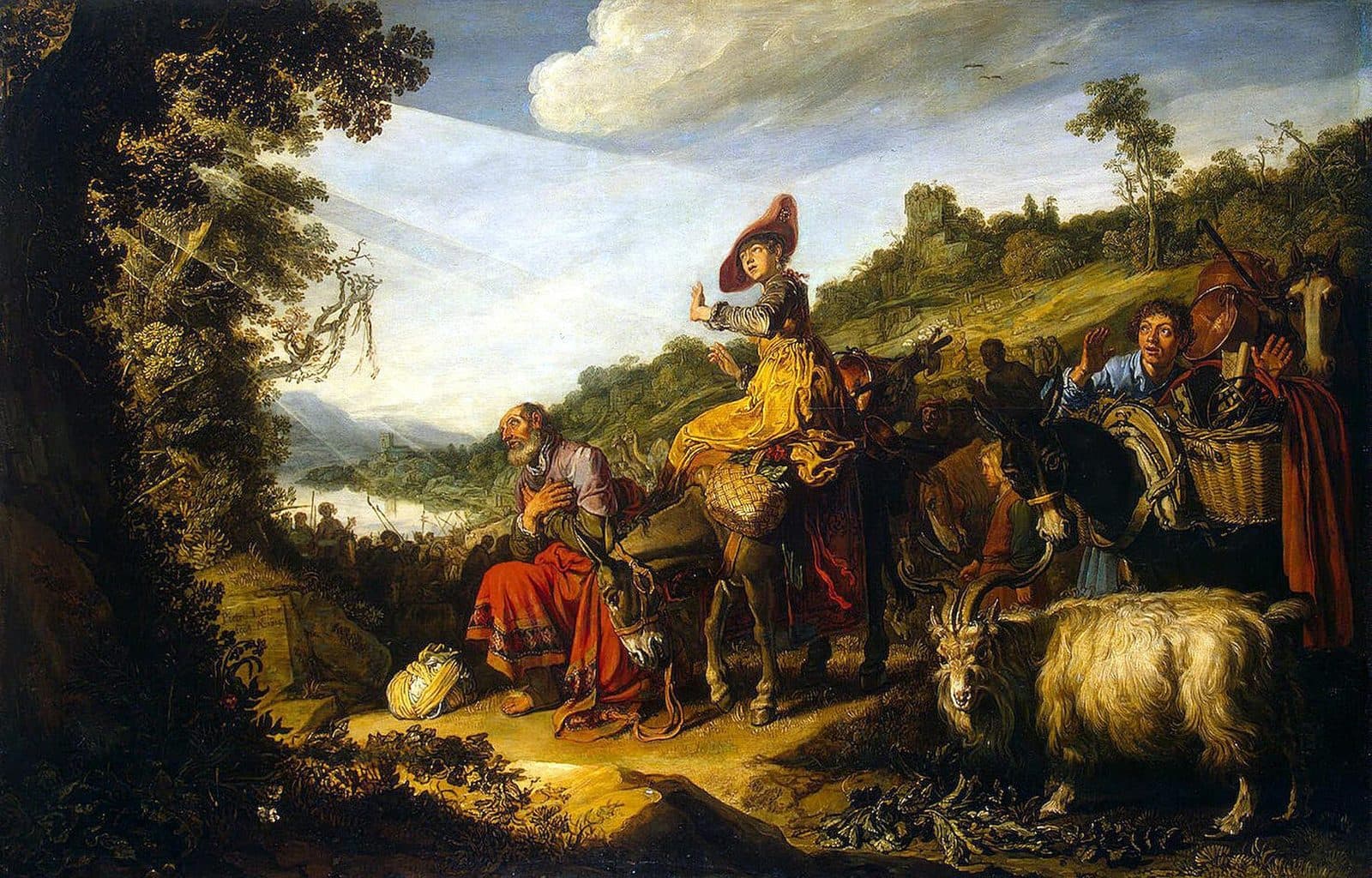
Pieter Lastman, Abraham's Journey to Canaan, 1614. Public domain, via Wikimedia Commons.
THE ARTWORKLastman painted the call and the journey in one scene. Abram kneels on the road to Canaan with his eyes on the light from heaven, and Sarai, the household and the flocks of Genesis 12:4 to 5 wait around him.
Abram set out from Haran toward a land the LORD had not yet named.
Summary
In Genesis 12 the LORD tells Abram to leave his country, kindred and father's household, and promises to make him a great nation and to bless all the families of the earth through him.
- Terah's household had left Ur of the Chaldeans for Canaan and stopped at Haran, where Terah died at 205.
- Abram left Haran with Sarai, Lot and all they had gained there, and built altars at Shechem and Bethel.
- Stephen in Acts 7 places God's first appearance to Abraham in Mesopotamia, before Haran.
- Paul calls the promise of Genesis 12:3 the gospel foretold to Abraham.
The Call in Haran
Genesis 11:31 to 12:6, the household on the road
The story begins with Terah, Abram's father, a generation before the call.
And Terah took his son Abram, his grandson Lot son of Haran, and his daughter-in-law Sarai the wife of Abram, and they set out from Ur of the Chaldeans for the land of Canaan. But when they arrived in Haran, they settled there. Terah lived 205 years, and he died in Haran.The LORD's words to Abram hold one command and six things He will do.
Then the LORD said to Abram, “Leave your country, your kindred, and your father’s household, and go to the land I will show you. I will make you into a great nation, and I will bless you; I will make your name great, so that you will be a blessing. I will bless those who bless you and curse those who curse you; and all the families of the earth will be blessed through you.”God speaks to Abram here for the first time in Genesis.
Abram answers with no word recorded.
So Abram departed, as the LORD had directed him, and Lot went with him. Abram was seventy-five years old when he left Haran. And Abram took his wife Sarai, his nephew Lot, and all the possessions and people they had acquired in Haran, and set out for the land of Canaan. When they came to the land of Canaan, Abram traveled through the land as far as the site of the Oak of Moreh at Shechem. And at that time the Canaanites were in the land.Every promise of Genesis 12:2 to 3 still lay ahead of him when he left.
From Ur to the Negev
The five stops of Genesis 11:31 to 12:9
The first two stops lie before Canaan and the last three inside it.
The House of Terah
Ur, the family's gods and the place of the city
Joshua, in his farewell at Shechem, speaks the LORD's words about Terah's house. The line of promise begins outside the promise.
And Joshua said to all the people, “This is what the LORD, the God of Israel, says: ‘Long ago your fathers, including Terah the father of Abraham and Nahor, lived beyond the Euphrates and worshiped other gods. But I took your father Abraham from beyond the Euphrates and led him through all the land of Canaan, and I multiplied his descendants. I gave him Isaac, and to Isaac I gave Jacob and Esau. I gave Esau Mount Seir to possess, but Jacob and his sons went down to Egypt.The question of Abram's own worship, under What the Text Leaves Unsaid, rests on this verse.
Where Ur stood is disputed. Jamieson, Fausset and Brown, in their commentary of 1871, placed it at Orfa in the north. Cyrus Gordon argued for the same region in Abraham and the Merchants of Ura in 1958. Alan Millard argued in Where Was Abraham's Ur? in 2001 for the mound of Tell el-Muqayyar in southern Iraq.
The Hebrew of the Call
The two opening words of the command and five words of the promise
Lekh lekha opens the command: lekh is the verb halak, to go, and lekha means for yourself, so the first words read go for yourself.
Rashi, in his commentary on Genesis, reads the words as for your own good: in the new land God would make him a great nation and give him children.
Barak, to bless, stands four times as a verb in Genesis 12:2 to 3, and its noun berakhah, a blessing, once in Genesis 12:2.
Genesis 12:3 uses two words for the curse. The one who disdains Abram takes qalal, to treat lightly, and God's answer takes arar, to curse.
Mishpachah is a clan, a family within a people. Genesis 10 ends by counting the clans of Noah's sons.
What the Text Leaves Unsaid
The reason for the choice, the land, Abram's own worship, the fire legend and Sarai's barrenness
Genesis gives no reason why God chose Abram and names no merit in him.
Didymus the Blind, in his commentary On Genesis, supplies a reason from outside the text.
“It is not by chance that God orders Abraham to leave his land and his relatives but because he sees in him something that makes him worthy of being the object of divine concern, that is, his faith in God.”
Didymus the Blind · On Genesis · on Genesis 12:1Patristic
Genesis 11:31 names Canaan as the household's goal, and the call of Genesis 12:1 names no land.
Whether Abram himself worshiped the gods of his father's house is left unsaid.
A later Hebrew legend, reported by Jerome in his Hebrew Questions on Genesis, has Abram thrown into the Chaldeans' fire for refusing to worship it and freed by God. Genesis tells only that the household left Ur.
The promise of a great nation stands beside Genesis 11:30 unanswered until Isaac is born.
But Sarai was barren; she had no children.It is recorded before the family's journey begins.
All the Families of the Earth
Genesis 12:3, Genesis 22:18 and Galatians 3:8
The call follows Babel, where the LORD scattered the builders across the earth. The promise turns to those scattered clans and says they will be blessed through one man.
The Hebrew of the promise in Genesis 12 puts the verb in the Niphal, they will be blessed, and the Berean text reads it so. The promise as repeated after the binding of Isaac puts it in the Hithpael, which can also read they will bless themselves, invoking Abraham's name in their own blessings.
And through your offspring all nations of the earth will be blessed, because you have obeyed My voice.”The second reading of the verb rests on this verse.
Paul writes to Gentile churches in Galatia and brings the promise into his argument.
The Scripture foresaw that God would justify the Gentiles by faith, and foretold the gospel to Abraham: “All nations will be blessed through you.” So those who have faith are blessed along with Abraham, the man of faith.Adam Clarke, in his Commentary on the Bible, reads through you as through the Messiah who would come from Abraham's line.
Three Voices on the Call
Three teachers on the call, earliest first
Matthew Henry, in his Commentary on the Whole Bible, reads the command as the pattern of the gospel call.
John Wesley, in his Explanatory Notes upon the Old Testament, calls Ur an idolatrous country and takes Terah's house as proof of how early idolatry spread.
Charles Spurgeon, in his sermon The Call of Abraham of 1859, preached the call as the start of a faith trained by long trials.
Where and When the Call Came
Acts 7:2 to 4 and Genesis 11:26 to 12:4
Genesis tells the call after Terah's death in Haran, and the first appearance of the LORD it records is at Shechem, after Abram has reached Canaan.
And Stephen declared: “Brothers and fathers, listen to me! The God of glory appeared to our father Abraham while he was still in Mesopotamia, before he lived in Haran, and told him, ‘Leave your country and your kindred and go to the land I will show you.’ So Abraham left the land of the Chaldeans and settled in Haran. After his father died, God brought him out of that place and into this land where you are now living.Readers ask two questions of the two accounts: whether God called Abram once or twice, and how the ages of Terah and Abram fit Stephen's order.
God appeared in Chaldea, and the household moved togetherJohn Chrysostom
John Chrysostom, in his Homilies on Genesis, says God called Abram to move, and Terah went with his son out of affection and died in Haran. God then moved Abram on to Canaan.
The objection: Genesis 11:31 has Terah lead the household out of Ur, where Chrysostom has the father follow the son.
Two calls, one at Ur and one at HaranWilliam Hales, reported by Adam Clarke; Jamieson, Fausset and Brown
Adam Clarke reports William Hales's case: the call at Ur is recorded only in Acts 7, and the call at Haran in Genesis 12 adds the command to leave the father's house. Jamieson, Fausset and Brown hold that Genesis 15:7 and Nehemiah 9:7 imply the first call.
You are the LORD, the God who chose Abram, who brought him out of Ur of the Chaldeans and gave him the name Abraham.The objection: Genesis records one command, and Stephen's words for it match the words of Genesis 12:1.
The ages of Terah and AbramJerome
Terah fathers his three sons from the age of seventy and dies at 205, and Abram leaves Haran at seventy-five. If Abram was born when Terah was seventy, Terah lived sixty years after Abram left, where Stephen says Abram left after his father died.
Jerome, in his Hebrew Questions on Genesis, calls this an unsolvable question.
Books on the Call
Three works that read Genesis 12 at length
Homilies on Genesis, Homily 31
John Chrysostom · c. 388
This homily gives in full the first reading on where the call came.
The City of God, Book 16
Augustine of Hippo · c. 420
Augustine follows Terah's family from Ur to Haran and weighs the years of Terah's life.
Effectual Calling, Illustrated by the Call of Abram, Sermon 843
Charles Spurgeon · 1868
Spurgeon preached this second sermon on the call nine years after the first.
Going Out by Faith
Hebrews 11 sets the call among the acts of faith.
By faith Abraham, when called to go to a place he would later receive as his inheritance, obeyed and went, without knowing where he was going. By faith he dwelt in the promised land as a stranger in a foreign country. He lived in tents, as did Isaac and Jacob, who were heirs with him of the same promise. For he was looking forward to the city with foundations, whose architect and builder is God.Keep studying
Read it1