
Psalm 90 · Subject · Death and Dying
Dying Well
Scripture asks its readers to number their days, and Christian books on dying well taught the sick and those beside them how to meet death in faith.
Richard Baxter wrote The Saints' Everlasting Rest far from home, in such poor health that he expected to die for many months, with no book to consult but his Bible.
So teach us to number our days, that we may present a heart of wisdom.
- Books
- Psalms, Ecclesiastes
- Hold in memory
- Psalm 39:4, Psalm 116:15
Summary
Dying well is the practice of preparing for death before it comes, so that a believer meets it in faith and peace. Scripture teaches it by prayer and by the deaths it records. The old books on the craft of dying named the temptations of the deathbed and the remedies against them.
- Psalm 90, which its title calls a prayer of Moses, asks God to teach His people to number their days, since the years pass quickly and are gone (Psalm 90:10 to 12).
- Jacob blessed Joseph's sons and Joseph spoke of the exodus as each was dying (Hebrews 11:21 to 22).
- Near his death Paul looked back on a race finished and a faith kept, and forward to a crown (2 Timothy 4:6 to 8).
- The Book of the Craft of Dying names five chief temptations of the dying, with counsel against each.
- Jeremy Taylor's Holy Dying teaches that a believer prepares for death on every day of life, long before sickness comes.
Preparing for Death
The Psalms and Ecclesiastes speak of the shortness of life.
Dying Well studies the practice of preparing for one's own death and for the death of those one loves.
The question it answers is how a Christian prepares to die. It gives the prayers of the Psalms and Ecclesiastes on the shortness of life and six practices Scripture gives for the end of life. It sets out the deaths of Jacob, Joseph, Moses and Stephen and the last letter of Paul. It then gives three books on dying well, from The Book of the Craft of Dying to Jeremy Taylor and Richard Baxter, and the teachers who read Psalm 90.
The prayer of Psalm 90 rests on the shortness of life: the psalm says of the years that "they quickly pass, and we fly away" (Psalm 90:10).
“Show me, O LORD, my end and the measure of my days. Let me know how fleeting my life is.The verse stands here because it makes for one man the request that Psalm 90:12 makes for a whole people.
It is better to enter a house of mourning than a house of feasting, since death is the end of every man, and the living should take this to heart.The Teacher sends the reader to the house of mourning, because there the living learn the end that awaits them.
Six Practices Scripture Gives the Dying
Each practice stands on a verse that records it or asks it.
Scripture shows the dying blessing their families, holding to God's promise and committing their spirits to the Lord.
| Practice | The Berean text | Verse |
|---|---|---|
| Remember that a life is a breath | "each man at his best exists as but a breath" | Psalm 39:5 |
| Set one's house in order | "Put your house in order, for you are about to die" | Isaiah 38:1 |
| Bless and instruct the family | "When Jacob had finished instructing his sons" | Genesis 49:33 |
| Speak of God's promise to those who remain | "God will surely visit you" | Genesis 50:24 |
| Commit one's spirit to the Lord | "Lord Jesus, receive my spirit." | Acts 7:59 |
| Call the elders to pray over the sick | "He should call the elders of the church to pray over him" | James 5:14 |
Deaths Scripture Records
Four deaths in Scripture and Paul's last letter show believers meeting the end in faith.
By faith Jacob, when he was dying, blessed each of Joseph’s sons and worshiped as he leaned on the top of his staff.The verse stands here because Hebrews counts Jacob's dying blessing among the acts of faith.
By faith Joseph, when his end was near, spoke about the exodus of the Israelites and gave instructions about his bones.The verse stands here because Joseph spoke at his death of a promise he would not live to see.
Stephen prayed for the men who were stoning him and then fell asleep (Acts 7:60).
For I am already being poured out like a drink offering, and the time of my departure is at hand. I have fought the good fight, I have finished the race, I have kept the faith.The verse stands here because Paul wrote it as a man who expected to die soon.
Three Books on Dying Well
An early English treatise and two works of the seventeenth century taught Christians to prepare for death.
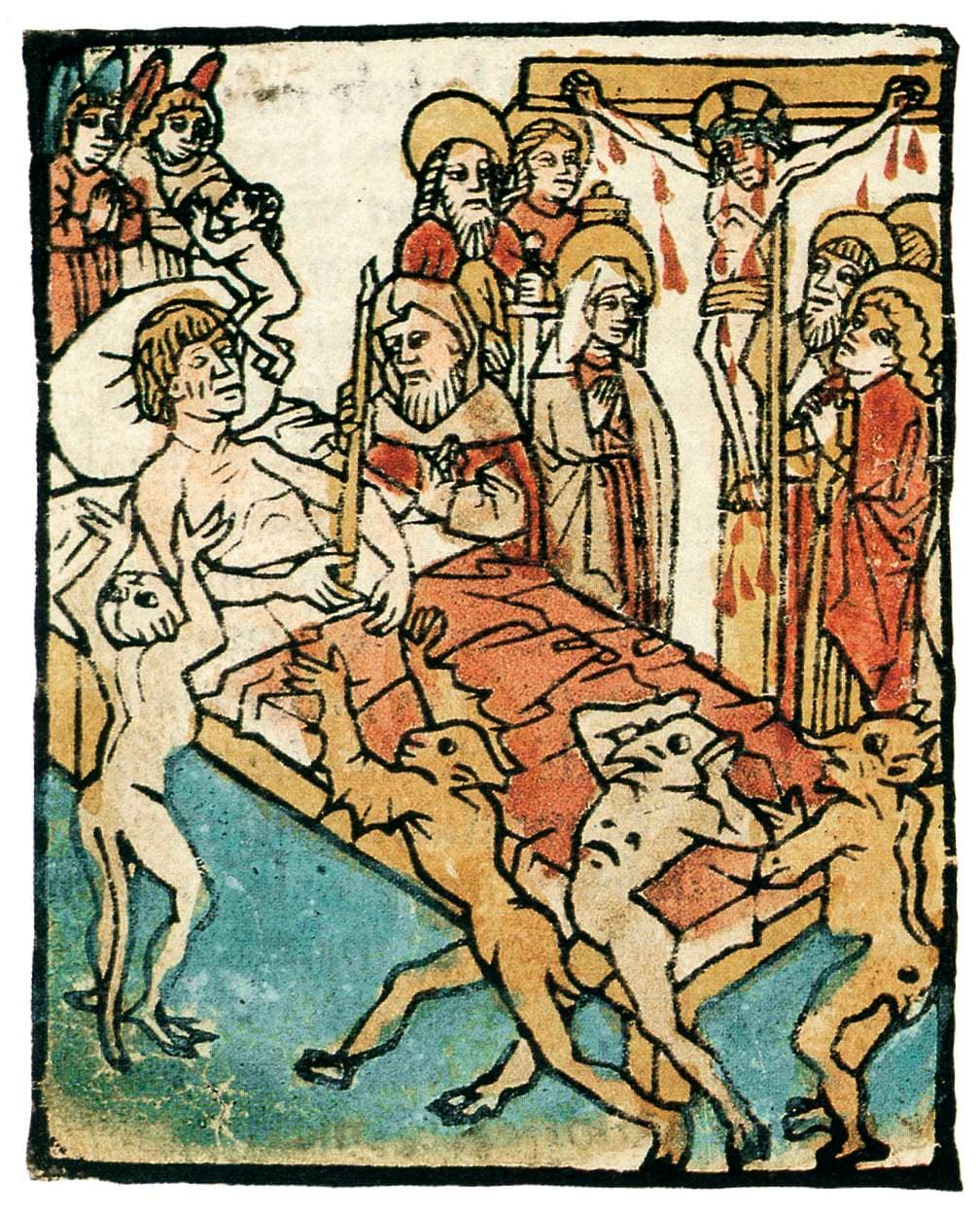
The Book of the Craft of Dying named the temptations of the deathbedThe Book of the Craft of Dying, in the collection of 1917
The Book of the Craft of Dying is an English treatise printed in the collection The Book of the Craft of Dying and Other Early English Tracts Concerning Death (1917). It opens by granting that "bodily death be most dreadful of all fearful things", as Aristotle had said in the third book of his Ethics.
Its second chapter treats the temptations of the dying and says that "of these temptations five be most principal". The first is against faith, the second is despair, the third impatience and the fourth complacence, a man's pleasure in himself. The fifth is "overmuch occupation, and business outward about temporal things".
Against despair it points to forgiven sinners: "we have open ensample in Peter that denied Christ; in Paul that pursued Holy Church". Its third chapter gives the questions to be asked of those who lie on their deathbed.
Jeremy Taylor wrote Holy Dying for the sick and those who tend themJeremy Taylor, The Rule and Exercises of Holy Dying
Jeremy Taylor (1613 to 1667), chaplain in ordinary to King Charles the First and later bishop of Down and Connor, wrote The Rule and Exercises of Holy Dying. His title page offers prayers "to be used by sick and dying persons, or by others standing in their attendance".
His second chapter gives three precepts preparatory to a holy death, to be practised in the whole of life, with a daily examination of one's actions. His third chapter names impatience and the fear of death as the two temptations of sickness.
Against the fear of death he wrote, "Either, therefore, let us be willing to die, when God calls". He asked that when God sends the scroll of death, "let us look on it as an act of mercy."
Richard Baxter turned the mind to the rest after deathRichard Baxter, The Saints' Everlasting Rest (1650)
Richard Baxter published The Saints' Everlasting Rest in 1650, as the prefatory notice of the abridged edition of 1758 records. The notice says that he wrote it "merely for his own use" and that he was then "little more than thirty years old".
Its chapters treat the rest of the saints, how a believer may discern a title to it, and how to lead a heavenly life upon earth.
What the Practice Asks
The practice includes the care of the body.
Scripture sets prayer beside care for the body. Medical and hospice care stand beside prayer and never in its place.
Luke, the beloved physician, and Demas send you greetings.The verse stands here because Paul names a physician among those who send greetings with him.
Teachers on Numbering Our Days
Adam Clarke and Charles Spurgeon read the prayer of Psalm 90:12 as a call to use the time that remains.
1762 to 1832 · Adam Clarke
Adam Clarke, in his Commentary on the Bible, asked readers to "deeply consider our own frailty, and the shortness and uncertainty of life, that we may live for eternity".
1834 to 1892 · Charles Spurgeon
Charles Spurgeon, in The Treasury of David, wrote, "Numeration is a child's exercise in arithmetic, but in order to number their days aright the best of men need the Lord's teaching."
Precious in His Sight
The believer who prepares for death prepares to meet God.
Psalm 116 gives thanks for a rescue from death, where the psalmist says, "The ropes of death entangled me" (Psalm 116:3), and tells the LORD, "You have delivered my soul from death" (Psalm 116:8).
Precious in the sight of the LORD is the death of His saints.The verse stands here because it gives the ground of every preparation for death.
Sources
Scripture is the Berean Standard Bible.
- The Book of the Craft of Dying, in The Book of the Craft of Dying and Other Early English Tracts Concerning Death (1917)
- Jeremy Taylor, The Rule and Exercises of Holy Dying, Christian Classics Ethereal Library edition.
- Richard Baxter, The Saints' Everlasting Rest (1650), abridged, with a prefatory notice signed B.F., Kidderminster, 25 December 1758, Christian Classics Ethereal Library edition.
- Adam Clarke, Commentary on the Bible.
- Charles Spurgeon, The Treasury of David, volume 4.
Keep Studying
Read it1
In this trial6
People and groups8