
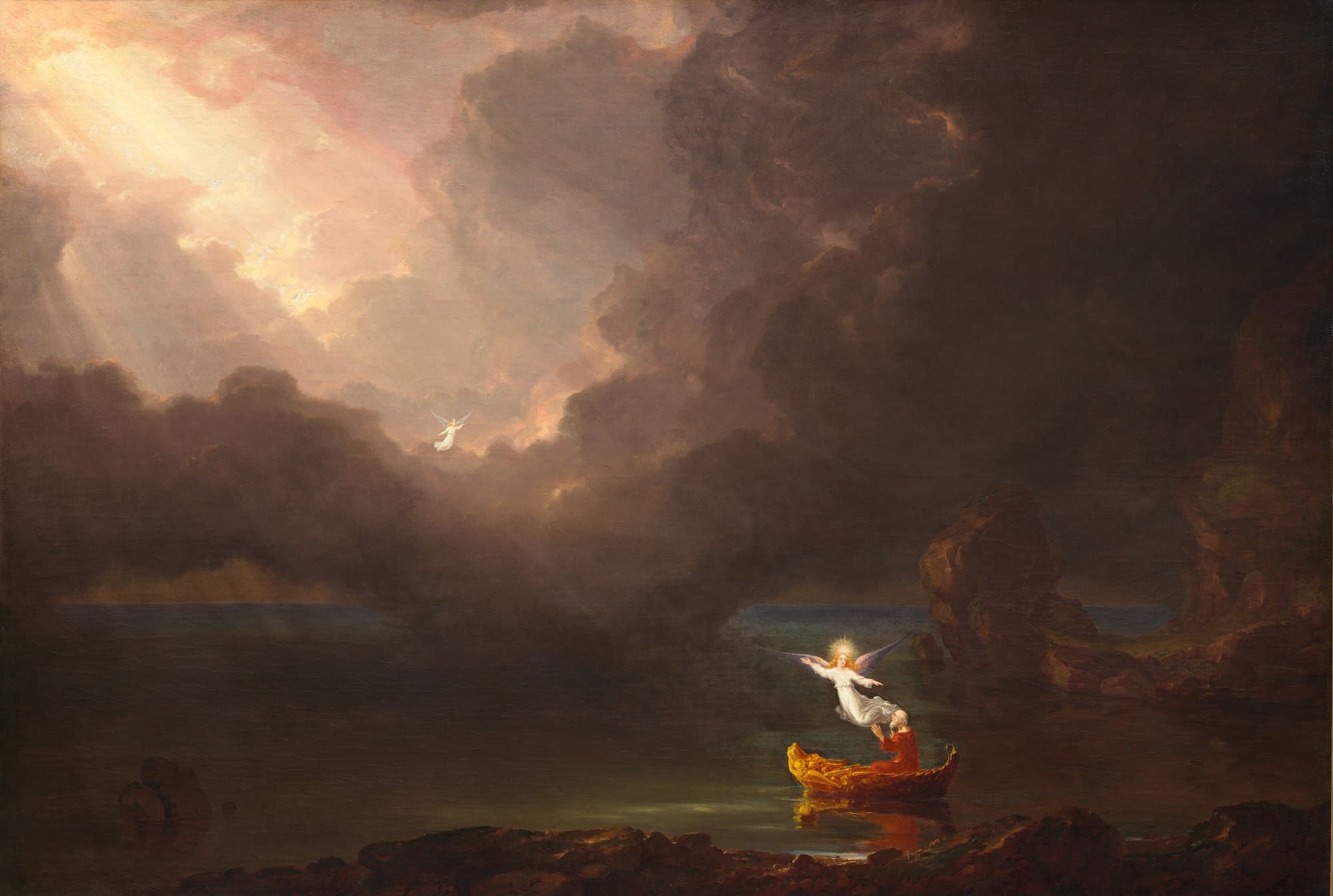
Psalm 23 · Passage · Death and Dying
The Valley of the Shadow
Psalm 23 tells how the LORD as shepherd leads the psalmist from green pastures, through a valley named for death, to a table and to the house of the LORD.
The Berean Standard Bible renders one Hebrew word “the shadow of death” in Psalm 23:4 and “gloom” in Job 10:21.
Even though I walk through the valley of the shadow of death, I will fear no evil, for You are with me; Your rod and Your staff, they comfort me.
- The passage
- Psalm 23:1 to 6
- Book
- Psalms
- Hold in memory
- Psalm 23:4, Psalm 23:6
Summary
Psalm 23 gives the one who faces death a companion for the road. Its word for the valley, tsalmaveth, names deep darkness, and the Bible uses it of the grave, of distress and of mortal danger. In that darkness the psalmist's comfort is the presence of the LORD. The psalm closes with goodness and mercy pursuing him and a dwelling in the house of the LORD.
- Readers take tsalmaveth either as two words joined, shadow and death, or as a single word for deep darkness.
- Jesus takes the shepherd's name for Himself in John 10:11 and ties it to His own death for the sheep.
- Readers divide over whether Psalm 23:6 looks beyond death to a dwelling with God or to a long life near His house.
- Augustine read the valley as the present life, and Charles Spurgeon read it as the believer's last hour.
A Psalm for the One Who Faces Death
Psalm 23 has six verses in four scenes, and the valley is the second.
The question this study answers is what comfort Psalm 23 holds for a person near death. It sets the psalm's four scenes side by side and shows where the psalmist turns from speaking of the LORD to speaking to Him. It follows tsalmaveth, the Hebrew word of the valley, through every place it stands, and it gives the hope of the last verse. It also gives the teachers who have read the valley and the readings of the word and of the house of the LORD.
The psalm opens with the LORD as shepherd: “The LORD is my shepherd; I shall not want” (Psalm 23:1). The pasture, the waters and the paths of righteousness of the first three verses are taught whole in the study of the psalm.
The work of a shepherd in Israel has its own study.
The Four Scenes of the Psalm
Each scene has its verses and its own way of naming the LORD.
The psalm moves through four scenes, and in the valley and at the table the psalmist speaks to the LORD instead of about Him.
| Scene | Verses | The Berean words | How the LORD is named |
|---|---|---|---|
| The pasture | Psalm 23:1 to 3 | “He makes me lie down in green pastures; He leads me beside quiet waters.” | Spoken of as He |
| The valley | Psalm 23:4 | “for You are with me” | Spoken to as You |
| The table | Psalm 23:5 | “You prepare a table before me in the presence of my enemies.” | Spoken to as You |
| The house | Psalm 23:6 | “I will dwell in the house of the LORD forever.” | Named as the LORD |
You Are with Me
The psalmist addresses the LORD for the first time in the valley.
In the first three verses the shepherd makes, leads, restores and guides, and each verb has He for its subject. In Psalm 23:4 the Hebrew sets the pronoun “you” before the words glossed “[are] with me”.
The verb of the valley is glossed “I will go”, the common verb for walking.
The comfort the psalmist names in the valley is the shepherd's own equipment, the rod and the staff, whose words and uses across Scripture have their own study.
Shadow as a picture in Scripture, for death, for distress and for God's protection, has its own study as well.
The Hebrew Word Tsalmaveth
The word behind the shadow of death stands in five books of the Old Testament.
The Hebrew word is tsalmaveth (H6757), which Strong's dictionary glosses “shade of death, i.e. the grave (figuratively, calamity)”. It stands 18 times in 17 verses, ten of them in Job, four in the Psalms, two in Jeremiah and one each in Isaiah and Amos.
The Tyndale House word-by-word gloss of the Hebrew Bible gives it as “deep darkness” in every one of those places.
Job 38:17 sets the word beside death itself: “Have the gates of death been revealed to you? Have you seen the gates of the shadow of death?”
The Greek translators of the Old Testament usually rendered the word “shadow of death”, as Brown, Driver and Briggs record. Matthew 4:16 quotes Isaiah 9:2 in the same words: “on those living in the land of the shadow of death, a light has dawned.”
The valley is gei (H1516), which Strong's glosses “a gorge”, a word used 59 times in the Old Testament.
The Table and the House
After the valley the shepherd becomes a host, and the psalm ends in the house of the LORD.
At the table the psalmist is an honoured guest in sight of his enemies: “You anoint my head with oil; my cup overflows” (Psalm 23:5).
The last verse speaks of the LORD again by name and looks to the whole span of life, with goodness and mercy following “all the days of my life”. Where the Berean reads “dwell”, the Hebrew verb is glossed “and I will return”, and “forever” stands for a phrase glossed “for length of days”.
The New Testament carries the shepherd to the cross: “I am the good shepherd. The good shepherd lays down His life for the sheep” (John 10:11).
The words Scripture uses for the place of the dead, Sheol, Hades and Paradise among them, have their own study.
Whether the believer is present with the Lord between death and the resurrection is the question of the intermediate state, which has its own study.
How the Valley Has Been Read
Augustine in the fifth century and Charles Spurgeon in the nineteenth read what the valley is.
1834 to 1892 · Charles Spurgeon
Charles Spurgeon, in The Treasury of David, wrote that the verse “has been sung on many a dying bed”. In a sermon of 1880 he told his hearers that he had meant to keep the text “till I came near the Jordan”, and had found he needed it at once.
Augustine, in his Exposition on Psalm 23, read the shadow as the present life. He wrote of walking “in the midst of this life, which is the shadow of death.” He read the presence of the LORD as the Lord dwelling “in my heart by faith”.
Two Questions of the Psalm
Readers divide over what tsalmaveth means and over whether the house of the LORD lies beyond death.
Tsalmaveth as shadow of death, a compound of shadow and deathThe Greek translators; Gesenius and Nöldeke, as Brown, Driver and Briggs list them
Brown, Driver and Briggs give the word as “death-shadow, deep shadow” in their Hebrew and English Lexicon of the Old Testament (1906). They take it as probably a compound of the words for shadow and death, and they list the Greek translators, Gesenius' Thesaurus and Theodor Nöldeke's article of 1897 for that reading.
The objection: the word stands where no death is in view, as in Amos 5:8, where the LORD “turns darkness into dawn”, and in Job 16:16, where “deep shadows ring my eyes”.
Tsalmaveth as deep darkness, from a root meaning to be darkHeinrich Ewald, Charles Briggs and most modern scholars, as Brown, Driver and Briggs report
Brown, Driver and Briggs report that Ewald, Briggs and most modern scholars read the word as tsalmuth, “darkness, deep darkness”, and compare words for being dark or black in Arabic, Assyrian and Ethiopic.
The objection: Job 38:17 sets the word beside the gates of death, and the Greek translators and Matthew 4:16 read it as the shadow of death.
The house of the LORD as a dwelling beyond this lifeAugustine of Hippo
Augustine read the mercy of Psalm 23:6 as following the psalmist through this mortal life and on into the house of the LORD. He wrote, “Now Your mercy shall follow me not here only, but also that I may dwell in the house of the Lord for ever.”
The objection: the verse's “length of days” can measure a life on earth.
The house of the LORD through a long life on earthAlbert Barnes
Albert Barnes held that the phrase “does not refer to eternity or to heaven”, and read it beside “all the days of my life” as the hope of a long life near God's house.
The objection: the same book of Psalms hopes for “eternal pleasures at Your right hand” (Psalm 16:11).
The house of the LORD for the rest of life and then in gloryAdam Clarke
Adam Clarke, in his Commentary on the Bible, rendered the verb “and I shall Return to the house of the Lord”. He read it of the rest of the psalmist's life and added that he “shall at last dwell with him in glory”.
The objection: Clarke also gave the last two verses to a priest returned from captivity, and the psalm names neither a priest nor an exile.
The Companion in the Valley
The psalm's answer to the fear of death is a person who goes with the walker.
For the one who faces death, Psalm 23 names the One who goes with him to the end of the road.
Sources
Scripture is the Berean Standard Bible.
- STEP Bible, Translators Brief lexicon of Extended Strongs for Hebrew (TBESH) and the Translators Amalgamated Hebrew Old Testament (TAHOT), Tyndale House, Cambridge, CC BY 4.0.
- James Strong, A Concise Dictionary of the Words in the Hebrew Bible (1890), entries 1516 and 6757.
- Francis Brown, S. R. Driver and Charles A. Briggs, A Hebrew and English Lexicon of the Old Testament (1906), entry צַלְמָוֶת.
- Albert Barnes, Notes, Explanatory and Practical, on the Old and New Testaments (1832 to 1869), on Psalm 23:1, 23:4 and 23:6.
- Charles Spurgeon, The Treasury of David, volume 1 (1869), on Psalm 23:4.
- Charles Spurgeon, The Valley of the Shadow of Death, Sermon 1595, The Metropolitan Tabernacle Pulpit (1880)
- Augustine of Hippo, Exposition on Psalm 23, in Nicene and Post-Nicene Fathers, first series, volume 8, edited by Philip Schaff (Buffalo, 1888)
- Adam Clarke, Commentary on the Bible (1832), on Psalm 23:6.
Keep Studying
Read it1
In this trial6
People and groups4
Symbols2
Doctrines2