
Matthew 5:10 to 12 · Passage · Persecution
Blessed Are the Persecuted
Matthew 5:10 to 12 closes the Beatitudes with a blessing on the persecuted, first in the third person and then spoken to Jesus' hearers.
In Luke's form of this blessing the disciples are told to leap for joy.
Blessed are those who are persecuted because of righteousness, for theirs is the kingdom of heaven.
- The passage
- Matthew 5:10 to 12
- Book
- Matthew
- Hold in memory
- Matthew 5:12
Summary
Jesus ends the Beatitudes by calling blessed those who suffer for what is right and for His sake, and He tells them to rejoice because their reward in heaven is great. The blessing reaches every disciple who is insulted, pursued or slandered for Him. Persecution for His sake is a mark of belonging to Him and an occasion for joy.
- The blessing on the persecuted repeats the promise of the first beatitude, the kingdom of heaven (Matthew 5:3 and Matthew 5:10).
- The blessing holds only where the evil said is false and the suffering is for the sake of Christ.
- Jesus names the prophets of Israel as those who were persecuted before His disciples (Matthew 5:12).
The Last Beatitude
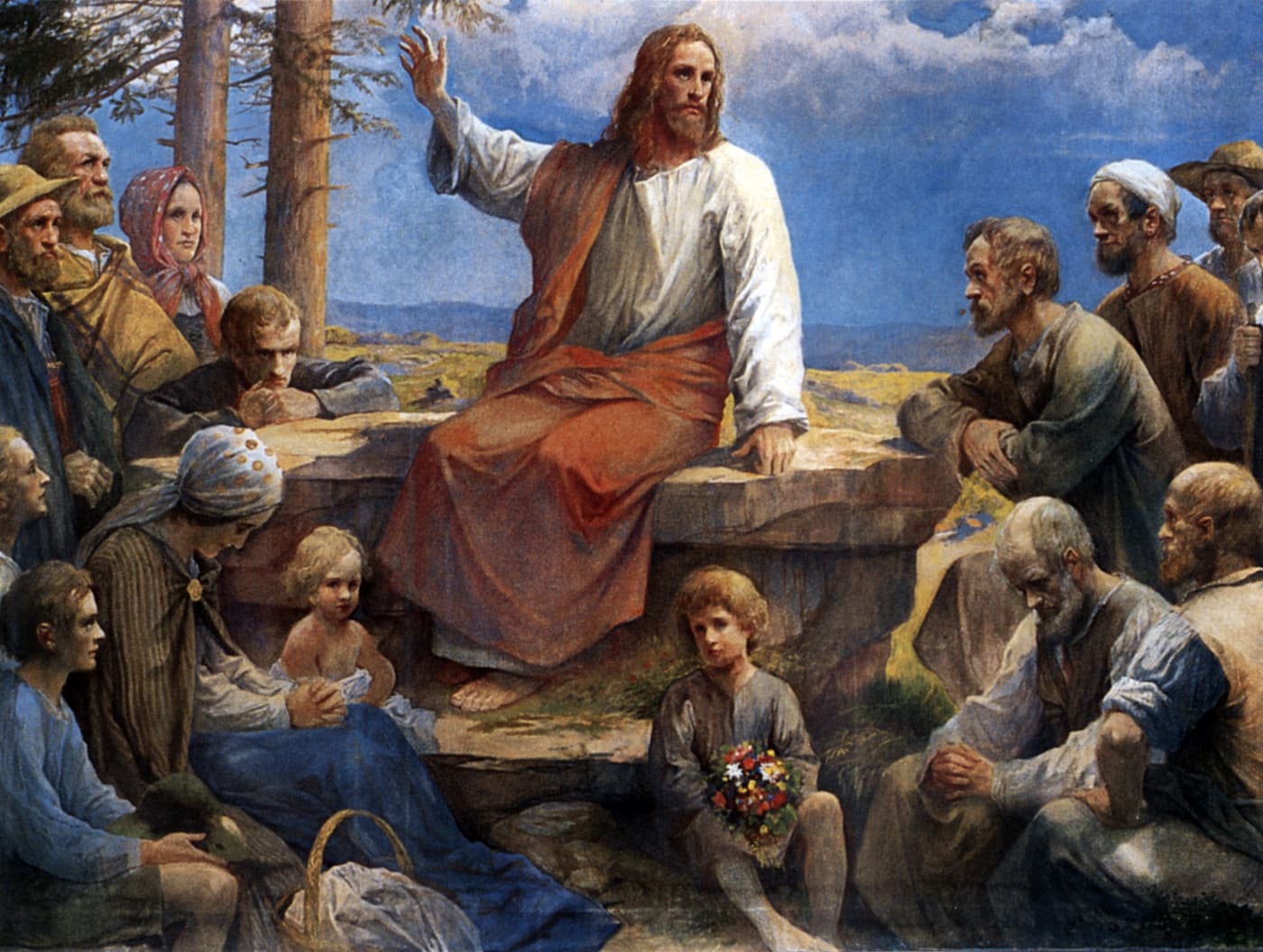
Jesus taught these blessings to His disciples on a mountain, where He sat down to teach (Matthew 5:1 to 2).
Jesus began the Sermon on the Mount with blessings on the poor in spirit, the mourners and the meek, and He ended them with the persecuted. A reader who meets hostility for following Christ finds in these three verses how Jesus Himself speaks of it.
This study asks whom Jesus calls blessed in Matthew 5:10 to 12, for what cause, and why He tells them to rejoice. It sets Matthew's form beside Luke's, reads the prophets Jesus names as the precedent, and gives three questions on which readers differ. The trial of persecution takes its first promise from these verses.
The blessings run from Matthew 5:3 to 12.
Matthew and Luke Side by Side
Luke gives the same blessing in his account of the sermon on a level place, with words of his own.
Both Gospels bless the persecuted, name the cause as Jesus, command joy and point to the prophets.
| Question | Matthew 5:10 to 12 | Luke 6:22 to 23 |
|---|---|---|
| Who is blessed | those who are persecuted; Blessed are you | Blessed are you |
| What is done | when people insult you, persecute you, and falsely say all kinds of evil against you | when people hate you, and when they exclude you and insult you and reject your name as evil |
| For whose sake | because of righteousness; because of Me | because of the Son of Man |
| What to do | Rejoice and be glad | Rejoice in that day and leap for joy |
| The reward | theirs is the kingdom of heaven; great is your reward in heaven | great is your reward in heaven |
| The precedent | in the same way they persecuted the prophets before you | For their fathers treated the prophets in the same way. |
From Those Who to You
Each verse adds to the one before it, a second cause, a command and a precedent.
The change of cause in Matthew 5:11 carries a claim about who Jesus is.
“He had before said, ‘for righteousness' sake.’ Here He identifies Himself and His cause with that of righteousness, binding up the cause of righteousness in the world with the reception of Himself. Would Moses, or David, or Isaiah, or Paul have so expressed themselves? Doubtless they suffered for righteousness' sake.”
Jamieson, Fausset & Brown · Commentary Critical and Explanatory on the Whole Bible · on Matthew 5:11Reformed
Jesus returns to reward in heaven in the next chapter, where He warns that righteousness done to be seen by men has no reward from the Father (Matthew 6:1).
The Prophets Before You
Matthew 23 and the Old Testament tell how some of the prophets were treated.
Jesus returned to the prophets' sufferings when He spoke to the crowds and His disciples about the scribes and Pharisees (Matthew 23:1).
O Jerusalem, Jerusalem, who kills the prophets and stones those sent to her, how often I have longed to gather your children together, as a hen gathers her chicks under her wings, but you were unwilling!Jesus names Jerusalem as the city that kills the prophets, the history Matthew 5:12 points to.
In the same speech Jesus names "Zechariah son of Berechiah, whom you murdered between the temple and the altar" (Matthew 23:35). The book of 2 Chronicles tells of Zechariah son of Jehoiada, a priest's son on whom the Spirit of God came. It says that "by order of the king, they stoned him in the courtyard of the house of the LORD" (2 Chronicles 24:21).
Pashhur the priest had "Jeremiah the prophet beaten and put in the stocks" (Jeremiah 20:2). Later, after the officials told the king that Jeremiah ought to die, they lowered him into a cistern that "had no water but only mud" (Jeremiah 38:6).
Joy for the Name
The apostles, Peter's letter and the rest of the sermon show what the blessing asks of a disciple.
The apostles left the Sanhedrin, rejoicing that they had been counted worthy of suffering disgrace for the Name.The council had just flogged the apostles and ordered them not to speak in the name of Jesus (Acts 5:40), and their joy is the response Matthew 5:12 commands.
Peter gives the blessing again to those who suffer for what is right and to those insulted for the name of Christ (1 Peter 3:14 and 1 Peter 4:14).
Later in the same sermon Jesus tells His hearers to "pray for those who persecute you" (Matthew 5:44).
The verb for persecuting in Matthew 5:10, Matthew 5:11 and Matthew 5:12 is diōkō, the Greek verb of pursuit.
Where Readers Differ
Readers differ on the number of the blessings, on the meaning of righteousness and on the measure of the reward.
Seven, eight or nine blessingsCharles Spurgeon; Matthew Henry; Bernardo Estrada
Charles Spurgeon spoke of "each of the seven Beatitudes", each rising above the one before it. Matthew Henry counted "eight beatitudes, which may justly be called paradoxes". Bernardo Estrada, in Biblica (2010), follows "the classical number of 8+1 beatitudes" and calls Matthew 5:11 to 12 "The ninth, concluding beatitude".
The strongest objection to a ninth is that Matthew 5:11 changes to the second person and leaves the pattern of the others. Against seven stands Matthew 5:10, which has a subject and a promise of its own in the form of the others. Against eight stands Matthew 5:11, which opens with the word Blessed as every beatitude does.
What because of righteousness meansJohn Chrysostom; Augustine of Hippo; John Wesley
John Chrysostom read righteousness here as right conduct, "for virtue's sake, for succor given to others, and for godliness".
Augustine tied the word to faith and wrote that "where there is no sound faith, there can be no righteousness". John Wesley read it as the righteousness the Beatitudes themselves describe, persecuted "because they have, or follow after, the righteousness here described".
Against the first reading stands Matthew 5:11, where the cause is Jesus Himself. Against the second stands Matthew 5:6, where righteousness is something a person hungers for.
The measure of the rewardAlbert Barnes; John Gill
Albert Barnes held that the reward grows with the suffering, writing that "To those who suffer most, God imparts the highest rewards".
John Gill called the reward "not of debt, but of grace; for there is no proportion or comparison between what the saints suffer for Christ, and the glory that shall be revealed in them".
Against a reward measured by suffering stands Gill's point that no suffering compares with the glory. Against Gill stands the word great in Matthew 5:12, a reward promised to the persecuted in particular.
Great Is Your Reward
Paul wrote to the church at Corinth of the weight of glory that affliction produces.
The reward of Matthew 5:12 lies ahead of the disciple, and the joy Jesus commands looks toward it.
For our light and momentary affliction is producing for us an eternal weight of glory that is far beyond comparison.This verse stands here because it shows a persecuted apostle measuring his suffering against the glory, as Matthew 5:12 asks a disciple to do.
Sources
Scripture is the Berean Standard Bible.
- STEP Bible, the Translators Amalgamated Greek New Testament (TAGNT), Tyndale House, Cambridge, CC BY 4.0.
- Jamieson, Fausset and Brown, Commentary Critical and Explanatory on the Whole Bible (1871), on Matthew 5:11.
- Matthew Henry, Commentary on the Whole Bible (1710), on Matthew 5:1 to 2.
- John Chrysostom, Homilies on Matthew, Homily 15, on Matthew 5:10 to 12.
- Augustine of Hippo, Our Lord's Sermon on the Mount, 1.5.13.
- John Wesley, Explanatory Notes upon the New Testament (1755), on Matthew 5:10.
- Charles Spurgeon, The Fourth Beatitude, Metropolitan Tabernacle Pulpit, Sermon 3157 (1909)
- Albert Barnes, Notes, Explanatory and Practical (1832 to 1869), on Matthew 5:10 and 5:12.
- John Gill, Exposition of the New Testament (1746 to 1748), on Matthew 5:12.
- Bernardo Estrada, "The Last Beatitude. Joy in Suffering", Biblica 91 (2010) 187 to 209.
Keep Studying
Read it2
In this trial4
People and groups10