
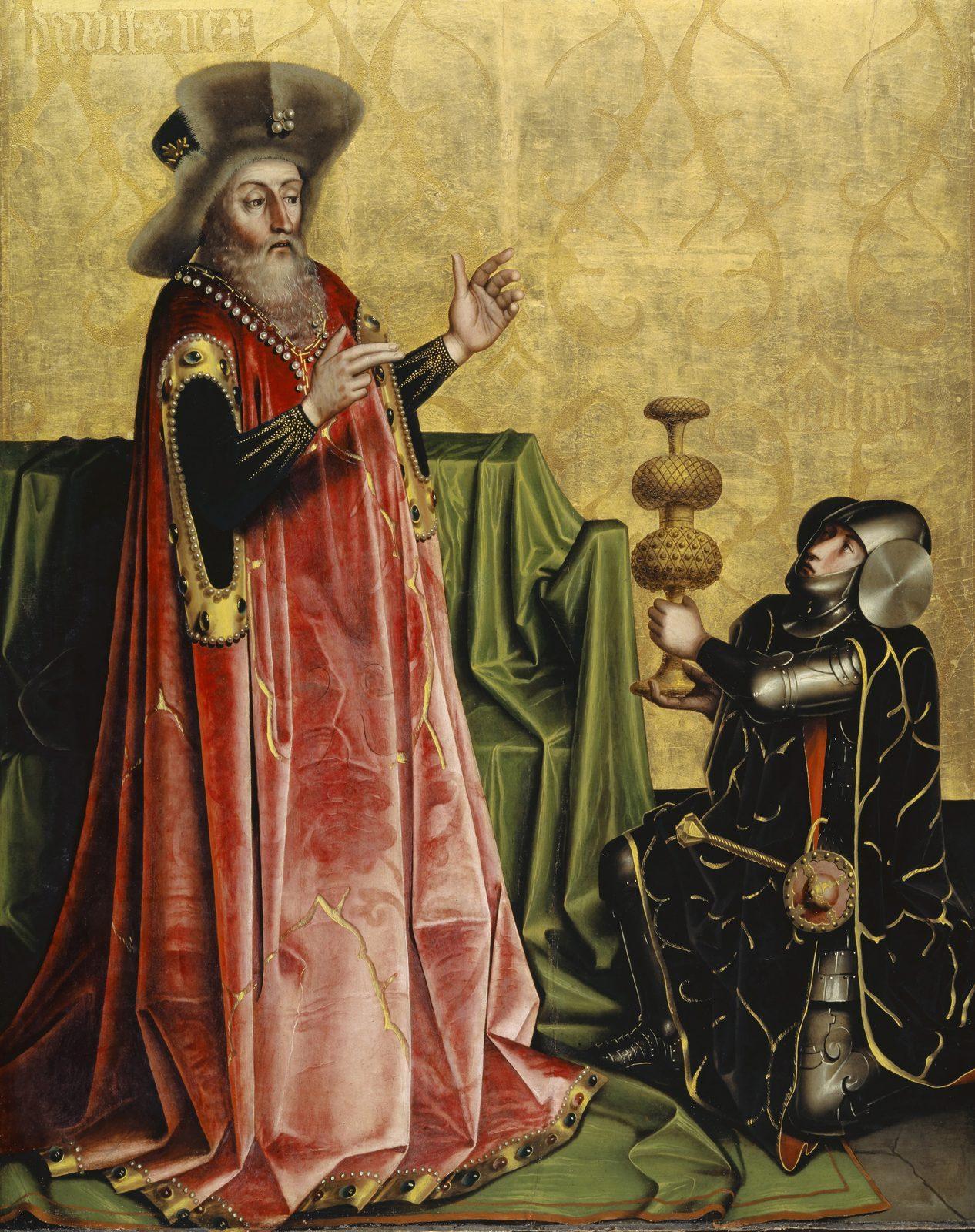
Konrad Witz, Abishai before David, about 1435. Public domain.
1 Samuel · Group · Featured Study
David's mighty men
The rolls of 2 Samuel 23 and 1 Chronicles 11 name the warriors who fought for David, ranked as the Three and the Thirty.
About four hundred men in distress gathered to David, and their names stand in Scripture as his mighty men.
These are the names of David’s mighty men: Josheb-basshebeth the Tahchemonite was chief of the Three. He wielded his spear against eight hundred men, whom he killed at one time.
- Began
- Gathered to David at the cave of Adullam (1 Samuel 22:1 to 2)
Summary
David's mighty men were the warriors who joined him while Saul hunted him. They fought for him as king, and 2 Samuel 23 and 1 Chronicles 11 list their names.
- The first band gathered at the cave of Adullam, with David's own family among them.
- The roll names the Three first, Josheb-basshebeth, Eleazar and Shammah, and then Abishai and Benaiah.
- Three of the Thirty broke through the Philistine camp to bring David water from Bethlehem's well.
- Two men of the roll, Eliam and Uriah, bear names that stand again in the story of Bathsheba.
The Names of David's Mighty Men
The men first gather at Adullam, and their roll stands near the end of 2 Samuel.
So David left Gath and took refuge in the cave of Adullam. When his brothers and the rest of his father’s household heard about it, they went down to him there. And all who were distressed or indebted or discontented rallied around him, and he became their leader. About four hundred men were with him.The band begins with David's family and about four hundred men in trouble.
Now these were the chiefs of David’s mighty men, who, together with all Israel, bolstered and strengthened his kingdom, according to the word of the LORD concerning Israel.Chronicles sets the same roll beside David's kingship, according to the word of the LORD.
The cave of AdullamJamieson, Fausset and Brown on 1 Samuel 22:1
Jamieson, Fausset and Brown place the caves of Adullam “six miles southwest from Beth-lehem,” on the borders of the Philistine plain.
The Three and the Thirty
The roll gives each man a rank.
Under David stand the Three, then Abishai and Benaiah, then the Thirty.
Generation 1
- DavidThe king the men served
Generation 2
- Josheb-basshebethChief of the Three, against eight hundred men
- Eleazar son of DodoOne of the Three, whose hand stuck to his sword
- Shammah son of AgeeOne of the Three, who held the field of lentils
Generation 3
- Abishai son of ZeruiahCommander of the Three, against three hundred men
- Benaiah son of JehoiadaMost honored among the Thirty, over David's guard
Generation 4
- The ThirtyThirty-one entries from Asahel to Uriah the Hittite
Each rank as 2 Samuel 23 gives it.
The Thirty, name by name2 Samuel 23:24 to 39
The thirty-one entries of the Thirty in the order of 2 Samuel 23, each with the town or people the roll gives.
| Name | From | Verse |
|---|---|---|
| Asahel, brother of Joab | not given | 2 Samuel 23:24 |
| Elhanan son of Dodo | Bethlehem | 2 Samuel 23:24 |
| Shammah | Harod | 2 Samuel 23:25 |
| Elika | Harod | 2 Samuel 23:25 |
| Helez | Pelet | 2 Samuel 23:26 |
| Ira son of Ikkesh | Tekoa | 2 Samuel 23:26 |
| Abiezer | Anathoth | 2 Samuel 23:27 |
| Mebunnai | Hushah | 2 Samuel 23:27 |
| Zalmon | the Ahohites | 2 Samuel 23:28 |
| Maharai | Netophah | 2 Samuel 23:28 |
| Heled son of Baanah | Netophah | 2 Samuel 23:29 |
| Ittai son of Ribai | Gibeah of the Benjamites | 2 Samuel 23:29 |
| Benaiah | Pirathon | 2 Samuel 23:30 |
| Hiddai | the brooks of Gaash | 2 Samuel 23:30 |
| Abi-albon | Arabah | 2 Samuel 23:31 |
| Azmaveth | Bahurim | 2 Samuel 23:31 |
| Eliahba | Shaalbon | 2 Samuel 23:32 |
| The sons of Jashen | not given | 2 Samuel 23:32 |
| Jonathan son of Shammah | Harar | 2 Samuel 23:33 |
| Ahiam son of Sharar | Harar | 2 Samuel 23:33 |
| Eliphelet son of Ahasbai | Maacah | 2 Samuel 23:34 |
| Eliam son of Ahithophel | Giloh | 2 Samuel 23:34 |
| Hezro | Carmel | 2 Samuel 23:35 |
| Paarai | Arab | 2 Samuel 23:35 |
| Igal son of Nathan | Zobah | 2 Samuel 23:36 |
| Bani | Gad | 2 Samuel 23:36 |
| Zelek | Ammon | 2 Samuel 23:37 |
| Naharai, Joab's armor-bearer | Beeroth | 2 Samuel 23:37 |
| Ira | the Ithrites | 2 Samuel 23:38 |
| Gareb | the Ithrites | 2 Samuel 23:38 |
| Uriah | the Hittites | 2 Samuel 23:39 |
Abiezer, Mebunnai, Zalmon, Maharai, Heled son of Baanah, Ittai son of Ribai, Benaiah, Hiddai and 17 more
Matthew Henry explains the men's surnames.
“The surnames here given them are taken, as it should seem, from the places of their birth or habitation, as many surnames with us originally were. From all parts of the nation, the most wise and valiant were picked up to serve the king. Several of those who are named we find captains of the twelve courses which David appointed, one for each month in the year, 1 Chron. xxvii .”
Matthew Henry · Commentary on the Whole Bible · on 2 Samuel 23:9Puritan
From Adullam to the Throne
Men joined David in the cave, at Ziklag and in the stronghold, and they guarded him as king.
Now these were the men who came to David at Ziklag, while he was still banished from the presence of Saul son of Kish (they were among the mighty men who helped him in battle; they were archers using both the right and left hands to sling stones and shoot arrows; and they were Saul’s kinsmen from Benjamin):The king's own tribe began to change sides.
Some Gadites defected to David at his stronghold in the desert. They were mighty men of valor, trained for battle, experts with the shield and spear, whose faces were like the faces of lions and who were as swift as gazelles on the mountains:Men of a tribe east of the Jordan joined David before he was king.
Then the Spirit came upon Amasai, the chief of the Thirty, and he said: “We are yours, O David! We are with you, O son of Jesse! Peace, peace to you, and peace to your helpers, for your God helps you.” So David received them and made them leaders of his troops.Amasai's words make the band's loyalty an oath.
Once again the Philistines waged war against Israel, and David and his servants went down and fought against the Philistines; but David became exhausted. Then Ishbi-benob, a descendant of Rapha, whose bronze spear weighed three hundred shekels and who was bearing a new sword, resolved to kill David. But Abishai son of Zeruiah came to his aid, struck the Philistine, and killed him. Then David’s men swore to him, “You must never again go out with us to battle, so that the lamp of Israel may not be extinguished.”The men guarded the king's life as the lamp of Israel.
Matthew Henry applies the roll to Christ's servants, a likeness that is Henry's own reading.
“Christ, the Son of David, has his worthies too, who like David's, are influenced by his example, fight his battles against the spiritual enemies of his kingdom, and in his strength are more than conquerors. Christ's apostles were his immediate attendants, did and suffered great things for him, and at length came to reign with him.”
Matthew Henry · Commentary on the Whole Bible · on 2 Samuel 23:34Puritan
Charles Spurgeon preached that these men “came to David when his fortunes were at the lowest ebb.” The sermon, on Eleazar, was printed in 1910.
1 Chronicles 12:18, 2 Samuel 21:15 to 17
The Water from the Well of Bethlehem
David turned a soldier's gift into an offering to the LORD.
David longed for water and said, “Oh, that someone would get me a drink of water from the well near the gate of Bethlehem!” So the three mighty men broke through the Philistine camp, drew water from the well near the gate of Bethlehem, and brought it back to David. But he refused to drink it; instead, he poured it out to the LORD, saying, “Far be it from me, O LORD, to do this! Is this not the blood of the men who risked their lives?” So he refused to drink it. Such were the exploits of the three mighty men.David will not treat his men's lives as the price of his thirst.
Matthew Henry wrote that David thought the water “too precious for his own drinking and fit only to be poured out to God as a drink-offering.”
Gregory the Dialogist on David's desireForty Gospel Homilies, Homily 34, on 2 Samuel 23:16
Gregory the Dialogist reads the scene as David's repentance at work.
“When long afterward David sat against the battle lines of enemies, he wished from desire to drink water from the cistern of Bethlehem. His chosen soldiers, breaking through the midst of the opposing forces, brought back unharmed the water the king had desired. But the man instructed by scourges immediately reproached himself for having desired water at the peril of his soldiers, and pouring it out, he offered it to the Lord, as it is written there: He poured it out to the Lord.”
Gregory the Dialogist · Forty Gospel Homilies, Homily 34 · on 2 Samuel 23:16Patristic
Foreigners in the Roll
The roll gathers men of other nations into David's service.
Igal came from Zobah, Zelek was an Ammonite, and Uriah was a Hittite, while Elhanan came from David's own Bethlehem.
So David sent and inquired about the woman, and he was told, “This is Bathsheba, the daughter of Eliam and the wife of Uriah the Hittite.”A man named Eliam and Uriah the Hittite both stand in the roll.
John Gill wrote on 2 Samuel 23:34 that the Jews suppose Eliam son of Ahithophel to be the father of Bathsheba.
What the Roll Leaves Unsaid
Albert Barnes leaves the third man of the second three unnamed, and Jamieson, Fausset and Brown name him Asahel.
The Last Name on the Roll
Uriah the Hittite stands last of the thirty-seven.
and Uriah the Hittite. There were thirty-seven in all.The total of thirty-seven depends on how the ranks are counted.
The man David had killed keeps his place among the mighty men.
Why then have you despised the command of the LORD by doing evil in His sight? You put Uriah the Hittite to the sword and took his wife as your own, for you have slain him with the sword of the Ammonites.The prophet names the sin against the last man of the roll.
How the Roll Is Counted
Commentators differ on how the roll reaches thirty-seven and on the number Josheb-basshebeth killed.
Two orders of three and thirty-one namesAlbert Barnes on 2 Samuel 23:19 and 2 Samuel 23:39
Barnes counts the two orders of three and the thirty-one names from 2 Samuel 23:24, which make thirty-seven, with Joab apart as captain of the host.
Three, three, thirty and JoabJohn Gill on 2 Samuel 23:39
Gill counts the first three, the second three, thirty men of the third order and Joab over them all.
The objection is that the roll names Joab only as a brother and a master, never among the mighty men.
Eight hundred or three hundredAdam Clarke on 2 Samuel 23:8; John Wesley on 1 Chronicles 11:11
This is the list of David’s mighty men: Jashobeam son of Hachmoni was chief of the officers; he wielded his spear against three hundred men, whom he killed at one time.Against this verse stands the eight hundred of 2 Samuel 23:8.
Adam Clarke judged the three hundred of Chronicles to be the true reading.
John Wesley held that the chief killed three hundred by his own hand and that five hundred more fell to the men who joined him.
Books to Read Next
Commentary on the Whole Bible, volume 2
Matthew Henry · 1710
Henry reads the roll of 2 Samuel 23 and its retelling in 1 Chronicles 11.
Free at the Christian Classics Ethereal LibraryExplanatory Notes upon the Old Testament
John Wesley · 1765
Wesley's notes set the two rolls of Samuel and Chronicles side by side.
Free at the Christian Classics Ethereal LibraryMen in Distress Made Mighty
Twice the roll says the LORD brought about the victory their swords won.
Sources
Scripture is the Berean Standard Bible.
- The Hebrew words of the verses with their Strong's numbers.
- Jamieson, Fausset and Brown, Commentary Critical and Explanatory on the Whole Bible (1871), on 2 Samuel 23:19 and 1 Samuel 22:1.
- Matthew Henry, Commentary on the Whole Bible (1710), on 2 Samuel 23:9, 23:17, 23:34 and 1 Chronicles 11:18 to 19.
- Gregory the Dialogist, Forty Gospel Homilies, Homily 34 (604), on 2 Samuel 23:16.
- Charles Spurgeon, The Metropolitan Tabernacle Pulpit, Sermon No. 3193, The Man Whose Hand Stuck to His Sword (printed 1910, CCEL edition), on 2 Samuel 23:9 to 10.
- Albert Barnes, Notes, Explanatory and Practical, on the Old and New Testaments (1832 to 1869), on 2 Samuel 23:13, 23:19 and 23:39.
- John Gill, Exposition of the Old Testament (1748 to 1763), on 2 Samuel 23:34 and 23:39.
- Adam Clarke, Commentary on the Bible (1832), on 2 Samuel 23:8.
- John Wesley, Explanatory Notes upon the Old Testament (1765), on 1 Chronicles 11:11.
Keep Studying
Read it3
Studies6
People and groups4
Doctrines1
Go further8