
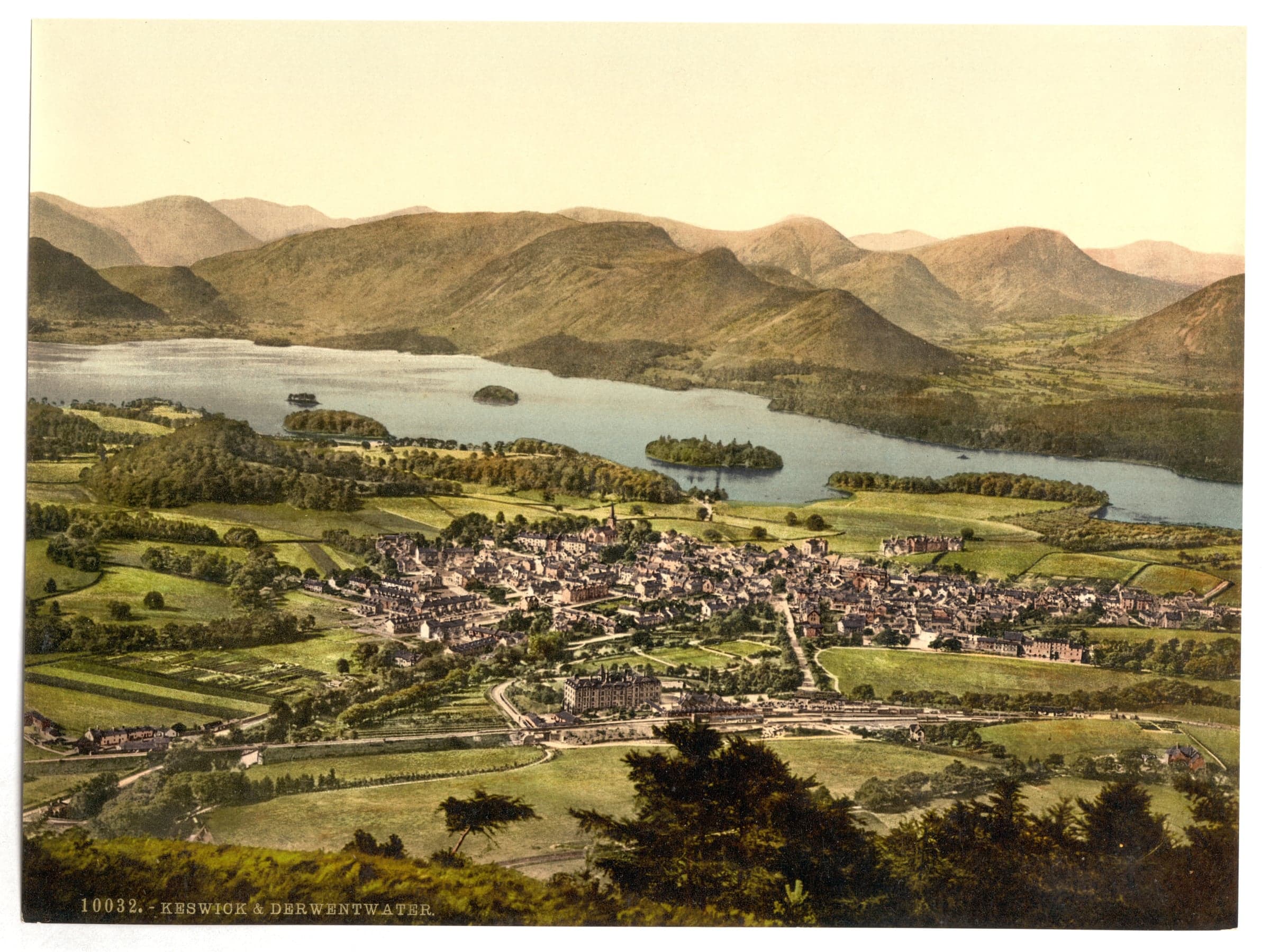
Derwentwater and Keswick, a photochrom, 1890 to 1900. Public domain.
The first Keswick Convention · Story · Featured Study
Keswick, 1875
Keswick's convention for holiness grew out of four meetings in two years.
- When
- 17 July 1874 to 2 July 1875
Moule wrote in the Memoir's preface that Harford-Battersby's life showed the saying “not new truth, but new trust.”
Rest in God alone, O my soul, for my hope comes from Him.
Summary
T. D. Harford-Battersby, the vicar of St John's at Keswick, called a convention for holiness at the end of June. By 1889 it had met there in the last week of July every year since 1876.
- Pearsall Smith's articles on holiness had come out in the Christian in 1873.
- In 1886 and 1887 the tent was lent on the Saturday for a missionary meeting.
- Amy Carmichael sailed in 1893 as the first missionary sent by the Keswick Mission Committee.
- Hudson Taylor spoke at the convention now and then, when he was home from China.
The Texts of the Convention
These verses stand in the record of the convention and of the years that led to it.
There is neither Jew nor Greek, slave nor free, male nor female, for you are all one in Christ Jesus.Robert Wilson chose the motto over the tent door from these words, Harford's The Keswick Convention says.
O Israel, put your hope in the LORD, for with the LORD is loving devotion, and with Him is redemption in abundance. And He will redeem Israel from all iniquity.Harford-Battersby preached on it in September 1873, while he wrestled with the teaching of the higher life.
Do not present the parts of your body to sin as instruments of wickedness, but present yourselves to God as those who have been brought from death to life; and present the parts of your body to Him as instruments of righteousness.A chapter of Harford's The Keswick Convention took its call to yield as “a crisis with a view to a process,” in Moule's phrase.
The Four Meetings
The meetings grew from a hundred people to thousands, and Keswick began small.
Brighton drew the largest crowd of the four.
| Meeting | Dates | How many came |
|---|---|---|
| Broadlands, a country house | 17 to 23 July | About a hundred attended, by Hopkins and the Account of the Oxford meeting. |
| Oxford, the union meeting | 29 August to 7 September | More than a thousand came, by the Account's preface. |
| Brighton, in the Pavilion | 29 May to 7 June | Hopkins gives eight thousand, and Webb-Peploe says only that it was said. |
| Keswick, in a tent | 28 June to 2 July | Three or four hundred came at first and as many as six hundred later, by Webb-Peploe. |
The First Convention
The circular promised three days, and the meetings ran from a Monday to a Friday.
Harford-Battersby had found “the rest of faith” at Oxford, and he consulted his friend Robert Wilson of Broughton Grange, near Cockermouth, who had been at the Oxford and Brighton meetings.
Their circular was headed “Three Days' Union Meetings for the Promotion of Practical Holiness” and invited “Christians of every section of the church of God.”
The tent was a marquee used for the diocese's own work, and it held about six hundred people.
Pearsall Smith sent word at the last moment that he could not come. He left England soon after, the Memoir says. Webb-Peploe wrote that he was ill.
The Record reported that the convention had been indefinitely postponed for the Smiths' absence, but it met.
A prayer meeting in the marquee opened it on the Monday evening, and it closed with praise on the Friday.
Webb-Peploe names the speakers as George Thornton, H. Bowker, T. M. Croome, an American named Shipley, and himself.
The Collapse of Pearsall Smithism
The evangelical press turned on Smith's teaching before the year was out.
Shortly before Christmas the Record ran three articles headed “Collapse of Pearsall Smithism.”
Harford-Battersby answered in the Record that he owed a great debt to “that remarkable man whose name has become a by-word and a reproach” among many he honoured.
A clergyman the Memoir quotes held that any error into which Smith had fallen never found entrance at Keswick.
What Keswick Taught
The teachers of Keswick put sanctification by faith at the centre of the convention.
Moule wrote that the points of agreement at Keswick could all be summed up under “the one short phrase, ‘HOLINESS BY FAITH.’”
Hopkins wrote that the movement “did not have its rise in the Keswick Convention.”
How the Key Verse Was Taught
Augustine, Matthew Henry, Adam Clarke and Charles Spurgeon each read Psalm 62:5.
Augustine of Hippo (died 430)
Exposition on Psalm 62, on Psalm 62:5
Augustine heard the psalm in the voice of Christ's body, the church, enduring its trials.
“There cometh my pain, there will come my rest also; there cometh my tribulation, there will come my cleansing also.”
Patristic
Matthew Henry (1662 to 1714)
Commentary on the Whole Bible, on Psalm 62:5
Matthew Henry read the psalmist's hope as one hope alone.
“His salvation was the principal matter of his expectation; let him have that from God, and he expects no more.”
Puritan
Adam Clarke (1762 to 1832)
Commentary on the Bible, on Psalm 62:5
Adam Clarke made the verse a counsel of surrender.
“There is none but him in whom thou canst safely trust; and to get his help, resign thyself into his hands; be subject to him, and be silent before him”
Methodist
Charles Spurgeon (1834 to 1892)
The Treasury of David, Vol. 3, on Psalm 62:5
Spurgeon read the verse as a call to keep a rest already found.
“When we have already practised a virtue, it is yet needful that we bind ourselves to a continuance in it.”
Particular Baptist
Adam Clarke, Charles Spurgeon
In Their Own Words
The vicar who called the convention and the woman whose book carried its teaching wrote these words.
T. D. Harford-Battersby
Letter on the first Keswick Convention, in Memoir of T. D. Harford-Battersby, chapter on Keswick, 1875
The keynote
“At the first meeting . . . the keynote was struck, which vibrated through all our after meetings . . . 'My soul, wait thou only upon God, for my expectation is from Him.'”
Church of England
About this saying1 paragraph
Harford-Battersby wrote this in 1875, of the psalm that set the tone of the meetings.
T. D. Harford-Battersby
Journal, December 1875, in Memoir of T. D. Harford-Battersby, chapter on Keswick, 1875
Fiercer hostility
“I fully see now that my espousing still the 'higher life' teaching will be to expose myself to still warmer and fiercer hostility from those 'who seem to be pillars' in the 'Evangelical camp,' and to separation from their company, it may be.”
Church of England
About this saying1 paragraph
Harford-Battersby saw in 1875 what the teaching would cost him among his old friends.
Hannah Whitall Smith
The Christian's Secret of a Happy Life, new and enlarged edition, chapter 1
God's part and man's part
“I refer of course to God's side and man's side; or, in other words, to God's part in the work of sanctification, and man's part.”
American teacher of the
About this saying1 paragraph
Hannah Whitall Smith, Robert's wife, set out the order of her book in 1888.
Hannah Whitall Smith
The Christian's Secret of a Happy Life, new and enlarged edition, chapter 1
The life hid with Christ
“Its chief characteristics are an entire surrender to the Lord, and a perfect trust in Him, resulting in victory over sin, and inward rest of soul”
American teacher of the
About this saying1 paragraph
Hannah Whitall Smith named in 1888 what the life the Smiths taught would bring.
Hannah Whitall Smith, Hannah Whitall Smith
Where Historians Disagree
Friends and critics of the convention differed on what its teaching was and where it came from.
A crisis or a second blessing?2 paragraphs
Harford's The Keswick Convention says that “stress is laid upon a crisis which may take place in the believer.”
E. H. Johnson wrote in 1901 that “the second blessing” was among the names given to that crisis, while leaders such as Campbell Morgan said they knew nothing of a second blessing.
Was it perfectionism?2 paragraphs
H. A. Boardman wrote in 1877 that where perfection is the prize and self is the judge, “it is easy to forecast the verdict,” and J. C. Ryle named Pearsall Smith among teachers whom careless readers held to be all alike.
Hopkins answered that Scripture offers not eradication but “counteraction,” and Webb-Peploe that Keswick never meant to teach “sinless perfection in man.”
Did it come from America?2 paragraphs
The Christian's review of the Oxford meeting named a ten days' convention in America as “the prototype of that at Oxford.”
Moule called the teaching “as old as the Apostles, and as catholic as the Creeds.”
Books to Read Next
Memoir of T. D. Harford-Battersby
Anonymous, with a preface by H. C. G. Moule · 1890
The Memoir prints the first circular and the vicar's own letters and journal.
Free at the Internet ArchiveThe Keswick Convention: Its Message, Its Method and Its Men
Charles F. Harford, editor · 1907
Hopkins, Webb-Peploe and Moule each wrote a chapter on the first years.
Free at the Internet ArchiveThe Christian's Secret of a Happy Life
Hannah Whitall Smith · 1875
Her book sets out the teaching of surrender and trust that the Smiths brought to England.
Free at the Internet ArchiveWhat Keswick Left
Harford's The Keswick Convention claims that the convention's prayer circles helped bring about the awakenings in Wales.
A member of the Keswick Committee sat in one of Evan Roberts's meetings there.
Sources
Scripture is the Berean Standard Bible.
- The Holy Bible, Berean Standard Bible (read 2026)
- Memoir of T. D. Harford-Battersby, with a preface by H. C. G. Moule (London: Seeley, 1890)
- Charles F. Harford, ed., The Keswick Convention: Its Message, Its Method and Its Men (London: Marshall Brothers, 1907), chapters by Evan H. Hopkins, H. W. Webb-Peploe, H. C. G. Moule and Eugene Stock.
- Account of the Union Meeting for the Promotion of Scriptural Holiness, held at Oxford, August 29 to September 7, 1874 (London: Daldy, Isbister, 1874)
- Hannah Whitall Smith, The Christian's Secret of a Happy Life, new and enlarged edition (New York: Fleming H. Revell, 1888; first edition 1875)
- Evan H. Hopkins, The Law of Liberty in the Spiritual Life (London: Marshall Brothers, undated edition)
- J. C. Ryle, Holiness: Its Nature, Hindrances, Difficulties, and Roots, the introduction (London: James Clarke, the edition of 1952)
- H. A. Boardman, The "Higher Life" Doctrine of Sanctification (Philadelphia: Presbyterian Board of Publication, 1877)
- E. H. Johnson, The Highest Life (New York: Armstrong, 1901)
- The Story of the Welsh Revival as Told by Eyewitnesses (New York: Revell, 1905)
- Augustine of Hippo, Exposition on Psalm 62, on Psalm 62:5.
- Matthew Henry, Commentary on the Whole Bible, on Psalm 62:5 (1710)
- Adam Clarke, Commentary on the Bible, on Psalm 62:5 (1832)
- Charles Spurgeon, The Treasury of David, Vol. 3, on Psalm 62:5 (1872)
Keep Studying
People and groups9
Symbols1
Values1
Doctrines2
Church history2