

Genesis 2 · Symbol · Featured Study
The Garden
A symbol study of the garden from Eden to the garden tomb, with the Hebrew and Greek words and three readings of the locked garden of the Song.
Mary Magdalene took the risen Jesus for the gardener.
- The word
- גַּן (gan), H1588
- First appears
- Genesis 2:8 “…the LORD God planted a garden in Eden,…”
Rembrandt, Christ and Saint Mary Magdalen at the Tomb, 1638. Public domain.
Summary
A garden in Scripture is ground that God plants, waters and keeps. The prophets measure a restored land by it.
- Genesis 2:15 places the man in the garden to cultivate it and to keep it.
- Isaiah 51:3 and Ezekiel 36:35 promise that ruined land will be made like Eden. Joel 2:3 turns the picture around.
- The Song of Solomon calls the bride a garden locked up, and in Song of Solomon 5:1 the beloved comes into his garden.
- John alone says that Jesus was arrested in a garden and buried in a garden.
The Garden God Planted
Genesis 2:8 and 2:15, the garden and the man's work in it.
The Hebrew word gan names ground with a fence around it, so the garden of Genesis 2 is a bounded place with a way in.
And the LORD God planted a garden in Eden, in the east, where He placed the man He had formed.The LORD God is the first gardener in Scripture.
Then the LORD God took the man and placed him in the Garden of Eden to cultivate and keep it.Two verbs give the man his work before the fall.
The Gardener at the Tomb
Six numbered places in Rembrandt's scene answer to verses of John 19 and 20.
Rembrandt set the meeting of John 20 in a garden, with the city on its hill beyond the hedges.
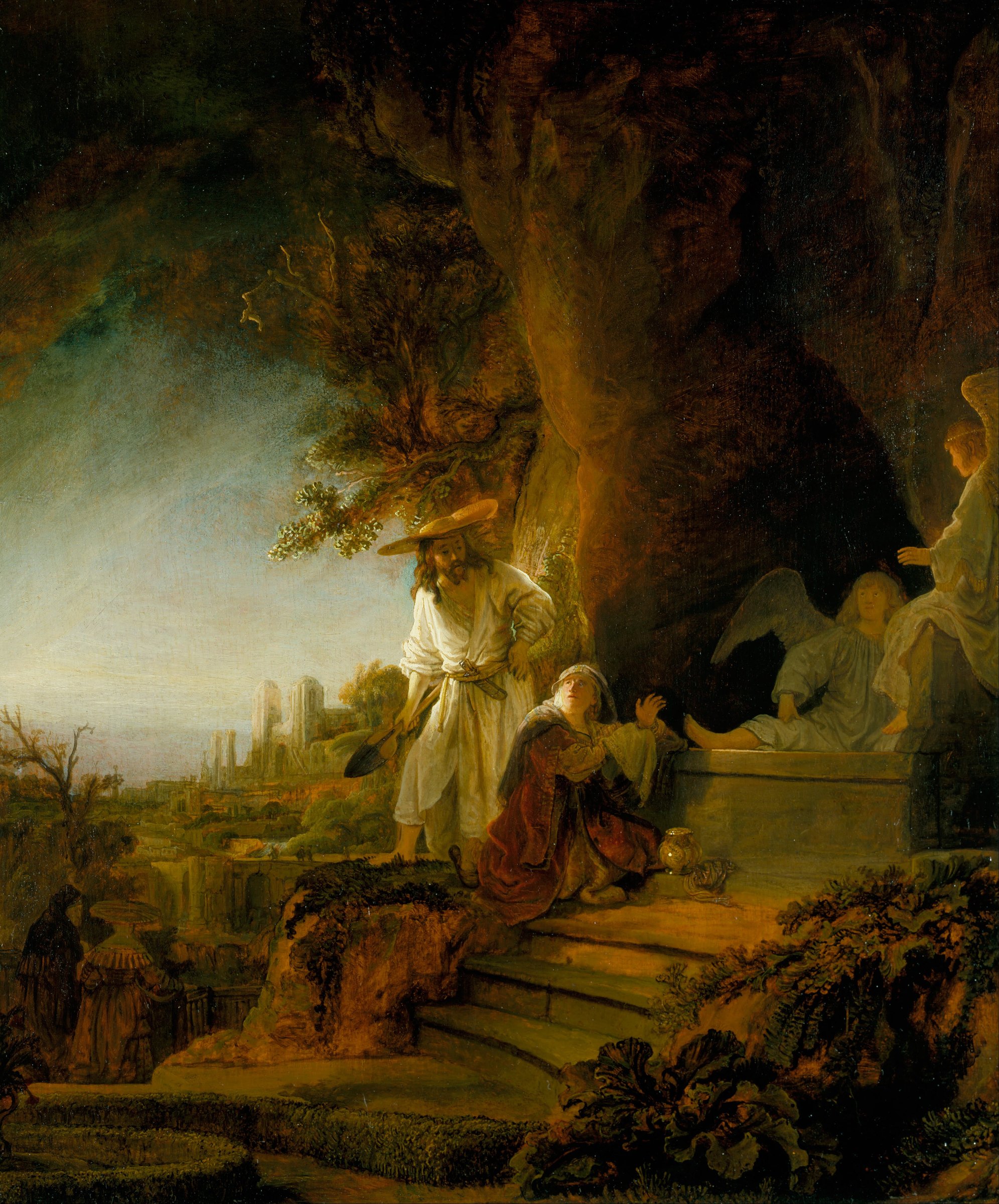
- The gardener's hat and spadeJesus wears a broad hat and carries a spade.John 20:15
- MaryMary kneels on the step and turns to look up at Him.John 20:11
- The two angelsTwo angels in white sit on the stone where the body lay.John 20:12
- The tombThe dark mouth of the tomb opens in the rock.Matthew 27:60
- The cityA walled city stands on the hill in the distance.John 19:20
- The gardenClipped hedges and beds run along the foot of the picture.John 19:41
Rembrandt, Christ and Saint Mary Magdalen at the Tomb, 1638. Public domain.
Each number marks a place in the picture.
The Garden Through Scripture
Each stop names one garden, or one land likened to Eden.
The garden runs from the planting of Genesis 2 to the tree of life promised in Revelation 2.
- Genesis 2The LORD God plants a garden, Genesis 2:8
- Genesis 3God walks in the garden, Genesis 3:8
- Genesis 3Cherubim guard the way, Genesis 3:24
- Genesis 13The plain like the garden of the LORD, Genesis 13:10
- 2 Kings 21Manasseh's palace garden, 2 Kings 21:18
- Song of Solomon 4A garden locked up, Song of Solomon 4:12
- Isaiah 51Zion's desert made like Eden, Isaiah 51:3
- Isaiah 58A well-watered garden, Isaiah 58:11
- Ezekiel 28Eden, the garden of God, Ezekiel 28:13
- Ezekiel 36Ruined cities rebuilt, Ezekiel 36:35
- Joel 2Eden before the army, desert behind it, Joel 2:3
- Luke 23With Me in Paradise, Luke 23:43
- John 18Across the Kidron into a garden, John 18:1
- John 19A new tomb in a garden, John 19:41
- Revelation 2The Paradise of God, Revelation 2:7
One stop for each passage in canon order; each stop opens its verse in the reader.
The garden of the LORD as a measure of landGenesis 13:10 and Joel 2:3
Lot chose the Jordan plain because it looked like the garden of the LORD.
Before them a fire devours, and behind them a flame scorches. The land before them is like the Garden of Eden, but behind them, it is like a desert wasteland—surely nothing will escape them.Joel sets the land before the locust army beside the land behind it.
What Scripture Makes a Garden
Four verses on a people, a land and a bride, and two readings of John's gardens.
A PEOPLE SATISFIED
God promises that His people will be like a well-watered garden.
A PEOPLE COME HOME
The exiles who come home to Zion will never languish again.
A LAND RESTORED
The nations will say the desolate land has become like Eden.
A BRIDE
The bridegroom calls his bride a garden shut to every other.
A land restored, A bride
Eden and the garden across the KidronMatthew Henry, Commentary on the Whole Bible, 1710, on John 18:1
Matthew Henry ties the arrest in this garden to the promise of Genesis 3:15.
“That he entered into a garden. This circumstance is taken notice of only by this evangelist, that Christ's sufferings began in a garden. In the garden of Eden sin began; there the curse was pronounced, there the Redeemer was promised, and therefore in a garden that promised seed entered the lists with the old serpent.”
Matthew Henry · Commentary on the Whole Bible · on John 18:1 to 2Puritan
The gardener of paradiseJerome, Homily 87, on John 20:15
Jerome takes Mary's mistake as true in a way she did not mean, since Jesus is the gardener of His own paradise.
“When Mary Magdalene had seen the Lord and thought that he was the gardener … she was mistaken, indeed, in her vision, but the very error had its prototype. Truly, indeed, Jesus was the gardener of his paradise, of his trees of paradise. ‘She thought that he was the gardener’ and wanted to fall at his feet. What does the Lord say to her? ‘Do not touch me, for I have not yet ascended to my Father.’ Do not touch me. You do not deserve to touch the one you looked for in a grave.”
Jerome · Homily 87, on John 1.1-14 · on John 20:15Patristic
Gardens and Tombs
Why a tomb stood in a garden near Jerusalem, and why a spring was sealed.
Adam Clarke, on the new tomb of John 19, explains that it was an ancient custom for families to keep burial places in their gardens.
And he was buried in his tomb in the garden of Uzza, and his son Josiah reigned in his place.Amon is buried in his own tomb in the same garden as Manasseh.
A spring shut up where water was scarceJohn Wesley on Song of Solomon 4:12
John Wesley, in his Explanatory Notes upon the Old Testament, says that springs were shut up in countries where water was scarce and precious, to keep them for the owner's use.
Gan, Kepos and Paradeisos
The Hebrew and Greek words for the garden and the park.
Gan stands 42 times in the Old Testament, and paradeisos only 3 times in the New.
| Word | Strong's number | Strong's definition | Uses |
|---|---|---|---|
| גַּן gan | H1588 | “a garden, as fenced” | 42 |
| עֵדֶן Eden | H5731 | “the region of Adam's home” | 16 |
| κῆπος kepos | G2779 | “a garden” | 5 |
| παράδεισος paradeisos | G3857 | “a park, specially an Eden” | 3 |
The three uses of paradeisosLuke 23:43, 2 Corinthians 12:4 and Revelation 2:7
was caught up to Paradise. The things he heard were too sacred for words, things that man is not permitted to tell.Paul uses the word for the place he was caught up to.
The gardener, kepourosAdam Clarke on John 20:15
Adam Clarke explains that the word for the gardener in John 20:15 is built on kepos, a garden, and names the overseer who had charge of the workmen and the produce.
What the Text Does Not Say
John and Paul name their gardens without these details.
Three questions stay open across the garden passages.
| What is not said | What the verse does say |
|---|---|
| Who owned the garden of the tomb? | There was a garden in the place where Jesus was crucified. |
| Is the garden of the arrest the garden of the tomb? | John names a garden across the Kidron and a garden at the place of the cross. |
| What does Paradise look like? | Paul says only that he heard things too sacred for words. |
The Way to the Tree Opened
The closing verse of the Eden story and the promise to Ephesus stand side by side.
So He drove out the man and stationed cherubim on the east side of the Garden of Eden, along with a whirling sword of flame to guard the way to the tree of life.The verse closes the garden story of Genesis.
He who has an ear, let him hear what the Spirit says to the churches. To the one who overcomes, I will grant the right to eat from the tree of life in the Paradise of God.The risen Christ grants the overcomer the right to eat from that tree.
The thief and the flaming swordJerome, On Lazarus and Dives, on Luke 23:43
And Jesus said to him, “Truly I tell you, today you will be with Me in Paradise.”Jesus answers the dying man with the word Paradise and the word today.
“That flaming, flashing sword was keeping Paradise safe. No one could open the gates that Christ closed. The thief was the first to enter with Christ. His great faith received the greatest of rewards. His faith in the kingdom did not depend on seeing Christ. He did not see him in his radiant glory or behold him looking down from heaven. He did not see the angels serving him. To put it plainly, he certainly did not see Christ walking about in freedom, but on a gibbet, drinking vinegar and crowned with thorns.”
Jerome · On Lazarus and Dives · on Luke 23:43Patristic
Voices on the Garden
Ambrose, John Wesley and Charles Spurgeon, each with the work named.
died 397 · Ambrose of Milan
Ambrose of Milan, in On Paradise, asks what walking can mean of God, who is everywhere, and answers that God walks wherever Scripture shows His presence.
1703 to 1791 · John Wesley
John Wesley, in his Explanatory Notes upon the Old Testament, on Genesis 3:24, observes that God sent the man out of the garden to till the ground. He notes that God might have sent him out of the world.
1834 to 1892 · Charles Spurgeon
Charles Spurgeon, in his sermon A Handkerchief, sets the sorrow pronounced on the woman in Eden beside the comfort given to a woman in the garden of the resurrection.
The Garden Locked Up
Three readings of Song of Solomon 4:12, each with its holder and the strongest objection.
A bride faithful to her husbandAdam Clarke, Commentary on the Bible, 1832
Adam Clarke reads the locked garden, the shut spring and the sealed fountain as three ways of saying that the bride is faithful and pure.
The objection: the Song is read in the synagogue and the church as more than a wedding poem, and the bridegroom's words reach past one marriage.
The church set apart under the lawMatthew Henry, Commentary on the Whole Bible, 1710
Matthew Henry reads the enclosure as the ceremonial law that shut the Old Testament church in one nation until the gospel went to every nation.
The objection: the bridegroom praises the closed garden as it stands.
The soul kept for GodAmbrose of Milan, On Isaac and the Soul
Ambrose reads the sealed fountain as the mind that must stay closed to bodily pleasure and kept by study and thought.
The objection: the bride is one woman and one people in the Song, and the poem gives no sign that it speaks of a single soul.
Books to Read Next
Three works a student reads next, each free to read.
Commentary on the Whole Bible
Matthew Henry · 1710
His notes on John 18 and 19 set the gardens of the Passion beside Eden.
READ HIS JOHN NOTES →Commentary Critical and Explanatory
Jamieson, Fausset and Brown · 1871
Their notes on Song of Solomon 4 read the enclosed garden as the gospel kingdom of heaven.
READ THEIR NOTES →Exposition of the New Testament
John Gill · 1746 to 1748
His notes on John 19 place the garden beside the spot of the crucifixion.
READ HIS JOHN NOTES →The Gardener Risen
Scripture opens with a man set in a garden to keep it.
On the first day of the week the risen Jesus called Mary by her name in that garden.
Sources
Scripture is the Berean Standard Bible.
- James Strong, Exhaustive Concordance of the Bible, 1890, entries H1588, H5731, G2779 and G3857, with each word's count of uses.
- Matthew Henry, Commentary on the Whole Bible, 1710, on John 18:1.
- Jerome, Homily 87, on John 20:15.
- Adam Clarke, Commentary on the Bible, 1832, on John 19:41.
- Adam Clarke, Commentary on the Bible, 1832, on John 20:15.
- John Wesley, Explanatory Notes upon the Old Testament, 1765, on Song of Solomon 4:12.
- Jerome, On Lazarus and Dives, on Luke 23:43.
- Ambrose of Milan, On Paradise 14.68 to 70, on Genesis 3:8.
- John Wesley, Explanatory Notes upon the Old Testament, 1765, on Genesis 3:24.
- Charles Spurgeon, The Metropolitan Tabernacle Pulpit, Sermon No. 2956, A Handkerchief, on John 20:15.
- Adam Clarke, Commentary on the Bible, 1832, on Song of Solomon 4:12.
- Matthew Henry, Commentary on the Whole Bible, 1710, on Song of Solomon 4:12 to 14.
- Ambrose of Milan, On Isaac and the Soul 1.2, on Song of Solomon 4:12.
- Jamieson, Fausset and Brown, Commentary Critical and Explanatory, 1871, on Song of Solomon 4:12.
- John Gill, Exposition of the New Testament, on John 19:41.
Keep Studying
Studies2
People and groups2