
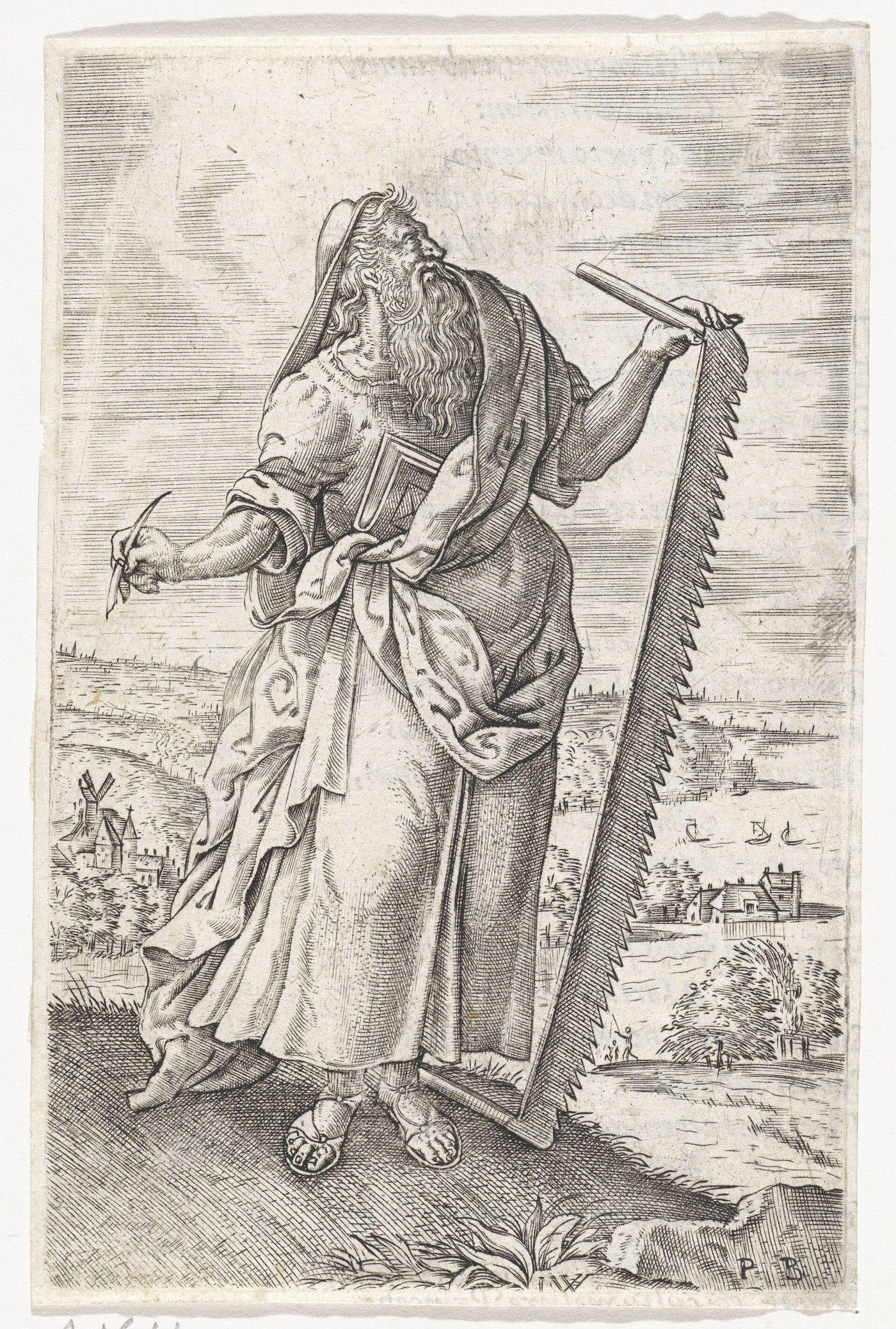
Johannes Wierix, Landscape with the Prophet Isaiah, 1571. Public domain.
Isaiah 1:1, Isaiah 6 and Isaiah 36 to 39 · Person · Featured Study
Isaiah
Isaiah son of Amoz brought the LORD's word to Ahaz and Hezekiah, kings of Judah, in Jerusalem.
A coal from the altar touched Isaiah's lips before he was sent.
Then I heard the voice of the Lord saying: “Whom shall I send? Who will go for Us?” And I said: “Here am I. Send me!”
Then I heard the voice of the Lord saying: “Whom shall I send? Who will go for Us?” And I said: “Here am I. Send me!”
- The name means
- the salvation of the Lord
- Family
- father: Amoz; mother of his son: the prophetess; son: Shear-jashub; son: Maher-shalal-hash-baz
- Places
- Jerusalem
- First named
- 2 Kings 19:2 “…wearing sackcloth, to the prophet Isaiah son of…”
- Last named
- Romans 15:12 “And once more, Isaiah says: “The…”
Summary
Isaiah carried the LORD's word to the court of Judah through peace, war and the king's sickness. His family and his own body became signs to the nation, and his writings reached beyond his book into the histories of the kings.
- Jesus read from his scroll in the synagogue at Nazareth.
- His sons' names were messages to the nation.
- Hebrews 11:37 has long been read of his death.
Where Isaiah Stands in Scripture
The heading of his book names his father and dates his ministry.
This is the vision concerning Judah and Jerusalem that Isaiah son of Amoz saw during the reigns of Uzziah, Jotham, Ahaz, and Hezekiah, kings of Judah.Every later scene falls within these reigns.
Outside his own book he appears in 2 Kings 19 and 20 and in 2 Chronicles. The Chronicler says the prophet wrote the acts of Uzziah and of Hezekiah.
As for the rest of the acts of Uzziah, from beginning to end, they are recorded by the prophet Isaiah son of Amoz.The prophet also wrote history, now lost, as Adam Clarke notes.
Matthew Henry wrote on the prophet's name.
“The name of the prophet, Isaiah, or Jesahiahu (for so it is in the Hebrew), which, in the New Testament is read Esaias. His name signifies the salvation of the Lord --a proper name for a prophet by whom God gives knowledge of salvation to his people, especially for this prophet, who prophesies so much of Jesus the Saviour and of the great salvation wrought out by him.”
Matthew Henry · Commentary on the Whole Bible · on Isaiah 1:1Puritan
His Life, Turn by Turn
His ministry runs from the death of Uzziah to the envoys of Babylon.
His ministry moved between the temple, the city and the king's house.
- Sees the Lord on His throne in the year Uzziah diesthe templeIsaiah 6:1
- Offers himself for the LORD's errandthe templeIsaiah 6:8
- Meets King Ahaz with his son Shear-jashubthe aqueduct of the upper poolIsaiah 7:3
- Writes a son's sign-name on a large scroll before witnessesnot stated in the textIsaiah 8:1 to 2
- Goes without sackcloth or sandals as a sign against Egypt and Cushnot stated in the textIsaiah 20:2 to 3
- Answers Hezekiah's envoys in the Assyrian crisisJerusalemIsaiah 37:5 to 7
- Sends Hezekiah the LORD's word against SennacheribJerusalemIsaiah 37:21
- Tells Hezekiah to put his house in orderthe king's sickroomIsaiah 38:1
- Brings the promise of fifteen more yearsthe king's sickroomIsaiah 38:5
- Foretells that the palace treasures will go to Babylonthe palaceIsaiah 39:5 to 6
Ten turns of his life, each with its verse.
Sends Hezekiah the LORD's word against Sennacherib, Tells Hezekiah to put his house in order, Brings the promise of fifteen more years, Foretells that the palace treasures will go to Babylon
The Prophet of Four Kings
His story runs through four scenes: the call, Ahaz, the sign against Egypt and Hezekiah.
The callIsaiah 6:1 to 8
Then I said: “Woe is me, for I am ruined, because I am a man of unclean lips dwelling among a people of unclean lips; for my eyes have seen the King, the LORD of Hosts.”The vision brings the prophet to confess his own sin.
Ahaz at the upper poolIsaiah 7:3 to 14
When Aram and Israel marched on Jerusalem, the LORD sent Isaiah and his son to meet Ahaz at the aqueduct of the upper pool.
The head of Ephraim is Samaria, and the head of Samaria is the son of Remaliah. If you do not stand firm in your faith, then you will not stand at all.’”The warning to Ahaz turns on faith.
The sign against Egypt and CushIsaiah 20:1 to 6
Before the year an Assyrian commander took Ashdod, the LORD told Isaiah to take off his sackcloth and sandals.
Then the LORD said, “Just as My servant Isaiah has gone naked and barefoot for three years as a sign and omen against Egypt and Cush, so the king of Assyria will lead away the captives of Egypt and the exiles of Cush, young and old alike, naked and barefoot, with bared buttocks—to Egypt’s shame.The sign was a forecast of Egypt's defeat.
Adam Clarke doubted that the prophet went uncovered for the whole three years.
Hezekiah in war and sicknessIsaiah 37 to 39; 2 Chronicles 32:20
In response, King Hezekiah and the prophet Isaiah son of Amoz cried out to heaven in prayer,Judah's defence rested on prayer.
After the envoys of Babylon left, he warned that some of the king's own descendants would serve in Babylon's palace.
The Circle of Isaiah
Eight people stand around him in the text.
His circle ran from his father and his sons to the officers of the king.
Generation 1
- AmozHis father
Generation 2
- The prophetessMother of Maher-shalal-hash-baz
- Uriah the priestA witness to the scroll he wrote
- Zechariah son of JeberekiahThe second witness to the scroll
- EliakimThe palace administrator sent to him
- ShebnaThe scribe sent to him
Generation 3
- Shear-jashubOne of the children given to him as signs
- Maher-shalal-hash-bazHis son, named as a sign against Damascus and Samaria
The prophetess is named only by her calling.
The Places of His Ministry
Assyria camped at Lachish, and Babylon was named in his last warning to Hezekiah.
Isaiah worked in Jerusalem while Assyria camped at Lachish.
| Place | What Scripture tells of it | When |
|---|---|---|
| Jerusalem | Where he saw the Lord and met Ahaz and Hezekiah. | From the year Uzziah died (Isaiah 6:1) |
| Lachish | The camp from which the Rabshakeh came to Jerusalem. | In Hezekiah's fourteenth year (Isaiah 36:1) |
| Babylon | The city he said would take the palace treasures. | After the king's recovery (Isaiah 39:1) |
How Did Isaiah Die?
Scripture is silent, and the Talmud, a later writing and Justin Martyr fill the gap.
The Jewish traditionThe Babylonian Talmud, Yevamot 49b; the Ascension of Isaiah 5
The early churchJustin Martyr, Dialogue with Trypho 120
Justin Martyr, in his Dialogue with Trypho, told his Jewish hearer that his people had sawn Isaiah asunder with a wooden saw.
Hebrews 11:37John Wesley; Ellicott's Commentary; Ephrem the Syrian
They were stoned, they were sawed in two, they were put to death by the sword. They went around in sheepskins and goatskins, destitute, oppressed, and mistreated.The letter names no one in its list of the sufferers.
John Wesley wrote that Isaiah was sawn asunder by Manasseh, according to the tradition of the Jews. Ellicott's Commentary and Ephrem the Syrian also read the words sawn in two of Isaiah.
What the Text Leaves Unsaid
Scripture leaves much of his life untold.
It gives no year of his birth and no account of his death.
It never gives the name of the prophetess.
It does not say what became of either son.
How Scripture Reads Him
John reads Isaiah as a prophet who saw the glory of Jesus, and the Gospels and Acts quote him by name.
Isaiah said these things because he saw Jesus’ glory and spoke about Him.John reads the throne vision of chapter 6 as a sight of Christ.
Voices on Isaiah
Two early Christian readers drew different lessons from Isaiah 6.
Eusebius of Caesarea (died 339)
PROOF OF THE GOSPEL 7.1
Eusebius read the throne vision with the Gospels in view.
“In approaching the account of his coming to humanity, the prophecy before us tells first of his divine kingdom, in which it says that the prophet saw him sitting on a throne high and exalted.”
on John 12:41Patristic
Desert Fathers (died 500)
The Desert Fathers, Sayings of the Early Christian Monks
A monk's saying draws a rule of the spiritual life from Isaiah's cry.
“Mathois said, 'The nearer a man comes to God, the more he sees himself to be a sinner. Isaiah the prophet saw the Lord and knew himself to be wretched and unclean (Is. 6:5).'”
on Isaiah 6:5Patristic
Is the Ophel Seal Isaiah's?
A clay seal impression from Jerusalem, published in 2018, bears his name, and scholars divide over the word after it.
Possibly the prophet's sealEilat Mazar, Biblical Archaeology Review, 2018
Eilat Mazar's team found the impression in the Ophel excavations, just south of the Temple Mount. It reads Isaiah followed by the letters nvy.
If an aleph stood at the damaged end, the word would be the Hebrew for prophet. The impression was found less than ten feet from a seal impression of King Hezekiah.
The objection: the letter that would make the word prophet is missing.
The reading is unprovenChristopher Rollston, 2018
Christopher Rollston judged the reading prophet doubtful. The critical letter aleph is lacking, and many names in the Bible begin with nun and bet, the first two letters of the word.
The objection: the end of the line is damaged, so the aleph may once have stood there.
Here Am I. Send Me!
Here am I, and the children the LORD has given me as signs and symbols in Israel from the LORD of Hosts, who dwells on Mount Zion.The prophet's household itself became his message.
Charles Spurgeon preached on the call of Isaiah 6:8 in his sermon The Divine Call for Missionaries.
Sources
Scripture is the Berean Standard Bible.
- Ellicott's Commentary for English Readers on Hebrews 11:37.
- The Babylonian Talmud, Yevamot 49b, William Davidson edition (Sefaria); the Ascension of Isaiah 5 (Early Christian Writings); Justin Martyr, Dialogue with Trypho 120, in the Ante-Nicene Fathers translation (New Advent)
- Biblical Archaeology Society, news report on Eilat Mazar's article Is This the Prophet Isaiah's Signature?, Biblical Archaeology Review, March to June 2018; Christopher Rollston, post of February 22, 2018.
- Matthew Henry, Commentary on the Whole Bible (1710), on Isaiah 1:1; the Desert Fathers, the saying of Mathois; Eusebius of Caesarea, Proof of the Gospel 7.1; John Wesley, Explanatory Notes upon the New Testament (1755), on Hebrews 11:37; Charles Spurgeon, sermon 1351, The Divine Call for Missionaries; Adam Clarke, Commentary on the Bible (1832), on Isaiah 20:2 and 2 Chronicles 26:22; Ephrem the Syrian on Hebrews 11:37.
Keep Studying
Read it4
Studies11
People and groups9
Places9
Doctrines8
Subjects6