
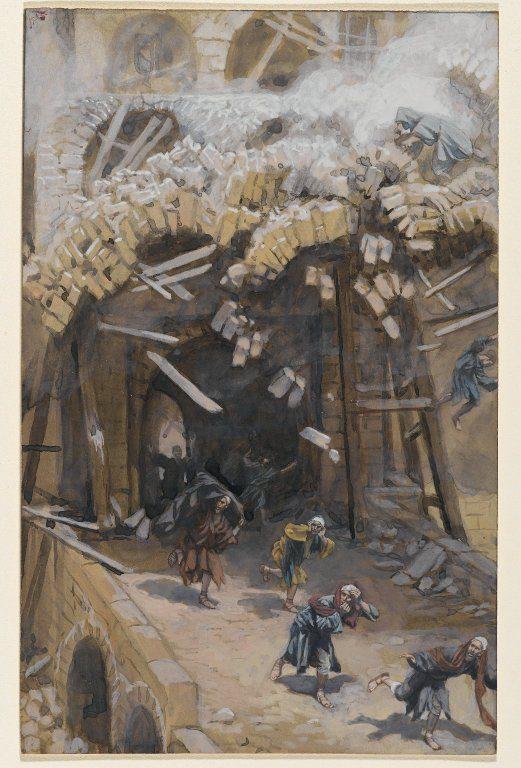
James Tissot, The Tower of Siloam, 1886 to 1894. Public domain.
Luke 13:1 to 9 · Subject · Featured Study
The Galileans, the Tower of Siloam and Suffering as a Measure of Guilt
Luke 13:1 to 9 answers the old belief that people struck by disaster must be guiltier than those spared.
Eighteen people died when the tower of Siloam fell, and Jesus gave their number.
No, I tell you. But unless you repent, you too will all perish.”
No, I tell you. But unless you repent, you too will all perish.”
- Books
- Luke, John
- Hold in memory
- Luke 13:5
Summary
Some people told Jesus that Pilate had killed men from Galilee at their sacrifices. Jesus asked if the dead were worse sinners than others, and He called the living to repent.
- One disaster came by a Roman governor and the other by a falling building.
- Eliphaz in the book of Job and the disciples in John 9 read suffering as proof of sin.
- A parable follows of a fig tree given one more year to bear fruit.
Two Disasters in Luke 13
The news of the Galileans reached Jesus as He taught a great crowd on His way to Jerusalem.
At that time some of those present told Jesus about the Galileans whose blood Pilate had mixed with their sacrifices. To this He replied, “Do you think that these Galileans were worse sinners than all the other Galileans, because they suffered this fate?The report gives Jesus the case, and His question names the belief His hearers held about it.
Jesus then raised the fall of the tower of Siloam Himself (Luke 13:4).
John Charles Ryle wrote that nothing certain is known of the murder of the Galileans. He observed that Jesus bade His informants look within and think of their own state before God.
Two Cases and One Answer
Luke tells the first case as news brought to Jesus and the second as His own example.
Jesus asks the same question of both disasters and gives the same answer.
| Point of comparison | The Galileans | The eighteen at Siloam |
|---|---|---|
| Who died | Galileans offering sacrifices | Eighteen people in Jerusalem |
| The cause | Pilate, the Roman governor | A tower that collapsed |
| Who raised it | Some of those present | Jesus Himself |
| The question | Worse sinners than other Galileans? | More sinful than others in Jerusalem? |
| The answer | No, and a call to repent | No, and the same call |
The Tower of Siloam
Luke gives the tower's name and the number of its dead, and little more is known of the event.
Then He told him, “Go, wash in the Pool of Siloam” (which means “Sent”). So the man went and washed, and came back seeing.The verse shows Siloam as a place of healing in the same city where the tower fell.
Adam Clarke thought the tower probably stood over one of the porticoes beside the water of John 9:7. Nehemiah names the Pool of Shelah beside the king's garden (Nehemiah 3:15).
Albert Barnes wrote that no one knows why the tower was built or when it fell. He judged that the event was recent, because Jesus spoke of it as fresh in His hearers' minds.
Suffering Read as Guilt
The LORD corrected Job's friends, and Jesus corrected His disciples, on the same mistake about suffering.
Consider now, I plead: Who, being innocent, has ever perished? Or where have the upright been destroyed? As I have observed, those who plow iniquity and those who sow trouble reap the same.Eliphaz speaks for the friends whom the LORD rebukes at the end of the book (Job 42:7).
and His disciples asked Him, “Rabbi, who sinned, this man or his parents, that he was born blind?” Jesus answered, “Neither this man nor his parents sinned, but this happened so that the works of God would be displayed in him.Jesus answers His disciples with the same refusal He gives in Luke 13.
Albert Barnes wrote that this is not a world of retribution. The wicked often prosper here, he observed, and the righteous are often called to suffer much.
Matthew Henry showed where the belief leads if it is followed through.
“And we might as justly conclude that the oppressors, and Pilate among the rest, on whose side are power and success, are the greatest saints, as that the oppressed, and those Galileans among the rest, who are all in tears and have no comforter, no, not the priests and Levites that attended the altar, are the greatest sinners.”
Matthew Henry · Commentary on the Whole Bible · on Luke 13:2 to 3Puritan
Charles Spurgeon preached on Luke 13:1 to 5 on 8 September 1861, after railway collisions in the Clayton Tunnel and at Kentish Town had killed 23 and 15 people. He called 1861 the year of calamities.
Who the Galileans Were
Luke gives no names, and teachers have tied the slain to the followers of Judas the Galilean.
Judas the Galilean led a rising in the days of the census, and he perished and his followers were scattered (Acts 5:37).
John Wesley counted the slain among his followers, who refused to own the authority of Rome. He wrote that Pilate surrounded and killed them while they worshipped in the temple at a public feast.
Cyril of Alexandria, in the fifth century, also made them followers of Judas, who refused to call Caesar their master.
The Greek Words of Luke 13
Four Greek words carry the passage: the debtors, the call to repent, the perishing and the place.
ὀφειλέτης opheiletēs, debtor
7 uses in the canon
One who owes; Luke 13:4 calls the eighteen debtors, rendered more sinful in the Berean text.
μετανοέω metanoeō, to repent
34 uses in the canon
To think again and turn, the act Jesus asks of His hearers in both answers.
ἀπόλλυμι apollumi, to perish
90 uses in the canon
To be destroyed fully or to be lost, the fate Jesus names for the unrepentant.
Σιλωάμ Silōam, Siloam
3 uses in the canon
The name of a pool of Jerusalem, Shiloach in Hebrew.
One More Year for the Fig Tree
Titus of Bostra explained why the parable follows the two disasters.
Titus of Bostra (died 378)
‘Sir,’ the man replied, ‘leave it alone again this year, until I dig around it and fertilize it. If it bears fruit next year, fine. But if not, you can cut it down.’”The parable answers the two disasters with a picture of patience that has a limit.
Titus of Bostra read the parable as an answer to boasting.
“The Jews were boasting, that while the eighteen had perished, they all remained unhurt. He therefore sets before them the parable of the fig tree, for it follows, He spake also this parable; A certain man had a fig tree planted in his vineyard.”
Titus of Bostra · Catena Aurea by Aquinas · on Luke 13:6Patristic
What It Means to Perish Likewise
Clarke and Wesley read the warning as a forecast of the fall of Jerusalem, and Bonaventure as the loss of the soul.
Fulfilled when Rome took JerusalemAdam Clarke, Commentary on the Bible (1832), on Luke 13:5; John Wesley, Explanatory Notes upon the New Testament (1755), on Luke 13:3
Adam Clarke held that the prediction was fulfilled to the letter. When the Romans took Jerusalem, priests were slain at their sacrifices and many were buried under the ruins, as Josephus records in the Jewish War.
John Wesley wrote that the Greek word for likewise means in the very same manner. The flower of the nation, he noted, was later slain at Jerusalem while it gathered for a great festival.
The objection, from Bonaventure: the word likewise points past bodily death to the punishment of the soul.
The loss of every unrepentant soulBonaventure, Commentary on Luke (1257), on Luke 13:5
Bonaventure read likewise as a warning of spiritual punishment in Gehenna, the place of final judgment, and of no bodily death.
The objection, from Clarke: the Greek words of Luke 13:3 and Luke 13:5 mean in a like way, and that manner was fulfilled when Jerusalem fell.
Repent While There Is Time
John Chrysostom taught that God gives time to repent and does not punish everyone in this life.
Luke then follows Jesus through the towns and villages toward Jerusalem (Luke 13:22).
Sources
Scripture is the Berean Standard Bible.
- Strong's lexicon entries g3781, g3340, g622 and g4611, with their counts of uses.
- J.C. Ryle, Expository Thoughts on the Gospels: Luke (1858), on Luke 13:1 to 5.
- John Wesley, Explanatory Notes upon the New Testament (1755), on Luke 13:1 and Luke 13:3.
- Cyril of Alexandria, on Luke 13:1 to 2, in Thomas Aquinas, Catena Aurea.
- Adam Clarke, Commentary on the Bible (1832), on Luke 13:4 and Luke 13:5.
- Albert Barnes, Notes, Explanatory and Practical (1832 to 1869), on Luke 13:4 and Luke 13:5.
- Matthew Henry, Commentary on the Whole Bible (1710), on Luke 13:2 to 3.
- Bonaventure, Commentary on Luke (1257), chapter 13, on Luke 13:5.
- Titus of Bostra, on Luke 13:6, in Thomas Aquinas, Catena Aurea.
- Charles Spurgeon, The Metropolitan Tabernacle Pulpit, Sermon No. 408, Accidents, Not Punishments (1861), CCEL edition.
- John Chrysostom, on Luke 13:4 to 5, in Thomas Aquinas, Catena Aurea.
Keep Studying
People and groups3
Places2
Symbols1
Go further10
Values1
Trials of life2