
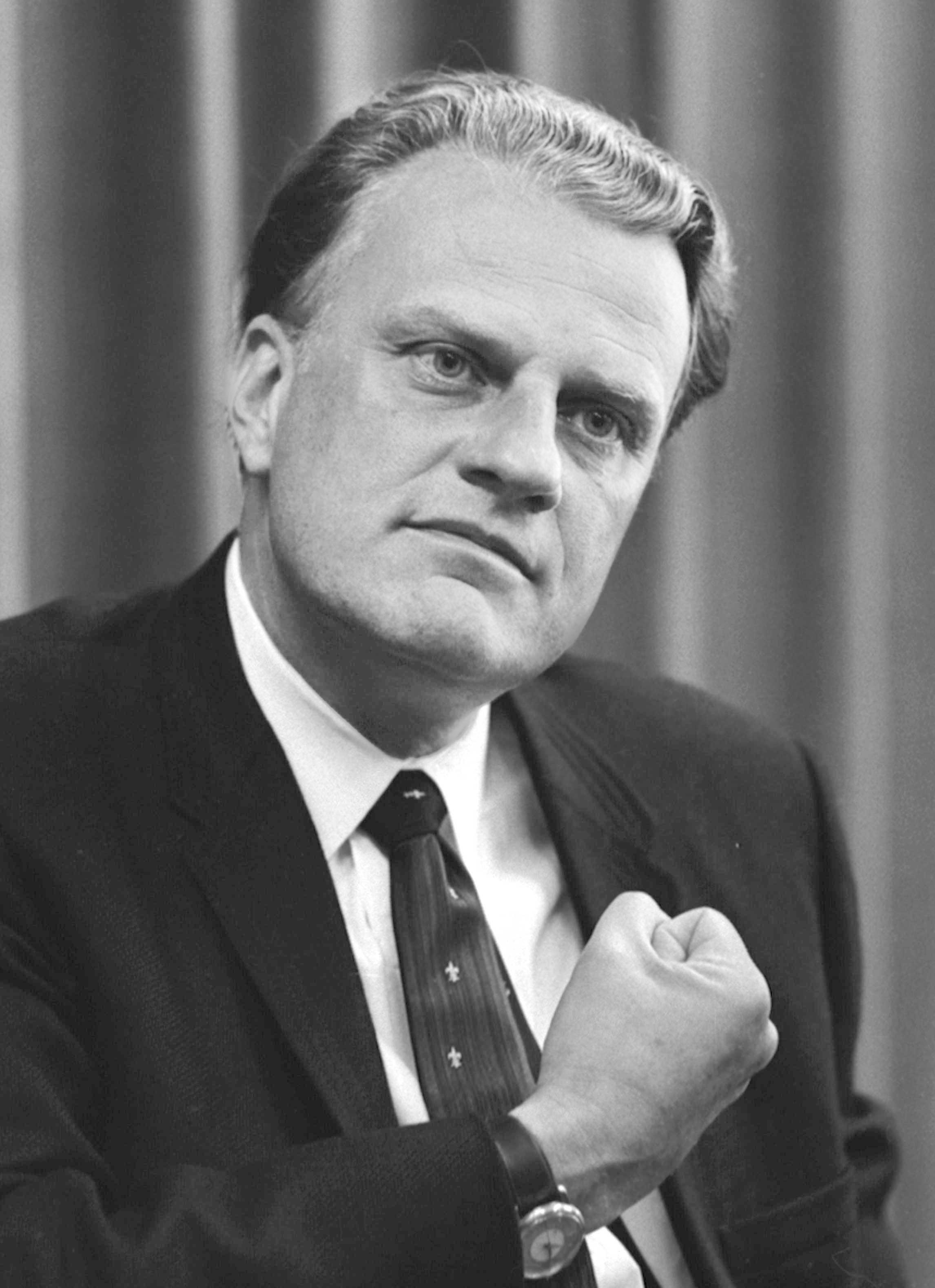
Warren K. Leffler, Billy Graham, Library of Congress. Public domain.
Charlotte to Montreat, 1918 to 2018 · Person · Featured Study
Billy Graham
A Southern Baptist evangelist, he led city crusades from 1949 to 2005.
A preacher who once expected to farm like his father held his last crusade at eighty-six.
Jesus answered, “I am the way and the truth and the life. No one comes to the Father except through Me.
Jesus answered, “I am the way and the truth and the life. No one comes to the Father except through Me.
- Born
- 7 November 1918, near Charlotte, North Carolina
- Died
- 21 February 2018 at Montreat, North Carolina
- Family
- father: William Franklin Graham; mother: Morrow Coffey Graham; wife: Ruth Bell Graham; son: Franklin Graham
- Places
- Charlotte, Wheaton, Los Angeles, Chattanooga, London, New York, Montreat
Summary
Billy Graham grew up on a dairy farm near Charlotte and came to faith in 1934, near his sixteenth birthday. He was ordained a Southern Baptist minister and studied at Wheaton. His Los Angeles campaign brought him national notice. His crusades ran in great cities for the next fifty-six years. He died at Montreat in 2018 and lay in honor in the Capitol.
- In 1953 at Chattanooga he took down the ropes that kept Black hearers apart. From then on his meetings were open to all.
- He opened the Lausanne Congress on world evangelization in 1974.
- A tape of 1972 caught him agreeing with Nixon about Jews, and in 2002 he apologized.
The Way and the Truth
The stone over his grave names him a preacher of the gospel and cites John 14:6.
He lies beside his wife in the prayer garden of the library in Charlotte that bears his name. The marker reads Preacher of the Gospel of the Lord Jesus Christ, with the reference John 14:6.
The question of this life is how a dairy farmer's son came to preach to crowds across the world. It is also what his nearness to presidents cost him.
After this I looked and saw a multitude too large to count, from every nation and tribe and people and tongue, standing before the throne and before the Lamb. They were wearing white robes and holding palm branches in their hands.At Lausanne in 1974 he marked the leaders gathered from the churches of Asia, Africa and Latin America.
The Life in Order
Most dates come from the chronology kept by the Billy Graham Center Archives at Wheaton.
His crusades ran for fifty-six years, from a tent to his last city crusade.
- 7 November 1918He was born near Charlotte, North CarolinaThe Wheaton archives
- 1 November 1934He came forward at Mordecai Ham's meetingsThe Wheaton chronology
- February 1939He was ordained a Southern Baptist minister in FloridaThe Wheaton chronology
- 13 August 1943He married Ruth Bell at MontreatThe Wheaton chronology
- 1945He left his pastorate for Youth for ChristThe Wheaton archives
- 25 September to 20 November 1949Christ for Greater Los Angeles ran under canvasThe Wheaton archives; the era brief
- 1950His team formed the Billy Graham Evangelistic AssociationThe Wheaton archives
- March to April 1953He held a crusade at ChattanoogaThe Wheaton chronology
- 1 March to 22 May 1954He held the Greater London CrusadeThe Wheaton chronology
- 15 May to 1 September 1957He held the New York CrusadeThe Wheaton chronology
- July 1974He opened the congress on world evangelization at LausanneThe Wheaton chronology; Lausanne
- May 1982He preached in Moscow's Baptist churchChristianity Today, 1982
- 31 March to 4 April 1992He visited PyongyangThe Wheaton chronology
- 13 February 1996Congress voted a gold medal to him and RuthPublic Law 104-111 (1996)
- 24 to 26 June 2005His final crusade drew 242,000, by the association's countThe Wheaton chronology
- 21 February 2018He died at MontreatThe Wheaton chronology
- 28 February to 1 March 2018He lay in honor in the Rotunda of the CapitolH. Con. Res. 107
Each step of the life stands with its witness.
1950, March to April 1953, 1 March to 22 May 1954, 15 May to 1 September 1957, July 1974, May 1982, 31 March to 4 April 1992, 13 February 1996 and 3 more
From the Farm to the Stadium
A boy raised to farm became a preacher whose meetings filled stadiums in cities across the world.
William Franklin Graham Jr. was born on a dairy farm outside Charlotte, North Carolina, on November 7, 1918. He was converted at sixteen under a travelling evangelist named Mordecai Ham.
He studied at Bob Jones College, then Florida Bible Institute, then Wheaton College in Illinois, where he met Ruth Bell, the daughter of a missionary surgeon in China. They married in 1943 and stayed married until her death in 2007.
His breakthrough was a tent campaign in Los Angeles in the autumn of 1949. It was scheduled for three weeks and ran eight. The newspaper chain owned by William Randolph Hearst is said to have sent its editors a two-word instruction: "Puff Graham." National coverage followed.
Then came the cities, London in 1954 for twelve weeks and New York in 1957. Two months into that crusade he preached to about 100,000 people at Yankee Stadium.
He preached in 185 countries and territories. The Wheaton archives put the number who heard him in person at some 215 million, with millions more by radio and television.
He held meetings in Moscow in 1982, which drew heavy criticism, and again in 1992. He went to North Korea in 1992 and 1994.
He met world leaders from Harry Truman to Donald Trump. The Nixon tapes caught him in remarks about Jews that he publicly apologized for in 2002.
He left the road in 2005 after a final New York crusade, weakened by Parkinson's disease, and lived quietly at Montreat, North Carolina. He died there in February 2018, at ninety-nine.
The Ropes at Chattanooga
A Southern preacher ended the separate sections at his meetings.
His biographer William Martin says that Graham at first accepted segregation as the way things were done.
He insisted on integrated seating in the American South before the law required it, personally pulling down the ropes that divided the white and Black sections at a Chattanooga meeting in 1953. He invited Martin Luther King, Jr., to pray at the New York crusade.
Martin adds that after the Supreme Court's decision of 1954 he never again allowed segregated seating at his meetings. The invitation to King, Martin says, cost him support in the South.
In Their Own Words
Four short sayings, from his conversion to his apology for the Nixon tape.
Billy Graham (1918 to 2018)
his prayer of 1934, as the Billy Graham Center Archives give it, Wheaton College, "Billy Graham", the biography
I don't know what happened to me tonight
“Lord, I don’t know what happened to me tonight”
Other
About this saying1 paragraph
The Wheaton archives give the prayer he made in his bedroom after the Ham meeting of 1934.
Billy Graham
Just As I Am (1997), as the Billy Graham Center Archives quote it, Wheaton College, "Billy Graham", the biography
Why me, Lord?
“I have often said that the first thing I am going to do when I get to heaven is to ask, ‘Why me, Lord? Why did You choose a farm boy from North Carolina to preach to so many?’”
Other
About this saying1 paragraph
In Just As I Am, his book of 1997, he named the question he would ask in heaven, as the Wheaton archives quote it.
Billy Graham
Why Lausanne?, 16 July 1974
Leaders from the growing churches
“Assembled here tonight are more responsible leaders from more growing national churches of Asia, Africa, and Latin America than have ever met before.”
Other
About this saying1 paragraph
He opened the congress at Lausanne with these words on 16 July 1974.
Billy Graham
his statement on the Nixon tape, March 2002, as Christianity Today reported it, Christianity Today, "Mea Culpa", April 2002
I sincerely apologize
“They do not reflect my views and I sincerely apologize for any offense caused by the remarks.”
Other
About this saying1 paragraph
He said this in March 2002, after the National Archives released a tape of 1972.
The People Around Him
His family, the men who shaped his early work and the team that stayed for decades.
Three of the team who made the pledge with him stayed beside him for decades.
| Person | Tie to Graham | The witness |
|---|---|---|
| Morrow Coffey Graham | His mother kept the dairy farm with his father. | The Wheaton archives |
| Mordecai Ham | The evangelist preached the meetings where he came to faith. | The Wheaton archives |
| Ruth Bell Graham | His wife grew up in China and Korea and studied at Wheaton. | The Wheaton archives |
| V. Raymond Edman | The president of Wheaton counselled him until 1967. | The Wheaton archives |
| Torrey Johnson | He handed him a radio program and brought him into Youth for Christ. | The Wheaton archives |
| Cliff Barrows | His song leader stayed with the team for more than forty years. | The Wheaton archives |
| George Beverly Shea | His soloist sang at his meetings from the radio days on. | The Wheaton archives |
| Grady Wilson | A boyhood friend, he joined the team as associate evangelist. | The Wheaton archives |
| Franklin Graham | His eldest son succeeded him as president of the association. | The Wheaton archives |
George Beverly Shea, Grady Wilson, Franklin Graham
The Places of His Life
He was born, married and buried in North Carolina, and he preached in cities across the world.
Two cities of his home state hold his birth, his home and his grave.
| Place | What the witnesses say | The witness |
|---|---|---|
| Charlotte | He grew up on the family dairy farm, and he is buried at the library there. | The Wheaton archives; the Christian Post |
| Wheaton | He studied there from 1940 to 1943 and met his wife. | The Wheaton archives |
| Los Angeles | The tent stood at Washington Boulevard and Hill Street in 1949. | The Wheaton archives |
| Chattanooga | The city's crusade chairman welcomed all races. | John Shearer |
| London | The Greater London Crusade ran for twelve weeks in 1954. | The Wheaton chronology |
| New York | His crusades there ran in 1957 and, for the last time, in 2005. | The Wheaton chronology |
| Lausanne | He opened the congress on world evangelization there in 1974. | The Wheaton chronology |
| Montreat | He and Ruth made their home there from 1945, and he died there. | The Wheaton archives |
Lausanne, Montreat
Four Pledges
The team set rules for money, conduct, the local churches and the counting of crowds.
The Wheaton archives write that Graham and his team knew the charge that evangelists were all con men. Graham, Cliff Barrows, George Beverly Shea and Grady Wilson pledged to one another to avoid what had led other evangelists into scandal.
They would avoid even the appearance of financial abuse. He would not travel, meet, or eat alone with a woman other than his wife.
They would work with any local churches willing to join them. They would be honest in their publicity and in reporting the results.
How the Key Verse Was Taught
John Wesley and J. C. Ryle read the words on his grave.
John Wesley (1703 to 1791)
Explanatory Notes upon the New Testament
John Wesley took the verse as Christ's answer to the disciples' questions.
“To the question concerning knowledge, he answers, I am the truth. To the question whither, I am the life. The first is treated of in this verse; the second, ver. 7-17; the third, xiv, 18, &c.”
on John 14:6Evangelical
J.C. Ryle (1816 to 1900)
Expository Thoughts on the Gospels: John (lightly modernized text, Grace Gems edition)
J. C. Ryle marked how much better Jesus speaks of believers than they speak of themselves.
“We should mark in these verses how much better Jesus speaks of believers than they speak of themselves. He says to His disciples, ‘You know where I go, and you know the way.’ And yet Thomas at once breaks in with the remark, ‘We know neither the where nor the way.’ The apparent contradiction demands explanation. It is more seeming than real. Certainly, in one point of view, the knowledge of the disciples was very small.”
on John 14:4 to 11Reformed Evangelical
What the Witnesses Leave Open
Readers differ on the Nixon tape, the Chattanooga ropes, the count of his hearers, the length of the tent campaign and Moscow.
The tape of 1972Billy Graham; William Martin
On the tape released in 2002 he told Nixon that Jews had a stranglehold on the American media. He said he had no memory of the occasion and apologized in full.
William Martin told Christianity Today that the tapes have gaps. He said they do not show clearly whether Graham meant Jews in general or Jewish liberals.
What happened at ChattanoogaBilly Graham; William Martin; John Shearer
In his autobiography he wrote that he tore down the ropes between the white and Black sections, and that the head usher resigned in anger. William Martin tells it the same way and says its first effect is not clear.
John Shearer looked through the Chattanooga papers of the first days in 2018 and found no report of it. He did find the crusade chairman offering special seats for Black hearers four days in.
How many heard himthe Wheaton archives; the Congress of 1996
The Act of Congress of 1996 gave 100 million in person to that date, well short of the later total. The Wheaton chronology says its own attendance figures come from the association's reports.
How long Los Angeles ranthe Billy Graham Library; the Wheaton archives
The Billy Graham Library says the campaign was planned for three weeks and extended to eight. The older Wheaton biography says it lasted seven.
What he said in MoscowEdmund Robb; Christianity Today
In 1982 Edmund Robb said he had been manipulated to give legitimacy to a conference the Soviet government controlled. Christianity Today's editors would not condemn him for offhand remarks to the press.
Books to Read Next
Just As I Am
Billy Graham · 1997
This is his own account of his life, which the Wheaton archives quote.
In print: find it wherever books are sold.
A Prophet with Honor: The Billy Graham Story
William Martin · 1991
Martin's life of him is the one the reports on the Nixon tape turned to.
In print: find it wherever books are sold.
What Graham Left
He left an association that carries on his work under his son, the congress at Lausanne, and the record of crusades the Wheaton archives keep.
Sources
Scripture is the Berean Standard Bible.
- The Holy Bible, Berean Standard Bible (read 2026)
- Wheaton College, "Billy Graham", the biography of the Billy Graham Center.
- Billy Graham Center Archives, Wheaton College, "Billy Graham", the archives' biography.
- Billy Graham Center Archives, Wheaton College, Chronology of Billy Graham's Life and Ministry, 1934 to 2018.
- Public Law 104-111, to award a congressional gold medal to Ruth and Billy Graham, 13 February 1996.
- House Concurrent Resolution 107 of the 115th Congress, agreed to 26 February 2018.
- Christianity Today, "Mea Culpa: Graham laments '72 comments on Jews", April 2002.
- Christianity Today, 18 June 1982, the news report on Moscow and the editorial "Graham in Moscow: What Did He Really Say?".
- WUNC, The Broadside, interview with William Martin, 29 May 2024, the transcript.
- John Shearer, "Billy Graham Actually Made Several Visits To Chattanooga Area", Chattanoogan.com, 24 February 2018.
- The Christian Post, on the marker of Billy Graham's grave, March 2018.
- Billy Graham, Just As I Am (HarperCollins, 1997)
- Evangelical Times, "Billy Graham, part two, 1949 to 2018".
- John Wesley, Explanatory Notes upon the New Testament (1755), on John 14:6.
- J. C. Ryle, Expository Thoughts on the Gospels: John, on John 14:6.
Keep Studying
People and groups7
Church history3