

Jean-Léon Gérôme, Jerusalem, 1867. Public domain.
Genesis 1 to Revelation 22 · Symbol · Featured Study
Darkness
A symbol study of fifteen places in canon order, the words choshek, araphel and skotos, and two disputed darknesses.
Darkness stands on the first page of the Bible, and the last pages promise a city with no night.
Now the earth was formless and void, and darkness was over the surface of the deep. And the Spirit of God was hovering over the surface of the waters.
- The word
- חֹשֶׁךְ (choshek), H2822
- First appears
- Genesis 1:2 “…was formless and void, and darkness was over…”
Darkness stands on the first page of the Bible, and the last pages promise a city with no night.
Summary
Scripture uses darkness for the night of creation, for His judgments, for the cloud that hides Him, and for life apart from Christ.
- Genesis 1:5 gives the darkness the name night.
- The ninth plague lay on Egypt for three days, while every Israelite house had light.
- From noon to three in the afternoon darkness covered the land as Jesus hung on the cross.
- John writes that God is light, and Peter that God has called His people out of the dark.
Darkness on the First Day
The first day of Genesis, the darkness over the deep, divided from the light and named.
Now the earth was formless and void, and darkness was over the surface of the deep. And the Spirit of God was hovering over the surface of the waters.The verse describes the earth before the first word of God.
And God saw that the light was good, and He separated the light from the darkness. God called the light “day,” and the darkness He called “night.” And there was evening, and there was morning—the first day.God keeps the darkness and gives it a part of every day.
And God saw that the light was good, and He separated the light from the darkness. God called the light “day,” and the darkness He called “night.” And there was evening, and there was morning—the first day.God keeps the darkness and gives it a part of every day.
The darkness stays in the creation after the light comes.
Scripture says darkness is ruled, sent as judgment, entered and loved.
| Darkness | What the verse says | Verse |
|---|---|---|
| Ruled by a light | The lesser light is made to rule the night. | Genesis 1:16 |
| Sent as judgment | The Day of the LORD will be darkness and not light. | Amos 5:18 |
| Entered by Moses | Moses approaches the thick darkness where God was. | Exodus 20:21 |
| Loved by people | Men loved the darkness rather than the Light. | John 3:19 |
Darkness Over Jerusalem
Matthew 27:45, painted by Jean-Léon Gérôme, with each part he painted named beside its verse.
Gérôme painted the crucifixion by its sky and its shadows.
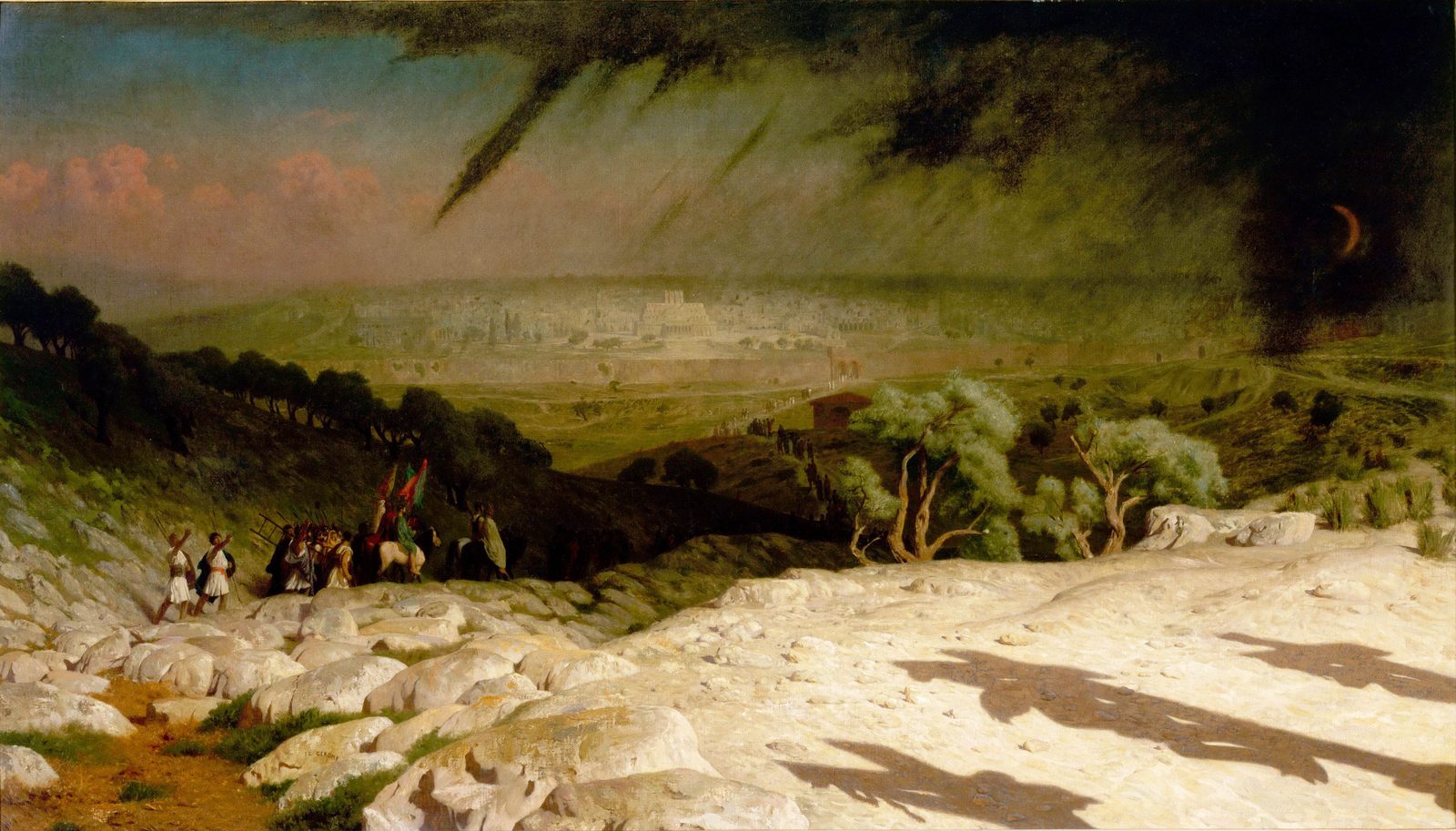
- The black skyA cloud spreads over the right half of the sky.Matthew 27:45
- The cityJerusalem lies across the valley under the cloud.Mark 15:33
- The crowd going homePeople with horses and banners walk down the slope.Luke 23:48
- Three shadowsThe shadows of three crosses fall across the rock.Luke 23:33
Jean-Léon Gérôme, Jerusalem, 1867. Public domain.
Four parts of the canvas, each numbered where it stands, with the verse the part answers to.
Darkness Through Scripture
Fifteen places in canon order, from the first day of Genesis 1 to the city that has no night.
Darkness is named, sent, entered, broken and ended.
- Genesis 1Light separated from the darkness, Genesis 1:4
- Genesis 15Terror and darkness on Abram, Genesis 15:12
- Exodus 10Three days of darkness in Egypt, Exodus 10:22
- Exodus 14The cloud dark to one camp and bright to the other, Exodus 14:20
- Exodus 20Moses goes into the thick darkness, Exodus 20:21
- 1 Kings 8The LORD said He would dwell in the thick cloud, 1 Kings 8:12
- Psalm 18Darkness His hiding place, Psalm 18:11
- Psalm 139The night shines like the day, Psalm 139:12
- Isaiah 9A great light on a people in darkness, Isaiah 9:2
- Isaiah 60Thick darkness over the peoples, Isaiah 60:2
- Amos 5The Day of the LORD, Amos 5:18
- Matthew 27From the sixth hour to the ninth, Matthew 27:45
- John 1The Light shines in the darkness, John 1:5
- Colossians 1Rescued from the dominion of darkness, Colossians 1:13
- Revelation 22No more night in the city, Revelation 22:5
Each stop opens its verse in the reader.
What the Verses Say About Darkness
Four verses that state what darkness is to God, and the Passover moon at the cross.
NONE IN GOD
John passes on the message that God is light and that in Him there is no darkness at all.
NOTHING HIDDEN
The psalmist finds no hour in which God cannot see him.
MADE BY GOD
God claims the dark and the light alike as His own work.
CALLED OUT OF IT
Peter names the people of God by where they were brought from.
Made by God, Called out of it
The darkness at the cross and the full moonAlbert Barnes, Notes on Matthew 27:45
The Passover was kept at the full moon, when the moon stands opposite the sun and cannot pass in front of it. Albert Barnes makes this point in his Notes on Matthew 27:45.
The Sun of Egypt
Exodus 10:21 to 23 against the worship of the sun in Egypt.
Then the LORD said to Moses, “Stretch out your hand toward heaven, so that darkness may spread over the land of Egypt—a palpable darkness.” So Moses stretched out his hand toward heaven, and total darkness covered all the land of Egypt for three days. No one could see anyone else, and for three days no one left his place. Yet all the Israelites had light in their dwellings.This is the ninth of the ten plagues and the last before the Passover.
Jamieson, Fausset and Brown, in their Commentary Critical and Explanatory, set the plague against the religion of the country that suffered it.
“The appalling character of this calamity consisted in this, that the sun was an object of Egyptian idolatry; that the pure and serene sky of that country was never marred by the appearance of a cloud.”
Jamieson, Fausset & Brown · Commentary Critical and Explanatory on the Whole Bible · on Exodus 10:21 to 23Reformed
Choshek, Araphel and Skotos
Two Hebrew words and one Greek word for darkness, each with its count.
Choshek stands 80 times in Strong's concordance, skotos 31 and araphel 15.
The three counts as a table
| Word | Occurrences |
|---|---|
| choshek, darkness, H2822 | 80 |
| skotos, darkness, G4655 | 31 |
| araphel, thick darkness, H6205 | 15 |
Solomon uses araphel for the place God said He would dwell.
Strong's glosses araphel as the gloom of a lowering sky.
What the Text Does Not Say
Four questions about darkness the verses leave open.
The verses report each darkness and leave its cause and its nature unstated.
| What is not said | What the verse does say |
|---|---|
| The source of the first darkness | It is there before God speaks. |
| The cause of the darkness on Egypt | Moses stretched out his hand toward heaven. |
| The cause of the darkness at the cross | Luke says the sun was darkened and gives no cause. |
| The nature of the outer darkness | Jesus names it and the weeping in it. |
A Great Light in Galilee
Isaiah 9:2 and Matthew 4:16 give the promise and its keeping, beside Psalm 18 and the last city of Revelation.
The people walking in darkness have seen a great light; on those living in the land of the shadow of death, a light has dawned.Isaiah speaks of Galilee of the nations in the verse before.
the people living in darkness have seen a great light; on those living in the land of the shadow of death, a light has dawned.”Matthew applies the words to Jesus settling in Capernaum.
Psalm 18:11 says God made darkness His hiding place. Augustine reads that verse as a word about the incarnation.
“When God wished to appear visibly to people and desired also to teach them in person what he had first laid down in the law, he tempered the force, the power of the divine, by taking on the human and ‘made the darkness his cover round about him,’ when he concealed himself in the tent of the flesh.”
Augustine of Hippo · SERMON 371:2 · on Psalm 18:11Patristic
The city where the day lastsRevelation 21:25 and Revelation 22:5
Its gates will never be shut at the end of the day, because there will be no night there.The gates stand open because the evening never comes.
There will be no more night in the city, and they will have no need for the light of a lamp or of the sun. For the Lord God will shine on them, and they will reign forever and ever.The last vision answers the first night of Genesis.
Voices on Darkness
Origen, Matthew Henry and Charles Spurgeon, each with the work named.
died 253 · Origen of Alexandria
HOMILIES ON PSALMS 4:7
This is the earliest of the three, a sermon on Psalm 18 from the third century.
The quotation1 quotation
“The reasons of the divine dispensation and providence are most obscure. For ‘God made darkness his hiding place.’ Those desiring audaciously and rashly to examine this darkness and appropriating for themselves one thing from another have fallen headlong into the dense ‘darkness’ of errors.”
Origen of Alexandria · Homilies on Psalms 4:7 · on Psalm 18:11Patristic
1662 to 1714 · Matthew Henry
Commentary on the Whole Bible
A Puritan commentary of 1710 reads the plague of Exodus 10 for its lesson about the soul.
The quotation1 quotation
“Now Pharaoh had time to consider, if he would have improved it. Spiritual darkness is spiritual bondage; while Satan blinds men's eyes that they see not, he binds them hands and feet that they work not for God, nor move towards heaven. It was a righteous thing with God thus to punish them.”
Matthew Henry · Commentary on the Whole Bible · on Exodus 10:23Puritan
1834 to 1892 · Charles Spurgeon
The Treasury of David, Vol. 7
The Treasury of David takes Psalm 139 verse by verse.
The quotation1 quotation
“Yea, of a surety, beyond all denial. The darkness hideth not from thee; it veils nothing, it is not the medium of concealment in any degree what ever. It hides from men, but not from God. But the night shineth as the day: it is but another form of day: it shines, revealing all; it ‘shineth as the day, ‘—quite as clearly and distinctly manifesting all that is done. The darkness and the light are both alike to thee.”
Charles Spurgeon · The Treasury of David, Vol. 7 · on Psalm 139:12
Where Careful Readers Differ
Four readings of two darknesses, the plague on Egypt and the darkness at the cross, each with its holders.
Egypt: a darkness with a natural cause, made extremeAlbert Barnes; Adam Clarke
Albert Barnes, in his Notes on Exodus 10:21, sets the plague beside the spring wind from the desert, which blows at intervals for two or three days at a time. Adam Clarke, in his Commentary on the Bible, takes it as a thick mist brought on by a miracle.
The objection is Exodus 10:23, where the Israelites had light in their dwellings in the same country.
Egypt: a darkness beyond natureMatthew Henry, Commentary on the Whole Bible, 1710
Matthew Henry reports a tradition of the Jews that the Egyptians were terrified in this darkness by evil spirits or by the horrors of their own consciences.
The objection is that Exodus records the darkness and the stillness of the three days and says nothing of spirits.
The cross: a darkness over Judea aloneOrigen, Commentary on Matthew
“It is my opinion that just as the other signs which accompanied Christ's Passion were performed only in Jerusalem, so also the darkness which covered the land until the ninth hour occurred only in Judea. For in Jerusalem alone was the veil of the temple rent asunder and the earth shook and rocks split apart and graves opened. … By the power of Christ, however, darkness fell upon all the land of Judea for three hours, but the light which illumines every church of God in Christ shone upon the rest of the land. Although darkness fell upon Judea until the ninth hour, it is clear that the light shone on it again, ‘until the full number of Gentiles come in, and so all Israel will be saved.’ The fact that darkness fell upon the land of Judea for three hours demonstrates that it was because of its sins that Judea was deprived of the light of three moments, that is, the light of God the Father, the splendor of Christ and the illumination of the Holy Spirit.”
Origen of Alexandria · Commentary on Matthew 134.7 · on Matthew 27:45Patristic
The objection is that ge, the Greek word Matthew and Luke use for the land, also means the whole earth.
The cross: a darkness over the whole earthJohn Gill; Dionysius the Areopagite, as the Catena Aurea gives him
John Gill, in his Exposition of the New Testament, calls the darkness so total as to darken the whole earth. A letter under the name of Dionysius, kept in the Catena Aurea of Thomas Aquinas, says its writer watched the sun darkened from Heliopolis in Egypt.
The objection is Origen's: the other signs of that hour, the torn veil and the opened tombs, stand in Jerusalem.
Books to Read Next
Three public domain works, each with a free copy to read.
City of God, Book 3
Augustine of Hippo · fifth century
Book 3 answers the charge that the calamities of Rome came after the false gods were left.
Read at New AdventHexaemeron, Homily 2
Basil of Caesarea · 379
The second sermon takes the formless earth and the darkness over the deep.
Read at New AdventCommentary on the Whole Bible, volume 1
Matthew Henry · 1708 to 1710
Volume 1 covers Genesis to Deuteronomy.
Read at CCELBrought Into the Kingdom
The God who named the first night has ended its rule over His people through His Son, and the text asks the reader to live as one who belongs to Him.
He has rescued us from the dominion of darkness and brought us into the kingdom of His beloved Son,Paul gives thanks to the Father for this in his prayer for the Colossians.
Sources
Scripture is the Berean Standard Bible.
- James Strong, Exhaustive Concordance of the Bible, 1890, entries H2822, H6205, G4655 and G1093, with glosses from STEP Bible (Tyndale House, CC BY 4.0)
- Augustine of Hippo, City of God, Book 3, chapter 15.
- Albert Barnes, Notes, Explanatory and Practical, on Matthew 27:45.
- Jamieson, Fausset and Brown, Commentary Critical and Explanatory on the Whole Bible, 1871, on Exodus 10:21 to 23.
- Augustine of Hippo, Sermon 371.2, on Psalm 18:11.
- Origen of Alexandria, Homilies on the Psalms 4.7, on Psalm 18:11.
- Matthew Henry, Commentary on the Whole Bible, volume 1, Genesis to Deuteronomy.
- Matthew Henry, Commentary on the Whole Bible, 1710, on Exodus 10:21 to 23.
- Charles Spurgeon, The Treasury of David, volume 7, 1885, on Psalm 139:12.
- Albert Barnes, Notes, Explanatory and Practical, on Exodus 10:21.
- Adam Clarke, Commentary on the Bible, 1832, on Exodus 10:21.
- Origen of Alexandria, Commentary on Matthew 134, on Matthew 27:45.
- John Gill, Exposition of the New Testament, on Luke 23:45.
- The letter to Polycarp ascribed to Dionysius the Areopagite, as the Catena Aurea of Thomas Aquinas gives it on Matthew 27:45.
- Basil of Caesarea, Hexaemeron, Homily 2.
Keep Studying
Read it1
People and groups1
Symbols7