
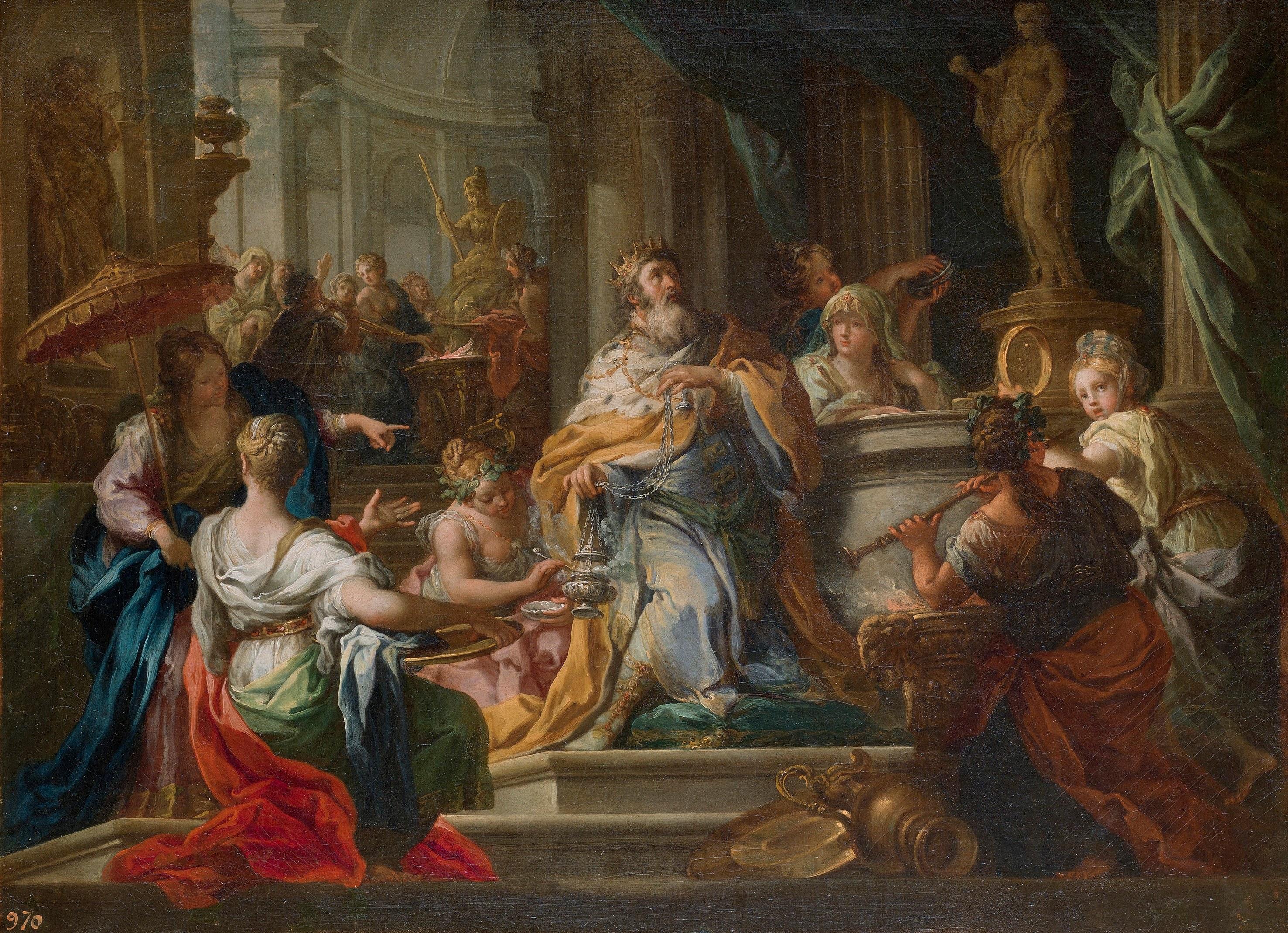
Sebastiano Conca, The Idolatry of Solomon, about 1750. Public domain.
Psalms 115 and 135 · Subject · Featured Study
The Making of an Idol
Two psalms name the parts of an idol that cannot work, and say that its makers become like it.
Those who make them become like them, as do all who trust in them.
- Books
- Psalms, Isaiah, Jeremiah, 2 Kings, Acts, Genesis, 1 John
- Hold in memory
- Psalm 115:8
An idol has every part of a body and the use of none.
Summary
Psalm 115 sets the God who is in heaven beside idols of silver and gold made by human hands. Isaiah 44 and Jeremiah 10 follow such an idol from the tree to the nails.
- Psalm 115:5 to 7 names seven parts of an idol, and each one fails at its work
- Psalm 135:17 adds that there is no breath in their mouths
- 2 Kings and Jeremiah say the same of Israel that the psalm says of the nations
Silver and Gold, Made by Hands
The psalm answers a taunt of the nations.
Why should the nations say, “Where is their God?” Our God is in heaven; He does as He pleases. Their idols are silver and gold, made by the hands of men.Psalm 115:4 begins the list of what idols are.
Adam Clarke, in his Commentary on the Bible, notes that Psalm 135:15 to 18 is almost word for word the same as Psalm 115:4 to 8.
they have ears, but cannot hear; nor is there breath in their mouths.Psalm 135 gives a shorter list.
Seven Parts That Do Not Work
The seven parts are marked on a bronze god from Ugarit.
A bronze god from Ugarit carries every part the psalm lists.
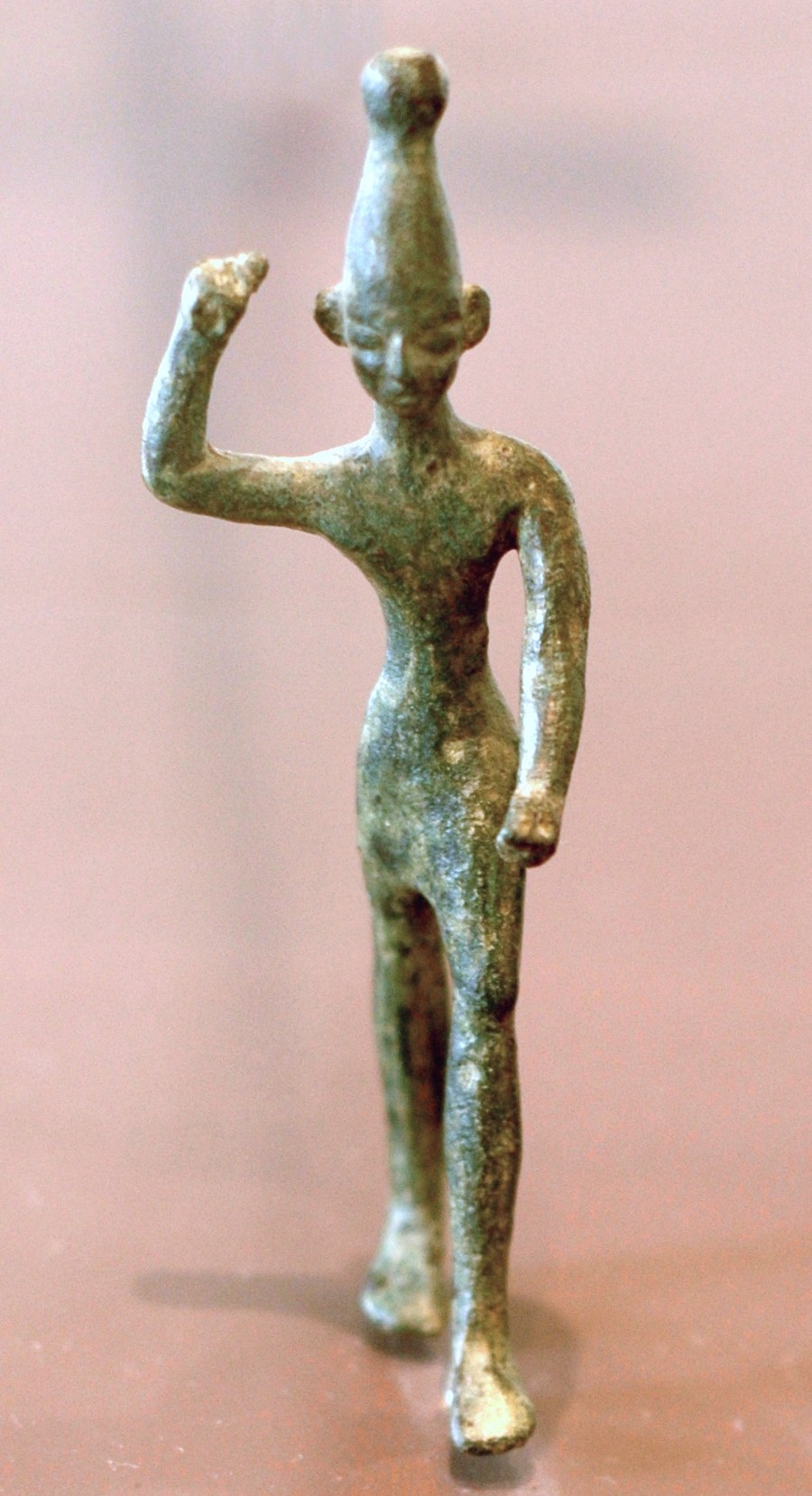
- Mouthscannot speak
- Eyescannot see
- Earscannot hear
- Nosescannot smell
- Handscannot feel
- Feetcannot walk
- Throatscannot even clear their throats
Figure of Baal with raised arm, bronze, 14th to 12th century BC, found at Ugarit (Ras Shamra), Louvre AO 17329; photograph by Jastrow, 2006, public domain; Wikimedia Commons file Baal Ugarit Louvre AO17329.jpg.
The figure is bronze of the 14th to 12th century BC and stands in the Louvre as AO 17329. The parts are numbered in the psalm's order.
From the Tree to the Nails
Two prophets describe the craftsman's work step by step.
He burns half of it in the fire, and he roasts meat on that half. He eats the roast and is satisfied. Indeed, he warms himself and says, “Ah! I am warm; I see the fire.” From the rest he makes a god, his graven image. He bows down to it and worships; he prays to it and says, “Save me, for you are my god.”Albert Barnes reads these verses as ridicule of the idol maker.
Isaiah 44:19 gives the question the man never asks himself: “Shall I bow down to a block of wood?”
On Isaiah 44:17 Matthew Henry, in his Commentary on the Whole Bible, cites the Roman poet Martial. The one who prays to the figure makes it a god, Martial says, and the one who only carves it does not.
For the customs of the peoples are worthless; they cut down a tree from the forest; it is shaped with a chisel by the hands of a craftsman. They adorn it with silver and gold and fasten it with hammer and nails, so that it will not totter. Like scarecrows in a cucumber patch, their idols cannot speak. They must be carried because they cannot walk. Do not fear them, for they can do no harm, and neither can they do any good.”Jeremiah's account adds the metalwork.
In Isaiah 46:1 and 7 the gods of Babylon are a load on weary animals, and a god set in its place does not move from it.
What the Makers Believed
In Mesopotamia a rite was held to bring a finished statue to life.
Catherine McDowell, in the Southeastern Theological Review in 2021, describes the Mesopotamian rite called the washing of the mouth from the texts Christopher Walker and Michael Dick published.
When the mouth had been washed and opened, the statue was held to be a living presence of the god, able to take offerings and smell incense. In the rite the craftsmen symbolically cut off their hands and swore that they had not made the statue.
McDowell holds that Isaiah 44 shows a knowledge of the rite's methods and materials. The psalm states plainly what the rite denied: the idols are made by human hands.
The Same Claim Made of Israel
The pattern of the psalm reappears in Israel's own history.
They rejected His statutes and the covenant He had made with their fathers, as well as the decrees He had given them. They pursued worthless idols and themselves became worthless, going after the surrounding nations that the LORD had commanded them not to imitate.Kings gives this among the reasons Samaria fell to Assyria.
This is what the LORD says: “What fault did your fathers find in Me that they strayed so far from Me, and followed worthless idols, and became worthless themselves?Jeremiah brings the same charge against Jerusalem.
The writer of Kings and the prophet apply the psalm's pattern to Israel itself.
Voices on the Likeness
Augustine and Matthew Henry each wrote on Psalm 115:8.
Augustine of Hippo (died 430)
“The result that ensues is that described in the next verse: ‘They that make them are like them, and so are all such as put their trust in them’ [Psalm 115:8]. Let them therefore see with open eyes, and worship with shut and dead understandings, idols that neither see nor live.”
Augustine of Hippo · Exposition on Psalm 115 · on Psalm 115:8Patristic
Matthew Henry (1662 to 1714)
“By worshipping these foolish puppets, they make themselves more and more foolish like them, and set themselves at a greater distance from every thing that is spiritual, sinking themselves deeper into the mire of sense; and withal they provoke God to give them up to a reprobate mind, a mind void of judgment, Rom. i.”
Matthew Henry · Commentary on the Whole Bible · on Psalm 115:8Puritan
How Readers Take the Likeness
The likeness has been read as dulled sense, as judgment and as an answer to a rite.
The worshipper grows senseless like the idolAugustine; Charles Spurgeon
Spurgeon, in The Treasury of David, calls the makers as senseless and irrational as the figures they make.
The objection: the verse says that the makers become like the idols, and it does not say how.
God gives the worshipper over to what he choseMatthew Henry
Matthew Henry joins the verse to Romans 1.
Although they claimed to be wise, they became fools, and exchanged the glory of the immortal God for images of mortal man and birds and animals and reptiles.Henry's reading rests on this passage.
The objection: Romans is a later text, and Psalm 115:8 states no act of God.
An answer to the rite that gave the image lifeCatherine McDowell
The makers claimed to give the statue life, and on McDowell's reading the psalm says the dead image makes its makers like itself.
The objection: the psalm mentions no rite, and its words fit any image of silver and gold.
The Maker and the Made
The psalm and the apostles turn from the made thing to the God who made the maker.
O Israel, trust in the LORD! He is their help and shield. O house of Aaron, trust in the LORD! He is their help and shield. You who fear the LORD, trust in the LORD! He is their help and shield.The psalm answers the list with a call to trust.
Therefore, being offspring of God, we should not think that the Divine Being is like gold or silver or stone, an image formed by man’s skill and imagination.Paul speaks in Athens, a city full of idols.
Paul argues from the other side of the likeness. Genesis 1:27 runs the same way: God created man in His own image.
Little children, keep yourselves from idols.John ends his first letter on this charge.
Sources
Scripture is the Berean Standard Bible.
- Adam Clarke, Commentary on the Bible (1832), on Psalm 135:15.
- Matthew Henry, Commentary on the Whole Bible (1710), on Psalm 115:8 and Isaiah 44:17.
- Charles Spurgeon, The Treasury of David, vol. 5 (1878), on Psalm 115:8.
- Albert Barnes, Notes, Explanatory and Practical, on Isaiah 44:15.
- Catherine McDowell, What Isaiah Knew: The LORD Is God and There Is No Other, Southeastern Theological Review 12.1 (Spring 2021), 3 to 14, citing Christopher Walker and Michael Dick, The Induction of the Cult Image in Ancient Mesopotamia (2001)
Keep Studying
Read it6
Symbols1
Doctrines5
Subjects8