
Psalm 88 · Subject · Featured Study
The Dark Night of the Soul
John of the Cross wrote his two books on the night after he escaped from prison at Toledo in 1578.
John of the Cross read Psalm 88 as the prayer of a soul that believes God has cast it away.
- Books
- Psalms, Isaiah, Job, Lamentations
- Hold in memory
- Psalm 88:6, Isaiah 50:10
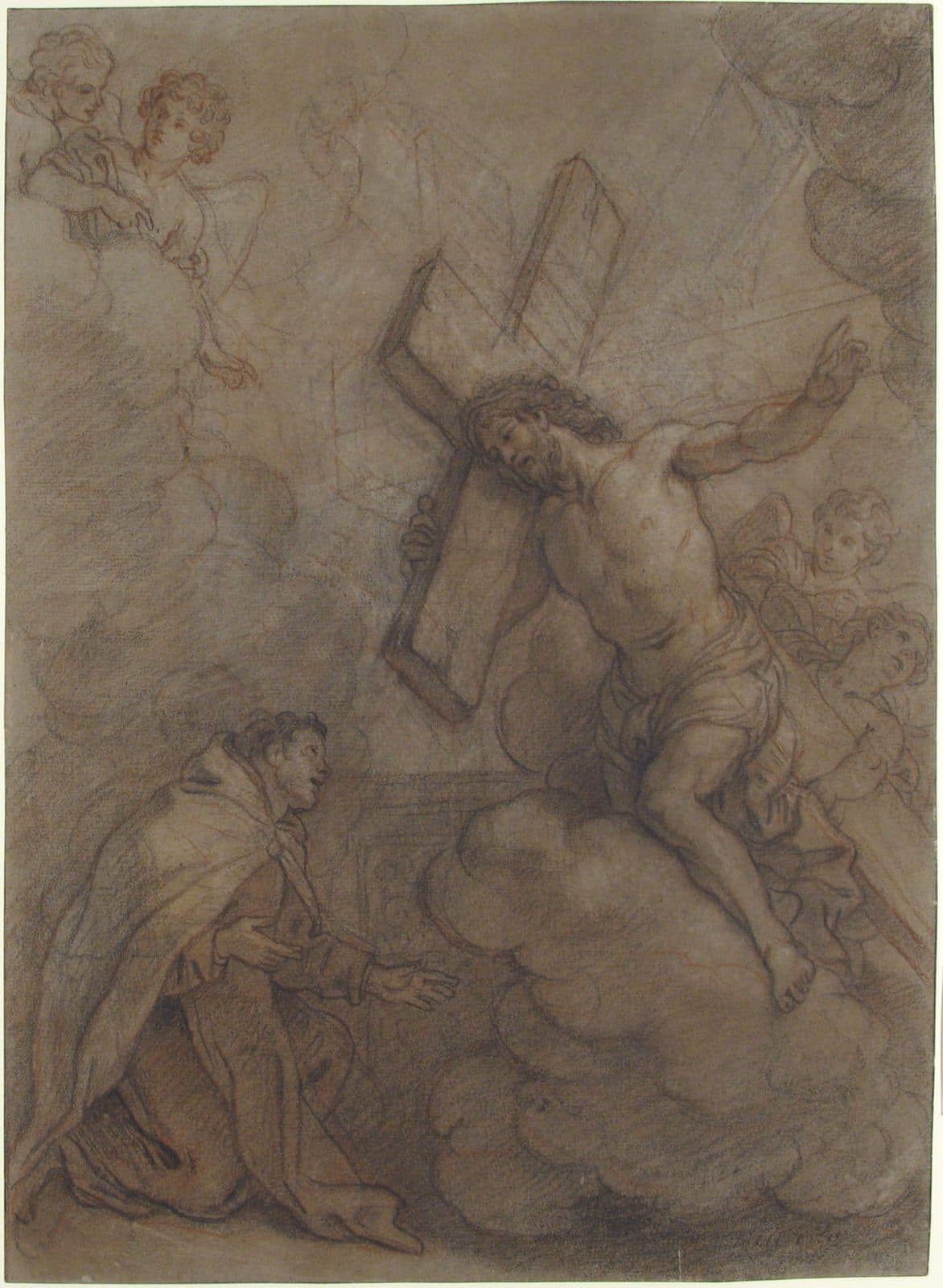
Charles de La Fosse, 1636 to 1716. CC0.
You have laid me in the lowest Pit, in the darkest of the depths.
Summary
The phrase comes from John of the Cross, a Spanish friar who died in 1591. He used it for a time when God seems absent and prayer gives no comfort, and he taught that God uses that time to purify the soul.
- John was a Carmelite friar who met Teresa of Ávila and took the name of the Cross in 1568.
- He taught two nights, a night of sense that many believers pass through and a night of spirit that few reach.
- He gave three tests to tell the night apart from sin, lukewarmness and bodily illness.
- He taught that both nights end in union with God in love.
- Protestant teachers wrote on the same darkness from Scripture, and the churches still differ on how far to follow John.
The Scripture the Night Reads
Passages of darkness and desertion, with those John cites in The Dark Night set first.
Cited by John
I am forsaken among the dead, like the slain who lie in the grave, whom You remember no more, who are cut off from Your care. You have laid me in the lowest Pit, in the darkest of the depths.
John quotes these verses in his second book, on the night of the spirit.
The cords of Sheol entangled me; the snares of death confronted me. In my distress I called upon the LORD; I cried to my God for help. From His temple He heard my voice, and my cry for His help reached His ears.
John sets these verses beside Psalm 88.
I was at ease, but He shattered me; He seized me by the neck and crushed me. He has set me up as His target; His archers surround me. He pierces my kidneys without mercy and spills my gall on the ground.
John cites Job's complaint that God has seized him.
I am the man who has seen affliction under the rod of God’s wrath. He has driven me away and made me walk in darkness instead of light.
John quotes this chapter at length.
Other passages of darkness
Who among you fears the LORD and obeys the voice of His Servant? Who among you walks in darkness and has no light? Let him trust in the name of the LORD; let him lean on his God.
Thomas Goodwin took this verse and the next as the text of his treatise A Child of Light Walking in Darkness.
Isaiah 50:10BSB
But I have trusted in Your loving devotion; my heart will rejoice in Your salvation. I will sing to the LORD, for He has been good to me.
These lines close the psalm that asks how long God will hide His face, and they show a lament that ends in trust.
Truly You are a God who hides Himself, O God of Israel, the Savior.
The verse joins God's hiding and His saving in one line, the comfort a believer in the night holds to.
Isaiah 45:15BSB
About the ninth hour Jesus cried out in a loud voice, “Eli, Eli, lema sabachthani?” which means, “My God, My God, why have You forsaken Me?”
Jesus cried the first line of Psalm 22 from the cross and took the psalmist's cry of forsakenness as His own.
Isaiah 50:10, Psalm 13:5 to 6, Isaiah 45:15, Matthew 27:46
John's Three Tests for the Night
The tests of book 1, chapter 9, and what each one rules out.
John tells the night apart from other causes of dryness by what the soul still desires.
| Test | What John looks for | What it rules out |
|---|---|---|
| First test | No comfort in the things of God, and none in created things either | Recent sin, which still finds pleasure in something |
| Second test | The mind turns to God often, with a painful fear that it is failing to serve Him | Lukewarmness, which does not care, and illness, which brings disgust without that desire |
| Third test | The soul can no longer meditate or picture things in prayer as it once did | Melancholy, which John warns in The Ascent may also stop meditation |
John of the Cross and His Book
A Spanish Carmelite friar, his prison at Toledo, his poem and his two commentaries.
John was born in 1542 at Fontiveros in Spain, and he died in the night of 13 to 14 December 1591.
He met Teresa of Ávila, and he was one of the four friars who opened the first house of the reformed Carmelites at Duruelo on 28 December 1568.
On the night of 3 December 1577 friars of the older observance of his order seized him and carried him to their convent at Toledo, where he was held for months.
He escaped on the night of 16 to 17 August 1578.
His poem opens with the line In a dark night, as David Lewis translated it, and he wrote two commentaries on it, The Ascent of Mount Carmel and The Dark Night of the Soul.
Benedict Zimmerman, who revised Lewis's translation in 1908, wrote that both books were left unfinished.
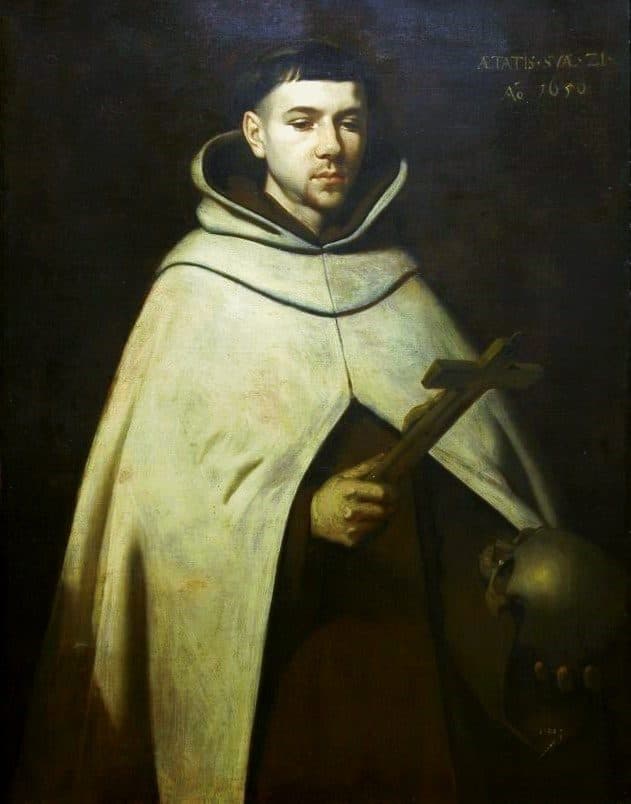
Attributed to Francisco de Zurbarán, Saint John of the Cross, 1656. Public domain. File:Zurbarán_(atribuido)-John_of_the_Cross-1656.jpg.
The painter shows John holding a cross, sixty-five years after his death.
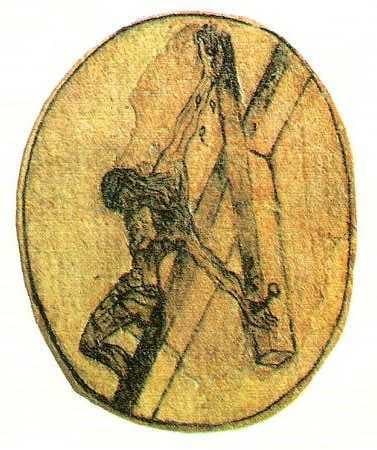
John of the Cross, drawing of Christ on the cross, about 1572 to 1577. Public domain. File:John_of_the_Cross_crucifixion_sketch.jpg.
John drew Christ hanging forward from the cross as if seen from above.
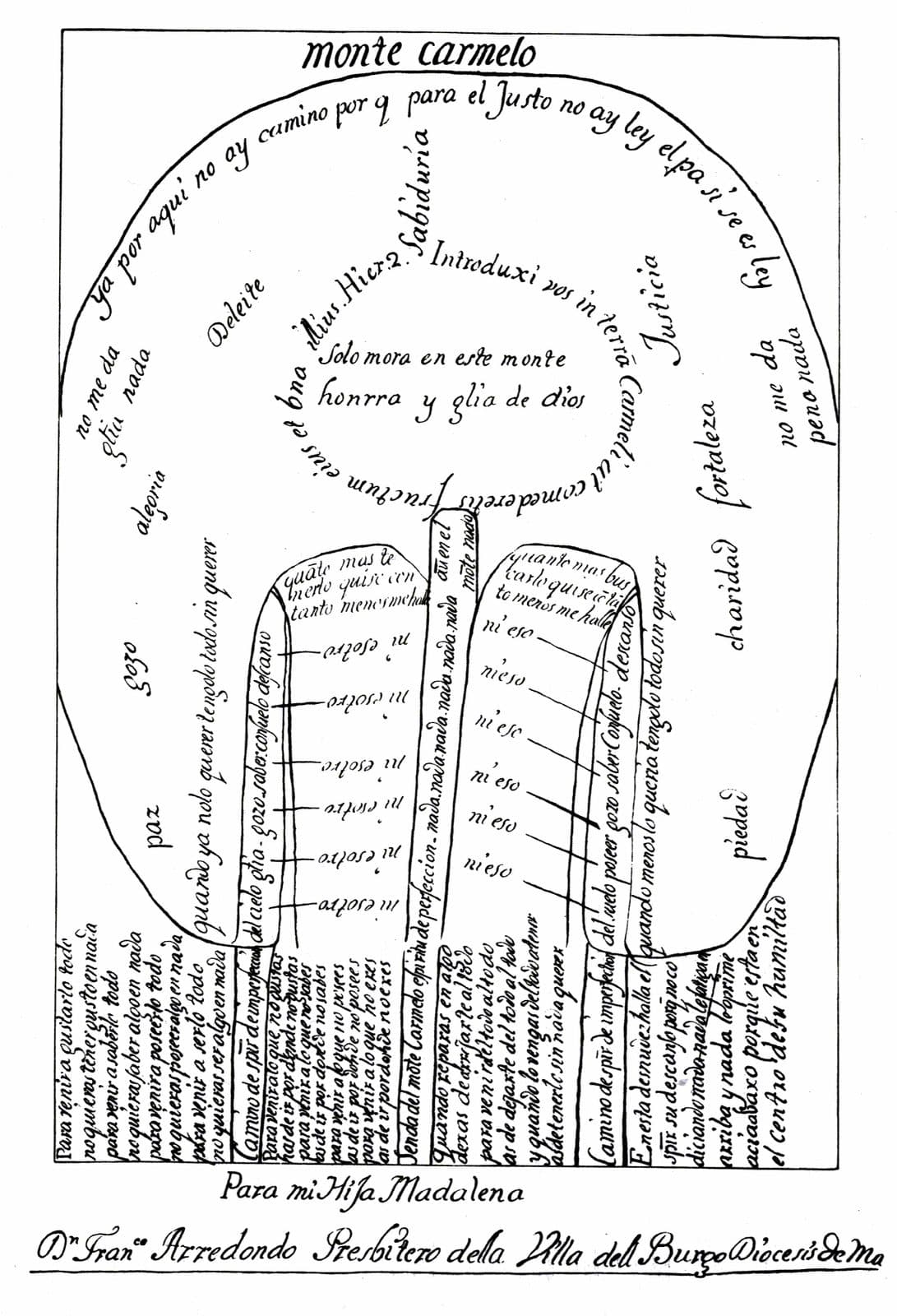
After John of the Cross, the drawing of Mount Carmel, a copy inscribed Para mi Hija Madalena. Public domain. File:Monte_Carmelo_Juan_de_la_Cruz.jpg.
John drew the mountain with three paths, and the word nada, nothing, runs up the narrow middle way.
What John Means by the Night
Two nights, of sense and of spirit, with God as the one who works in them.
John calls the night contemplation.
In Zimmerman's introduction, The Ascent teaches the active night, which a person carries out by his own effort with God's grace, and the second book teaches the passive night, which God brings about.
In 2011 Benedict XVI taught that God is the chief actor in this purification. He said that the soul's part is to prepare itself and be open to Him.
In his second book John describes what the soul suffers in the night of the spirit.
“But the greatest affliction of the sorrowful soul in this state is the thought that God has abandoned it, of which it has no doubt; that He has cast it away into darkness as an abominable thing. The thought that He has abandoned it is a grievous and pitiable affliction.”
John of the Cross · The Dark Night of the Soul, book 2, chapter 6 · on Psalm 88:5 to 7Roman Catholic
The Night and Melancholy
What John wrote of melancholy, illness and lukewarmness beside the night.
John lists the other causes of dryness before he gives his tests.
“But as these aridities frequently proceed, not from this night and purgation of the sensitive appetite, but from sins or imperfections, from weakness or lukewarmness, from some physical derangement or bodily indisposition, I shall here propose certain tests”
John of the Cross · Book 1, chapter 9 of the Noche oscura, the tests · on Psalm 85:8Roman Catholic
In book 1, chapter 4, he writes that people of a melancholy temperament are seldom freed from such trials until their bodily health improves.
In the prologue to The Ascent he warns of advisers who, like Job's comforters, blame a true night on melancholy.
John did not treat melancholy as the night.
Read Hope and Despair in the Mind, which holds the clinical studies
The Phrase Today
The phrase as people use it today, beside John's meaning, with one modern case.
Stanton's correction and Mother Teresa's lettersGlenn T. Stanton (2013); Brian Kolodiejchuk (2007)
Glenn T. Stanton, writing for The Gospel Coalition in 2013, observed that most people who use the phrase mean something other than what John meant.
Stanton described the night as something a disciple enters on purpose, as a practice of the spiritual life.
That description fits the active night of The Ascent more than the passive night of the Dark Night.
A modern case is Mother Teresa, whose letters Brian Kolodiejchuk edited as Come Be My Light (Doubleday, 2007).
In an interview with ZENIT in September 2007, Kolodiejchuk said that apart from one month in 1958 she did not have the consolation of union with God. He described her darkness as a trial of faith in which she felt that she did not believe in God.
What to Do in a Dark Season
Steps for a believer in darkness, each with the verse that gives it.
- 1Pray the lamentBring the darkness to God in words, and keep praying while the answer is delayed.Psalm 88:13
- 2Test the drynessAsk John's three questions about comfort, desire and prayer.Isaiah 50:10
- 3Confess known sinWhere sin causes the darkness, confess it and take hold of the promise of cleansing.1 John 1:9
- 4Keep the means of graceKeep to the teaching, the fellowship, the Supper and prayer, which Wesley said the mystics of his day slighted.Acts 2:42
- 5See a doctorHave a doctor examine the body, since an illness can weigh down the mind.1 Timothy 5:23
- 6Call a pastorAsk the elders to pray with you, as James tells the sick to do.James 5:14
Test the dryness, Confess known sin, Keep the means of grace, See a doctor, Call a pastor
Voices on Darkness of Soul, Earliest First
Six teachers, from Luther to Spurgeon, on darkness and desertion.
1483 to 1546 · Martin Luther
Martin Luther held that trials drive a believer into Scripture.
“for no man, without trials and temptations, can attain to the true understanding of the Holy Scriptures. St. Paul had a devil that beat him with fists, and with temptations drove him diligently to study the Holy Scripture.”
Martin Luther · Table Talk, That God's Word will not be truly understood without Trials and Temptations · on 2 Corinthians 12:7Other
died 1591 · John of the Cross
John of the Cross held that God measures the night to what each soul needs.
“These trials are measured by the divine will, and are proportioned to the imperfections, many or few, to be purged away: and also to the degree of union in love to which God intends to raise the soul”
John of the Cross · Noche oscura, book 1, chapter 14, in Lewis's translation · on Jeremiah 31:18Roman Catholic
1600 to 1679 · Thomas Goodwin
Thomas Goodwin, a Puritan, found the same darkness in David and in Heman, whose name stands over Psalm 88.
“And so he dealt with David often, and sometimes a long time together: Ps. xiii. 1, 'How long wilt thou hide thy face from me?' ... And the like was Heman's case, and this also long, even from his youth up, Ps. lxxxviii. 14, 15.”
Thomas Goodwin · A Child of Light Walking in Darkness, part 1, chapter 2 · on Psalm 88:14 to 15Puritan
died 1688 · John Bunyan
John Bunyan reminded his readers that God had brought him out of the same darkness.
“if you have sinned against light, if you are tempted to blaspheme, if you are drowned in despair, if you think God fights against you, or if heaven is hid from your eyes; remember it was thus with your father; but out of them all the Lord delivered me.”
John Bunyan · Grace Abounding to the Chief of Sinners, the preface · on 2 Timothy 3:11English Puritan
1703 to 1791 · John Wesley
John Wesley taught that heaviness under trial differs from darkness of soul.
“Darkness, or the wilderness-state, implies a total loss of joy in the Holy Ghost: Heaviness does not; in the midst of this we may ‘rejoice with joy unspeakable.’ They that are in darkness have lost the peace of God; They that are in heaviness have not; So far from it, that at the very time ‘peace,’ as well as ‘grace,’ may ‘be multiplied’ unto them.”
John Wesley · Sermon 47, Heaviness through Manifold Temptations, section 5 · on 1 Peter 1:6Evangelical
1834 to 1892 · Charles Spurgeon
Spurgeon told his students that he knew depression from his own life.
“As it is recorded that David, in the heat of battle, waxed faint, so may it be written of all the servants of the Lord. Fits of depression come over the most of us. Usually cheerful as we may be, we must at intervals be cast down.”
Charles Spurgeon · Lectures to My Students, first series, Lecture 11, The Minister's Fainting Fits, the opening · on 2 Samuel 21:15
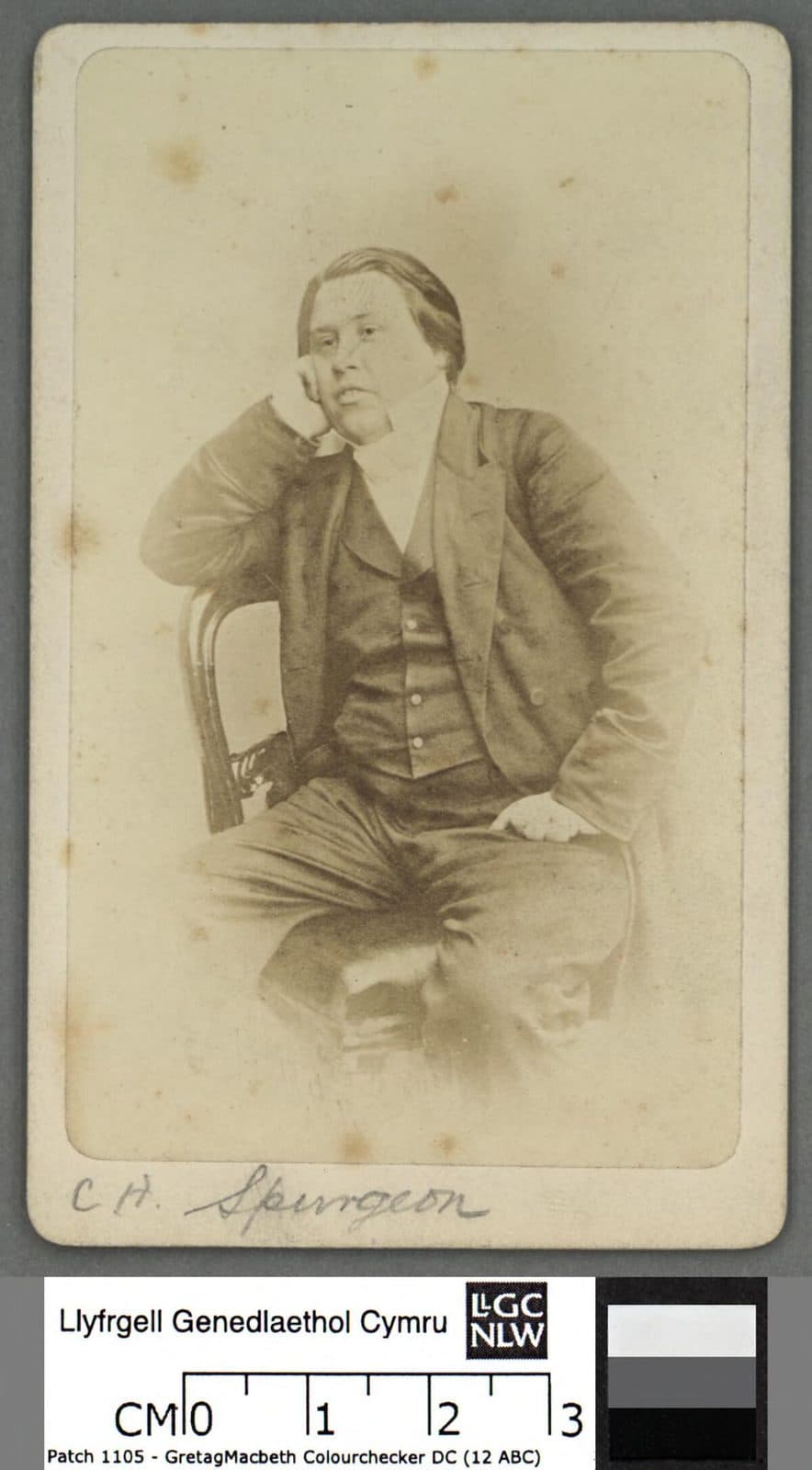
Portrait of Rev. C. H. Spurgeon by an unknown photographer, 1870s, National Library of Wales, public domain, File:Portrait_of_Rev_C._H._Spurgeon_(4671162).jpg.
Thomas Goodwin, John Bunyan, John Wesley, Charles Spurgeon
How the Churches Have Received John
Three positions, each with its holders, its case and the strongest objection to it.
Received with selectionBenedict XVI, General Audience, 16 February 2011
This position holds that the night is real and scriptural, and that God purifies the soul in it as He wills.
Benedict XVI taught it in 2011, and the Catholic Church had beatified John in 1675, canonized him in 1726 and named him a Doctor of the Church in 1926.
A. W. Tozer, one of the voices on the site's roster, drew freely on the Christian mystics while he was sharply critical of Roman Catholic sacramental and Marian teaching.
The objection comes from Wesley, who held that a believer's darkness most often has sin as its cause.
The Protestant parallelThomas Goodwin, John Bunyan
This position holds that a believer may walk in darkness, and it reads that darkness from Scripture and the promises of God, without John's scheme of stages.
Goodwin's treatise A Child of Light Walking in Darkness holds that a child of God may walk in darkness, chiefly an inward darkness from the want of the sense of God's favour.
Goodwin also gave melancholy a part, for he wrote that when fear and melancholy are stirred, every suggestion strikes the soul through.
The objection is that the two darknesses differ. John wrote of God purging a soul that seeks union with Him in love, and Bunyan wrote of despair over his sin.
CautionJohn Wesley, Sermon 46 and his letter of 1736
This position holds that God does not withdraw Himself as a method, and that teaching darkness as a higher state misleads believers.
“Men imagine (because so they have been taught, particularly by writers of the Romish communion, whose plausible assertions too many Protestants have received without due examination) that they are not always to walk in luminous faith; that this is only a lower dispensation; that as they rise higher they are to leave those sensible comforts, and to live by naked faith (naked indeed, if it be stripped both of love, and peace, and joy in the Holy Ghost!) that a state of light and joy is good, but a state of darkness and dryness is better; that it is by these alone we can be purified from pride, love of the world, and inordinate self-love; and that, therefore, we ought neither to expect nor desire to walk in the light always.”
John Wesley · Sermon 46, The Wilderness State, section 2 · on John 16:22Evangelical
In a letter of 1736 to his brother Samuel he wrote that the writings of the mystics had come nearest to wrecking his faith. He named Tauler, Molinos and the author of the Theologia Germanica, and John of the Cross is not among them.
The objection is that Scripture shows faithful people in darkness they did not cause, as Goodwin argued from Psalm 88.
Where Readers Disagree
Three questions that divide careful readers, each with its holders and the answer given to them.
Does God withdraw His felt presence to purify the soul?John of the Cross, Benedict XVI and Thomas Goodwin; John Wesley
John in The Dark Night and Benedict XVI in his audience of 2011 say yes, and they hold that God works in the dark to purify the soul.
Thomas Goodwin agrees from the Puritan side in A Child of Light Walking in Darkness.
Wesley, in Sermon 46, answers that the general causes of darkness are sin, ignorance and temptation.
Both sides read Isaiah 50:10, Psalm 88 and Lamentations 3.
Is the dark night depression?John of the Cross; John Wesley; Gerald May and W. W. Meissner
John answers with his three tests, and Wesley, in Sermon 47, answers that an illness of the body works on a believer as on anyone.
“And faith does not overturn the course of nature: Natural causes still produce natural effects. Faith no more hinders the sinking of the spirits (as it is called) in an hysteric illness than the rising of the pulse in a fever.”
John Wesley · Sermon 47, Heaviness through Manifold Temptations, section 3 · on 1 Peter 1:6Evangelical
The psychiatrist Gerald May wrote a book under John's title (HarperSanFrancisco, 2004) to set the night and depression side by side. W. W. Meissner, reviewing it in America in 2004, judged that May asserted the differences without justifying them.
May a Protestant read John?Benedict XVI; John Wesley; the site's position
Readers of the first position, with Benedict XVI, read John as a guide, and readers of the third read him with the warning of Wesley's letter of 1736 in mind.
The site's position, which its founder confirmed on 25 April 2026, engages the contemplative tradition with significant caution.
Under that position John is taught as church history, and what he says is tested against Scripture.
The God Who Sees in the Dark
Psalm 88 ends in darkness.
Psalm 139
If I say, “Surely the darkness will hide me, and the light become night around me”— even the darkness is not dark to You, but the night shines like the day, for darkness is as light to You.
David's psalm answers that darkness with the God who sees in it.
Sources
Scripture is the Berean Standard Bible.
- John of the Cross, The Dark Night of the Soul, translated by David Lewis, with corrections and an introduction by Benedict Zimmerman (London: Thomas Baker, 1908)
- John of the Cross, The Ascent of Mount Carmel, translated by David Lewis (London: Thomas Baker, 1906)
- Benedict XVI, General Audience on Saint John of the Cross, 16 February 2011.
- Benedict Zimmerman, St. John of the Cross, The Catholic Encyclopedia, vol. 8 (1910)
- Thomas Goodwin, A Child of Light Walking in Darkness, in The Works of Thomas Goodwin, vol. 3 (Edinburgh: James Nichol, 1861)
- John Bunyan, Grace Abounding to the Chief of Sinners (1666), the preface.
- Martin Luther, Selections from the Table Talk, translated by Henry Bell (Cassell's National Library, 1886)
- John Wesley, Sermon 46, The Wilderness State, 1872 edition.
- John Wesley, Sermon 47, Heaviness through Manifold Temptations, 1872 edition.
- John Wesley, letter to Samuel Wesley, 23 November 1736 (the transcription is marked provisional by its site)
- Charles Spurgeon, Lectures to My Students, first series (London: Passmore and Alabaster, 1875), Lecture 11, The Minister's Fainting Fits.
- Glenn T. Stanton, FactChecker: What Is the Dark Night of the Soul?, The Gospel Coalition, 5 September 2013 (cite only)
- W. W. Meissner, review of Gerald May, The Dark Night of the Soul (HarperSanFrancisco, 2004), America, 1 March 2004 (cite only)
- ZENIT, The Light of Mother Teresa's Darkness, interview with Brian Kolodiejchuk, 4 and 5 September 2007 (cite only)
- The site's roster of voices, the node for A. W. Tozer.
- The founder's position survey, question 13.5, the contemplative tradition, locked at B and confirmed 25 April 2026.
Keep Studying
Studies8
People and groups10
Doctrines1
Trials of life3